



No-shows kill real estate operations in ways most agents don't fully track. You lose the obvious stuff—wasted drive time, missed opportunities with other buyers—but the hidden damage runs deeper. Your listing agent loses faith in your scheduling. The seller questions your professionalism. Other agents start declining your showing requests because they've heard you're unreliable.
The standard approach most agents use? Send a text the night before. Maybe call if you remember. Hope for the best. This passive system bleeds money through your operation without anyone realizing how much revenue walks away each month.
Why basic confirmations fail real estate showings
Property showings have unique confirmation challenges that generic appointment systems miss. Unlike a doctor's office where people book weeks ahead, real estate showings happen fast—sometimes same-day. Buyers juggle multiple properties, work schedules shift, and excitement fades quickly after that initial Zillow browsing session.
The complexity multiplies when you factor in the stakeholders. You're confirming with the buyer, coordinating with the listing agent, managing lockbox codes or seller availability, and often dealing with a buyer's spouse who wasn't part of the original conversation. Each moving part creates another failure point.
Most agents treat confirmations like a courtesy rather than an operational requirement. One message, through whatever channel feels convenient, with no tracking or escalation plan. The result? Somewhere around 15-20% no-show rates get normalized as "just part of the business." They're not.
Building your multi-channel confirmation sequence
A proper confirmation cadence needs four distinct touchpoints across multiple channels. Not because buyers need four reminders, but because each touchpoint serves a different operational purpose.
Never miss a showing or follow-up again.
TryRealy helps you schedule, track, and manage every client interaction smoothly.
- Unified property and client management
- Automated client notifications
- Integrated sales pipeline tracking
No credit card required
Initial Confirmation (Booking + 30 minutes) Channel: Email Purpose: Documentation and details Script: "Your showing is confirmed for [property address] on [date] at [time]. Reply YES to confirm receipt. Lockbox code: [code]. Parking: [instructions]. Contact if plans change: [your number]."
Pre-Showing Check (24 hours before) Channel: SMS Purpose: Catch early cancellations Script: "Tomorrow's showing at [address] is at [time]. Reply CONFIRM if you're coming, CANCEL to release the slot, or RESCHEDULE if timing changed. -[Your name]"
Day-Of Reminder (Morning of showing) Channel: SMS or automated voice Purpose: Final logistics and commitment SMS Script: "Today's [time] showing at [address]. GPS: [link]. Door code: [code]. I'll meet you there. Text if running late." Voice Script: "This is [name] confirming your [time] showing today at [address]. Press 1 to confirm, 2 if running late, 3 to cancel."
Go/No-Go Call (2 hours before) Channel: Phone (direct call) Purpose: Final verification and relationship building A quick personal call—not just confirmation. Use this to gauge genuine interest, answer last-minute questions, build rapport. A live conversation two hours out nearly eliminates surprise no-shows. Buyers who've spoken with you directly feel more obligated to show up or at least notify you of changes.
Here's a quick visual of the cadence.
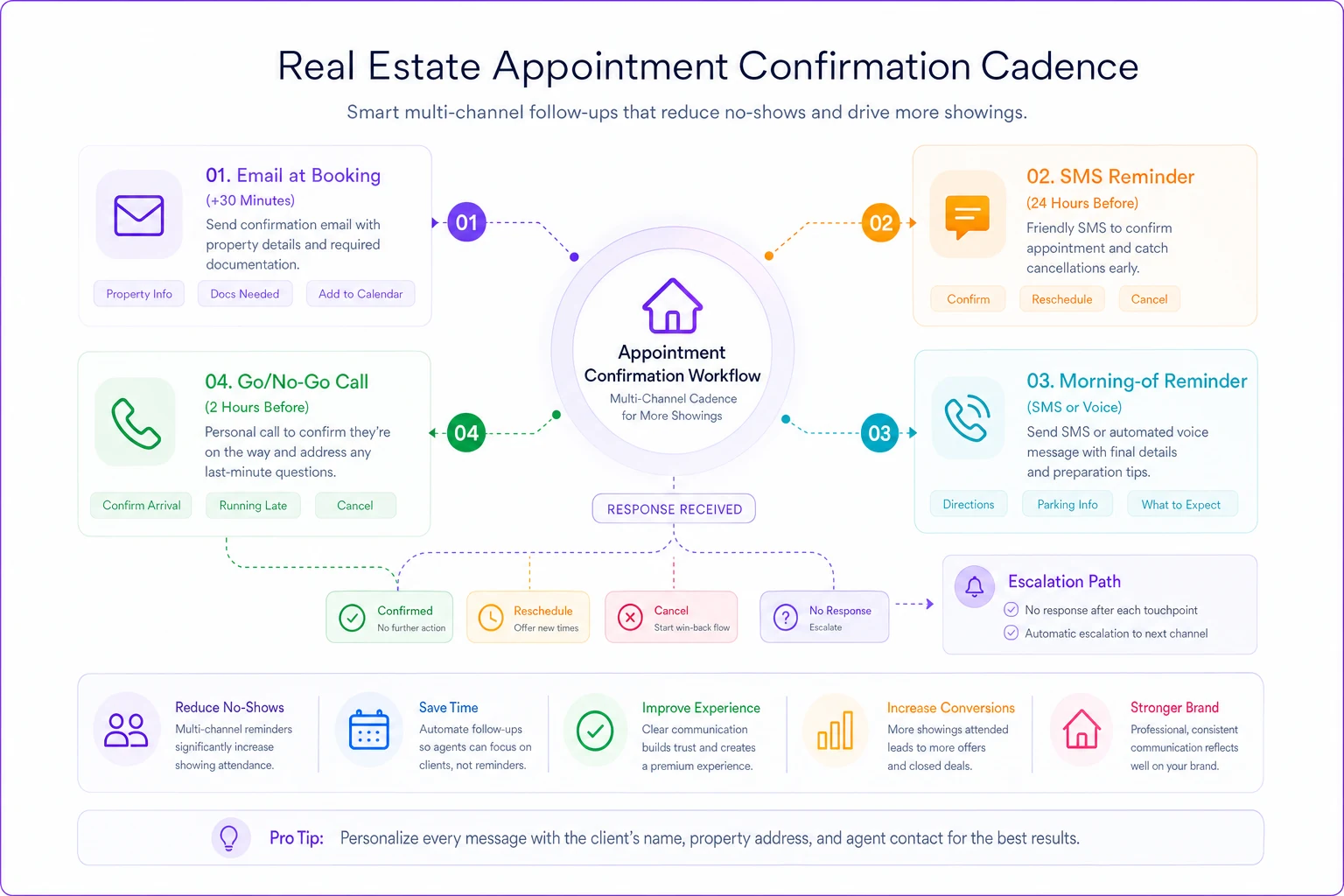
The 24-hour mark catches problems while you still have recovery time. SMS gets higher open rates than email for time-sensitive messages. The three-option response format reduces friction—buyers don't need to compose an explanation.
Morning reminders catch forgotten appointments and last-minute schedule conflicts. Voice calls work better for older clients or high-value properties where you need absolute confirmation.
Channel selection based on buyer profiles
Not every buyer responds to the same channel. Your confirmation strategy needs to adapt based on observable patterns.
First-time homebuyers under 35 typically prefer text-heavy communication. They're comfortable with links, digital calendars, automated confirmations. These buyers often ghost phone calls but respond quickly to texts. Lean heavily on SMS with email backup.
Move-up buyers aged 35-50 split between channels. They'll answer phones during business hours but prefer texts in evenings. These clients typically have more complex schedules, so give them multiple response options. Email confirmations matter more here since they're often forwarding details to spouses.
Luxury buyers and investors expect phone calls. They're buying relationship as much as property. Automated confirmations feel cheap to someone dropping seven figures. Even your text messages should feel individually crafted, not templated.
Out-of-town buyers require overcommunication. They're coordinating flights, hotels, and multiple showings. Send calendar invites alongside regular confirmations. Include local context—parking restrictions, building access requirements, neighborhood navigation tips. These buyers no-show less often, but when they do, it's usually travel complications that caught them off guard.
Late cancellation contingency rules
Cancellations will happen. The operational question is how you handle them to minimize damage and preserve relationships.
The 24-Hour Rule Any cancellation before 24 hours gets rescheduled without penalty. Life happens. Financing falls through. Spouses object. Better to know early than waste everyone's time. Track these cancellations by reason—patterns reveal qualification problems upstream.
The 4-Hour Window Cancellations between 24 and 4 hours before a showing trigger a confirmation requirement for future bookings. The buyer must speak with you directly (not just text) to book their next showing. Small friction, but it reduces serial cancellers without being punitive.
The 2-Hour Deadline Cancellations within 2 hours count as no-shows operationally. The damage is already done—you've blocked calendar time, the seller prepared the house, the listing agent adjusted their schedule. These buyers go on a "confirm-first" list requiring deposit or direct agent accompaniment for future showings.
The No-Show Nuclear Option Actual no-shows trigger a three-strike policy. First offense: future showings require 48-hour advance booking with phone confirmation. Second offense: must be accompanied by their agent, no solo showings. Third offense: removed from showing eligibility for 90 days.
Document every cancellation with timestamp, reason, and communication channel. This data becomes crucial when listing agents start asking questions about your reliability.
Messaging scripts that actually work
Generic confirmation messages get ignored. Your scripts need to balance professionalism with personality while making response as easy as possible.
Email Confirmation Template Subject: Showing Confirmed: [Address] on [Date] at [Time] Body: Your showing is confirmed! Here's everything you need: Property: [Full address] Date/Time: [Day, Date at Time] Duration: 30 minutes allocated Lockbox: [Code or instructions] Parking: [Specific instructions] What to expect:
-
The house will be vacant
-
Lights will be on
-
Feel free to test appliances/systems
-
Back gate code
[if applicable]
Need to change timing? Text me at [number] before [time]. Running late? Send a quick text so I can adjust with the listing agent. See you there, [Your name] [Your number]
SMS Templates That Get Responses
Booking confirmation (immediate): "Got it! You're confirmed for [address] tomorrow at [time]. Save this text for the door code: [code]. Reply YES if you got this."
24-hour reminder: "Hey [name]! Tomorrow's showing at [address] still good for [time]? Reply Y for yes, N to cancel, or R if you need to reschedule."
Day-of reminder: "Showing today at [time]! Here's the GPS: [link]. Code: [code]. Text if running late. See you at [address]"
2-hour check: "Heading to [address] for our [time] showing? Quick reply Y/N helps me coordinate with the seller. Thanks!"
Voice Message Script "Hi [name], this is [your name] calling about today's showing at [address]. We're scheduled for [time]—just wanted to confirm you're still planning to make it. Call or text me back when you get this. If I don't hear from you by [time], I'll need to release the showing slot. My number is [number]. Thanks!"
Tracking metrics that matter
Most agents have no idea what their actual no-show rate is. They remember the painful ones but miss the pattern. Proper tracking reveals which parts of your confirmation process are breaking down.
Core Metrics to Track
Confirmation Rate by Channel
-
Email confirmations
typically 60-70% response rate
-
SMS confirmations
should hit 85-90% response rate
-
Voice confirmations
70-75% success rate
-
Overall confirmation achievement
target 95% minimum
No-Show Rate by Type
-
Confirmed but didn't show
should be under 3%
-
Unconfirmed no-shows
expect 40-50% failure rate
-
Late cancellations (under 2 hours)
track separately from true no-shows
Channel Performance by Demo
-
Track which channels work for which client types
-
Monitor response time by channel
-
Identify channel preference patterns
Recovery Success Rate
-
How often you successfully reschedule after cancellation
-
Conversion rate from rescheduled showings
-
Time between cancellation and rebooking
Creating Your Tracking System
Build a simple spreadsheet with these columns:
| Showing date/time | Property address | Buyer name | Confirmation sent (Y/N and channel) | Confirmation received (Y/N and timestamp) | Showing outcome (Completed/Cancelled/No-show) | Cancellation timing (if applicable) | Rescheduled (Y/N) |
|---|---|---|---|---|---|---|---|
Every Monday, run through your weekly numbers. Look for patterns. Maybe Tuesday afternoon showings have higher no-show rates. Maybe email confirmations work poorly for condo showings but great for single-family homes. These patterns let you stop guessing and start adjusting.
Automating without losing the personal touch
The confirmation cadence described here takes roughly 15 minutes per showing if done manually. For an agent doing 20 showings weekly, that's five hours of administrative work. This is where operational software changes the game.
Modern platforms can trigger your entire confirmation sequence automatically while maintaining personalization. The system sends your initial email within minutes of booking. SMS reminders deploy at optimal times based on showing data. Voice calls happen automatically with response tracking.
But automation shouldn't mean generic. The best systems let you set rules based on property type, buyer profile, and showing history. First-time buyers get extra details and encouragement. Repeat visitors receive shorter, assumption-based messages. Luxury showings trigger personal phone calls while entry-level confirmations stay digital.
When automating, set rules so first-time buyers receive extra details while repeat visitors get concise messages.
The real power comes from integration. When your confirmation system talks to your calendar, CRM, and showing scheduler, you eliminate the gaps where no-shows hide. A buyer can't book without entering the confirmation workflow. Cancellations automatically open calendar slots. No-show patterns flag problematic clients before they waste more time.
Some agents worry automation feels impersonal. Buyers don't care if a computer sent their confirmation—they care that they received clear, timely information. The personal touch comes from the two-hour call and the in-person showing, not from manually typing the same door code fifteen times a week.
Adjusting your cadence based on results
Your confirmation system needs a proper review every quarter. Markets change. Buyer behavior shifts. What works in downtown condos might fall flat for suburban houses.
Start by analyzing your no-show patterns. If most failures happen with evening showings, add an afternoon checkpoint. If weekend showings run smooth but weekdays suffer, adjust channel selection for working buyers who can't answer phones during business hours.
Test different script variations. Try adding urgency ("This slot will be released if not confirmed by 3pm"). Test friendly versus formal tone. Experiment with response mechanisms—maybe "Reply 1 for yes, 2 for no" works better than "Reply Y or N."
Watch for seasonal patterns. Spring buyers are motivated and responsive. Late summer browsers waste more time. Holiday showing no-shows spike. Adjust your confirmation requirements based on time of year.
Market conditions matter too. In seller's markets, buyers rarely no-show because they know properties move fast. During buyer's markets, you'll need tighter confirmation discipline as buyers become pickier and less committed.
The real cost of fixing no-shows
Each no-show wastes roughly 90 minutes when you factor in drive time, waiting, follow-up, and rescheduling. At three no-shows weekly, you're losing 4.5 hours of productive time. Over a year, that's close to six weeks of work gone.
The relationship damage hurts worse. Listing agents remember which buyer's agents are reliable. They prioritize showing requests from agents who respect their time. Your reputation in the agent community directly impacts your ability to book premium showings.
Then there's buyer confidence. When you run a tight confirmation process, buyers perceive you as organized and professional. They trust you to handle their transaction. They refer friends. Your operational discipline becomes a quiet marketing advantage that most agents don't even recognize they're missing.
Moving beyond basic confirmations
The best agents don't just confirm showings—they optimize the entire showing workflow. Their confirmation touchpoints gather intelligence. They learn which properties genuinely interest buyers. They spot uncertainty before it becomes cancellation.
That intelligence feeds back into your broader operation. Buyers who consistently confirm respond well to aggressive showing schedules. Those who waffle need more nurturing before viewing properties. The confirmation process becomes a qualification filter, not just a scheduling tool.
Some agents add showing prep directly into their confirmations. The 24-hour message includes neighborhood details. The morning reminder has traffic warnings. The 2-hour call covers what to look for based on the buyer's priorities. Each touchpoint adds value beyond basic logistics.
The goal isn't just reducing no-shows—though cutting them in half genuinely transforms your operation. The goal is building a showing system that respects everyone's time, maintains professionalism, and converts more browsers into buyers.
Every no-show is a process failure, not a people problem. Buyers don't intentionally waste your time. They forget, get overwhelmed, or lack the structure to manage their showing schedule properly. Your confirmation system provides that structure. The agents doing well in this business aren't always the best salespeople—they're better operators. They've built systems that eliminate friction and deliver consistency.
Start with the framework outlined here, track your metrics, and adjust based on results. Within a quarter, you'll see no-shows drop and client confidence rise.
Ready to elevate your real estate business?
Join 2,000+ agencies using TryRealy to streamline operations, close deals faster, and deliver exceptional client experiences.