

Portal leads feel different from other real estate leads because, honestly, they are different. A Zillow inquiry at 9pm on Tuesday isn't the same as someone walking into your open house Sunday afternoon. The person clicking "contact agent" on Realtor.com while eating breakfast has completely different expectations than a referral from a past client.
Yet most small agencies treat every portal lead exactly the same way. Generic auto-responder. Random agent assignment. Maybe a phone call tomorrow if someone remembers to check the system.
The agencies converting portal leads at 8-12% instead of the typical 2-3% understand something pretty fundamental: portal lead triage isn't about speed alone—it's about qualification speed. The difference between calling someone back in 5 minutes versus 50 minutes matters less than knowing which lead to call back in 5 minutes and which one needs a completely different approach.
The portal lead paradox nobody talks about
Portal leads create this weird operational tension. Someone just spent 45 minutes browsing listings, found exactly what they want, clicked contact—and then silence on your end. Meanwhile, they submitted their info to four other agents at the same time. They're comparing response quality, not just response time. Some are ready to tour tomorrow. Others are casually browsing from another state with no real timeline.
Traditional lead routing fails here because it assumes all leads deserve equal urgency. When you have three agents handling 60 portal inquiries weekly, that assumption breaks everything. Your top performer wastes Tuesday afternoon calling someone who's "just looking" while a cash buyer ready to make an offer gets stuck in someone's voicemail for two days.
The math gets ugly fast. Say your team gets 240 portal leads monthly. Without proper qualification, agents spend roughly 15 minutes per lead on initial contact attempts. That's 60 hours monthly just on first touches—before you know if anyone's actually interested. Meanwhile, the handful of leads who were genuinely ready to move get lost in the noise.
Building your qualification decision tree
What actually works to qualify portal leads in real estate is a branching decision tree that starts before the lead even submits their info.
Never miss a showing or follow-up again.
TryRealy helps you schedule, track, and manage every client interaction smoothly.
- Unified property and client management
- Automated client notifications
- Integrated sales pipeline tracking
No credit card required
Start with the portal source itself. Zillow Premier Agent leads behave differently than Realtor.com connections. Someone contacting you through Redfin already has access to a ton of data and virtual tours—they're further along than someone filling out a form on a generic real estate site. Your routing rules need to reflect these behavioral differences.
-
Zillow listing inquiry
+3 points
-
Realtor.com saved search contact
+4 points
-
Redfin direct message
+5 points
-
Generic portal form
+1 point
-
Multiple property inquiries (same session)
+2 points
Next layer is engagement signals. A lead who provides a phone number scores higher than email-only. Someone who writes "looking to see this property this weekend" in the comments gets immediate priority over "interested in more information."
The property type matters too. Inquiries on properties under $400k typically indicate first-time buyers who need more education and handholding. Luxury listings above $1M often attract investors or move-up buyers who expect immediate, sophisticated responses. Properties sitting on market 60+ days might signal bargain hunters versus fresh listings drawing serious buyers.
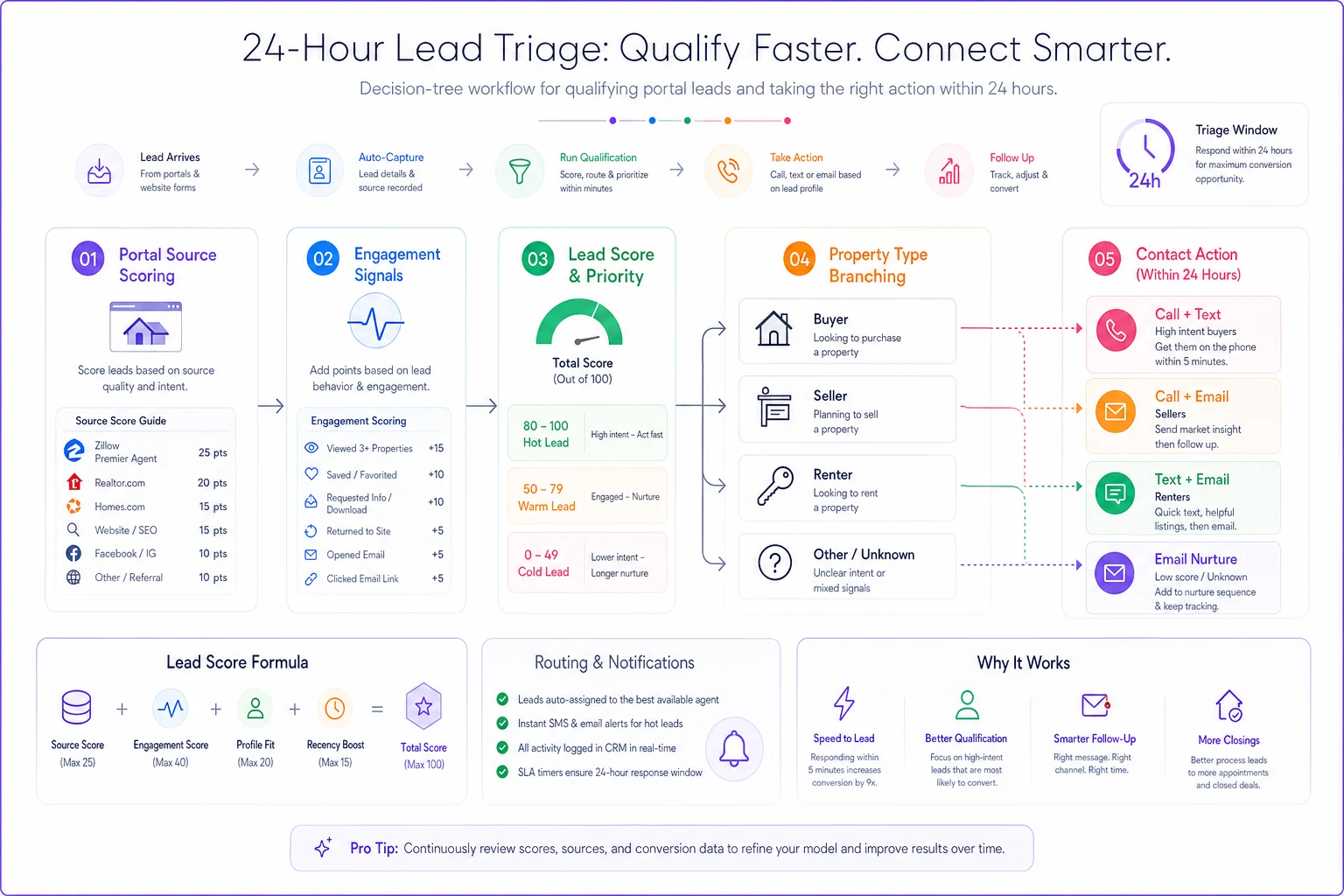
Below is a simple visualization of that decision-tree workflow.
Initial Contact Decision Points: If score 8+: Immediate phone call (within 10 minutes) If score 5-7: Personalized text within 30 minutes, call within 2 hours If score 3-4: Email with property details within 1 hour, call attempt next business day If score under 3: Automated email sequence, manual review after 48 hours
First contact scripts that actually qualify
Generic scripts kill portal lead conversion. "Hi, I'm calling about your inquiry on 123 Main Street" tells them nothing and wastes precious seconds while they're deciding whether to engage or hang up.
High-score lead opening: "Hey [Name], I saw you were looking at the Colonial on Maple Drive—that one actually just had a price adjustment yesterday that hasn't hit the portals yet. Are you specifically interested in that neighborhood, or are you exploring a few different areas?" This immediately provides new information while qualifying their geographic focus. Their response tells you almost everything about their readiness level.
Medium-score text message: "Hi [Name], thanks for reaching out about [property address]. That seller is pretty motivated and accepting offers this weekend. What's your ideal timeline for moving?" Creates urgency while qualifying timeline in the same message.
Low-score email opener: "I noticed you were browsing homes in [area]. The market's pretty interesting there right now—inventory is actually up 15% from last month, which means better negotiating power for buyers. What initially drew you to that area?" You're educating while qualifying, which builds trust even with casual browsers.
The 24-hour handoff framework
The first 24 hours determine whether a portal lead becomes a client or disappears forever. Small teams can't maintain perfect availability though, and this is where your handoff system becomes critical.
Hour 0-1: Initial qualification happens. Either through automated scoring or quick manual review, you know if this lead needs immediate attention or can follow standard protocol. Hour 1-4: First human contact attempt based on score. High-scores get calls, medium get texts, low get emails. No response, the lead automatically moves to secondary protocol. Hour 4-12: Secondary contact through a different channel. No phone answer? Send text. No text response? Send an email with useful information about their property of interest or neighborhood. Hour 12-24: The handoff decision. Engaged leads—responded, asked questions, scheduled something—stay with the original agent. Non-responsive high-score leads get reassigned to your closer, that one agent who somehow gets everyone on the phone. Low-score non-responders enter the nurture sequence.
Reassign non-responsive high-score leads immediately to your top closer to salvage the opportunity.
The Handoff Template: "Hi [Name], I wanted to make sure you got the information about [property]. I'm handing you over to [Agent name], who specializes in that exact area and has some off-market options that might interest you. They'll reach out via [channel] by [specific time]." This prevents the lead from feeling abandoned while setting clear expectations.
Lead scoring rules that reflect real buyer behavior
Traditional lead scoring counts form fields and demographics. For portal leads, behavior patterns matter more.
A lead who views 3+ properties in the same neighborhood scores higher than someone viewing 10 properties across different zip codes. The focused lead has clear criteria; the scattered one is still figuring out what they want.
| Behavior | Points | Why It Matters |
|---|---|---|
| Views same property 3+ times | +4 | Strong interest in specific home |
| Inquires on price-reduced listings | +3 | Value-conscious and monitoring market |
| Contacts about multiple properties in 24hrs | +5 | Active shopping mode |
| Includes pre-approval info | +6 | Financially ready |
| Asks about viewing schedule | +7 | Ready to take action |
| Mentions timeline under 60 days | +8 | Urgent need |
| Out-of-state phone number | -2 | Might be investor or browser |
| Only views homes 20%+ above area median | -3 | Might be aspirational browser |
Time of inquiry indicates urgency too. Weekend evening inquiries often come from serious buyers doing research after touring homes. Weekday afternoon inquiries might be casual browsers killing time at work.
SLAs that match portal lead reality
Service Level Agreements for portal leads can't match your referral SLAs.
The volume is higher, quality varies wildly, and response expectations are different.
Portal Lead SLAs by Score:
Score 8+:
-
First contact
10 minutes
-
Follow-up if no response
2 hours
-
Property showing scheduled
within 48 hours
-
Escalation to team lead
4 hours
Score 5-7:
-
First contact
30 minutes
-
Follow-up
same day
-
Information packet sent
2 hours
-
Showing offered
within 72 hours
Score 3-4:
-
First contact
2 hours
-
Follow-up
next business day
-
Added to email campaign
immediately
-
Manual review
weekly
Score under 3:
-
Automated response
immediate
-
Manual review
72 hours
-
Nurture campaign
90 days
-
Quarterly audit for re-engagement
The volume is higher, quality varies wildly, and response expectations are different.
When automation helps (and when it hurts)
Portal lead automation works well for initial capture and scoring. Operational software can instantly categorize leads, trigger the right response sequence, and alert the right agent—cutting the chaos of manual lead distribution significantly.
But automation fails when it becomes the entire strategy. Auto-responders saying "We'll contact you soon!" actually reduce conversion. Automated texts that sound robotic make leads think they're talking to a call center, and from there it's a quick hang-up.
The sweet spot is AI-powered operational platforms that handle routing and tracking while your team handles the actual human connection. The software captures the lead, scores it based on your criteria, assigns it to the right agent, sends the initial response, tracks follow-up compliance, and escalates when SLAs are missed. Your agents focus on conversations, not spreadsheet management.
Smart automation also helps with pattern recognition. When your system notices that Saturday morning Zillow leads convert at significantly higher rates than Tuesday afternoon ones, you can adjust staffing accordingly. When certain property types consistently attract tire-kickers, you can modify your qualification criteria to filter earlier.
The portal lead lifecycle most agents miss
Portal leads don't die after the first "not interested" response. They go dormant. The person browsing million-dollar homes today might be seriously shopping in six months after their bonus comes through. The casual browser comparing markets might become your relocation client next year.
-
Initial interest level
-
Qualification score
-
Objection or delay reason
-
Re-engagement timeline
Build your re-engagement protocol into the original triage system. Every lead gets tagged with:
Someone who says "we're not ready until next year" gets a different nurture sequence than "just browsing for fun." The first gets monthly market updates and annual check-ins. The second might get interesting property alerts without any sales pressure attached.
Common portal lead triage mistakes
The biggest mistake? Treating portal leads like they're already clients. They're not. They're strangers who clicked a button. Your triage system needs to acknowledge this reality while still providing genuine value.
Another common problem is the "speed only" mentality. Yes, quick response matters. But calling an unqualified lead in 30 seconds while a qualified one waits three hours makes no operational sense. Speed without strategy just wastes everyone's time.
Over-automation creates distance when leads want connection. Under-automation creates chaos when volume spikes. The Friday afternoon flood of portal inquiries shouldn't crash your entire weekend showing schedule.
Some agencies assign portal leads purely on rotation—"next lead goes to next agent" sounds fair but ignores that some agents excel at converting cold leads while others thrive with warm referrals. Match lead types to agent strengths.
Making the numbers work
Here's a realistic picture. Small agency, three agents, roughly 200 portal leads monthly from various sources. Without a triage system, each agent blindly works through 65-70 leads. Maybe 2-3 convert per agent monthly. That's 6-9 total conversions, or around 3-4.5% conversion rate.
With proper triage, those same 200 leads get segmented. Maybe 30 score high (8+), 60 score medium (5-7), 80 score low (3-4), and 30 barely register. Your best converter focuses on those 30 high-scores and converts 5-6. Your solid agents split the medium scores and convert 4-5 total. The low scores go to automated nurture and eventually produce 2-3 more. You're now at 11-14 conversions—somewhere around 5.5-7% conversion rate.
That's not magic. It's just matching effort to opportunity. Same hours, same team, nearly double the results.
Beyond the first 24 hours
The best portal lead triage systems think beyond immediate conversion. They build operational intelligence. Every lead interaction teaches you something about your market, your competition, and your own process.
Track not just conversion rates but conversion velocity. How quickly do different lead types move from inquiry to showing to offer? Which portal sources deliver the fastest closings versus the highest commissions? This data shapes your advertising spend and staffing decisions over time.
Create feedback loops between your triage system and your marketing. When certain zip codes consistently produce low-score leads, investigate why. Maybe your ads target the wrong demographic there. Maybe competitors dominate that area. Maybe the inventory doesn't match what buyers in that range actually want.
Portal leads will always be a volume game. But volume doesn't mean chaos. The right triage system turns that flood of inquiries into a predictable pipeline where you know exactly which leads to chase, when to chase them, and who should do the chasing.
Stop treating every portal click like a hot referral and start treating them like what they are—people at various stages of interest who need different types of engagement. Match your response to their reality, and conversion rates climb while team stress drops.
The agencies winning at portal leads don't work harder. They work smarter, with systems that qualify portal leads in real estate before anyone picks up the phone. That's the difference between drowning in low-quality inquiries and building a sustainable acquisition channel that actually feeds your business.
Ready to elevate your real estate business?
Join 2,000+ agencies using TryRealy to streamline operations, close deals faster, and deliver exceptional client experiences.