


Running a real estate agency means constantly balancing growth against cash flow. Every new agent represents potential revenue, but also immediate costs—desk fees, training time, marketing materials, CRM licenses. The standard industry approach? Throw them a manual, pair them with whoever's available, and hope they figure it out before burning through their savings.
The hidden cost structure of traditional onboarding
Most agencies underestimate what a slow ramp actually costs. Beyond the obvious stuff—desk space, business cards, MLS access—there's opportunity cost. Every week a new agent isn't closing deals represents listings not taken, buyers not converted, referrals not generated.
A typical scenario: You hire someone in January. They shadow randomly for two weeks, spend another two weeks "getting familiar with systems," then slowly start taking overflow leads. By March, they've closed maybe one deal. By April, they're frustrated and eyeing other brokerages. You've invested three months of overhead for almost nothing.
The real problem usually isn't the agent's capability. It's the absence of structure that maps activities to revenue milestones. Without clear targets and accountability checkpoints, new agents drift through their first months consuming resources without contributing much back.
Day 1-10: Foundation and shadowing structure
The first ten days determine trajectory. Instead of generic orientation sessions, structure this phase around three things: shadowing productive agents, mastering your transaction coordination process, and understanding your local market inventory.
Never miss a showing or follow-up again.
TryRealy helps you schedule, track, and manage every client interaction smoothly.
- Unified property and client management
- Automated client notifications
- Integrated sales pipeline tracking
No credit card required
Shadowing assignments with purpose
-
Day 1-3
Shadow listing appointments. New agent documents objection handling, pricing discussions, and close techniques
-
Day 4-6
Shadow buyer showings. Focus on qualifying questions, managing expectations, and tour logistics
-
Day 7-10
Shadow contract negotiations and inspections. Learn escalation patterns and problem resolution
Each shadow session requires a debrief document. Not a summary—specific observations about what worked, what didn't, and what they'd do differently. This forces active learning instead of passive observation.
Knowledge base acceleration
-
Transaction coordination workflows (how deals actually move through your office)
-
Local market analysis templates (not generic stats—your specific farm areas)
-
Client communication standards (response times, update frequencies, escalation triggers)
Set completion benchmarks: By day 5, they should be able to navigate your CRM without asking for help. By day 10, they should explain your commission structure, referral fees, and transaction timelines without hesitation.
First milestone check: Day 10
-
Role-play a listing appointment with objections
-
Walk through a complete transaction timeline
-
Demonstrate CRM proficiency with a mock client scenario
Agents who can't pass this checkpoint need more foundation time. Better to catch gaps now than discover them mid-appointment.
Day 11-20: Supervised client interaction
The second phase shifts from observation to participation. New agents take on increasing responsibility while keeping safety nets in place.
The buddy system that actually works
-
New agent handles initial buyer inquiries, partner reviews responses before sending
-
New agent conducts property research, partner validates findings
-
New agent schedules showings, partner joins for the first two weeks
Revenue-generating activities from day one
-
Respond to online inquiries within your SLA windows
-
Conduct sphere of influence outreach (minimum 10 contacts daily)
-
Create social media content showcasing new listings
-
Host open houses with an experienced agent present
Track these activities daily. Not to micromanage, but to establish productivity habits early. Agents who hit activity metrics in their first 20 days are significantly more likely to close deals in month two.
Quick win opportunities
-
Rental inquiries (lower stakes, faster closes)
-
Buyer representation for pre-qualified clients
-
Showing coverage for busy agents
-
Open house hosting
Second milestone check: Day 20
-
Review five actual email/text exchanges with prospects
-
Listen to recorded phone conversations (with permission)
-
Evaluate their pipeline development (should have 10+ warm prospects)
The goal isn't perfection—it's competence with support. They should handle routine interactions confidently while knowing when to escalate.
Day 21-30: Independent operation with guardrails
The final phase transitions from supported to independent, with structured checkpoints to prevent anything going sideways.
The graduated autonomy model
-
Day 21-23
Handle buyer consultations solo, debrief afterward
-
Day 24-26
Conduct listing appointments with partner on standby
-
Day 27-30
Manage a complete transaction cycle with weekly check-ins
This lets you catch problems before they become expensive ones. An agent struggling with pricing discussions gets additional training before they underprice someone's listing.
Daily accountability metrics
-
5 meaningful prospect conversations
-
10 follow-up touches on existing pipeline
-
1 new relationship-building activity
-
CRM updates completed before end of day
These aren't suggestions—they're requirements tied to support levels. Agents who consistently hit metrics get more autonomy. Those who don't get more structure.
Commission ramp tied to milestones
| Period | Commission |
|---|---|
| Days 1-10 | Draw against future commissions or training stipend |
| Days 11-20 | 40% split on any closed business |
| Days 21-30 | 50% split on any closed business |
| Day 31+ | Full split based on production tiers |
This structure incentivizes quick ramp while protecting agency investment. Agents who close faster earn more. Those who take longer still get support but share more revenue to offset costs.
Final milestone check: Day 30
-
Review closed transactions or active pipeline
-
Evaluate client satisfaction (survey recent interactions)
-
Assess operational proficiency (can they handle a transaction solo?)
-
Calculate ROI (revenue generated vs. costs invested)
Agents meeting benchmarks move to standard support. Those falling short get an additional 30-day structured plan with specific improvement targets.
Below is a quick visual of the 30-day onboarding workflow.
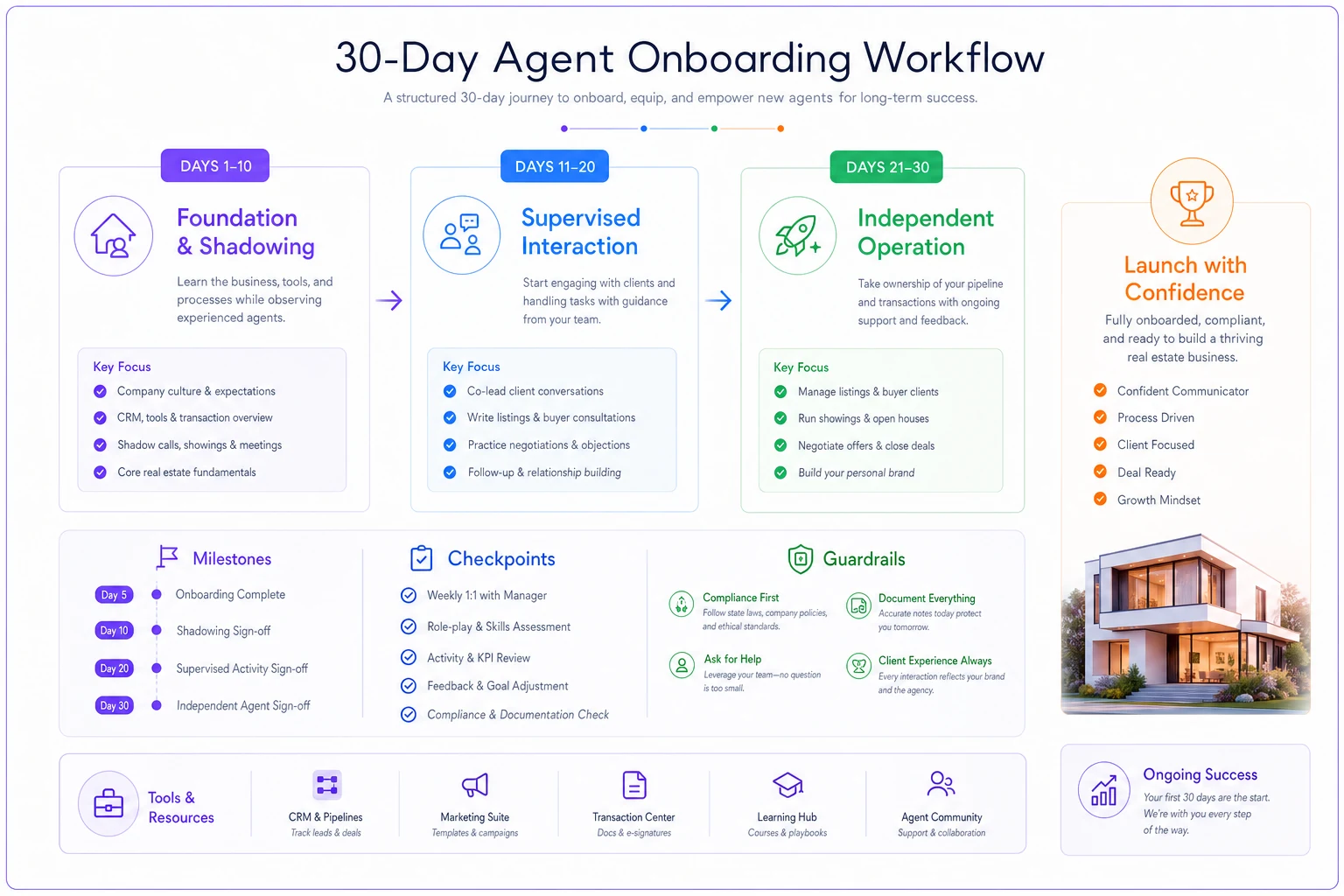
Use this as a reference when running cohort intakes.
The technology layer that makes this scalable
Manually tracking all these checkpoints and activities would bury your operations manager fast. This is where AI-powered operational software turns theory into practice.
Modern platforms can automate activity tracking, flag when agents miss benchmarks, and analyze communication patterns to surface coaching opportunities. Instead of managers chasing updates, the system surfaces what actually needs attention.
AI automation can monitor new agent email response times and flag when they exceed your SLA standards. It can track pipeline development and alert managers when an agent's prospect count drops. Some platforms can even analyze recorded calls to identify missed opportunities or flag compliance issues before they escalate.
Use automated SLA alerts to catch slow response times before they impact conversion.
The practical result: managers spend time coaching instead of chasing data. New agents get consistent feedback instead of sporadic check-ins. And the whole onboarding process becomes repeatable instead of relying on whoever happens to have time that week.
Common onboarding failures to avoid
The "sink or swim" approach
Some brokers pride themselves on minimal hand-holding. "Real estate is entrepreneurial," they say. Sure, but even entrepreneurs need systems. Throwing new agents in the deep end doesn't build resilience—it builds resentment and turnover.
The eternal training trap
The opposite problem: endless modules, certifications, and classes before any real work. Agents join to sell houses, not attend seminars. Front-load essential knowledge, then learn by doing with support.
The favoritism problem
When shadowing and mentorship depend on who's available or willing, quality varies wildly. New agents paired with top producers thrive. Those stuck with whoever drew the short straw struggle. Standardize the experience so it doesn't come down to luck.
The activity without purpose trap
Requiring calls for the sake of calls, or open houses just to check a box, builds bad habits. Every activity should tie to a revenue outcome or a specific skill development goal. Volume matters, but not if the volume is hollow.
Measuring what matters
Track these metrics for each new agent cohort:
-
Time to first transaction
-
90-day revenue generation
-
Activity-to-outcome conversion rates
-
Client satisfaction scores
-
6-month retention rate
Compare cohorts using structured onboarding against those without. The difference typically shows up as significantly faster revenue generation and meaningfully higher retention rates.
Also track manager time invested. A good onboarding system should reduce management burden after initial setup, not increase it. If managers spend more time managing the system than supporting agents, something's broken.
Beyond 30 days: sustaining momentum
The 30-day mark isn't graduation—it's the end of intensive support. Successful agencies keep a lighter-touch structure going:
-
Weekly pipeline reviews for the first 90 days
-
Monthly skills development sessions
-
Quarterly business planning check-ins
-
Ongoing activity tracking with alerts for drops
The agents who thrive long-term are the ones who internalize the habits built during their first 30 days. Daily prospecting, consistent CRM updates, proactive client communication—these become automatic instead of forced.
The real ROI of structured onboarding
Agencies using structured 30-day onboarding typically see:
-
50-70% reduction in time to first transaction
-
30-40% higher revenue per agent in year one
-
25-35% improvement in retention beyond 12 months
-
Significantly lower management overhead per agent
But the biggest benefit might be cultural. When new agents see clear expectations and real support systems, they perform better. When existing agents watch new hires succeeding quickly, it raises the bar across the office. The whole place elevates.
Structured onboarding isn't about control—it's about acceleration. Give new agents a clear path to revenue, support them through the learning curve, and tie everything to measurable outcomes. The agents win by ramping faster. The agency wins through higher productivity and lower turnover. The clients win by working with prepared, confident agents from day one.
The alternative—hoping new agents figure it out while burning through savings and patience—isn't just inefficient. It's expensive, frustrating, and completely preventable with the right operational structure in place.
Ready to elevate your real estate business?
Join 2,000+ agencies using TryRealy to streamline operations, close deals faster, and deliver exceptional client experiences.