



Most agents think a 48-hour listing launch is about speed. It's not. It's about ownership.
When an agent says "we'll have this live in two days," they're usually lying to themselves. Not intentionally—they genuinely believe their photographer will deliver on time, their admin will write descriptions quickly, and they'll somehow coordinate six different tasks across three people while also showing properties and handling existing clients.
The real problem isn't the timeline. It's that nobody owns hour 14. Or hour 27. Or hour 41.
The hour-ownership problem that kills listing launches
Here's what typically happens when a listing comes in on Monday at 2pm:
-
The agent texts their photographer
"Need photos ASAP"
-
The photographer replies
"Can do Thursday morning"
-
The agent tells the client
"We'll be live by Wednesday"
-
The admin starts prepping paperwork "when they get to it"
-
Tuesday afternoon
panic mode activated
Nobody owns specific hours. Everyone owns vague responsibilities. The photographer owns "photos" but not "photos delivered by hour 18." The admin owns "descriptions" but not "first draft complete by hour 8."
This creates what I'd call responsibility fog—everyone's sort of responsible for everything, which means nobody's actually responsible for anything specific.
The worst part? When something slips (and something always slips), there's no clear escalation point. If photos aren't delivered by Tuesday 8pm, who makes the call to switch photographers? At what exact point does the agent step in to write descriptions themselves? When does "waiting for photos" become "we need plan B"?
Why traditional listing checklists fail small teams
Standard listing checklists look great on paper. They have all the tasks:
Never miss a showing or follow-up again.
TryRealy helps you schedule, track, and manage every client interaction smoothly.
- Unified property and client management
- Automated client notifications
- Integrated sales pipeline tracking
No credit card required
-
Schedule photography
-
Gather property details
-
Write descriptions
-
Create marketing materials
-
Upload to MLS
-
Distribute to portals
No time boundaries. "Schedule photography" could mean today or Thursday. There's no deadline that triggers action if it's not done.
No clear handoffs. When the photographer finishes, who exactly do they notify? How? Through what channel? What information needs to be included?
No contingency triggers. If the photographer cancels Tuesday morning, what happens? Who decides? Based on what criteria?
No communication templates. Every update requires crafting a new message. This eats time and creates inconsistency.
Agencies using these generic checklists consistently miss their launch dates by a day or two. Not because they're slow—because they're operating without clear ownership boundaries.
The 48-hour framework that actually works
After building operational software for dozens of real estate teams, here's what consistently works: hour-based ownership with escalation triggers.
This isn't about micromanaging. It's about creating clarity so everyone knows exactly what they own and when to raise their hand if something's off track.
Hour 0-6: Foundation Phase (Agent Owns)
Hour 0-2: Initial Setup
-
Agent confirms property access
-
Creates listing folder in shared drive
-
Sends initial brief to team (using template)
-
Books photographer for hour 12-18 slot
Hour 2-4: Information Gathering
-
Pull tax records
-
Gather HOA docs if applicable
-
Create feature list (minimum 15 items)
-
Document any special access requirements
Hour 4-6: Team Kickoff
-
Send consolidated brief to admin
-
Confirm photographer arrival time
-
Set MLS target time (usually hour 44)
Escalation Trigger: If photographer not confirmed by hour 4, agent must either book backup or shoot with phone by hour 8.
Hour 6-18: Content Creation Phase (Multiple Owners)
Hour 6-12: Admin Prep (Admin Owns)
-
Draft initial description (300 words minimum)
-
Create neighborhood highlights
-
Prepare MLS fields (everything except photos)
-
Send draft to agent for review
Hour 12-18: Photography (Photographer Owns)
-
Arrive within 30-minute window
-
Minimum 25 photos, maximum 40
-
Upload raw files by hour 17
-
Send confirmation text with preview
Escalation Trigger: If photos not uploaded by hour 18, admin starts listing with virtual staging or previous exterior shots (if available).
Hour 18-30: Production Phase (Admin Owns)
Hour 18-22: Photo Processing
-
Select best 20-25 photos
-
Basic edits (brightness, straightening)
-
Order for MLS upload
-
Create photo captions
Hour 22-26: Description Finalization
-
Incorporate property-specific details
-
Add photo-based observations
-
Create compelling headline
-
Prepare social media variations
Hour 26-30: MLS Prep
-
Enter all data fields
-
Upload photos in correct order
-
Set showing instructions
-
Preview full listing
Escalation Trigger: If MLS prep not complete by hour 30, agent takes over personally.
Hour 30-42: Quality Control Phase (Agent Owns)
Hour 30-34: Internal Review
-
Agent reviews full MLS listing
-
Checks accuracy of all details
-
Confirms photos properly displayed
-
Reviews pricing strategy
Hour 34-38: Client Approval
-
Send preview to seller
-
Get written approval (email/text)
-
Make any requested changes
-
Document approval timestamp
Hour 38-42: Final Preparations
-
Schedule go-live time
-
Prepare announcement emails
-
Queue social media posts
-
Alert showing agents
Hour 42-48: Launch Phase (Multiple Owners)
Hour 42-44: Go Live (Admin Owns)
-
Activate MLS listing
-
Confirm syndication started
-
Post to company website
-
Send confirmation to agent
Hour 44-48: Distribution (Agent Owns)
-
Send announcement to sphere
-
Post on social media
-
Text top buyer agents
-
Update CRM pipeline
Here's a visual workflow to follow.
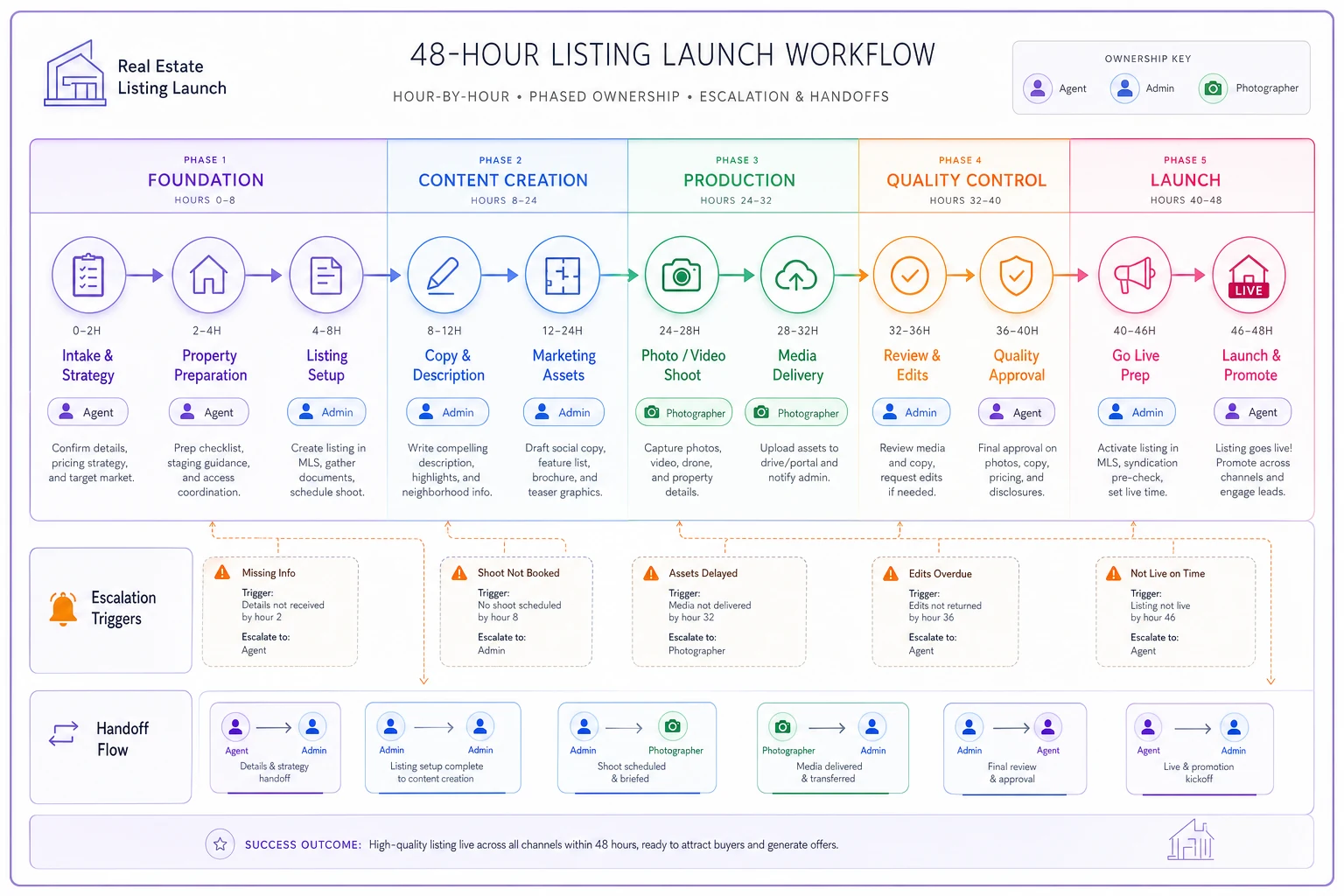
Pro-tip: Pre-book a backup photographer when you book the primary to avoid hour 4 escalations.
This isn't about micromanaging. It's about creating clarity so everyone knows exactly what they own and when to raise their hand if something's off track.
The communication templates that prevent dropped balls
Every handoff needs a template. Not for bureaucracy—for speed and completeness.
Photography Confirmation (Hour 4) "Photography confirmed for [PROPERTY] at [TIME]. Access via [METHOD]. Special notes: [NOTES]. Please confirm receipt and upload to [FOLDER] by [DEADLINE]."
Photo Delivery (Hour 17) "Photos complete for [PROPERTY]. [COUNT] images uploaded to [LOCATION]. Preview: [LINK]. Processing can begin."
MLS Ready (Hour 30) "[PROPERTY] ready for review in MLS draft. Login and check [MLS NUMBER]. Needs approval by hour 34 to maintain launch schedule."
Client Approval Request (Hour 34) "Your listing is ready for review: [LINK]. Please confirm approval by [TIME] to go live as scheduled Wednesday morning. Any changes needed?"
Go-Live Confirmation (Hour 44) "[PROPERTY] is now live on MLS. Syndication started. Social posts scheduled for [TIME]. Showing instructions active."
Templates remove the guesswork from each handoff and ensure consistent, quick communication.
Service level agreements that small teams can actually meet
SLAs for small teams need to be realistic but firm. Here's what works:
Photography Turnaround
-
Standard
6 hours from shoot to upload
-
Rush
3 hours (with pre-arrangement)
-
Emergency
90 minutes (phone photos acceptable)
Description Writing
-
First draft
6 hours from brief
-
Final version
4 hours from photo delivery
-
Revisions
2 hours per round
MLS Entry
-
Data entry
4 hours from content ready
-
Photo upload
2 hours from processed files
-
Full review
1 hour
Response Times
-
Urgent issues
30 minutes
-
Standard questions
2 hours
-
Non-urgent updates
4 hours
The key: these aren't aspirational. They're what your team commits to hitting 95% of the time. The other 5% triggers escalation.
Contingency rules for when reality hits
Things go wrong. The photographer's kid gets sick. The seller changes their mind about pricing. The MLS system crashes. Here's how to handle the common failures:
Photographer Issues
No-show or late cancellation (Hour 12)
-
Agent shoots with phone immediately
-
Focus on exterior and main rooms
-
Admin notes "professional photos coming"
-
Update with pro photos within 72 hours
Late delivery (Hour 18)
-
Proceed with phone photos if available
-
Or use virtual staging on floor plan
-
Launch with limited photos
-
Update within 24 hours
Information Gaps
Missing property details (Hour 6)
-
Admin creates placeholder descriptions
-
Notes "details pending" in internal docs
-
Agent has 12 hours to provide
-
Generic descriptions used if not received
Seller unresponsive (Hour 34)
-
One attempt via text
-
One attempt via call
-
If no response by hour 38, delay launch
-
Notify all parties of new timeline
Technical Problems
MLS system down (Hour 42)
-
Post to company site first
-
Email to known buyer agents
-
Social media goes live on schedule
-
MLS entry as soon as available
Team Member Unavailable
Admin sick/unavailable
-
Agent handles descriptions
-
Photographer uploads directly to MLS
-
Templates reduce workload significantly
Agent unreachable
-
Admin proceeds with standard decisions
-
Uses pre-approved price/terms
-
Documents all choices made
-
Agent reviews at next availability
Contingencies keep the launch moving even when unexpected problems arise.
The escalation matrix that keeps things moving
Escalation isn't about blame—it's about maintaining momentum. Here's when and how to escalate:
| Issue | First Escalation (Time) | Second Escalation (Time) | Final Decision |
|---|---|---|---|
| Photos not confirmed | Hour 4 (Agent texts) | Hour 6 (Agent calls) | Hour 8 (Use phone) |
| Descriptions not started | Hour 10 (Admin reminder) | Hour 12 (Agent checks) | Hour 14 (Agent writes) |
| Photos not delivered | Hour 18 (Photographer reminder) | Hour 20 (Agent calls) | Hour 22 (Launch without) |
| MLS not ready | Hour 32 (Admin alert) | Hour 34 (Agent takes over) | Hour 36 (Delay launch) |
| Client not responding | Hour 36 (Second attempt) | Hour 38 (Call directly) | Hour 40 (Delay launch) |
| System technical issue | Immediate (Try workaround) | +1 hour (Alternative platform) | +2 hours (Manual process) |
The rule: escalate based on time, not frustration. If it's hour 18 and photos aren't uploaded, escalate. Don't wait because the photographer "usually delivers."
Real workflow: Tuesday listing to Thursday launch
Let me walk through an actual timeline from a small team handling a $430,000 listing:
Tuesday 10am (Hour 0): Listing agreement signed. Agent creates folder, books photographer for Wednesday 10am.
Tuesday 12pm (Hour 2): Agent pulls tax records, emails brief to admin with 18 feature points.
Tuesday 4pm (Hour 6): Admin starts description, writes 340 words about neighborhood, schools, recent updates.
Wednesday 10am (Hour 24): Photographer arrives, shoots for 90 minutes, leaves at 11:30am.
Wednesday 3pm (Hour 29): Photos uploaded—31 images total. Admin selects best 22, orders them, writes captions.
Wednesday 5pm (Hour 31): MLS entry complete except for final agent review.
Wednesday 7pm (Hour 33): Agent reviews, requests two description changes, approves photos.
Wednesday 8pm (Hour 34): Preview sent to seller via text with link.
Wednesday 9:30pm (Hour 35.5): Seller approves with one price adjustment.
Thursday 8am (Hour 46): Listing goes live, email blast sent to 340 agents, social posts published.
Thursday 10am (Hour 48): First showing request received.
Total active work time: roughly 8 hours across three people. But it worked because everyone knew their hours and handoffs.
Why better coordination changes the game
The complexity isn't in any single task—it's in the coordination overhead. That's where operational software enhanced with AI automation fundamentally shifts the dynamic.
Instead of manually tracking who owns hour 27, the system monitors progress automatically. When the photographer uploads at hour 17, it immediately notifies the admin and starts the next timer. If photos aren't uploaded by hour 18, it texts the agent with the pre-determined escalation plan—no one has to remember to check.
More useful than the automation itself is the pattern recognition. If your photographer consistently delivers at hour 19 instead of hour 17, the system adjusts the timeline while maintaining the 48-hour target. If your admin typically needs 5 hours for descriptions instead of 4, it builds that into the schedule going forward.
This is especially valuable for small teams where one person wearing multiple hats can't constantly monitor every handoff. The operational software becomes the backbone that catches slippage before it becomes a missed deadline, so your team's attention stays on actual work rather than checking whether other people did theirs.
Making the 48-hour system work for your team
The framework above isn't meant to be copied exactly. Your photographer might need different hours. Your admin might handle different tasks. Your market might demand a faster or slower launch window.
The principles, though, are universal:
Own hours, not just tasks. "Photos" is vague. "Photos delivered by hour 17" is clear.
Build escalation triggers before you need them. Decide now what happens if photos are late—not when you're stressed at hour 19.
Template every handoff. Five seconds to send a template beats two minutes crafting a message from scratch.
Document contingencies. When plan A fails, everyone should already know plan B.
Track patterns, adjust accordingly. If something consistently takes longer than the SLA, build that reality into your timeline.
The goal isn't perfection. It's predictability. When a seller asks "when will my house be listed?" you can answer confidently because you know what happens each hour, who owns it, and what triggers the next phase.
Your 48-hour listing process becomes less about rushing and more about rhythm. Each person knows their part, their timing, and their handoffs. The listing launches on time not because everyone worked faster, but because everyone knew exactly what they owned.
That's the difference between a checklist and an operational system—one hopes things get done, the other ensures they do.
Ready to elevate your real estate business?
Join 2,000+ agencies using TryRealy to streamline operations, close deals faster, and deliver exceptional client experiences.