



The strange thing about closings is that most of the drama happens on deals that already looked won. The offer is accepted, everyone relaxes, and then the last 21 days turn into a scramble — a missing HOA doc, an appraisal that comes in low, a lender waiting on a pay stub nobody asked for, a buyer's agent who went dark for four days.
Why deals that looked "done" still fall apart in the final two weeks
The strange thing about closings is that most of the drama happens on deals that already looked won. The offer is accepted, everyone relaxes, and then the last 21 days turn into a scramble — a missing HOA doc, an appraisal that comes in low, a lender waiting on a pay stub nobody asked for, a buyer's agent who went dark for four days.
Small agencies almost never lose deals because of bad negotiation. They lose them — or bleed hours and goodwill — because the space between "listing goes live" and "keys handed over" isn't actually a process. It's a series of individual heroics held together by whoever happens to be paying attention that week. That works fine until you're running six or seven active deals at once. Then it doesn't.
This is a systems article, not a tips article. The point isn't to hand you a longer checklist. It's to show you how the whole listing‑to‑close workflow fits together — where inputs get dropped, where handoffs silently fail, and how to build something predictable enough that a closing feels boring instead of terrifying.
The real reason closings feel chaotic: nobody owns the middle
Every agency has a clear owner at the start (the listing agent) and a clear owner at the end (whoever shows up to the closing table). The problem lives in the middle — inspection period, financing, title, appraisal, repair negotiation, final walkthrough. That's a two-to-four week stretch with maybe 30–40 discrete tasks, and in most small offices it has no single owner.
Never miss a showing or follow-up again.
TryRealy helps you schedule, track, and manage every client interaction smoothly.
- Unified property and client management
- Automated client notifications
- Integrated sales pipeline tracking
No credit card required
What tends to happen on small teams is that the transaction coordinator role either doesn't exist yet, or it exists as a part-time responsibility bolted onto someone already stretched thin. So ownership is implied rather than assigned. The listing agent assumes the buyer's side is tracking the appraisal. The buyer's agent assumes the lender is chasing docs. The lender assumes the client uploaded everything. Everyone assumes, and the deal drifts until a hard deadline forces a panic.
The pattern worth sitting with: chaos isn't caused by things going wrong. It's caused by nobody noticing things went wrong until the deadline. A financing contingency that lapsed unnoticed is a disaster on day 21 and a five-minute fix on day 8. The difference is entirely whether someone was watching the middle.
The five things a listing‑to‑close system actually needs
Before any playbook makes sense, you need to know what a functioning system is made of. Strip away the industry jargon and every reliable operations system runs on the same five components:
-
Inputs — the exact information or document required before a step can start (e.g., accepted contract with all dates, buyer lender contact, earnest money receipt)
-
Handoffs — the moment work passes from one person to another, and what has to travel with it
-
SLAs — the promised time window for each step ("earnest money confirmed within 48 hours of acceptance")
-
Checkpoints — scheduled moments where someone verifies the deal is actually on track, not just assumed to be
-
Escalation rules — what happens, and who gets pulled in, when an SLA is missed
Most small agencies have a fuzzy version of the first two and almost none of the last three. That's not a knowledge gap — everyone knows appraisals have deadlines. It's a visibility gap. The information exists in someone's head or inbox, but there's no shared place where the whole team can see that step 9 is late.
One mistake worth flagging: teams often try to fix chaos by adding more communication. More group texts, more "just checking in" emails. Communication is not a system. A system is what lets you communicate less because everyone already knows the status.
Mapping the workflow: from live listing to funded
Below is the actual timeline laid out so the handoffs are visible. This assumes a listing that's already prepped and marketed — the getting-to-accepted-offer part is its own machine. The focus here is acceptance through close.
Below is a visual summary of the timeline and parallel tracks.
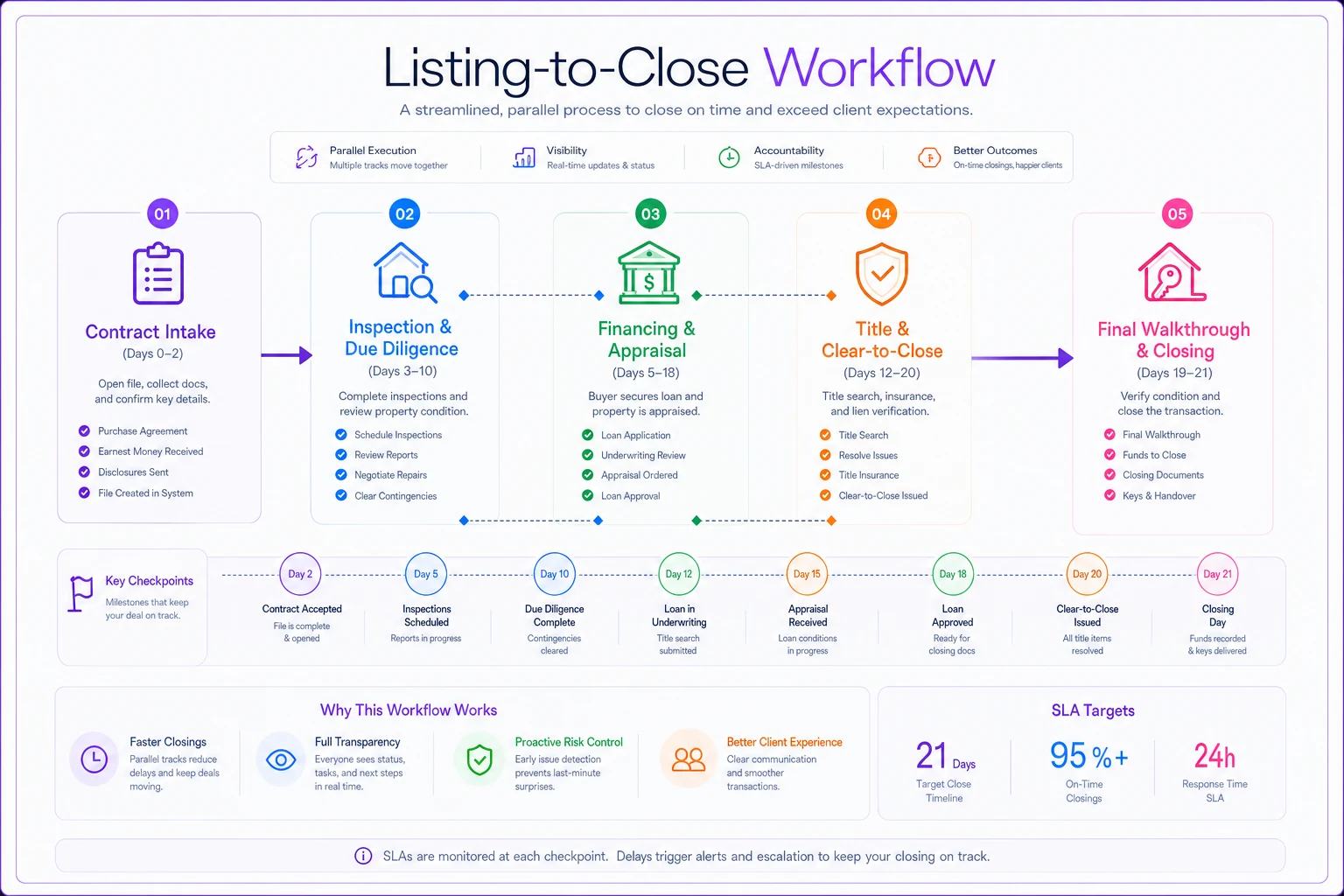
Phase 1 — Contract intake (Day 0–2). The moment an offer is accepted, someone extracts every critical date into one place: inspection deadline, financing contingency, appraisal deadline, title commitment date, final walkthrough, closing. If these dates live only in the contract PDF, they'll get missed. This is the single highest-leverage step in the whole process, and it's the one most often done sloppily.
Phase 2 — Inspection & due diligence (Day 3–10). Inspection scheduled, report received, repair requests drafted and negotiated. The handoff risk here is between the client's reaction to the report and the agent's negotiation timeline. Clients sit on inspection reports for days; the contingency clock does not care.
Phase 3 — Financing & appraisal (Day 5–18). Runs partly parallel to inspection. The agency doesn't control the lender, which is exactly why checkpoints matter more here than anywhere else. You can't do the lender's job, but you can verify it's happening.
Phase 4 — Title & clear-to-close (Day 12–20). Title search, resolving any liens or clouds, confirming the lender has issued clear-to-close. Quiet phase that suddenly isn't quiet when a title issue surfaces late.
Phase 5 — Final walkthrough & closing (Day 19–21). Walkthrough, final numbers confirmed, closing disclosure reviewed with the client, signing.
The thing most people miss: these phases overlap. Financing starts before inspection ends. Title work begins before appraisal returns. A linear checklist actively lies to you — it makes it look like you finish one thing before starting the next. A real system tracks parallel tracks and flags when a slow track (usually financing) threatens a downstream deadline.
A sample playbook for a 3‑agent office
Here's the part you can actually copy. Assume a small office: two producing agents and one person acting as transaction coordinator (TC) — even if that person also does other things. If you don't have a dedicated TC, one of the agents wears that hat, but the role must be named on every deal.
The RACI for each phase
| Phase | Responsible | Accountable | Consulted | Informed |
|---|---|---|---|---|
| Contract intake / date extraction | TC | Listing agent | — | Both agents |
| Inspection scheduling & report | TC | Listing agent | Inspector | Client |
| Repair negotiation | Listing agent | Listing agent | TC | Client |
| Financing follow‑up | TC | Listing agent | Lender | Listing agent |
| Appraisal tracking | TC | Listing agent | Appraiser | Client |
| Title & clear‑to‑close | TC | Listing agent | Title officer | Client |
| Final walkthrough & closing | Listing agent | Listing agent | TC | Client |
Notice the TC is Responsible for most of the tracking and chasing, while the agent stays Accountable for the outcome and owns the client-facing judgment calls. That split is the whole point. The agent shouldn't be the one refreshing an email waiting for the appraisal — but the agent should be the one who owns whether the deal closes.
SLAs that make lateness visible
-
Critical dates extracted and entered into the shared tracker
within 24 hours of contract acceptance
-
Earnest money receipt confirmed
within 48 hours
-
Inspection scheduled
within 3 business days of acceptance
-
Repair requests submitted to buyer/seller
within 48 hours of receiving the report
-
Lender status check
every 3 days until clear‑to‑close
-
Appraisal ordered confirmation
by day 7
-
Title commitment received
by day 14
-
Closing disclosure reviewed with client
at least 3 days before closing
An SLA is worthless unless a missed one triggers something. These are the ones that catch the most fires:
Escalation rules
-
SLA missed by one cycle → TC flags it in the shared tracker and pings the responsible party directly.
-
SLA missed a second time, or a hard contract deadline is within 72 hours → escalate to the accountable agent, who makes the call (extension request, direct call to the lender, etc.).
-
Any deadline that cannot be met → escalate to the agency manager same day, with the risk and options written out — not just "we have a problem."
The rule that saves deals: escalate on the risk, not on the failure. Don't wait for the deadline to pass. If the lender's been silent for six days and clear-to-close is due in five, that's an escalation now, not a post-mortem later.
Role templates so the system survives a busy week
Systems break when the person holding them in their head is out sick or slammed. The fix is writing the role, not just the task list. A usable TC role template for a small office covers:
-
What they own every active deal's tracker, all SLA monitoring, all vendor scheduling, all document chasing
-
What they decide scheduling, reminder cadence, when to flag a risk
-
What they escalate anything client-facing, any negotiation, any missed hard deadline
-
Their daily rhythm a 15-minute morning pass through every active file to check what's due in the next 72 hours
Make the 15-minute morning pass a calendar appointment labeled "72-hour look-ahead" so it happens even on busy days.
That last one — the daily 72-hour look-ahead — is the single habit that prevents most last-minute chaos. It moves the whole operation from reactive to slightly-ahead. You're not managing today's fires; you're spotting the ones about to start.
A real scenario: what changes when you install this
Consider a two-agent office closing somewhere around 55–60 deals a year, running with no formal coordination. The owner's pattern was roughly one deal a month turning into a last-week emergency — usually financing or a title surprise — and two or three a year that actually fell through in the final stretch.
The fixes weren't dramatic. They named a part-time TC (initially just one of the agents' assistants), built a single shared tracker with the critical dates for every active deal, and set the every-3-days lender check as a hard rule. Nothing fancy.
The difference showed up mostly in the absence of things. The scrambles didn't disappear entirely, but the "we found out today the appraisal came in low three days ago" category basically ended. Their late-stage fall-throughs dropped to roughly one over the following year. The agents also got a quieter benefit they didn't expect: they stopped working weekends on transaction admin, because the weekday look-ahead caught things before they became emergencies.
The lesson isn't the numbers. It's that predictability came from checkpoints, not from anyone working harder. They were already working plenty hard. They were just working blind.
Where software fits — and where it doesn't
At some point a shared spreadsheet stops scaling. Around 8–10 concurrent deals, the manual look-ahead gets heavy and dates start slipping through simply because there are too many to eyeball. This is where operational software earns its place — a platform that holds every deal's dates in one view, automatically flags SLAs coming due or breached, and routes escalations to the right person without someone manually noticing.
The useful version of AI automation here is pretty unglamorous. Parsing the accepted contract to pull critical dates so nobody transcribes them by hand. Generating the daily 72-hour look-ahead automatically. Nudging the responsible party before an SLA breaches instead of after. It targets the two most common failure points in the workflow: dates entered wrong at intake, and slippage nobody caught in time.
That said — software formalizes a system, it doesn't create one. If you don't have named roles, SLAs, and escalation rules first, a tool just gives you a faster way to be disorganized. Build the playbook on paper, run it manually until it's real, then let a platform carry the tracking load as your volume grows.
When this level of structure makes sense (and when it's overkill)
If you're closing fewer than a dozen deals a year and it's genuinely just you, a lightweight version of this — a single dates checklist and a weekly self-review — is plenty. Building a full RACI for a one-person operation is process theater.
This system earns its keep when you cross into multiple agents, overlapping deals, and any handoff between people. The moment two humans have to coordinate on the same transaction, ambiguity about who owns the middle gets expensive. That's the threshold.
And it's the wrong move for anyone who'll build the playbook and then not run it. A documented system nobody follows is worse than no system, because it creates a false sense that the middle is covered when it isn't. Better to have three rules everyone actually uses than a forty-page manual sitting in a shared drive.
The takeaway for your next closing
The agencies that stopped dreading closings didn't hire more people or find better clients. They just stopped treating the middle of the deal as a black box. They gave it an owner, gave each step a promised time window, and built a habit of looking 72 hours ahead so risks surfaced while they were still fixable.
Start with the smallest version this week: pull the critical dates for every active deal into one shared view, assign a single person to check what's due in the next three days, and write down the one escalation rule that matters most to you. That alone will catch the majority of last-minute surprises. Everything else in this playbook is just making that first instinct — watch the middle — reliable enough to survive a busy month.
Ready to elevate your real estate business?
Join 2,000+ agencies using TryRealy to streamline operations, close deals faster, and deliver exceptional client experiences.