



Most agents write property descriptions backwards. They start with square footage, move to bedrooms, then tack on "beautiful hardwood floors" and call it done. Meanwhile, buyers scroll past without clicking.
Real estate platforms have trained buyers to filter by specs—beds, baths, price, location. Your written description needs to do something else entirely. It needs to make someone feel something about living there, not recite facts they already filtered for.
High-converting descriptions follow specific voice rules depending on property type and price tier. They paint lifestyle scenes first, features second. And they go through real QA before going live.
Why generic descriptions kill listing performance
Property descriptions fail for three main reasons.
First, agents copy-paste templates without adjusting for market segment. A $2M waterfront property needs completely different language than a $300K starter home, yet both end up with the same "stunning kitchen with granite countertops" treatment.
Second, most descriptions lead with features instead of benefits. Nobody actually cares about "recessed lighting throughout." They care about how their dinner parties will look under perfect ambient lighting. The feature is just the mechanism.
Third, there's no quality control. Listings go live with typos, inconsistent capitalization, and contradictory information between the description and the specs. Each mistake chips away at credibility.
The conversion gap between mediocre and excellent descriptions shows up in metrics pretty fast. Well-written listings generate significantly more showing requests in identical market conditions. They also sell faster and often closer to asking price because buyers arrive pre-sold on the lifestyle, not just checking boxes.
Property type determines your entire voice strategy
Luxury properties ($1M+): Paint exclusive experiences
Never miss a showing or follow-up again.
TryRealy helps you schedule, track, and manage every client interaction smoothly.
- Unified property and client management
- Automated client notifications
- Integrated sales pipeline tracking
No credit card required
Template structure for luxury:
``
[Opening lifestyle scene - 2 sentences]
[Unique positioning statement]
[Entertainment scenarios - 2-3 sentences]
[Architectural/designer credentials if applicable]
[Privacy/exclusivity elements]
[Subtle practicality mentions]
``
Before: "Beautiful 5-bedroom home with pool and mountain views. Granite counters, hardwood floors, 3-car garage. Master suite with walk-in closet."
After: "Morning coffee transforms into meditation when sunrise hits the infinity pool, city lights twinkling below as steam rises from your cup. This architectural statement by Morrison Design Group positions you above the noise—literally—with 2.3 acres buffering your private compound from the nearest neighbor. The great room flows seamlessly to the covered loggia where you'll find yourself hosting impromptu gatherings that stretch past midnight, your guests reluctant to leave the view. Yes, there's a temperature-controlled wine room and chef's kitchen, but you'll remember this home for how it made Tuesday mornings feel like vacation."
Mid-market family homes ($400K-$800K): Focus on daily life improvement
Template structure for families:
``
[Current problem they're solving]
[Daily routine improvement]
[Family gathering scenario]
[Practical wins - storage, layout, maintenance]
[Neighborhood benefits for kids]
[One unexpected delight]
``
Before: "Spacious 4-bedroom colonial in great school district. Updated kitchen, finished basement, large backyard."
After: "No more breakfast chaos—this kitchen's double islands mean homework happens while dinner prep unfolds, everyone together but nobody underfoot. The mudroom alone will transform your mornings (individual cubbies for four, plus a dedicated sports equipment zone that actually contains the mess). Basement movie nights become a real thing with the already-wired theater space, while the covered back patio handles everything from birthday parties to quiet Sunday mornings with just you and coffee. Piedmont Elementary is a 6-minute walk through the neighborhood greenway—no buses, no car lines."
Starter homes (<$400K): Emphasize possibility and pride
Template structure for starters:
``
[Emotional hook about ownership]
[One standout feature that punches above price]
[Low-maintenance benefits]
[Flexibility for growth]
[Money-saving elements]
[Community connection]
``
Before: "Cute 2-bedroom bungalow perfect for first-time buyers. New roof, updated bathroom, nice yard."
After: "That first morning making breakfast in your own kitchen hits different—especially when sunlight streams through the original 1942 windows you'll never find in new construction. The sellers just replaced the roof and HVAC (receipts provided), so your house fund can go toward the fun stuff instead of surprises. The unfinished attic is already framed for a future office or nursery whenever you're ready. Meanwhile, the deep lot leaves room for the garden you've been Pinterest-planning, and the neighborhood's monthly food truck Friday happens right at the corner park."
Investment properties need pure numbers (dressed up slightly)
Investors scan for cash flow, but they still need to envision tenant quality and maintenance headaches. Your description should telegraph "easy to manage, attracts good tenants, minimal drama."
Template structure for investments:
``
[Current income or income potential]
[Tenant attraction factors]
[Recent upgrades that reduce maintenance]
[Location benefits for retention]
[Expansion potential if applicable]
``
Example: "Currently grossing $3,400/month with tenants through 2025 (lease transfers available). Professional tenants chose this unit for the Walk Score of 89—everything daily is walkable, keeping parking drama minimal. 2019 renovation included all mechanicals, windows, and waterproofing, with warranties transferring. Upper unit roughed for studio conversion would add roughly $1,100/month based on neighborhood comps."
Conversion rules that work across all property types
Rule 1: Start with a scene, not specs
-
❌ "This beautiful 3-bedroom home features..."
-
✅ "Saturday farmers market is a four-minute walk, Sunday brunch at Roseline's is five..."
Rule 2: Use "you" language strategically
-
❌ "The master bedroom has a private balcony"
-
✅ "Your morning routine includes stepping onto a private balcony before anyone else wakes up"
Rule 3: Mention problems that won't exist
-
❌ "Large garage with storage"
-
✅ "The garage workshop means your projects finally leave the dining table alone"
Rule 4: Include one surprising detail
-
"The original speakeasy door in the basement still works"
-
"Previous owner was Tesla's head engineer—the garage is already wired for everything"
-
"The neighborhood book club meets monthly, wine included"
Rule 4: Include one surprising detail
Before/after examples with measured outcomes
Case 1: Downtown condo that wouldn't move
Original listing: "Stunning 2BR/2BA condo in heart of downtown. Granite counters, stainless appliances, in-unit laundry. Building amenities include gym and rooftop deck. Low HOA fees."
Rewritten listing: "Lock your door and walk to everything—dinner at Oku (3 blocks), Saturday yoga at Modo (4 blocks), even Whole Foods sits just seven minutes away. Work-from-home becomes sustainable with a dedicated office nook that doesn't eat your living space, while the west-facing windows mean golden hour happens in your living room daily. The building's rooftop becomes your personal entertaining space (reserve through the app, grills included), though honestly the in-unit laundry might be the real luxury after years of quarters and waiting."
Result: Showing requests jumped from 2-3 weekly to 8-10 weekly. Sold in 22 days versus a market average of 47 days for comparable units.
Case 2: Suburban family home with dated interior
Original listing: "Great family home needs some updating. 4 bedrooms, 2.5 baths, full basement. Large lot, mature trees. Sold as-is."
Rewritten listing: "The bones are what builders can't recreate—real hardwood under that carpet, plaster walls that actually block sound between rooms, and a lot that would cost $200K alone in today's market. Yes, the kitchen's from 1987, but the layout works perfectly (ask anyone who's cooked Thanksgiving here). Your renovation budget goes further when you're not fixing structural problems or cramped layouts. Meanwhile, the kids can walk to Madison Middle through the back gate, and that basement is begging to become whatever your family needs most."
Result: Shifted buyer perception from "project" to "opportunity." Multiple offers the first weekend, sold $15K over asking.
The QA checklist for scaling quality descriptions
When you're managing multiple listings or training new agents, quality degrades fast without some kind of system. This checklist catches the mistakes that quietly kill conversions.
Technical accuracy
-
[ ] Square footage matches MLS exactly
-
[ ] Bedroom/bathroom count correct
-
[ ] Lot size accurate
-
[ ] Year built confirmed
-
[ ] School districts verified through official sources
-
[ ] HOA fees current (call to confirm)
-
[ ] Parking situation clearly explained
-
[ ] Pet policy mentioned if relevant
| Technical accuracy |
|---|
| Square footage matches MLS exactly |
| Bedroom/bathroom count correct |
| Lot size accurate |
| Year built confirmed |
| School districts verified through official sources |
| HOA fees current (call to confirm) |
| Parking situation clearly explained |
| Pet policy mentioned if relevant |
Voice consistency
-
[ ] First sentence creates scene, not specs
-
[ ] "You" language appears at least 3 times
-
[ ] Zero generic phrases
"stunning," "beautiful," "charming," "move-in ready"
-
[ ] One specific neighborhood detail included
-
[ ] Price tier language matches template
-
[ ] Avg sentence length under 20 words
-
[ ] No passive voice in first paragraph
Conversion optimization
-
[ ] Addresses likely buyer pain point
-
[ ] Mentions one unexpected detail
-
[ ] Includes specific distance/time to something desirable
-
[ ] Features appear as benefits, not lists
-
[ ] Call-to-action doesn't sound desperate
-
[ ] Mobile preview looks good (check first 150 characters)
Legal/compliance
-
[ ] No discriminatory language (even subtle)
-
[ ] Fair Housing compliance verified
-
[ ] No promises about future development
-
[ ] "Approximately" used for non-verified measurements
-
[ ] No school performance claims without data
-
[ ] Environmental disclosures noted if required
Final polish
-
[ ] Read aloud to catch awkward phrasing
-
[ ] Spell check complete
-
[ ] No CAPS except proper nouns
-
[ ] Numbers formatted consistently
-
[ ] Punctuation creates rhythm, not confusion
-
[ ] Would you save this listing if house-hunting?
Assign description review to a transaction coordinator for a fresh set of eyes before publishing.
When you're managing multiple listings or training new agents, the checklist above should be enforced as a gate before any listing goes live.
Building this process into your operations
Agencies seeing the best results from improved descriptions aren't just writing better—they're systematizing the whole thing. They maintain property description template libraries organized by price tier and property type. New listings get matched to the right template immediately, not whenever someone gets around to it.
One Phoenix agency tracks showing requests before and after description updates. They found that spending an extra 20 minutes on copywriting generates the equivalent impact of a $500 price reduction. Their agents now budget 45 minutes minimum for description writing, up from the previous "type it while uploading photos" approach.
The QA process works best when someone other than the writer does the review. Fresh eyes catch assumptions and unclear references. Some agencies assign description review to their transaction coordinators, creating a natural checkpoint before listings go live.
This kind of systematic approach gets more powerful when it's built into operational software. Instead of agents recreating descriptions from scratch every time, AI-powered platforms can analyze successful past listings, identify which voice rules apply to new properties, and generate first drafts that follow proven templates. The agent reviews, personalizes, adds specific neighborhood details, then runs the QA checklist. The platform handles the scaffolding; the agent handles the judgment.
create an image depicting a workflow for property description creation and QA: template selection based on property type and price, draft generation, agent personalization, independent QA checklist review, and publication/tracking of showing requests.
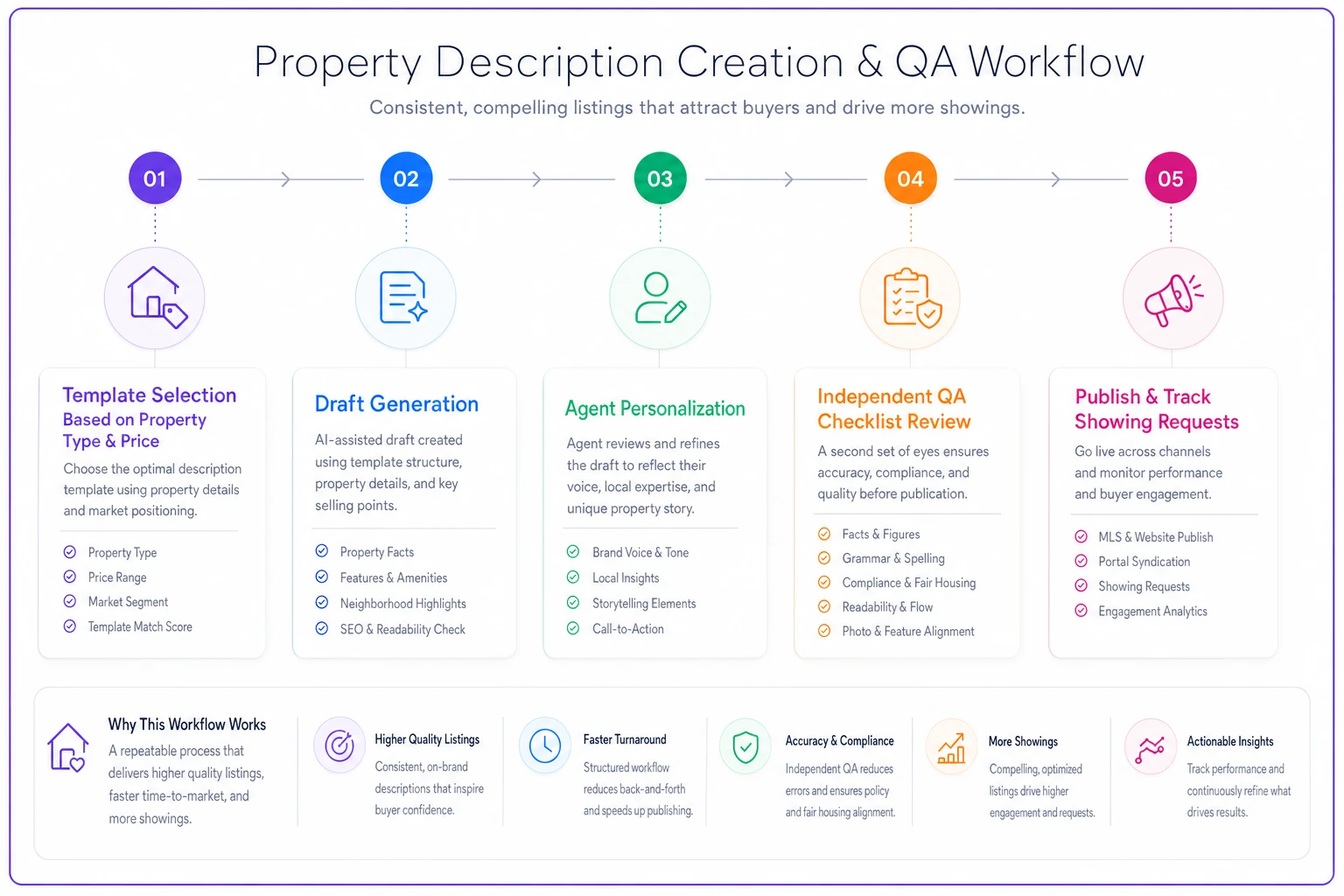
Some listing management tools now include these copywriting workflows built-in—tracking which descriptions generate the most engagement, testing different approaches over time, and gradually learning what resonates in specific markets. It's not magic, but it does eliminate a lot of the inconsistency that comes with scaling a team.
When templates actually hurt conversions
Not every property fits a template. Converted churches, former schools, true architectural statements—these need custom approaches. The template becomes a useful starting point for voice rules, but the actual description should lean into what makes the property unusual rather than sand it down to fit a category.
Over-relying on templates also creates a different problem. When every listing in a neighborhood sounds identical, none of them stand out. The best approach combines systematic templates with enough customization to still feel fresh.
Watch for these signs a template isn't the right tool:
-
Multiple similar properties listed simultaneously
-
Truly unique properties that defy categories
-
Luxury properties where generic language signals inexperience
-
Markets where buyers are especially sophisticated
-
Properties with complicated histories needing careful positioning
When a property falls into one of the categories above, start from a blank slate and build voice rules that fit the story.
Your next listing is your testing ground
The gap between average and excellent property descriptions isn't really about writing talent. It's about following proven voice rules, matching language to buyer psychology, and maintaining quality at scale.
Start with your next listing. Pick the right template based on property type and price tier. Follow the voice rules. Run the QA checklist before going live. Then track showing requests compared to similar properties.
Most agents never measure description performance because they assume writing doesn't matter once buyers can see photos. But photos get them interested—words get them emotionally invested. And emotional investment is what drives showing requests, offers, and ultimately commissions.
The agencies consistently outperforming their markets aren't necessarily better at sales. They're better at the operational fundamentals that create opportunities for sales to happen. Strong property descriptions are one part of that system, but they're the part buyers see first.
Ready to elevate your real estate business?
Join 2,000+ agencies using TryRealy to streamline operations, close deals faster, and deliver exceptional client experiences.