



Most real estate agencies treat past clients like completed transactions. Close the deal, celebrate, move on. Then they spend money chasing cold leads while previous buyers and sellers quietly drift toward whatever agent shows up next.
That gap is bigger than most teams realize. Agencies sitting on 200+ past clients often generate somewhere around 10 referrals a year when a functioning retention system could realistically push that to 40 or 50. At a typical commission in the $5,000–$7,000 range per side, that's a lot of revenue sitting dormant — not from strangers who need convincing, but from people who already trusted you enough to buy or sell through you.
The agencies that crack this don't rely on birthday texts or holiday cards. They build operational systems that segment clients by value, automate touchpoints based on transaction history, and track referral conversion like any other sales pipeline. What used to depend entirely on an agent's personality becomes a repeatable process.
Why "staying in touch" falls apart at scale
Individual agents try to maintain relationships through sheer personal effort — texting occasionally, sending market updates when they remember, maybe grabbing coffee once a year. That works fine for 20 or 30 people. Past that, it falls apart.
An agency with four agents averaging 25 transactions a year accumulates 100 past clients annually. Within three years, that's 300 relationships to maintain. No amount of good intentions can systematically nurture that many connections without people falling through the cracks.
Agencies generating consistent referrals don't leave it to agent memory or motivation. They run structured retention workflows that trigger based on client profiles and transaction dates. A first-time buyer who closed six months ago gets different touchpoints than an investor who's bought three properties. That distinction matters more than most agencies realize.
One agency owner I spoke with — a mid-sized team out of the Denver metro — told me their referral volume roughly doubled within about eight months of building out proper segmentation. Not because they hired more people. Because they stopped treating every past client the same way.
Client segmentation that actually changes what you do
Generic segmentation kills retention programs. Dividing clients into "A, B, C" tiers based on transaction value alone misses what actually drives referrals. The $800k home seller might never send you anyone. The $250k condo buyer might become your single best referral source.
Never miss a showing or follow-up again.
TryRealy helps you schedule, track, and manage every client interaction smoothly.
- Unified property and client management
- Automated client notifications
- Integrated sales pipeline tracking
No credit card required
Effective segmentation considers multiple factors:
-
Transaction recency and type — An investor operates completely differently than a family in their forever home. The investor wants market data and opportunity alerts. The family wants community information and home maintenance resources.
-
Life stage indicators — Young professionals who bought starter homes will likely move within a few years. Empty nesters downsizing probably won't transact again, but they have wide networks of similarly-aged friends going through the same transition.
-
Communication preferences — Some clients engage with detailed market reports. Others only respond to quick texts. Track not just contact information, but which channels and content types actually generate replies.
-
Referral history — Clients who've already sent referrals get tagged differently than those who haven't. They've proven they'll recommend you, so the focus shifts from building trust to staying visible.
Where agencies go wrong is creating segments without linking them to specific actions. They'll identify "high-value clients" and then send everyone the same monthly newsletter. Real segmentation drives differentiated workflows — different cadences, different content, different channels.
Building cadences that balance automation with actual human contact
Pure automation feels robotic. Pure manual outreach doesn't scale. The agencies generating predictable referrals blend both approaches based on client value and engagement signals.
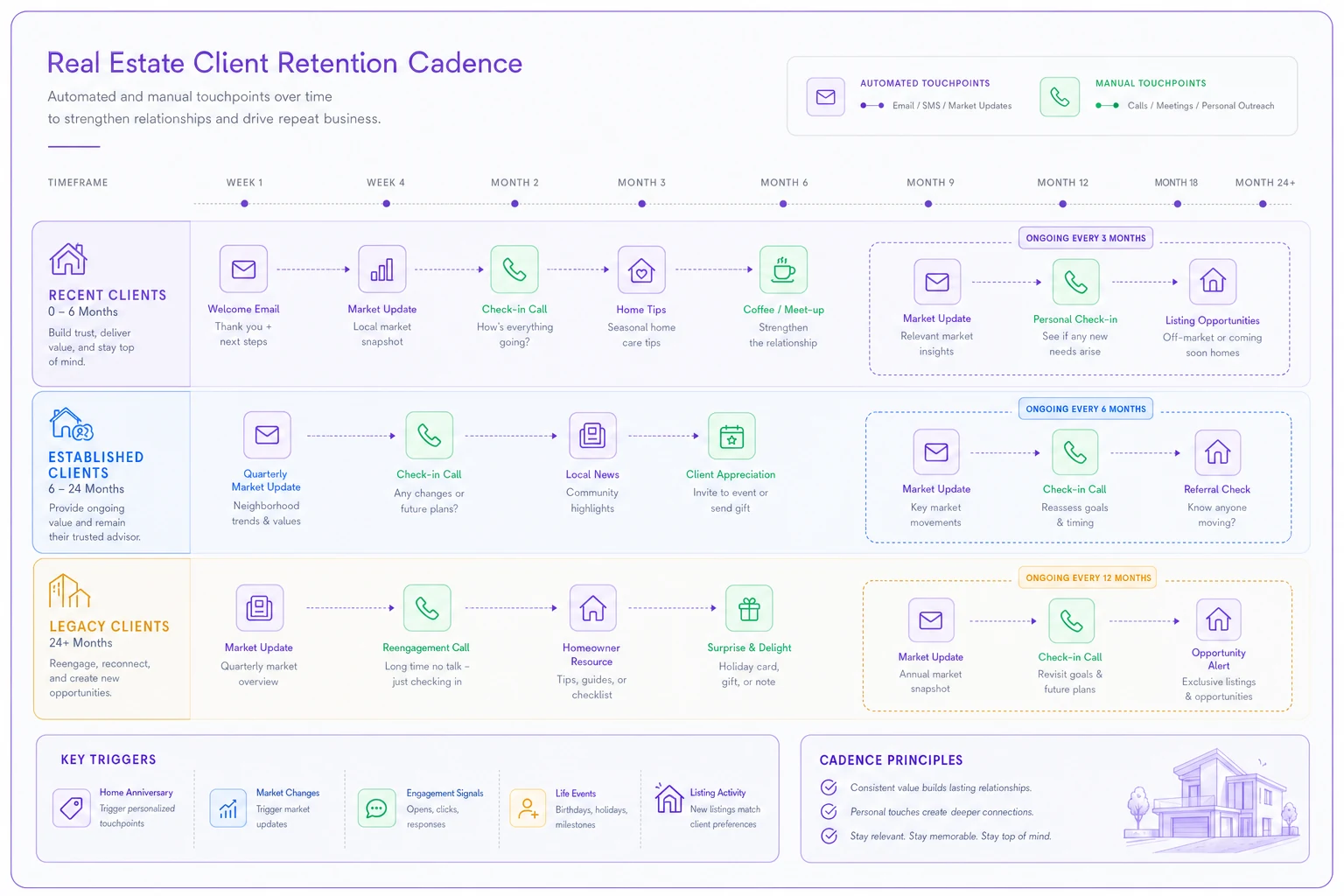
Below is a rough structure one agency actually uses — not gospel, just a real example of how to think about it:
Recent transaction (0–6 months):
-
Week 1 post-closing
Automated thank you video from agent
-
Week 2
Manual check-in call about move-in experience
-
Month 1
Automated home maintenance checklist for the season
-
Month 2
Manual text asking about the neighborhood
-
Month 3–6
Monthly automated market update for their zip code
-
Month 6
Manual call to review home value and catch up
Established client (6–24 months):
-
Quarterly automated market reports
-
Semi-annual manual "coffee chat" invitation
-
Automated birthday and transaction anniversary messages
-
Manual reach-out when similar homes sell in their neighborhood
-
Quarterly automated community event recommendations
Legacy client (24+ months):
-
Bi-annual automated market summary
-
Annual manual relationship touch (call/coffee/lunch)
-
Automated holiday greetings
-
Manual contact when major market shifts occur
-
Automated invites to client appreciation events
The automation handles consistent touchpoints that would otherwise get forgotten. Manual outreach happens at the moments when personal connection actually matters. Neither works alone.
Below is a visual representation of the cadence workflow.
Worth noting: not every agency nails this structure on the first try. One team ran a great cadence for recent clients but completely let legacy clients go dark. They were surprised when a competitor scooped up three referrals from clients they'd had for years. Small gaps compound over time.
KPI targets that actually predict referral pipeline health
Agencies obsessively track closed deals but ignore the metrics that predict future referrals. They'll know their conversion rate from leads to appointments but have no idea what percentage of past clients they've actually contacted in the last 90 days.
Referral-generating agencies monitor different numbers:
-
Contact coverage rate — What percentage of your past client database received outreach this month? A reasonable target is close to full coverage for clients from the last two years, with lower frequency for older relationships.
-
Response rate by channel — Which communication methods actually generate replies? Email might hover around 8–10% response while text hits closer to 30–35%. That data should shape your channel mix.
-
Referral conversion timeline — How long after closing do most referrals come? Data tends to show two peaks: 3–6 months post-transaction (immediate network) and 18–24 months (life changes triggering moves).
-
Segment performance variance — Which client segments generate referrals above or below average? If young families are referring at two or three times the rate of other groups, that's where more resources should go.
-
Touch-to-referral ratio — How many touchpoints typically precede a referral? If it averages eight contacts over 14 months, stopping at six means leaving money on the table.
Without these measurements, you're guessing. With them, you can optimize cadences, sharpen segment definitions, and actually anticipate referral volume based on retention activity.
Testing campaigns by value tier without overwhelming operations
Running retention experiments sounds great until you realize you're juggling different message versions across multiple segments while also trying to close actual deals. The agencies that successfully test their retention programs build experimentation into standard workflow rather than treating it as extra work.
Start with value tier differentiation. High-value clients — multiple transactions, consistent referrers, luxury price points — warrant more customization and testing. For this group, you might test:
-
Quarterly personal video messages versus written updates
-
Invitation-only market insight sessions versus public seminars
-
Direct mail luxury market reports versus digital delivery
-
Partner perks (preferred vendor rates) versus standard service
Mid-tier clients get systematic A/B testing on scalable elements. Split them into test groups for:
-
Email subject lines on market updates (data-focused versus benefit-focused)
-
Text message frequency (monthly versus quarterly check-ins)
-
Content types (market stats versus community news)
-
Call-to-action placement (early versus end of message)
Lower-tier clients receive baseline retention with minimal customization. Not about devaluing them — it's resource allocation. Test one variable at a time with this group:
-
Annual versus semi-annual direct contact
-
Group events versus individual outreach
-
General market updates versus hyperlocal stats
Build testing into standard operating procedure. Every month, one segment gets one variable tested. Track results for 90 days, implement winners, move to the next element.
Templates and measurement frameworks for systematic iteration
Random acts of improvement don't compound. You need standardized templates and measurement frameworks that capture what works and build on it over time.
Communication template library:
Post-closing check-in (Month 2): "Hi [Name], can't believe it's been two months since you got the keys to [Address]! How's [specific feature they loved] working out? Noticed [relevant local development] near you — thought you'd want to know. Any questions as you're settling in?"
Market update for past sellers: "[Name], your old neighborhood is seeing interesting changes. Three homes similar to your previous place at [Address] sold last month. Average was [X%] above what you sold for in [Year]. Happy you timed your move well! Here's what's happening in [Current neighborhood] where you are now..."
Referral thank you with status update: "[Name], wanted to update you on [Referral name] whom you kindly introduced. We've shown them [X] properties in [Area] and have strong interest in [specific property]. Really appreciate your trust in referring them. Will keep you posted on their journey!"
Measurement dashboard structure:
| Metric | Target | Current Month | 3-Month Avg | 6-Month Trend |
|---|---|---|---|---|
| Contact coverage | 100% | 87% | 91% | ↑ +8% |
| Response rate | 25% | 22% | 24% | ↓ -2% |
| Referrals generated | 8/month | 6 | 7 | ↑ +15% |
| Referral close rate | 60% | 67% | 58% | → 0% |
| Revenue from referrals | $48k/mo | $41k | $44k | ↑ +12% |
Tracking these numbers monthly forces honest conversations about what's working. The dashboard above isn't complicated — it's just consistent. Most agencies skip this entirely and then wonder why their retention efforts feel random.
Iteration tracking sheet:
-
Test period
March 1–31
-
Segment
Recent buyers (3–6 months post-close)
-
Variable
Video message versus text check-in
-
Sample size
24 clients (12 each group)
-
Result
Video generated 42% response, text 33%
-
Decision
Implement video for this segment
-
Next test
Length of video (under 30 sec versus 45–60 sec)
This documentation builds institutional knowledge. New agents can see what's been tried, successful tests get rolled out across applicable segments, and failed experiments prevent the same mistakes from repeating.
Common failure points when implementing retention systems
The first failure usually happens during initial database cleanup. Agencies discover their past client data is a mess — duplicate entries, missing contact info, unclear transaction histories. They spend weeks trying to perfect the database before running any retention activities. Meanwhile, months pass without client contact, making re-engagement even harder.
Better approach: start with whatever clean data you have while gradually improving the rest. Contact the clients with complete information while systematically filling gaps for the others. Done beats perfect here.
The second breakdown comes when agents resist systemization. They insist their relationships are too personal for structured workflows — usually stems from a fear that automation will damage connections they've carefully built. The fix isn't forcing compliance. It's demonstrating value. Run retention workflows for orphaned clients first, meaning clients whose original agent left the agency. When referrals start flowing from previously dormant relationships, active agents want in. That shift tends to happen faster than anyone expects once the numbers are visible.
Technology integration creates another stumbling block. Agencies try connecting their CRM, email platform, text service, and video tools into one seamless workflow. The complexity overwhelms them and they retreat to manual processes. Start simpler — use your CRM for segmentation and tracking, run email automation through one platform, handle texts manually or through a basic scheduling tool. Add complexity only after basic workflows run smoothly.
The final failure point is measuring activity instead of outcomes. Agencies track emails sent, calls made, events hosted — but don't connect these activities to referrals generated. They can't tell which efforts actually drive results. Every retention activity needs some tracking mechanism linking it to referral outcomes. This can be as simple as asking every new referral "What made you think of us?" Without that connection, you're flying blind.
Treating retention like a profit driver instead of overhead
Most agencies view past client retention as a cost — the time, tools, and effort required to stay in touch. They budget for it grudgingly. That mindset guarantees mediocre results.
The agencies generating strong referral pipelines treat retention as a profit multiplier. A typical buyer might generate $6,000 in initial commission. But if they refer two friends over five years and eventually sell and buy again themselves, total lifetime value can be three to five times that figure. That math justifies serious investment in retention.
The operational shift is treating retention like a sales pipeline:
Lead stage = Past client in database Every closed transaction immediately enters the retention pipeline. No cooling-off period. They're a lead for future business and referrals from day one post-closing.
Nurture stage = Active retention program participant Clients receiving regular touchpoints, occasionally responding, opening emails, attending events. They're engaged but haven't generated referrals yet. Track engagement scores like any marketing qualified lead.
Opportunity stage = Referral indicator detected Client mentions a friend looking to move, asks about market conditions for a family member, or forwards your content. These signals warrant increased attention and specific referral-generating follow-up.
Closed won = Referral received and converted Track both the referral received and whether it closes. This full-cycle visibility shows which retention efforts generate quality referrals, not just volume.
When retention operates like revenue generation rather than relationship maintenance, investment follows performance. Programs that generate returns get resources. Those that don't get optimized or cut.
Technology stack for scaled retention operations
The tech requirements for retention seem simple until you try coordinating touchpoints across hundreds of clients with varying preferences, histories, and values. Basic CRM features prove insufficient fast.
Core system requirements:
Dynamic segmentation based on multiple variables — Your system needs to automatically adjust client segments as data changes. When someone refers their third client, they should automatically move to a "top referrer" segment with different retention tactics. Static lists require constant manual updates that never actually happen.
Multi-channel orchestration — Clients engage through different channels at different times. Your morning email might get ignored, but an afternoon text generates an immediate reply. The system needs to coordinate across email, text, phone, direct mail, and social without creating redundant or conflicting messages.
Activity tracking with attribution — Every touchpoint needs tracking not just for completion but for impact. When a referral arrives six months after a client attended your market update seminar, you need to know that connection. This means unique tracking codes, campaign attribution, and comprehensive activity logs.
Automated trigger responses — Certain client actions demand immediate follow-up. Someone visiting your website's home valuation page after two years of silence signals potential transaction interest. Your system should automatically trigger appropriate outreach without waiting for manual review.
Start with your CRM for segmentation and basic automation before integrating multiple specialized tools.
Most agencies cobble together multiple tools trying to achieve these capabilities — CRM for contact management, email automation through one platform, a separate SMS tool, scheduling software, and spreadsheets to tie everything together. The integration overhead kills efficiency and things still fall through regardless.
AI-powered operational software consolidates these functions while adding intelligent automation. Instead of rigid if-then workflows, it analyzes response patterns and optimizes timing, channel selection, and message content for each client. The system learns that certain clients always respond to texts on Tuesday afternoons while others engage with Sunday evening emails. Over time, it gets better at the job without requiring constant manual adjustments from your team.
That shift — from a series of disconnected tools to an integrated operational system — is what separates agencies generating predictable referral revenue from those hoping clients remember to send their friends.
Building retention culture across your agency team
Systems and technology enable scaled retention, but culture determines whether it actually happens. Agencies with strong referral pipelines make past client relationships everyone's responsibility, not just the original agent's afterthought.
This starts with compensation alignment. If agents only earn commission on direct deals, they'll prioritize new leads over past client retention every time. When referrals from any past client benefit the referring agent financially, behavior changes. Some agencies pay 25% referral fees even when a different agent handles the new transaction.
Training reinforces the culture. New agents learn retention workflows alongside prospecting techniques. They practice client segmentation, understand retention KPIs, and see real examples of referral revenue impact. Retention becomes part of operational DNA, not an advanced skill picked up later.
Weekly team meetings should include retention metrics alongside traditional sales numbers. Agents share what tactics generated responses that week — someone mentions video messages to recent sellers got strong engagement, another notes that investment property owners responded well to a tax law summary email. That kind of knowledge sharing spreads what's working across the team organically.
Leadership modeling matters more than anything else. When agency owners personally call past clients, attend retention-focused training, and celebrate referral wins as enthusiastically as new listings, the message is clear. Retention isn't just another task on the checklist — it's core to how the agency operates.
From reactive relationships to predictable revenue Agencies struggling with feast-or-famine referrals treat past clients as completed history. There might be holiday cards or occasional check-ins, but there's no system, no measurement, no optimization. Referrals feel random because they essentially are.
Building a real estate client retention system changes that. You segment clients based on behavior and value. You create touchpoint cadences mixing automation with personal outreach. You measure what actually drives referrals and optimize accordingly. You test different approaches by client tier and improve based on real results.
Agencies implementing these systems typically see referral rates climb from roughly 5% to somewhere in the 15–20% range of past clients annually. Scale that across several hundred past clients, and you're looking at substantial, compounding income that grows every year without adding more marketing spend.
The choice is fairly straightforward: keep treating retention as random acts of relationship maintenance, or build operational systems that turn past clients into systematic revenue generators. The agencies choosing systems are building sustainable advantages. The rest are still chasing the next cold lead.
Ready to elevate your real estate business?
Join 2,000+ agencies using TryRealy to streamline operations, close deals faster, and deliver exceptional client experiences.