



Most agencies dump neighborhood pages onto their site like afterthoughts. Generic descriptions about "tree-lined streets" and "great schools" that could describe literally anywhere. Then they wonder why their hyperlocal traffic flatlines while solo agents with half their budget show up above them in search.
The difference isn't budget or team size. It's operational structure.
Small agencies that do this well treat neighborhood pages as products, not blog posts. They build once, scale everywhere — same data blocks, same schema markup, same CTA placements — deployed across dozens of neighborhoods with consistent structure.
Why neighborhood pages fail (hint: it's not the content)
Pull up any random brokerage site and click through their neighborhood pages. You'll spot the pattern within minutes. Some pages have 3,000 words, others have 300. Market stats from 2019 sitting next to lifestyle descriptions written last week. CTAs scattered randomly — sometimes three per page, sometimes none.
This happens because most agencies treat each neighborhood page as a one-off project. An agent writes about their farm area. Marketing adds a few pages when they remember. Someone rebuilds everything from scratch after hiring a new consultant. Each page becomes its own little universe with its own structure and its own problems.
That inconsistency kills performance in three concrete ways.
Search engines can't parse the structure. When every page follows a different pattern, Google struggles to understand what you're actually offering. One page leads with schools, another with market data, a third with restaurants. The inconsistency signals low authority — or at least low effort.
Maintenance becomes impossible at scale. Updating market stats across 50 unique page layouts means touching 50 different structures. Most agencies just don't bother. So their Chelsea page ends up showing median prices from a completely different market cycle.
Quality degrades as you add pages. Page five might be excellent. Page forty-five is probably thrown together in twenty minutes by whoever had time that day.
The anatomy of a winning neighborhood page template
Data block architecture
Never miss a showing or follow-up again.
TryRealy helps you schedule, track, and manage every client interaction smoothly.
- Unified property and client management
- Automated client notifications
- Integrated sales pipeline tracking
No credit card required
Every page needs five core data blocks, always in the same order.
Market Snapshot Block
-
Median sale price (last 30 days)
-
Average days on market
-
Inventory levels
-
Year-over-year change percentage
-
Price per square foot
Position this immediately after your intro paragraph. Buyers scanning for market intel should find it within a few seconds of landing.
School Performance Block
-
Elementary, middle, high school names
-
GreatSchools ratings
-
Distance from neighborhood center
-
Test score percentiles
-
Student-teacher ratios
Even buyers without kids check schools. It's a proxy for property values and neighborhood stability.
Transit & Commute Block
-
Nearest subway/bus stops with walk times
-
Average commute to major employment centers
-
Traffic patterns (morning/evening)
-
Parking availability
-
Bike lane access
Structure this as scannable bullets, not paragraphs. People make commute decisions fast.
Lifestyle Amenities Block
-
Restaurant count by cuisine type
-
Grocery stores within 10-minute walk
-
Parks and recreation facilities
-
Healthcare facilities
-
Shopping districts
Group by category with distances. "Coffee shops (4): Blue Bottle (3 min), Starbucks (5 min)..." beats "lots of great coffee options nearby" every time.
Demographics Block
-
Median age
-
Owner vs renter percentage
-
Average household income
-
Education levels
-
Population density
Keep this factual, not interpretive. Let buyers draw their own conclusions about neighborhood fit.
The schema markup layer
Schema markup transforms your neighborhood pages from text documents into structured data that search engines actually understand. Most agencies skip this entirely or implement it wrong.
-
LocalBusiness schema for your agency info
-
Place schema for the neighborhood itself
-
AggregateRating if you have reviews
-
FAQPage schema for your FAQ section
-
BreadcrumbList for navigation
-
Dataset schema for market statistics
The most common mistake: agencies mark up their agency information but forget to mark up the neighborhood data itself. Google needs to understand that "Median Price: $650,000" is a statistical property of Brooklyn Heights, not random text on your page.
Deploy schema through JSON-LD in the page header — keep it separate from your HTML so updates don't break your markup. Test every page through Google's Rich Results tool. In practice, somewhere around 40% of schema implementations have errors that completely neutralize their benefit.
CTA placement
Neighborhood pages need three CTA types, each with specific placement logic.
Primary CTA: "View Homes in [Neighborhood]"
-
Position after market snapshot block
-
Repeat in sticky header on mobile
-
Include current inventory count
"View 23 homes in Park Slope"
Secondary CTA: "Get Neighborhood Report"
-
Position after lifestyle amenities block
-
Offer downloadable PDF with expanded data
-
Gate with email only, not phone number
Soft CTA: "Questions about [Neighborhood]?"
-
Float in bottom right after 50% scroll depth
-
Link to agent matching, not a generic contact form
-
Include agent headshot and specialization note
Moving CTAs around between pages kills conversions. Pick your positions and stick with them across every neighborhood page. Visitors learn your patterns and know where to look.
Building the publishing engine
One great neighborhood page means nothing at scale. Fifty mediocre ones mean even less. You need a publishing system that holds quality while expanding aggressively.
Content production workflow
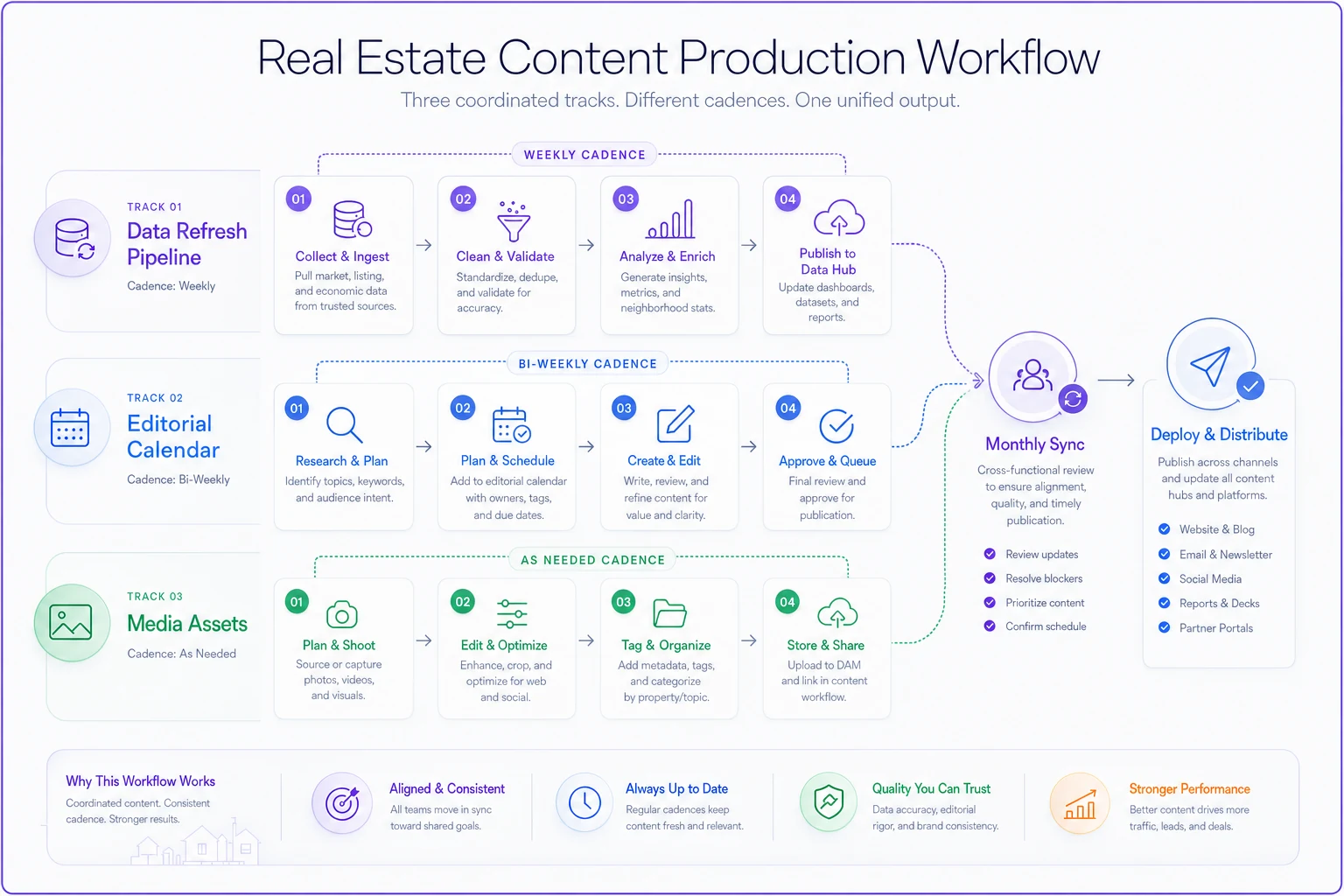
Map your content production into three parallel tracks.
Track 1: Data refresh pipeline
-
Pull MLS data weekly via API
-
Update market snapshot blocks automatically
-
Flag statistical anomalies for human review
-
Push updates through staging environment
-
Deploy Tuesday mornings
Track 2: Editorial calendar
-
Assign 2-3 neighborhoods per agent monthly
-
Require 500-word lifestyle updates minimum
-
Focus on recent changes
new restaurants, development projects, community events
-
Edit centrally for voice consistency
-
Publish Thursday afternoons
Track 3: Media assets
-
Shoot neighborhood photography quarterly
-
Maintain 15-20 images per neighborhood
-
Include seasonality — spring blooms, fall foliage, holiday decorations
-
Store in a central DAM with consistent naming conventions
-
Compress and optimize before upload
The tracks run independently but sync monthly. Data updates don't wait for new photos. Editorial content doesn't wait for new market stats. This prevents bottlenecks while maintaining freshness across all three.
Here's how the tracks flow into a monthly sync and deployment.
Editorial governance rules
Without governance, neighborhood pages devolve into chaos within about six months. These rules keep quality consistent.
Voice and tone standards
-
Write in active voice
-
Use "you" to address readers directly
-
Avoid superlatives unless backed by data
-
Include specific examples, not generic descriptions
-
Limit paragraphs to 3-4 sentences
Data accuracy requirements
-
Source all statistics from MLS, Census, or municipal data
-
Date stamp every statistic
-
Update any stat older than 90 days
-
Include methodology notes for calculated metrics
-
Link to primary sources when possible
Update frequency minimums
| Content Type | Update Frequency |
|---|---|
| Market data | Weekly |
| School ratings | Per semester |
| Lifestyle content | Quarterly |
| Photography | Seasonally |
| Schema markup | With any structural change |
Quality checkpoints
-
Editor review before initial publish
-
Quarterly audit of top 20% traffic pages
-
Annual complete inventory review
-
Automated broken link checking weekly
-
Manual schema validation monthly
Good governance is mostly about consistency, not perfection. A page that's reliably accurate and structurally predictable will outperform a beautifully written page that nobody remembers to update.
The scaling timeline
-
Month 1-3 — Foundation Build core template with all data blocks. Create first 5 neighborhood pages. Establish data refresh pipeline. Document editorial standards.
-
Month 4-6 — Acceleration Add 10-15 neighborhoods per month. Assign agents to specific territories. Automate market data updates. Build photo asset library.
-
Month 7-12 — Optimization Reach 50-75 total neighborhoods. A/B test CTA placements. Add comparison tools between neighborhoods. Launch email alerts for new listings by neighborhood.
At 50 neighborhoods with a consistent template, you have 50 targeted landing pages pulling hyperlocal traffic. Each one becomes a funnel entrance for that specific market.
The data pipeline that runs itself
Manual updates kill neighborhood pages over time. The agencies doing well in hyperlocal search automate everything they reasonably can while keeping human judgment where it actually matters.
Automated data streams worth setting up
-
MLS API for pricing and inventory
-
GreatSchools API for education data
-
Transit APIs for commute times
-
Census API for demographics
-
Google Places API for amenities
Set up webhooks to trigger updates when source data changes. Your Chelsea page updates within hours of new MLS data, not months later when someone finally remembers to check.
Semi-automated enrichment
Some data needs human context. A workable hybrid looks like this: the system pulls new restaurant openings from Google Places, an editor writes 2-3 sentences about notable additions, the system inserts those into the lifestyle block with consistent formatting, a publisher approves and deploys. The mechanical work is handled. The local judgment still comes from a person.
Version control and rollback
Every update should create a version snapshot. When the MLS feed sends garbage data — and it will at some point — you can rollback in seconds instead of scrambling to fix 50 broken pages. Store at least 90 days of versions.
Measurement beyond pageviews
Most agencies check pageviews and call it success. That misses most of what actually matters.
Engagement depth
-
Scroll depth by section
-
Time spent on market data vs lifestyle content
-
Click patterns on internal links
-
Download rates on neighborhood reports
Conversion pathway
-
Neighborhood page → listing view rate
-
Neighborhood page → agent contact rate
-
Multi-neighborhood research patterns
-
Return visitor percentage
Local search performance
-
Rankings for "[neighborhood] real estate"
-
Rankings for "[neighborhood] homes for sale"
-
Featured snippet capture rate
-
Local pack appearances
Revenue attribution
-
Leads generated per neighborhood page
-
Closed deals traced to neighborhood entry
-
Average commission per neighborhood-sourced lead
-
ROI per page including maintenance costs
Track these monthly per neighborhood, not just in aggregate. Your Park Slope page might drive solid traffic but zero conversions while Carroll Gardens quietly generates three deals a quarter. Aggregate numbers hide that.
Common governance failures
Even with good templates and systems, neighborhood pages break down when oversight slips. A few patterns come up repeatedly.
The star agent problem. Your top producer decides their neighborhood pages need special treatment — custom design, different data blocks, unique CTAs. Soon you're maintaining two systems. Performance data becomes incomparable. Quality standards erode because if they can deviate, others will follow.
One reasonable approach: star agents can contribute better photography or deeper lifestyle content, but the template structure doesn't change for anyone.
The data freshness spiral. One neighborhood's data goes stale, then five, then twenty. Visitors notice immediately. Trust erodes fast when your listed prices are obviously outdated. Automated monitoring dashboards that flag data beyond your freshness threshold help here. If data can't be updated automatically, consider taking the page offline until it's fixed. Thirty accurate pages outperform fifty with mixed reliability.
The SEO consultant disruption. A new consultant declares everything wrong and rebuilds from scratch. Six months later, another consultant, another rebuild. Each iteration breaks what was working while chasing the latest trend. Documenting why every template decision was made — and requiring A/B testing before structural changes — gives you something to push back with.
Where AI-powered tooling actually helps
The agencies pulling ahead aren't just using better templates. They're using AI-powered operational software to handle repetitive work while their people focus on local expertise.
The data refresh pipeline is an obvious starting point. Instead of manually checking whether market stats have shifted meaningfully, automation monitors MLS feeds continuously, flags anomalies, and drafts update summaries for human review. Your team spends time verifying and adding context, not copying numbers between systems.
Lifestyle content works similarly. The software can scan local news, building permits, and business licenses to surface neighborhood changes — new restaurants, closed shops, development projects. It drafts update paragraphs, agents review and add personal context, content goes live. The mechanical work is handled. The local knowledge still comes from people who actually know the area.
The governance layer benefits from this too. Automated quality checks can run continuously — scanning for outdated statistics, identifying broken internal links, checking schema markup validity, flagging pages that drift from the template. None of that requires human time.
The point isn't replacing judgment. It's getting your team out of mechanical tasks so they can focus on what actually differentiates your agency: local knowledge and real relationships. Instead of agents spending Tuesday mornings updating pages, they're out visiting new developments, talking to local business owners, building the kind of specific insights that no automation generates on its own.
Build once, deploy everywhere
Neighborhood pages aren't content marketing — they're operational infrastructure. You don't write them; you build them. You don't maintain them individually; you operate a system.
-
Same data blocks across every neighborhood
-
Same schema markup structure
-
Same CTA placement
-
Same update cadence
-
Same governance rules
Adding a new neighborhood takes hours, not weeks. When market conditions shift, updates flow automatically. When something needs to change structurally, you adjust once and it propagates everywhere.
This is genuinely how smaller agencies compete with larger brokerages on hyperlocal terms. You might not have their advertising budget, but you can build better operational infrastructure. Fifty neighborhood pages, properly templated and maintained, will outperform five hundred pages of inconsistent content.
Start with five neighborhoods. Get the template right. Build the data pipeline. Establish governance. Then scale.
The system, once it's running, largely runs itself — new agents slot into existing structures, market updates flow automatically, and quality holds through consistent rules. It's an operational asset that compounds over time, turning local knowledge into revenue without requiring constant manual intervention to stay alive.
Ready to elevate your real estate business?
Join 2,000+ agencies using TryRealy to streamline operations, close deals faster, and deliver exceptional client experiences.