


The gap between "buyer says they're pre-approved" and "buyer can actually close" is where a lot of showing hours quietly disappear. An agent spends a Saturday driving someone to four properties, writes an offer on the fourth, and then finds out the buyer's "pre-approval" was a 90-second online soft pull from six weeks ago. Now there's a signed offer, a nervous seller, and a lender who hasn't even seen a pay stub.
This is a tight, specific problem and it deserves a tight, specific fix. The goal here isn't to turn agents into loan officers. It's to give you a repeatable 5-minute conversation that tells you, fast, whether a buyer is real — and to do it without tipping off the buyer (or the other side) about how much negotiating room you actually have.
Below is the whole system: a pre-call audit you run before you ever dial, a 5-minute qualification script you can read off a card, a one-page required-doc checklist to send immediately after, and a lender-intro email that protects your leverage instead of leaking it.
Why "they're pre-approved" means almost nothing on its own
Pre-approval has quietly become one of the most abused phrases in a buyer conversation. What you find across a lot of agent pipelines is that the word covers at least four completely different situations, and only one of them is worth building an offer on.
| What the buyer says | What it usually actually is | How much you can trust it |
|---|---|---|
| "I'm pre-approved" | An online soft-pull estimate, no docs reviewed | Low — treat as unverified |
| "My bank told me I qualify" | A verbal conversation, no credit pulled | Low to none |
| "I have a pre-qualification letter" | Stated-income letter, no verification | Medium-low |
| "I have a pre-approval letter from [lender]" with docs reviewed | Credit pulled, income + assets verified | High — this is the one |
The trap is that all four buyers sound the same on a tour. They're all excited, they all want to see more, and they'll all say "yes, I'm good on financing" because they genuinely believe it. The buyer isn't lying — they just don't know the difference between a soft-pull estimate and an underwritten pre-approval, and most agents never ask the questions that would surface it.
The second trap is subtler. Even when a buyer is genuinely strong, a sloppy pre-approval conversation can leak that strength to the listing side. If your buyer intro email says "my client is pre-approved up to $720k and ready to move fast," you just told the seller's agent exactly how much room they have to push. That's the leverage-preservation piece most SOPs ignore completely.
The pre-call audit: five things to check before you dial
Run this before the qualification call, not during it. Two minutes, tops. It stops you from wasting the five-minute call on information already sitting in your CRM.
Never miss a showing or follow-up again.
TryRealy helps you schedule, track, and manage every client interaction smoothly.
- Unified property and client management
- Automated client notifications
- Integrated sales pipeline tracking
No credit card required
-
Lead source and recency. When did they come in, and from where? A portal lead from two days ago behaves very differently than a referral who's been circling for three months. If you want the full handling sequence for fresh portal leads, the workflow in From portal lead to booked appointment in 24 hours pairs directly with this one.
-
Any financing language already on file. Did the intake form or first message mention cash, a lender name, a price ceiling, or "just looking"? Flag it so you don't ask what they already answered.
-
Timeline signals. Lease end date, relocation date, "need to be in before school starts." Timeline is the single best predictor of whether a pre-approval conversation is urgent or premature.
-
Price band vs. your inventory. If their stated range doesn't match anything you can show them, the qualification call changes shape — you're triaging, not fast-tracking.
-
Who they've talked to already. Another agent? A lender? A loan officer at their own bank? This tells you whether you're starting cold or stepping into a half-built process.
The point of the audit is to walk into the call already knowing which of the four "pre-approval" situations is most likely. You're not interrogating from zero — you're confirming a hypothesis.
Here's a quick visual of the audit workflow.
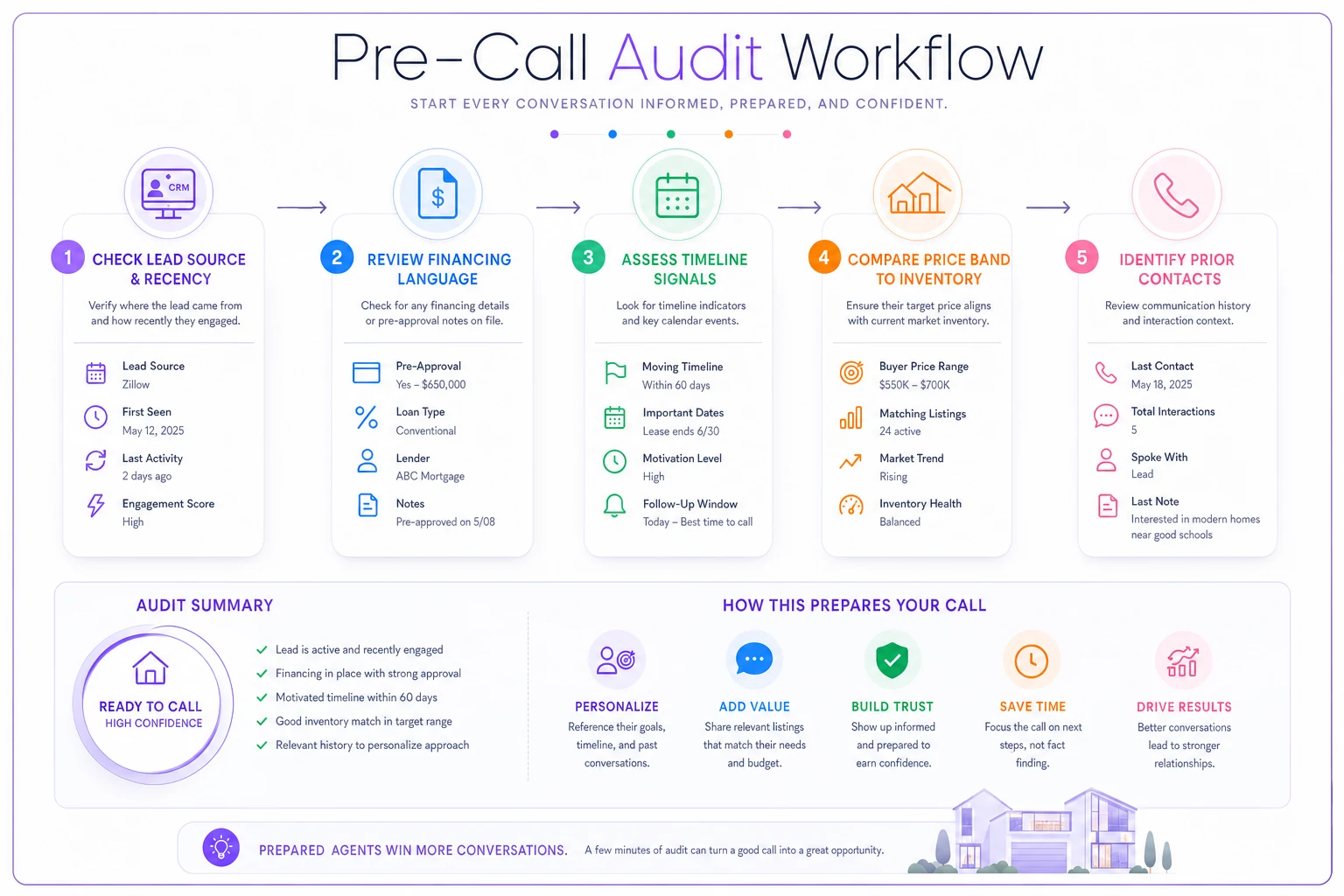
Use this to standardize your pre-call checks.
The 5-minute qualification script (read it off the card)
The script is built in four short blocks. Each block has a purpose, and the whole thing is designed to stay under five minutes without sounding like a form. Keep it conversational — you're confirming, not auditing.
Block 1 — Frame it (30 seconds).
"Before we spend a Saturday looking at homes, I want to make sure the ones I show you are actually ones you can write a strong offer on. Mind if I ask a few quick questions about where you're at on the financing side? Takes about five minutes."
Almost nobody says no to this, because it's framed as protecting their time, not screening them.
Block 2 — Separate the four buckets (90 seconds). Ask these in order:
-
"Have you spoken with a lender yet, or are we still early?"
-
"When you got your number, did they actually pull your credit, or was it more of an estimate?"
-
"Did they ask you for any documents — pay stubs, bank statements, tax returns?"
-
"Do you have a letter you can forward me, and when's it dated?"
Those four questions do the whole job. If credit was pulled, docs were reviewed, and the letter is recent, you have a real pre-approval. If any of those are missing, you know exactly what's missing.
Block 3 — Surface the constraints (90 seconds). "A couple of practical questions so I don't waste your time:"
-
"Is there a number you don't want to go above on the monthly payment?" (monthly, not price — this tells you more and reveals less)
-
"Any timing you're working around — lease, job, anything?"
-
"Will you be putting money down, or are you still figuring that part out?"
Notice you're asking about monthly comfort, not maximum purchase price. That's deliberate. You get the information you need to show the right homes without building a hard price ceiling into the buyer's head that then shows up in your offers.
Block 4 — Set the next step (60 seconds). "Here's what I'd suggest. I'm going to send you a short checklist of what a lender will need. If you're already working with someone great, if not I can point you to a couple people who move fast and won't jerk you around. Once we've got a real pre-approval in hand, I'll line up showings so every home you see is one you can actually win."
That last line does two things: it makes the pre-approval the gate to showings (so you stop driving unqualified buyers around), and it frames the lender intro as a favor, not a hurdle.
The one-page required-doc checklist
Send this immediately after the call, while the conversation is still warm. The format matters — one page, plain language, no jargon. Buyers stall when a document request feels overwhelming.
What your lender will need to issue a real pre-approval:
-
Income Two most recent pay stubs. If self-employed, last two years of tax returns plus a recent profit/loss.
-
Assets Two most recent statements for any account you'll pull the down payment from (checking, savings, retirement).
-
Identity Photo ID and Social Security number (the lender collects this securely — don't send it to me).
-
Employment Name and contact for your employer (lenders verify this directly).
-
The letter If you already have a pre-approval, forward the actual PDF, not a screenshot.
-
The gaps Anything unusual — a recent job change, a large deposit, a co-signer — tell your lender up front. Surprises in underwriting are what kill deals late.
"The faster these get to the lender, the faster we can go after homes before other buyers do."
The lender-intro email that protects your leverage
This is where most agents accidentally give away the farm. The instinct is to hype the buyer to the lender, or worse, to copy the listing side on anything with financing details. Keep the lender intro clean, factual, and stripped of anything that reveals negotiating room.
Lender intro template (agent → lender, buyer CC'd):
> Subject: Buyer intro — [First name L.] > > Hi [Lender], > > Introducing [Buyer first name], who's looking in the [area] market. They're ready to get a proper pre-approval in place so we can move quickly on the right home. > > [Buyer] — [Lender] is someone I trust to move fast and communicate clearly. They'll walk you through exactly what's needed and keep your information secure. > > Timeline-wise, [Buyer] is aiming to be [in a home by X / actively shopping now]. I'd appreciate a heads-up once a full pre-approval is issued so I can start lining up showings. > > Thanks both, > [Agent]
Notice what's not in there: no price ceiling, no down-payment amount, no "they can go up to $X." The lender finds that out directly from the buyer and the underwriting. You stay out of the number, which means the number can't leak through you into the transaction.
The leverage rule: price-band and financial-strength details live between the buyer and the lender. They do not travel in any email that could be forwarded, CC'd, or screenshotted toward the listing side. When it's time to write an offer, you decide what financing strength to reveal and when — that's a strategic choice, not a default.
A real scenario
A two-agent team in a mid-sized suburban market was running somewhere around 18–22 buyer tours a month between them. Their conversion from tour to accepted offer was stuck in the low teens, and a chunk of their Saturdays were going to buyers who fell apart at the financing stage.
They put in the pre-call audit and the 5-minute script as a hard gate: no full showing tour until there was a verified pre-approval on file. The first month felt slower — a few buyers dropped off when asked for docs. But those were buyers who were never going to close anyway.
Over the next couple of months, tours dropped slightly but the quality jumped. Accepted-offer conversion moved from roughly 13% up into the low-to-mid 20s. The bigger win was quieter: their offers started landing cleaner because they controlled when financing strength got disclosed, and they stopped bleeding two or three negotiating points by over-sharing in the intro stage. Fewer tours, more closings, better terms.
When this makes sense — and when it doesn't
This fits well when:
-
You're spending real time (and gas) on tours before verifying financing.
-
You're in a competitive market where offer strength and discretion matter.
-
You work with repeat lenders who can turn around a real pre-approval fast.
This is a bad idea when:
-
You're dealing with genuine cash buyers — the whole script collapses to one question and you skip the lender entirely.
-
You're in a slow market and gating showings too hard will cost you the few live buyers you have. In that case, loosen the gate and run the audit, but show homes while the pre-approval is in progress.
Who should skip this: agents whose business is mostly listing-side, or anyone working a referral book so warm that financing is already handled before you're involved. Don't bolt process onto a relationship that doesn't need it.
Making it stick
The reason these conversations don't happen isn't that agents don't know to have them. It's that under pressure — a motivated buyer, a hot listing, a busy week — the script gets skipped and everyone reverts to "sure, you said you're pre-approved, let's go look." The fix is making the audit and script live somewhere you'll actually use them: a card in the showing folder, a saved template in your CRM, a required field that won't let a tour get booked until the financing status is logged.
Put the script on a card in the showing folder and a saved template in your CRM.
Keep the whole thing boring and repeatable. The buyers worth your Saturdays will move through it without friction, the ones who won't were going to cost you later anyway, and your negotiating leverage stays exactly where it belongs — in your hands, not scattered across a dozen forwarded emails.
Keep the whole thing boring and repeatable. The buyers worth your Saturdays will move through it without friction, the ones who won't were going to cost you later anyway, and your negotiating leverage stays exactly where it belongs — in your hands, not scattered across a dozen forwarded emails.
Ready to elevate your real estate business?
Join 2,000+ agencies using TryRealy to streamline operations, close deals faster, and deliver exceptional client experiences.