
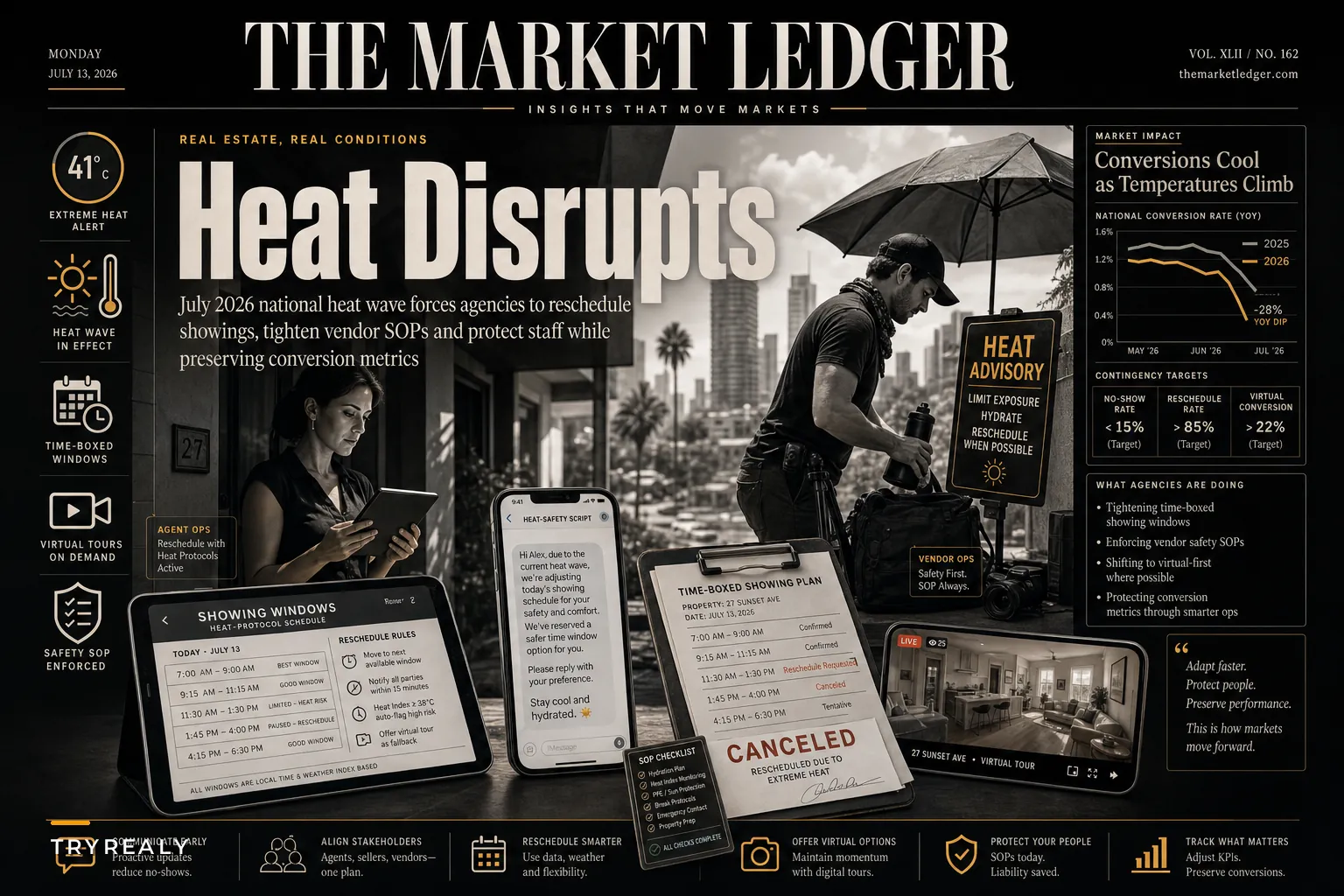

The forecast map looked apocalyptic. Deep red stretching from Ohio down through the Carolinas, heat index values pushing past 110°F. My phone started buzzing around 6 AM on Thursday with cancellations—three showings before noon, an open house that weekend, and a photographer asking if we could push Tuesday's exterior shoot to "maybe next month."
NBC News analysis shows the heat dome pattern settling over much of the eastern U.S. through the July 4th weekend, with record-breaking temperatures expected across 22 states. For real estate operations, this isn't just uncomfortable—it's breaking every carefully planned showing schedule, vendor timeline, and open house strategy locked in for the busiest weekend of summer.
The Immediate Operational Breakdown
Last summer, a smaller heat wave showed me that extreme weather doesn't just cause cancellations—it cascades through your entire operational stack. One 95-degree Saturday afternoon resulted in:
-
8 of 11 scheduled showings rescheduled or cancelled
-
A staging crew walking off a job at 2 PM (rightfully protecting their safety)
-
Two elderly clients nearly passing out during a tour of a house with broken AC
-
Photography delayed by 4 days, pushing the listing launch past a critical Thursday night MLS upload window
-
An open house with 3 attendees instead of the usual 25-30
The problem wasn't the heat itself. The problem was zero contingency workflows built for weather that makes normal operations impossible.
Why Standard Showing Schedules Fall Apart Above 95°F
Most agencies run showing schedules assuming relatively consistent conditions. Thirty-minute blocks, standard confirmation sequences, some buffer between appointments. Works great until the heat index hits 105°F and suddenly everything compresses.
Never miss a showing or follow-up again.
TryRealy helps you schedule, track, and manage every client interaction smoothly.
- Unified property and client management
- Automated client notifications
- Integrated sales pipeline tracking
No credit card required
Morning compression happens. Everyone wants the 8 AM slot. Nobody wants anything after 11 AM. A calendar that usually spreads nicely across the day gets jammed into a three-hour morning window where you're trying to fit eight showings.
The cascade effect kicks in. An agent calls at 10 AM to reschedule their noon showing. That buyer had three other showings lined up that afternoon. Now they want to move everything to Saturday morning—but Saturday morning is already triple-booked because of the open house you've been promoting for two weeks.
Vendors disappear. Your photographer who normally knocks out three properties in an afternoon can maybe handle one before the heat becomes dangerous. The inspection that takes three hours now needs five because the inspector is taking mandatory cooling breaks every half hour.
Building Heat-Specific SOPs That Actually Work
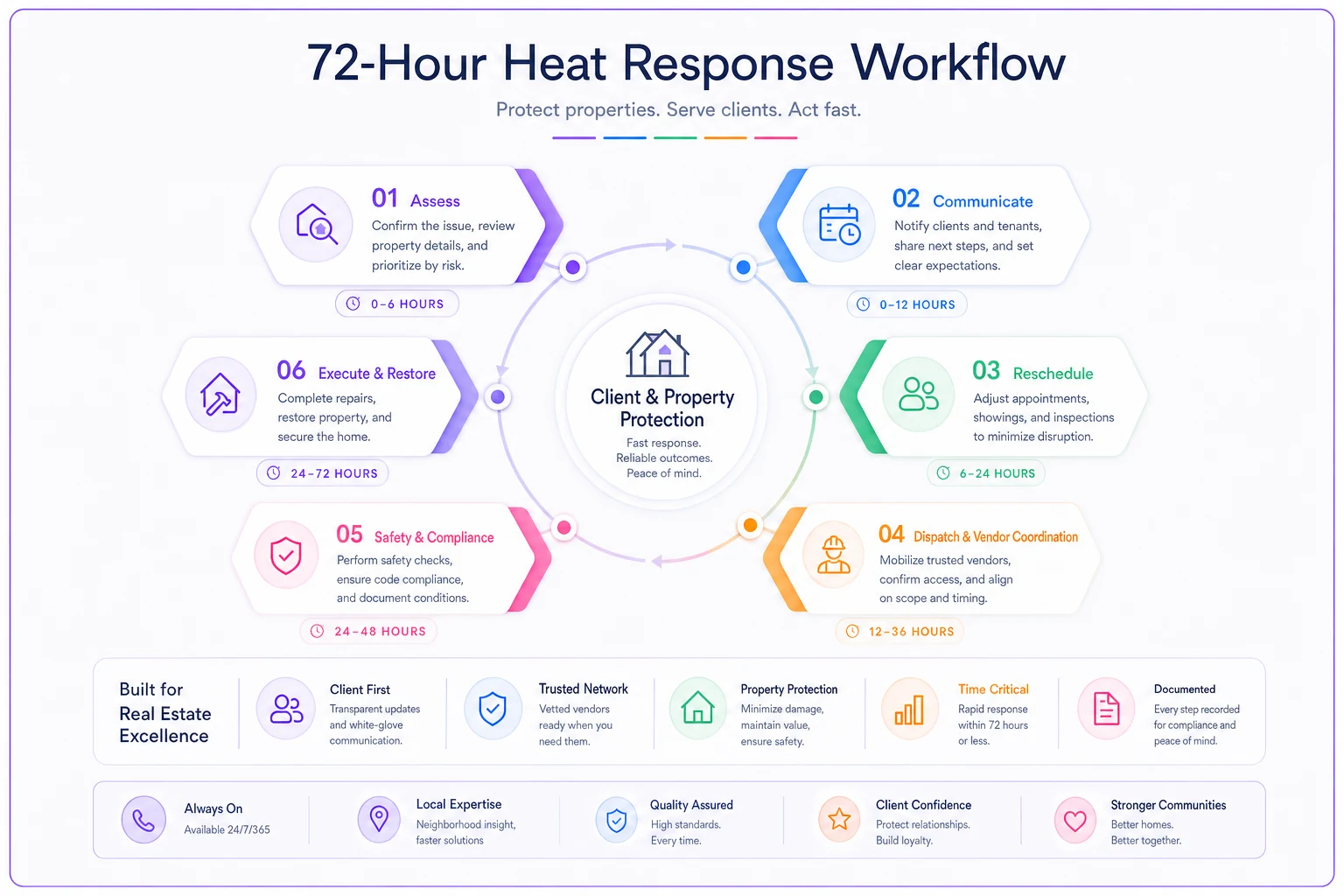
The 72-Hour Heat Response Protocol
When heat advisories hit, you need immediate operational shifts—not improvisation.
Hour 0-24: Assessment and Communication
-
Pull all showing schedules for the next 5 days
-
Flag any properties without functional AC
-
Send proactive "heat advisory" messages to all scheduled clients
-
Identify which showings can convert to virtual
-
Lock in early morning time blocks before everyone else does
Hour 24-48: Rescheduling and Alternatives
-
Move all showings to windows before 10 AM or after 7 PM
-
Offer virtual tour options for midday slots
-
Coordinate with other agencies to avoid compression conflicts
-
Adjust vendor schedules to dawn/dusk windows
Hour 48-72: Execution and Safety Monitoring
-
Mandatory water and cooling supplies in every showing kit
-
15-minute max showing times for non-AC properties
-
Check-in protocols every two showings
-
Backup agent coverage for heat exhaustion scenarios
The agencies that move fastest in hours 0-24 absorb most of the available morning slots before competitors even realize the schedule needs to change. That alone is worth building a process around.
Use this workflow image for training and SOP documents.
Modified Showing Confirmation Sequences
Standard confirmation sequences assume normal conditions. During extreme heat, you need different messaging. Our standard multi-channel confirmation approach needs heat-specific modifications:
T-minus 48 hours: "Hi Sarah, confirming your Tuesday 2 PM showing at 445 Oak. Heads up—we're expecting 98°F that afternoon. The property's AC is working well, and we'll have cold water available. Would you prefer to move to our 8 AM slot instead? Reply Y for 2 PM, M for morning."
T-minus 24 hours: "Tomorrow's showing confirmed for 2 PM. Heat index expected at 105°F. Please bring water, wear light clothing, and we'll keep the tour under 20 minutes. The house has excellent AC. Text CHANGE if you'd prefer a virtual tour instead."
T-minus 2 hours: "See you at 2 PM today. Currently 96°F outside. AC is running, cold waters ready. I'll meet you inside the front entrance—no need to wait outside. If you need to reschedule, just text back."
Vendor Coordination During Heat Events
Your vendor network needs completely different SLAs during extreme heat:
| Standard Operations | Heat-Adjusted Operations | Key Changes |
|---|---|---|
| Photography: 2-4 hour blocks | Dawn/dusk only, max 90 minutes | ~50% capacity reduction |
| Staging: Full day installs | 6-10 AM only, multi-day splits | Crew safety mandatory |
| Inspections: 3-hour standard | 5-hour minimum with breaks | Attic/exterior limitations |
| Landscaping: Flexible scheduling | Pre-7 AM or postpone | OSHA heat guidelines |
| Open house signs: Morning of | Night before placement | Avoid midday setup |
One staging company I work with has this figured out cold. During heat advisories, they automatically split installations across multiple mornings, apply a 15% heat premium to cover extra labor, and require properties to have AC running 24 hours before arrival. No negotiation, no exceptions. It sounds rigid, but it's actually what makes them reliable.
Inspectors are trickier. Most don't have formal heat protocols, so you have to build that expectation into the scheduling conversation upfront—because finding out mid-inspection that the attic is off-limits due to heat is a mess you don't want.
Conversion Protection Strategies
The buyers who show up during a heat wave are serious. They're not casually browsing—they fought through 100-degree weather to see your property. The no-show rate doubles, but the conversion rate on the people who do show up is noticeably higher.
Pre-showing prep becomes critical. Run AC for at least two hours before any showing. Keep blinds closed on sun-facing windows. Have a cooler with sealed water bottles by the entrance. One agent I know keeps instant cold packs in her showing kit—she said it saved a deal when a buyer's kid got overheated mid-tour.
Shortened, focused tours. Instead of a leisurely 45-minute walkthrough, you're running 20-minute focused tours. Start with the best features, skip the extensive backyard tour if the sun is brutal, concentrate on interior spaces. Send detailed virtual tours as follow-up.
Virtual-first for initial interest. Flip the funnel during heat waves. Go virtual first for everyone, then only serious buyers will brave the heat for in-person confirmation.
The Open House Dilemma
That Saturday open house you've been promoting? At 103°F outside, expect maybe 20% of normal traffic. But canceling kills momentum and frustrates sellers.
Shift to split "Open House Hours." Instead of 1-4 PM, run 9-11 AM and 6-8 PM sessions. Same total time, avoids peak heat entirely.
Create actual comfort zones. Cooling stations in the garage, portable AC in key rooms, cold refreshments beyond a basic water pitcher. Make attending comfortable enough that people linger.
Digital overlap. Run a simultaneous virtual open house during peak heat hours. "Can't make it in person? Join our virtual tour at 2 PM." You capture both audiences without losing either.
Sellers sometimes push back on the split format because it feels less prestigious than a traditional Sunday open house. Worth explaining the math clearly—20% traffic at peak heat versus solid turnout across two comfortable windows is an easy decision.
Technology and Automation Advantages
Manually rescheduling 20+ showings while coordinating vendor changes and updating confirmation sequences is where mistakes multiply fast. Agencies handling heat waves smoothly tend to have automated the repetitive coordination work—bulk rescheduling that suggests optimal alternative slots, heat-triggered confirmation message variants, vendor dashboards showing availability in adjusted windows, automated virtual tour scheduling for converted showings.
One brokerage owner showed me their setup: when the National Weather Service issues a heat advisory, their operational software automatically triggers modified SOPs, pushes adjusted confirmation templates, and flags high-risk showings based on client profiles and property conditions. What would normally take six hours of manual coordination happens in a fraction of that time. That's not magic—it's just having the right systems configured before the heat hits.
Configure your software to auto-suggest morning/evening slots based on local sunrise/sunset times to minimize manual schedule juggling.
That's not magic—it's just having the right systems configured before the heat hits.
Safety Protocols and Liability Management
The part nobody wants to talk about: liability when someone gets heat stroke during your showing.
Documentation is everything. Every heat-related schedule change, safety warning, and client acknowledgment needs to be logged. "Client declined morning reschedule option, proceeded with 2 PM showing after receiving heat advisory notification." Timestamped, in writing.
Hard stops on dangerous conditions. When heat index exceeds 110°F, some agencies suspend operations completely. That's not overreaction—that's risk management. One heat stroke incident can trigger lawsuits that make a lost weekend of revenue look trivial.
Agent safety isn't negotiable. Your agents are running multiple showings in extreme heat. Mandatory break protocols, hydration requirements, and check-in systems need to be treated as operational requirements, not suggestions. Rotate agents more frequently, pair up for afternoon showings if possible.
The Post-Heat Recovery Sprint
The operational chaos after the heat breaks doesn't get talked about enough. Suddenly four days of postponed showings are trying to fit into two days of normal weather. Every vendor wants the same Tuesday morning slot. Everyone's playing catch-up simultaneously.
The agencies that recover fastest have pre-built surge capacity schedules, vendor agreements guaranteeing priority slots after weather delays, client communication templates that set realistic timeline expectations, and clear prioritization rules—contracts pending first, then new listings, then routine showings.
Without that structure, the recovery period creates almost as much chaos as the heat wave itself.
Making Heat Response Systematic
Agencies that handle extreme weather well aren't just reacting better—they've built heat response into their standard operating procedures. Their SOPs include:
-
Temperature triggers Specific actions at 90°F, 95°F, 100°F, 105°F
-
Role assignments Who handles vendor coordination, client communication, schedule rebuilding
-
Resource pre-positioning Cooling supplies, backup agents, virtual tour capability ready before it's needed
-
Recovery protocols How to handle the post-heat surge without things falling through the cracks
Building this out takes a few hours the first time. After that, it's just execution.
The Competitive Advantage Hidden in Crisis Management
While other agencies are canceling everything and waiting for cooler weather, you're running modified operations that keep deals moving. That seller watching other homes sit idle while yours gets toured—carefully, safely—at 8 AM instead of 2 PM notices that. They remember it.
The buyers remember it too. You didn't just cancel and leave them hanging. You found alternatives, kept their search moving, and made sure everyone stayed safe doing it.
Building Your Heat-Ready Operations
Start with the basics and build from there.
Immediate implementations:
-
Heat-modified showing confirmation templates
-
Morning and evening schedule compression plans
-
Vendor heat protocols and adjusted SLAs
-
Safety supplies and documentation requirements
Next-level additions:
-
Automated heat response triggers in your operational software
-
Virtual tour infrastructure for quick pivots
-
Surge capacity planning for post-heat recovery
-
Rescheduling workflows tied to forecast data
The agencies that struggled through this recent heat dome were trying to force normal operations through extreme conditions. The ones that managed well had already built in the flexibility to adapt, protect everyone's safety, and keep business moving even when the thermometer hit triple digits.
According to NPR's coverage, these extreme heat patterns are becoming more frequent and intense. For real estate operations, that means heat response can't be an emergency reaction anymore—it needs to be part of your standard operational capabilities, built out and tested before the next advisory drops.
Your showing schedules, vendor coordination, and safety protocols need to flex with the weather. Because when it's 105°F outside and every other agency is shut down, the one still safely running operations wins more than just that day's showings.
Ready to elevate your real estate business?
Join 2,000+ agencies using TryRealy to streamline operations, close deals faster, and deliver exceptional client experiences.