



If you run an agency or do lead-ops in a market where a decent chunk of your buyers pull a tech paycheck, the last few weeks probably put a knot in your stomach. Amazon trimmed around 250 roles in its Devices & Services unit, which Reuters reported came right after a wave of product launches — and that's just one headline inside a broader pattern of companies cutting jobs to redirect spend toward AI.
The news itself isn't really the point. Layoffs happen. What matters is the lag. A buyer who got cut — or whose spouse got cut, or who just watched their whole team get restructured — doesn't tell you. They go quiet. Ghost the pre-approval. Say they want to "think about timing." And by the time your pipeline numbers actually show it, you're already six weeks behind on a reforecast you should've started the day the headlines broke.
This isn't a macro doom piece. It's about tightening a few operational screws fast, before the soft spot in your pipeline turns into a hole in your Q1 revenue.
The real problem isn't fewer buyers — it's stale assumptions
What trips up most small brokerages in moments like this: your lead-scoring, hiring triggers, and revenue forecasts were all calibrated during a stretch where tech employment felt like bedrock. Steady W-2 income, big RSU vesting, fast pre-approvals. A buyer at a brand-name tech firm was practically a green light.
That assumption is now a liability you haven't repriced.
The underlying issue is that employment risk is invisible in most CRMs. You track lead source, price band, timeline, maybe a motivation note. But you almost never track income fragility — and in a tech-concentrated market, that's suddenly the most predictive variable for whether a deal actually closes.
What tends to happen when markets wobble like this: top-of-funnel numbers often look fine for 30–45 days. Lead volume holds. Showing requests hold. What collapses first is the conversion from "interested" to "financing locked." Buyers get skittish, lenders get stricter, and deals that would've cruised through now stall at underwriting. If your forecast only watches lead count, you'll feel confident right up until the closings don't come in.
A quick way to re-score leads for employment and financing risk
You don't need a data science project. You need a crude, fast overlay on your existing scoring — something that flags which deals in your current pipeline are exposed, so your agents spend their hours on the ones that can actually close.
Never miss a showing or follow-up again.
TryRealy helps you schedule, track, and manage every client interaction smoothly.
- Unified property and client management
- Automated client notifications
- Integrated sales pipeline tracking
No credit card required
| Risk signal | Lower risk | Higher risk |
|---|---|---|
| Employment type | Dual income, varied industries | Single income, tech employer |
| Pre-approval status | Underwritten, not just pre-qual | Verbal or expired pre-qual |
| Down payment source | Cash on hand | Pending RSU/equity vesting |
| Timeline flexibility | Must-move (lease end, relocation) | "Sometime in the next year" |
| Buyer sentiment | Actively touring, responsive | Slow replies, rescheduling |
None of these alone kills a deal. But a buyer who's single-income at a tech firm, leaning on unvested equity, with a verbal pre-qual and a fuzzy timeline? That's not a bad person — that's a deal that needs a lender conversation this week, not next month.
One pattern worth watching specifically: equity-dependent down payments. In the good years, plenty of buyers planned to fund part of their purchase from vesting stock. When layoffs hit a company, that equity assumption can evaporate fast — and that's the deal that falls apart two days before closing, taking your commission with it.
Freeze the hiring trigger before you freeze the hiring
A lot of agencies made verbal commitments to bring on new agents this quarter. Market felt busy, pipeline looked healthy, so the plan was to add capacity. In a sudden-softness scenario, this is where small brokerages bleed runway without fully realizing it.
Onboarding a new agent isn't free. Even on straight commission, you're carrying desk costs, tech seats, training time, and — most expensive — your senior people's attention. If the pipeline that justified the hire is now carrying 20–30% employment-risk exposure, that hire math changed and nobody updated the spreadsheet.
A realistic example: a three-office brokerage planning to add four agents over 60 days, budgeting somewhere around $4k–$6k per agent in ramp costs before they produce anything. If buyer conversion slips even modestly in a tech-heavy zip code, those four hires can turn into mouths to feed during the exact months your margin is tightest. Pausing two of the four and staggering the rest isn't timid — it's just reading the room.
When pausing hiring makes sense:
-
A meaningful share of your pipeline sits in tech-employer households
-
Your 30-day conversion-to-financing-locked is already softening
-
The new hires were capacity hires, not "we're turning away business" hires
When it does NOT make sense:
-
You're genuinely overflowing and leaving leads unworked
-
Your buyer base is diversified across industries and income types
-
The hire fills a specific operational gap — a transaction coordinator, say — rather than adding redundant sales capacity
The mistake to avoid: treating hiring as all-or-nothing. Staggering start dates, shifting one sales hire to an ops role, or moving someone from full onboarding to shadowing-only are all middle options that protect runway without killing momentum.
Shorten your reforecast cycle — monthly is too slow right now
Quarterly forecasting is fine in calm water. In a market absorbing a local employment shock, you want a tighter loop. Agencies that handle these moments well don't predict the future better — they just notice faster and adjust while there's still time to do something about it.
This is exactly where short-cycle thinking earns its keep. If you haven't already built that muscle, our breakdown of short-cycle revenue forecasting for small real estate agencies walks through how to run tighter forecast loops without drowning in spreadsheets. The core idea for right now: look at leading indicators every week or two, not reconcile actuals every quarter.
A simple reforecast rhythm for the next 90 days:
-
Week 1 — Tag your exposure. Run the risk overlay above across every active pipeline deal. Flag the high-risk ones. Note what percentage of expected commission sits in that bucket.
-
Week 2 — Pressure-test financing. Get every flagged buyer back in front of a lender for a real underwritten pre-approval, not a verbal. Deals that can't or won't move forward — reclassify them honestly.
-
Weeks 3–4 — Rebuild the forecast with two lines. One for "confident" pipeline, one for "at-risk." Watch the gap, not just the total.
-
Weeks 5–8 — Check the leading indicators. Response times, reschedule rates, pre-approval completion rates. These move before closings do.
-
Weeks 9–12 — Adjust spend and hiring. Now your decisions rest on real signal instead of last quarter's optimism.
The step most teams skip is the first one. Tagging exposure feels tedious, but it turns a vague "I'm worried about the market" into something like "about 28% of my expected Q1 commission is sitting in employment-risk deals." That number changes how you behave. It's the difference between reacting to a problem and catching it while you still have options.
A simple workflow visualization can help teams follow the 90-day loop without missing a step.
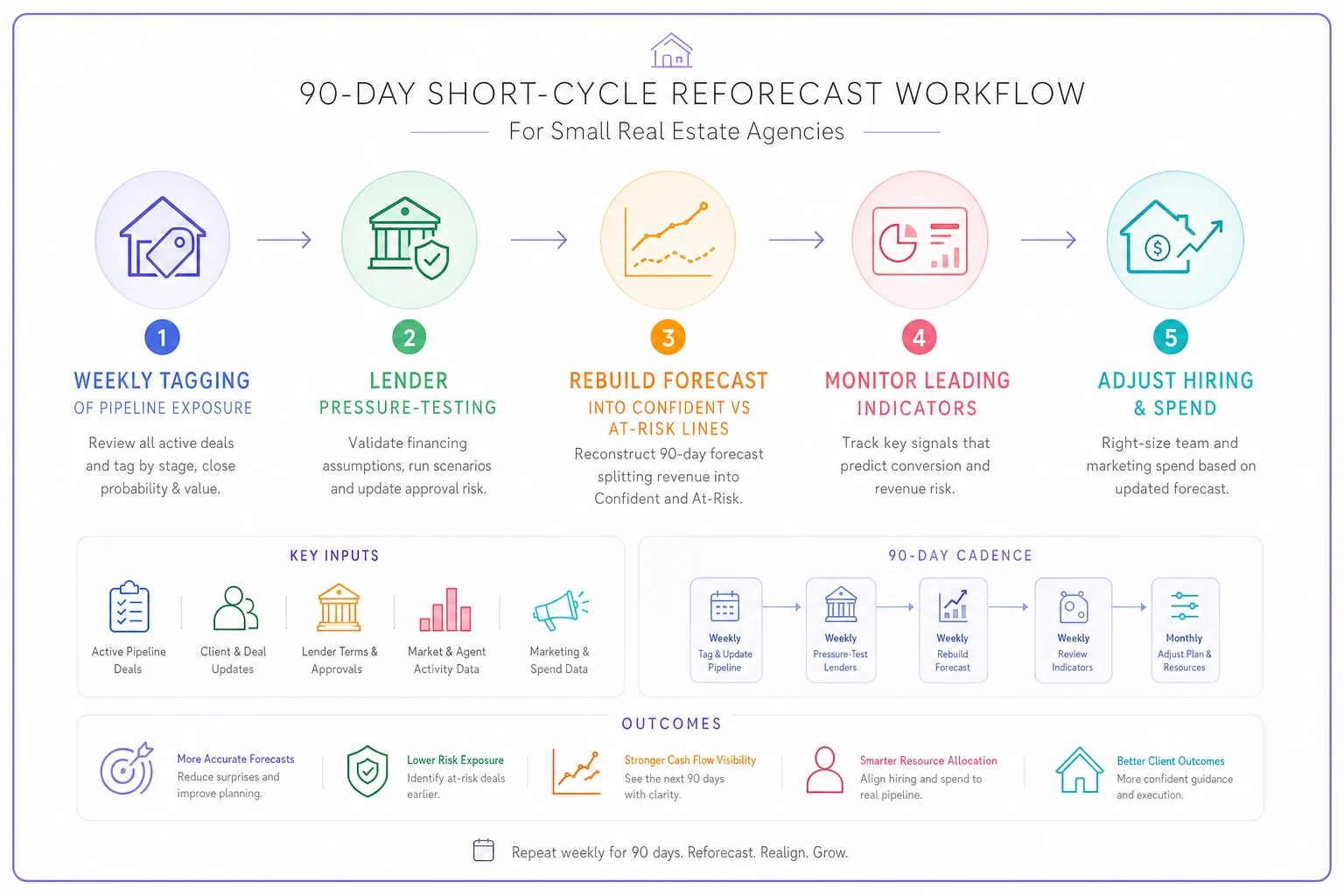
A visual like this makes it easy to assign owners and deadlines for each couple-week block.
Protect the deals already in motion
While you're reforecasting, don't let the deals that can close slip through the cracks. Softer markets reward agencies that remove friction from the back half of the transaction. A buyer who's already nervous about their job is far more likely to walk from a deal that feels slow or uncertain.
A few operational moves that matter more than usual right now:
-
Tighten listing-to-launch speed. The faster a listing hits the market clean, the less time a wobbly buyer has to talk themselves out of it.
-
Keep virtual-tour fallbacks ready. A buyer who just got laid off might pause in-person showings. Don't lose them — give them a credible remote way to stay engaged.
-
Over-communicate on timelines. In anxious markets, silence reads as a problem. Buyers who hear from you proactively tend to stay in deals longer.
-
Firm up vendor SLAs. An inspection or appraisal delay giving a nervous buyer a reason to walk is the last thing you need. Contingency vendors matter more when every added day is a risk.
Prioritize lenders and vendors who can compress underwriting or inspection timelines for flagged buyers.
In soft stretches, deals don't usually die from price. They die from doubt plus delay. You can't control the market's mood, but you can absolutely control the delay half of that equation.
A real scenario
A small brokerage — four agents, one ops coordinator, working a metro where a big share of buyers were in tech — noticed showings staying steady in the first few weeks after local layoff news. But pre-approvals were quietly stalling. Three deals they'd counted as near-certain for the quarter went soft within two weeks of each other, all tied to buyers at the same handful of employers.
Instead of waiting for the closings to not happen, they ran a risk tag across their pipeline and found roughly a third of their expected commission sitting in employment-exposed deals. They paused two of three planned hires, pushed every flagged buyer back to a lender for a hard pre-approval, and shifted one agent's time toward reactivating past clients in more stable industries.
The outcome wasn't dramatic. A couple of the flagged deals still fell through. But by catching it early, they avoided carrying two extra agents through a thin quarter and backfilled enough from their past-client base to keep revenue in a manageable range rather than a free-fall. The win wasn't prediction — it was reaction time.
What to actually do this week
If you only take a handful of actions, make them these:
-
Pull your active pipeline and tag every deal for employment and financing risk
-
Calculate the percentage of expected commission sitting in at-risk deals
-
Get every soft or verbal pre-approval converted to a real underwritten one
-
Pause or stagger any capacity hires until your signal clears
-
Switch from quarterly to biweekly reforecasting for the next 90 days
-
Firm up vendor and lender contingency plans so delays don't sink wobbly deals
None of this requires a major operational overhaul. Most of it can be done inside whatever tools you're already using — it's more about discipline and sequencing than finding new software.
The takeaway
Tech layoffs don't hit your brokerage the day they hit the news. They hit when a buyer's pre-approval quietly expires, when an equity-funded down payment disappears, when a confident deal just goes dark.
The agencies that come through these stretches in decent shape aren't the ones with the best crystal ball. They're the ones who re-price their assumptions early, watch leading indicators instead of lagging ones, and keep hiring and spend tethered to real signal rather than last quarter's momentum.
Your pipeline is telling you something right now. The only question is whether your forecast is updated often enough to hear it.
Your pipeline is telling you something right now. The only question is whether your forecast is updated often enough to hear it.
Ready to elevate your real estate business?
Join 2,000+ agencies using TryRealy to streamline operations, close deals faster, and deliver exceptional client experiences.