

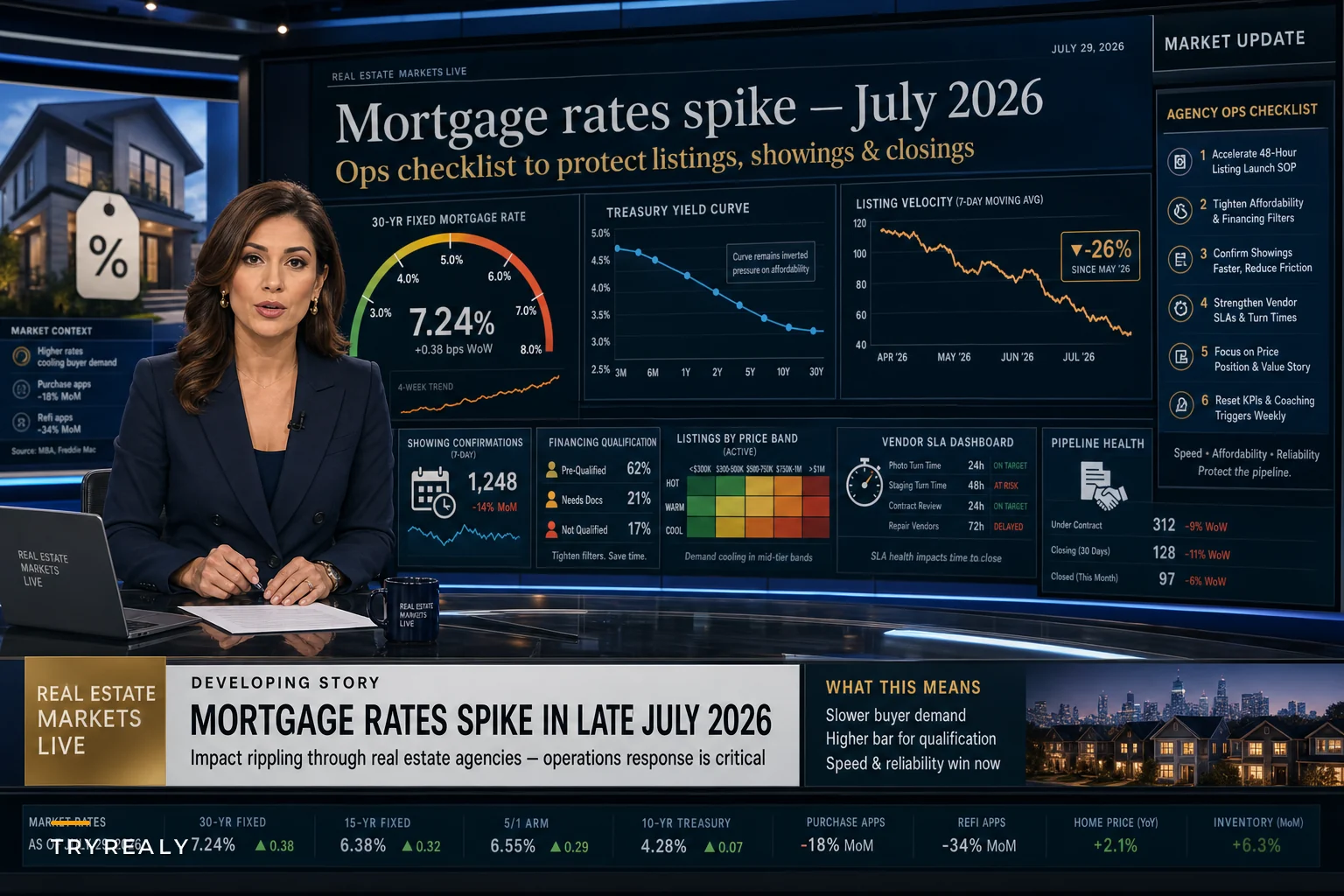

The mortgage rate jump to 6.6% last week wasn't gradual. Reuters reported the spike as rates hit their highest point in about a year, and the immediate impact on buyer psychology was brutal. Pre-approvals from June are worthless. Buyers who could afford $450k homes three weeks ago now qualify for around $410k. Your current listing strategy assumes a buyer pool that no longer exists.
Most agencies will respond wrong. They'll push sellers to drop prices, chase increasingly desperate buyers down-market, and burn through their pipeline forcing deals that fundamentally don't work anymore.
The agencies that survive this shift won't be the ones with the best market predictions. They'll be the ones who rewire operations fast enough to match the new reality before their cash flow collapses.
The qualification crisis hits before you realize it
Your CRM shows 147 active buyers. At least 40 of them don't know they can't afford what they're looking at anymore.
That pre-approval letter from May showing $475k buying power? With rates jumping from 5.9% to 6.6%, that same buyer now qualifies for roughly $440k. That's not a small adjustment—it's an entirely different inventory segment. The three-bedroom colonial they toured last month is gone. They're looking at townhomes now, competing with cash investors.
But what really breaks things: your agents are still operating on old assumptions. They're scheduling showings for homes these buyers can't afford. They're writing offers that will fail underwriting. They're burning relationships by putting buyers through the emotional wringer of falling in love with impossible homes.
The operational failure compounds fast. Each dead-end showing costs somewhere around $200-300 in agent time, mileage, and opportunity cost. Each failed offer damages your reputation with listing agents. Each frustrated buyer who ghosts you after realizing they can't afford anything decent becomes negative social proof in your market.
Your showing-to-offer ratio is about to crater
When rates were stable through most of 2025, a decent agent converted roughly 1 in 8 showings to offers. Some teams hit 1 in 6. The math was predictable: show 24 homes, write 3 offers, close 1 deal.
Never miss a showing or follow-up again.
TryRealy helps you schedule, track, and manage every client interaction smoothly.
- Unified property and client management
- Automated client notifications
- Integrated sales pipeline tracking
No credit card required
At 6.6%, that ratio breaks. Not gradually—immediately.
Buyers who were already stretching their budgets are now completely priced out. The psychological impact is worse than the mathematical one. A buyer who loses $35k in purchasing power doesn't just adjust expectations—they often freeze entirely. They stop touring. They "wait for rates to drop." They become zombie leads in your CRM.
Agents still showing 24 homes to write 3 offers are now showing 24 homes to write maybe 1. Their time-per-deal triples. Their cost-per-acquisition explodes. Their motivation craters.
Meanwhile, the operational weight stays the same. You're still coordinating the same number of showings, just with dramatically worse conversion. Your showing coordinator is burning out scheduling tours that go nowhere.
Speed becomes your only competitive advantage
Every day a listing sits costs more than it used to. Not just in carrying costs for sellers—in market perception.
According to Freddie Mac's weekly survey, rates aren't stabilizing—they're volatile. A home that looks overpriced today might be correctly priced next week if rates tick up another 20 basis points. But by then, it's already stale. Already passed over by the shrinking pool of qualified buyers.
The old playbook of launching listings over 5-7 days is suicide in this market. While you're waiting for professional photos, another 50 buyers dropped out of this price range. While you're tweaking listing copy, three competing homes dropped their prices and absorbed what little demand remained.
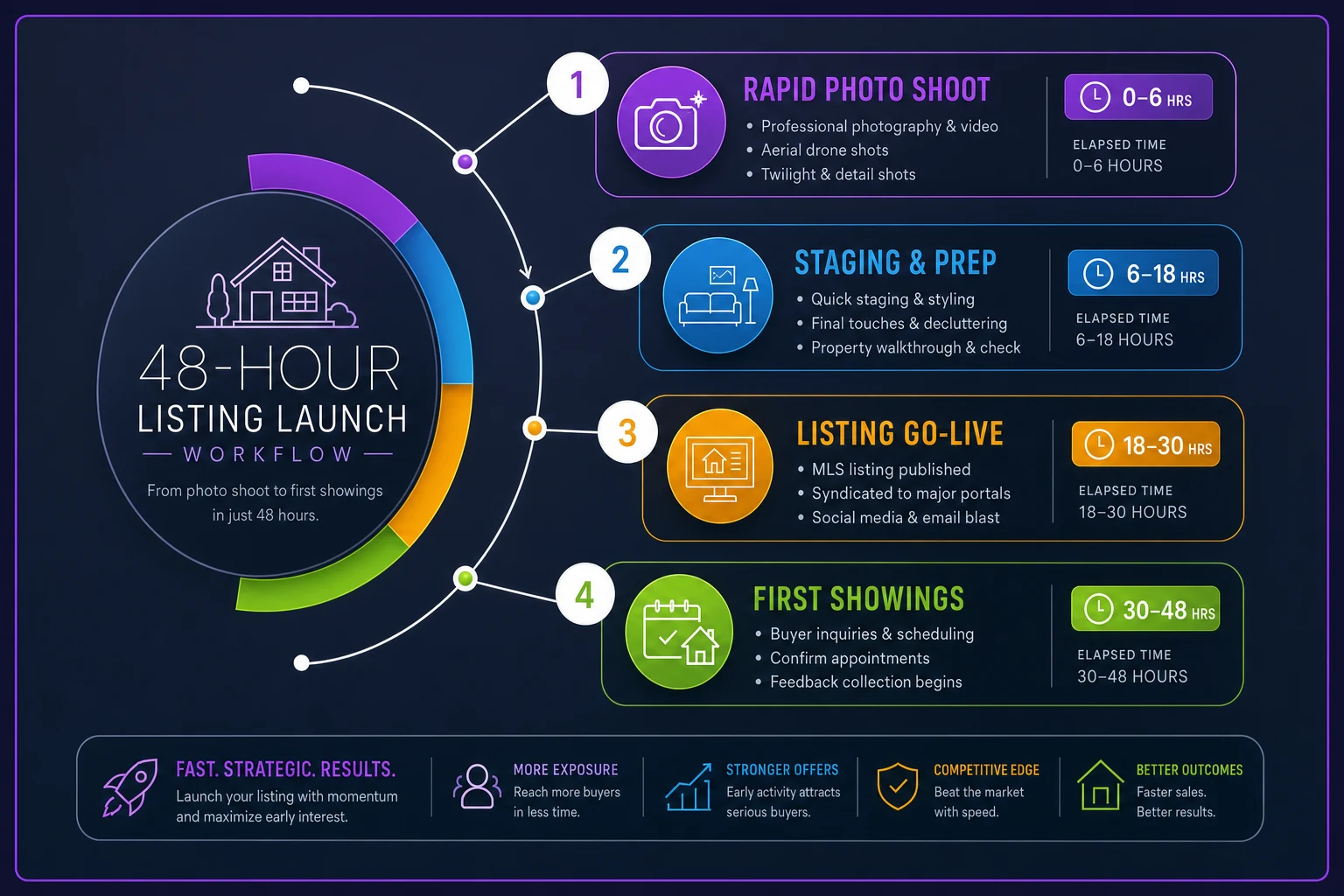
This is where that 48-hour listing launch system stops being a nice-to-have and becomes survival infrastructure. The agencies still taking a week to go live are hemorrhaging opportunity cost they can't see yet.
Quick visual of the 48-hour listing launch workflow.
The agencies still taking a week to go live are hemorrhaging opportunity cost they can't see yet.
The vendor bottleneck will kill you
Your photographer is booked until Thursday. Your stager can't deliver until next Tuesday. Your videographer is "getting back to you."
In stable markets, these delays are annoying. At 6.6% rates with buyers dropping out daily, they're catastrophic.
A listing delayed 4 days for photography doesn't just miss 4 days of exposure. It misses the entire cohort of buyers who were actively looking that week before they realized they couldn't afford this price range. By the time your listing goes live, those buyers have either dropped to lower price points or stopped looking entirely.
Staging delays are worse. Unstaged homes in this market don't just sell for less—they often don't sell at all. Buyers who are already stretched emotionally and financially can't envision potential. They need turnkey. They need to walk in and feel like this home is worth destroying their budget for.
Vendor relationships need renegotiation now. Not next quarter. Photography needs 24-hour turnaround guarantees. Staging needs to be pre-scheduled in blocks. Video tours need to be produced in-house or cut entirely.
Reset your KPIs or watch your team implode
Your dashboard still shows targets from when rates were under 6%. Those benchmarks are fiction now.
The agent who was hitting 2 deals monthly is about to drop to 1. Not because they got worse—because the market changed. If you keep managing to the old numbers, you'll create a doom spiral: pressure increases, performance drops, morale crashes, good agents leave.
Here's what actually needs to change:
Showing efficiency metrics: Stop tracking showing volume. Start tracking showing-to-qualified-buyer ratio. An agent doing 12 showings weekly to qualified, correctly-priced buyers beats one doing 25 showings to anyone who answers a text.
Response time SLAs: A 4-hour response time made sense when buyers had options. Now, the few qualified buyers left are getting swarmed. Your 4-hour window means they've already connected with three other agents. Drop it to 30 minutes or lose them entirely.
Pipeline velocity: Days-on-market used to be a vanity metric. Now it's survival. Track listing-to-offer time religiously. Anything over 14 days needs an immediate price adjustment conversation.
Conversion ratios: Your 25% lead-to-appointment rate is about to become 15%. That's not failure—that's market reality. Adjust the targets before your team internalizes it as something they did wrong.
| Metric | Action |
|---|---|
| Showing efficiency metrics | Stop tracking showing volume. Start tracking showing-to-qualified-buyer ratio. An agent doing 12 showings weekly to qualified, correctly-priced buyers beats one doing 25 showings to anyone who answers a text. |
| Response time SLAs | A 4-hour response time made sense when buyers had options. Now, the few qualified buyers left are getting swarmed. Your 4-hour window means they've already connected with three other agents. Drop it to 30 minutes or lose them entirely. |
| Pipeline velocity | Days-on-market used to be a vanity metric. Now it's survival. Track listing-to-offer time religiously. Anything over 14 days needs an immediate price adjustment conversation. |
| Conversion ratios | Your 25% lead-to-appointment rate is about to become 15%. That's not failure—that's market reality. Adjust the targets before your team internalizes it as something they did wrong. |
Run weekly KPI huddles to adjust targets quickly.
Conversion ratios: Your 25% lead-to-appointment rate is about to become 15%. That's not failure—that's market reality. Adjust the targets before your team internalizes it as something they did wrong.
The qualifying conversation nobody wants to have
Your agents are about to have the same brutal conversation dozens of times this week: "You can't afford what you thought you could."
Most will botch it. They'll be vague about numbers, offer false hope, waste weeks showing homes that will never close. Then the buyer figures it out themselves, feels misled, and disappears.
The fix isn't scripts—it's systematic pre-qualification. Before any showing gets scheduled, run fresh numbers. Not the pre-approval from April. Fresh calculations with today's rates. Build this into your showing scheduling workflow and make it non-negotiable. Agents will resist it until they realize it saves them from 15-20 dead-end showings every month.
When buyers fail the fresh qualification, the conversation gets cleaner: "At today's rates, your comfortable range is $385k-$410k. I can show you solid options there, or we can wait and see if rates improve." Clear. Direct. No false hope.
The buyers who accept reality become viable deals. The ones who don't were never going to close anyway.
Your listing presentation needs emergency surgery
Stop pitching based on comps from March. Stop promising timelines from when rates were lower.
Your listing presentation needs to lead with rate reality now. Not buried on slide 17—upfront. "The average buyer lost tens of thousands in purchasing power since spring. Here's exactly how we'll position your home to the buyers who remain."
Then shift to speed as the core strategy, not a selling point. "We're launching in 48 hours because every day we wait, more buyers exit your price range. Photos tomorrow by 3pm, staging Thursday morning, live Thursday night, first showings Friday."
Pricing changes too. No more "testing the market" with ambitious numbers. Overpricing by even 3% in this environment means missing the entire remaining buyer pool. You price to sell immediately or you probably don't sell at all.
Protect your cash flow before it's too late
Most agencies run 60-90 days of cash reserves. Enough to handle normal seasonality. Not enough to survive a transaction volume drop of 30-35%.
The math is simple and ugly. If your average agent closes 2 deals monthly at $8k gross commission each, they're generating $16k. At 6.6% rates with longer sales cycles and fewer qualified buyers, that drops to maybe 1.2 deals monthly—$9,600 gross. Your operational costs didn't drop 40%. Your rent didn't decrease.
That means:
-
Cutting non-essential software immediately
-
Renegotiating every vendor contract this week
-
Eliminating any role that doesn't directly drive transactions
-
Consolidating office space if possible
-
Moving toward performance-based compensation models
But there's a second piece most teams miss: you also need the operations you keep to actually work. The agents you retain need to handle more with less support. The systems you maintain need to run cleanly. There's no room for slack in the workflows anymore.
The upside nobody's discussing
Crisis markets create real opportunity for the operationally disciplined. This isn't feel-good advice—it's just what happens when a large portion of competitors can't adapt.
When 60% of agents are flailing, the ones who aren't capture disproportionate market share. When emotional sellers panic, agencies with clear processes and real data win listings. When buyers are confused and scared, the teams with systematic qualification and honest communication become the ones people actually trust.
The window for this is narrow though. Speed of implementation matters more than the quality of the plan.
Build your qualification workflow this week. Renegotiate vendor contracts now. Reset KPIs before Monday's meeting. Launch listings in 48 hours instead of 7 days. The competitive advantage comes from doing this while everyone else is still reading market reports trying to figure out what to do.
Your business at 5.2% rates is gone. The question is whether you'll build the 6.6% business fast enough to survive the gap.
The decision that matters now
Two choices. Treat this rate spike as a temporary inconvenience, maintain current operations, and wait for rates to drop. Most agencies will go this route. They'll burn reserves, lose good agents, and eventually close or get absorbed.
Or treat it as an operational emergency requiring immediate restructuring. Rewire your qualifying process. Accelerate listing launches. Renegotiate every vendor relationship. Reset every metric. Build for the market that exists instead of the one you want back.
The agencies still debating this in September won't be around in December. The ones making changes this week will own the market by fall.
The mortgage rate spike isn't just a market event—it's an operations test. The agencies with the systems, discipline, and speed to adapt will pass. Everyone else is about to find out why operational infrastructure matters more than market timing.
Ready to elevate your real estate business?
Join 2,000+ agencies using TryRealy to streamline operations, close deals faster, and deliver exceptional client experiences.