



Yesterday's inflation report wasn't subtle. The PCE index hit 4.1% year-over-year, and if you're running a small to mid-sized brokerage, you probably felt it before the numbers confirmed it. Reuters reported the May reading came in hotter than expected, which basically locks in elevated Fed rates through summer.
What the headlines miss is this: it's not just mortgage rates creeping up another quarter point. When inflation runs this hot, your whole operational playbook needs adjustment. The agencies that survived 2008 didn't do it by waiting for better days — they rebuilt around a smaller, pickier buyer pool.
The operational math that changed overnight
A typical small brokerage with 15 agents used to convert roughly 1 in 8 leads into showings. Now we're seeing closer to 1 in 12, sometimes 1 in 14. That's not because agents forgot how to sell. When inflation pushes monthly payments up $400–600 on a median-priced home, entire buyer segments just disappear.
What that means operationally: if you were running 120 showings a month to hit revenue targets, you now need closer to 180 for the same result. And your lead volume probably dropped too, because fewer people are even starting their search.
The agencies making it work aren't chasing more leads. They're squeezing more value out of the leads they already have. Every missed follow-up, every weak listing description, every no-show now costs roughly 40% more in lost opportunity than it did six months ago.
Why your current listing process is bleeding money
Most agencies still operate like it's 2019. Agent gets a listing, takes a week to prep it, writes the description themselves, goes live whenever it's convenient. That worked when buyers were desperate and inventory was tight.
Never miss a showing or follow-up again.
TryRealy helps you schedule, track, and manage every client interaction smoothly.
- Unified property and client management
- Automated client notifications
- Integrated sales pipeline tracking
No credit card required
Today, by day three of casual listing prep, seventeen other properties in that price range already went live with professional photos and decent copy. Your listing hits the market already stale.
The math is brutal. Properties that launch within 48 hours of signing get roughly 3x more first-week activity than those launching after five days. In a high-inflation environment where buyers are already hesitant, first-week momentum often determines whether you sell in 30 days or 130.
The showing confirmation problem nobody talks about
Inflation doesn't just reduce buyer numbers — it changes buyer behavior. When money feels tight, people get flaky. They book showings "just in case" but don't fully commit until the morning of.
A brokerage in Phoenix shared their data with us. Pre-inflation, their no-show rate sat around 15%. Post-inflation? 28%. Nearly one in three scheduled showings, nobody showed up.
The operational impact cascades fast. Agents waste drive time. Sellers prep their home for buyers who never arrive. Other potential showings get blocked by ghost appointments. One agency calculated they were losing around $8,400 monthly in agent productivity from no-shows alone.
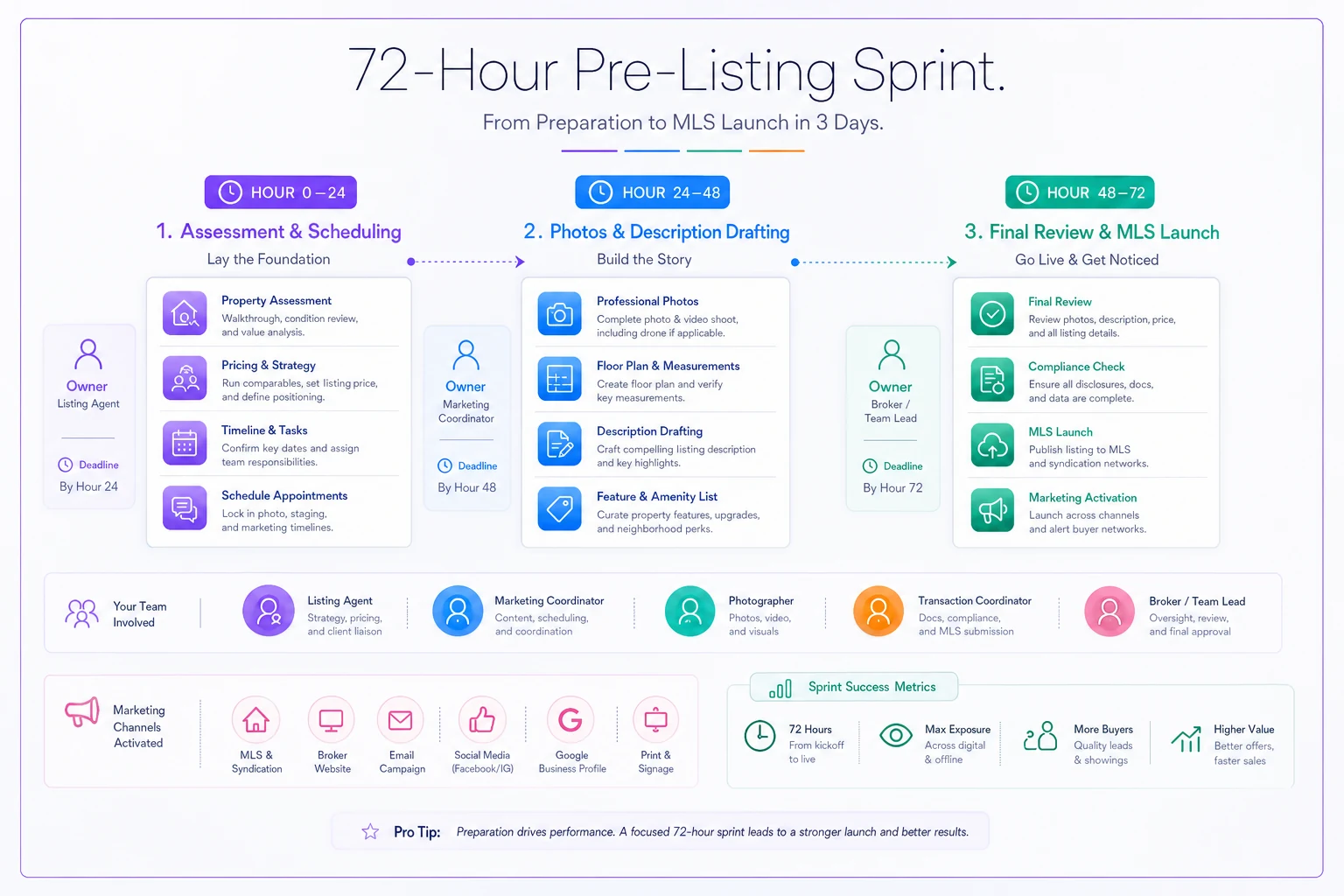
The 72-hour pre-listing sprint
Forget leisurely listing prep. The agencies protecting market share have moved to what amounts to a sprint for every new listing.
-
Hour 0–24 Initial property assessment, rough pricing analysis, photography scheduled
-
Hour 24–48 Photos shot and edited, description drafted using proven templates, all marketing materials created
-
Hour 48–72 Final review, MLS entry, coordinated launch across all channels
The key isn't just speed — it's removing decision fatigue.
When every step has a clear owner and a deadline, agents stop overthinking and start executing. One agency in Denver standardized this process and saw average days-on-market drop from 67 to 41, even as the broader market slowed.
Here's a simple visual to keep the team aligned on the sprint steps and owners.
Your listing descriptions particularly matter right now. Generic copy that worked in a seller's market falls flat when buyers have options and tighter budgets. The difference between "3BR/2BA with updated kitchen" and copy that actually speaks to what buyers care about can mean 40% more initial inquiries.
The confirmation sequence that cuts no-shows in half
The standard "see you tomorrow at 2pm!" text doesn't cut it anymore. Agencies getting results have built a three-touch confirmation system:
T-minus 48 hours: Soft confirmation via text. "Hi Sarah, looking forward to showing you 123 Oak Street this Thursday at 2pm. Reply YES to confirm you're still planning to attend."
T-minus 24 hours: Email with property details, parking instructions, what to bring. This isn't just logistics — it's psychological commitment. When someone reads specific instructions, they mentally commit to showing up.
T-minus 2 hours: Final text with the agent's photo and phone number. "Hi Sarah, I'm Jennifer and I'll be showing you 123 Oak today at 2pm. I'll be in a blue Honda Accord. See you soon!"
An agency in Austin implemented this sequence and watched no-shows drop from 31% to 14% in six weeks. That's not magic — inflation-stressed buyers need more hand-holding to follow through on commitments, and this kind of structured communication gives them that.
Vendor spend audit: The cuts that don't hurt
When revenue softens, most agencies panic-cut marketing spend. That's the wrong move. But there's fat to trim if you know where to look.
Start with your software stack. The average 15-agent brokerage subscribes to somewhere between 12 and 18 different tools. At least four are redundant. Another two or three are barely used. That's easily $800–1,200 monthly that could go back into lead generation.
Next, look at photography. Many agencies pay premium rates for exclusive photographers when they could get identical quality for 30% less by working with multiple vendors. One brokerage saved over $2,000 monthly just by opening photography to competitive bids.
Track software usage weekly for 30 days to identify unused subscriptions before canceling anything important.
Marketing spend needs surgery, not amputation. Cut the vanity stuff — branded swag, expensive print ads, billboard space. Keep performance marketing that directly generates leads. Track cost per lead weekly, not monthly. In volatile markets, monthly analytics arrive too late to change anything.
Transaction coordinator workload redistribution
Traditional TC roles assume steady deal flow — assign each coordinator their agents and let them handle whatever comes through. That model breaks when deal volume drops but complexity increases.
Smart agencies have moved to specialization. One TC handles all pre-listing prep. Another manages active showings. A third focuses on offers and negotiations. This isn't about hiring more people — it's about letting each person get genuinely good at one thing instead of juggling everything.
When one person handles all showing coordination, patterns start emerging. They notice which confirmation messages work, which time slots get fewer no-shows, which agents need backup for challenging buyers. Specialization turns coordination from administrative work into real operational intelligence.
The uncomfortable conversation about agent productivity
Not every agent deserves equal resources when margins are tight. This isn't favoritism — it's operational reality. An agent closing one deal monthly needs different support than someone closing five.
Start tracking resource ROI by agent:
-
Cost of their leads, marketing, and coordinator time
-
Revenue they actually generate
-
Management bandwidth they consume
You'll probably find that around 30% of your agents generate 70% of your profit. The rest are learning, building, or struggling. In normal markets, you invest in their growth. Right now, you protect your producers.
That doesn't mean abandoning newer agents. It means being deliberate. Pair struggling agents with top producers for showings. Have them handle buyer inquiries for listings they didn't generate. They learn, they contribute, and they stay busy without draining resources you can't spare.
Building a leaner tech stack
The agencies holding up well right now didn't add more software — they consolidated into platforms that handle multiple functions. Instead of separate tools for CRM, showing scheduling, document management, and communication, everything runs through integrated operational platforms.
When your showing scheduler talks directly to your CRM, which feeds your transaction management system, nothing falls through the cracks. Agents spend less time on data entry and more time with clients. The AI-assisted platforms that work best here aren't flashy — they're quiet, they reduce manual work, and they make coordination feel less like herding cats.
The real value comes from automation that doesn't feel automated. Confirmation messages that reference specific property details. Follow-ups that acknowledge previous conversations. Listing alerts that match what buyers actually said they wanted, not just price ranges. These small touches matter more when buyers are anxious and have more options than they did two years ago.
Leading indicators that actually tell you something
Most agencies track lagging indicators — closed deals, commission collected, agent retention. By the time those numbers look bad, you're already in trouble.
In inflationary markets, watch these instead:
| Metric | Warning Threshold |
|---|---|
| Weekly showing-to-offer ratio | Below 8:1 means listings need work or buyer qualification is off |
| Response time to new inquiries | Every hour of delay reduces conversion roughly 15% |
| Days from listing agreement to go-live | Anything over 3 days means market share loss |
| Confirmation-to-show rate | Below 75% signals a communication problem |
| Offer acceptance rate | Under 20% means pricing strategy needs a rethink |
Build a simple dashboard tracking these five. Review it every Monday. When something drops, you have days to fix it, not months.
The pricing conversation framework
Sellers still think it's 2021. They remember their neighbor's house selling 20% over asking with fifteen offers. Now you're explaining why their home should price 5% below their expectations just to move.
Agencies getting listings priced right aren't having philosophical debates about market conditions. They're showing operational data. "Homes priced above $X in this neighborhood average 97 days on market. Homes priced below $X average 34 days. Where do you want to be?"
A simple one-page pricing reality check works better than any CMA:
-
Average days on market by price range
-
Number of price reductions in the past 60 days
-
Showing activity for comparable properties
-
Mortgage payment calculations at current rates
When sellers see the operational reality instead of market theory, they adjust. One agency reported that 78% of sellers agreed to recommended pricing after seeing this data, compared to 45% using traditional CMAs.
What happens next
The PCE inflation numbers aren't heading back to 2% anytime soon. The Fed will keep rates elevated. Buyers will stay cautious. The agencies that tighten operations now will take market share from those waiting for conditions to improve.
Start with the showing confirmation sequence — it's the fastest win with the clearest ROI. Then move to the 72-hour listing launch sprint. Get those two working, and you'll have breathing room to tackle everything else.
The agencies that survived 2008 didn't do it through optimism or marketing genius. They tracked the right metrics, cut the right costs, and extracted maximum value from every opportunity. That playbook still applies — it's just happening faster now.
Your buyer pool shrank significantly, which means every single touchpoint matters more than it did a year ago. Make them count.
Ready to elevate your real estate business?
Join 2,000+ agencies using TryRealy to streamline operations, close deals faster, and deliver exceptional client experiences.