



Nonfarm payrolls came in at just 29,000 for September, and unemployment nudged up to 4.2% — well below what most forecasters expected. The CNBC breakdown of the September jobs report called it a meaningful cooling, and Reuters flagged the sharp slowdown in hiring going into a quarter that's already seasonally soft for real estate.
The mistake most agency managers make in the first 48 hours after a report like this: they either panic and freeze everything, or shrug it off because "the market always does this." Both reactions skip the actual work. A soft jobs print doesn't tell you what to do. It tells you which of your current plans are now running on bad inputs.
This isn't a macro essay. It's a 30-day operational response — the specific decisions around hiring, commission pacing, pipeline weighting, and budget that you need to revisit before the numbers quietly break your Q4.
Why a jobs report actually touches your P&L (and why the lag is the dangerous part)
A cooling labor market hits agencies through a few channels, and they don't all arrive at the same speed. That timing mismatch is what causes the real damage.
-
Buyer confidence moves almost immediately. People who feel less secure about their job — or watch a coworker get let go — delay the biggest purchase of their life. You'll feel this in showing requests and tour-to-offer conversion within weeks.
-
Financing risk climbs quietly. More of your pipeline will have thinner buffers, which means more conditional approvals, more deals that wobble at underwriting, and longer time-to-close.
-
Your cost structure is already locked. You hired, committed to marketing spend, set commission splits — all based on an August view of demand. None of that adjusts on its own.
The trap is the gap between those three things. Demand softens first, but your costs are fixed from decisions made weeks earlier. By the time slower closings show up in your bank account, you've already paid for the staffing and spend that assumed a stronger market.
The agencies that get hurt aren't usually the ones with weak pipelines. They're the ones who never re-ran their numbers after the environment shifted, so they kept making August-sized commitments in a September-sized market.
The first real decision: pause or proceed on hiring
Most small agencies have one or two hiring moves in flight at any given time — a new buyer's agent, an ops coordinator, maybe a part-time ISA. A soft report forces a question you were probably avoiding: does this role pay for itself in the next 90 days, or is it a bet on a market that just got riskier?
Never miss a showing or follow-up again.
TryRealy helps you schedule, track, and manage every client interaction smoothly.
- Unified property and client management
- Automated client notifications
- Integrated sales pipeline tracking
No credit card required
| Role type | What it does to cash flow | September-report response |
|---|---|---|
| Revenue-generating (producing agents) | Costs little upfront, scales with closings | Usually proceed — but tighten the ramp timeline and comp structure |
| Overhead/support (ops, admin, marketing) | Fixed cost, no direct revenue tie | Delay or convert to contract until demand stabilizes |
| "Nice to have" (second coordinator, junior hire) | Pure margin drag in a soft quarter | Pause, revisit in 60 days |
The nuance people miss: a producing agent is not automatically safe to hire just because they're commission-based. A new agent who takes four months to close their first deal is a cost center during the exact window your market is softest.
When proceeding with a hire still makes sense
-
The candidate brings an existing book or warm sphere that closes inside 60 days
-
You're replacing a departed producer, not adding net headcount
-
The role directly shortens time-to-close (a transaction coordinator who unclogs your pipeline)
When pausing is the smarter call
-
The hire is justified by "we'll need them when things pick back up"
-
The role's ROI depends on lead volume you can't confidently forecast right now
-
You'd be funding their ramp out of reserves rather than current cash flow
If you're bringing someone on, their ramp plan needs to be shorter and more structured than it would be in a hot market — because you have less runway to carry them.
Reweight your lead scoring before you reallocate a dollar
This is the step almost everyone skips, and it quietly wastes the most money.
In a softening market, your lead sources don't degrade evenly. Some channels hold up fine; others fill your pipeline with tire-kickers who were never going to transact in a shaky economy. If you keep scoring leads the way you did in August, you'll pour follow-up effort and ad spend into sources that look busy but no longer convert.
-
Pull conversion rate by lead source for the last 90 days versus the prior 90.
-
Flag any source where conversion dropped more than 20% while volume held steady — that's a confidence-sensitive channel.
-
Downgrade those leads in your scoring and routing. Don't kill them; just stop giving them your best response time at the expense of high-intent sources.
-
Protect and prioritize your referral, repeat, and sphere channels. These hold through a soft patch.
-
Re-run this in 30 days, because the picture shifts fast after a report like this.
In uncertain markets, intent matters more than volume, and most lead-scoring setups are still optimized for volume. Fix that first, and your budget reallocation decisions get a lot clearer.
Move marketing budget toward retention and high-intent funnels
Once you know which channels still convert, the budget move is straightforward in principle and uncomfortable in practice: shift dollars away from top-of-funnel awareness and toward people who are closer to transacting.
In a strong market, broad spend works because demand is doing half your job. In a soft one, it just raises your cost per closing. The money is better spent on:
-
Past-client and sphere reactivation. These people already trust you. A soft market is exactly when a well-timed check-in turns into a listing.
-
High-intent retargeting — buyers who've toured, requested financing info, or hit a listing page more than once.
-
Nurture for stalled deals. Buyers who paused aren't gone; many are waiting for a reason to move. Staying in front of them costs far less than acquiring a new lead.
A small agency running roughly $4k–$6k a month in ad spend can often protect its closing count through a soft quarter just by moving 30–40% of that budget from cold acquisition into retargeting and reactivation — without spending an extra dollar.
The underlying problem this report exposes
Step back from the specific numbers and the real issue becomes clear: it isn't the jobs report at all. Most small agencies don't have a tight loop connecting what the market is doing to what they're spending and staffing for.
In practice, the forecast lives in one spreadsheet, the hiring plan lives in the managing broker's head, and the marketing budget is on autopilot from a decision made two quarters ago. So when the environment shifts, nothing updates together. You find out your assumptions were wrong when a closing falls through or payroll feels tighter than expected.
The agencies that handle shocks like this well aren't smarter forecasters. They've built the plumbing so that when demand signals change, the forecast, the hiring decision, and the budget all get looked at in the same conversation. If you want the full framework for wiring those three together, the revenue-ops playbook linking forecasts to hiring and budgets walks through exactly that connection. A report like September's is just the moment it becomes obvious you needed it.
A real scenario: the mid-sized brokerage that got the timing right
A brokerage with eight producing agents in a mid-sized metro had been planning to bring on a second ops coordinator and a new buyer's agent in October. Monthly closings had been running around 11–13.
When the slowdown signals showed up, the managing broker ran both hires through the bucket test above. The ops coordinator — pure overhead, justified mostly by "we'll be busier soon" — got pushed to a 60-day revisit. The buyer's agent hire stayed, but with a tightened ramp: a 45-day first-close target and a slightly adjusted split that protected the brokerage's cash during the ramp window.
At the same time, they pulled about a third of their cold lead spend and redirected it into past-client reactivation and retargeting stalled buyers. Over the next two months, closings dipped only slightly — down to around 9–10 — while a couple of nearby competitors who kept spending flat and hired on schedule reported sharper drops and a cash squeeze going into the holidays.
Nothing heroic happened. They just re-ran their numbers within a week of the report instead of waiting for the slowdown to show up in their bank balance.
Your 30-day checklist
Work through these in roughly this order:
-
Re-run your short-cycle revenue forecast with a softer demand assumption (model a 10–15% downside case, not just your base case)
-
Sort every open role into revenue / overhead / nice-to-have and make a pause-or-proceed call on each
-
Tighten ramp timelines and comp pacing for any hire you keep
-
Pull 90-day conversion-by-source and flag confidence-sensitive channels
-
Reweight lead scoring and routing toward high-intent sources
-
Shift 30–40% of cold acquisition budget into reactivation and retargeting
-
Review vendor SLAs and commitments you can make flexible or short-term
-
Check commission pacing against a longer time-to-close assumption
-
Schedule a 30-day re-check — the picture will change again
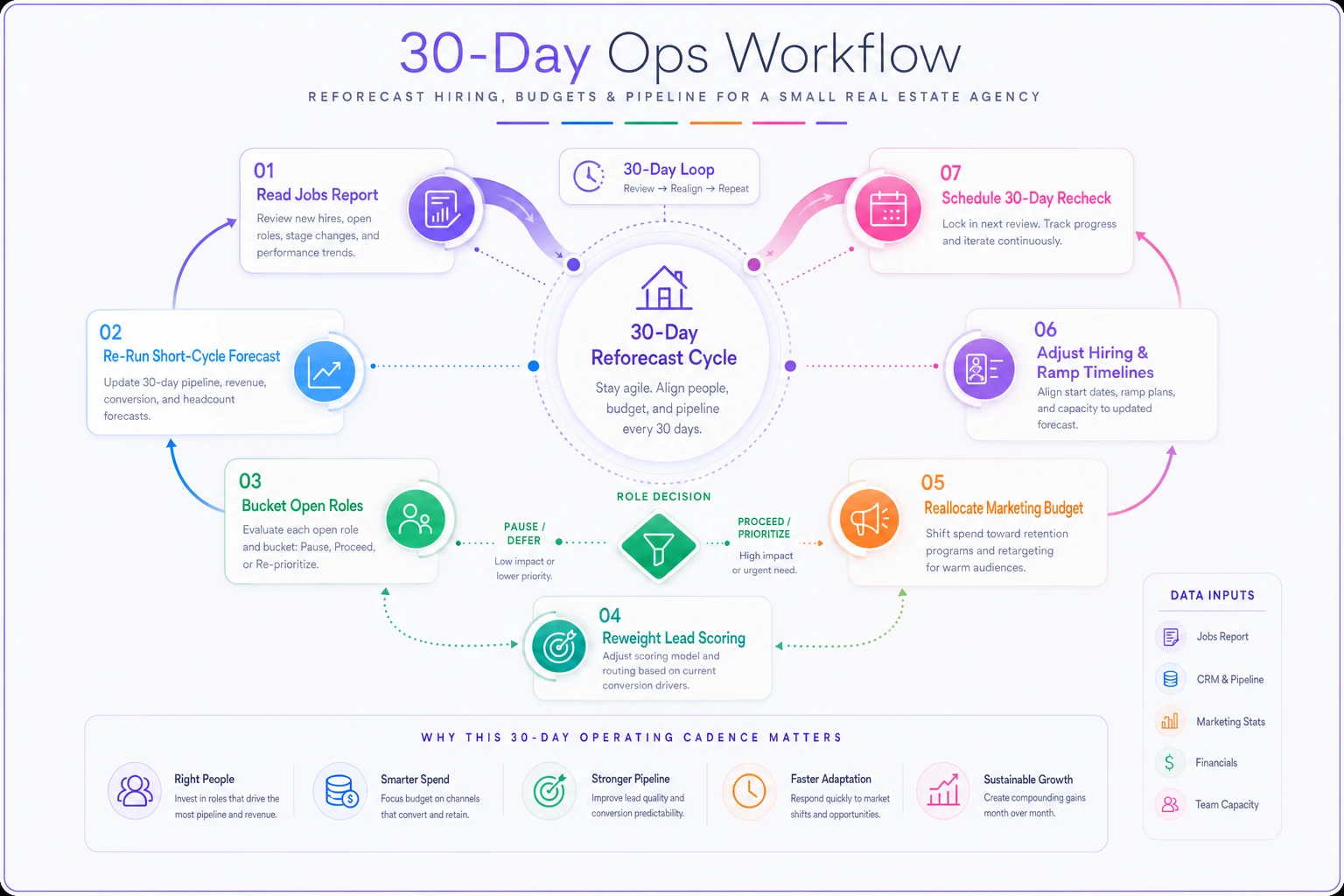
A quick workflow to run the 30-day reforecast and decision loop.
Bottom line
A soft September print isn't a reason to batten down the hatches or to pretend nothing happened. It's a prompt to re-run the few decisions that were built on last month's assumptions — the hire you were about to make, the budget running on autopilot, the forecast you haven't touched since summer.
The agencies that come through a cooling market in decent shape aren't the ones who called it correctly. They're the ones who had a fast, repeatable way to adjust hiring, spend, and pipeline the moment the inputs changed — and then actually did it, within days, instead of waiting for the slowdown to show up in their numbers.
Ready to elevate your real estate business?
Join 2,000+ agencies using TryRealy to streamline operations, close deals faster, and deliver exceptional client experiences.