


Most small agencies treat their forecast like weather. Something you check, comment on, maybe worry about — then ignore when it's time to actually make a decision. The broker looks at a pipeline number, gets a gut feeling, and either hires too late or spends into a slowdown that everyone quietly saw coming three weeks earlier.
The gap isn't forecasting. Plenty of teams already do decent short-cycle revenue forecasting. The gap is what happens after the number lands. Nothing connects the forecast to the levers that cost or make money: hiring, pay runs, and the 90-day marketing plan. So the forecast becomes trivia instead of a trigger.
This is a playbook for closing that loop — a forecast→action system where specific confidence levels automatically trigger specific decisions. Not "let's discuss it next Tuesday." Actual pre-approved actions with templates, thresholds, and a calendar cadence so the loop runs whether or not the broker is having a good week.
Why the loop breaks in almost every small agency
Walk into most agencies and you'll find three separate conversations that never touch each other.
Finance talks about cash and pay runs. Sales talks about pipeline and closings. Marketing talks about lead volume and cost per lead. Each has numbers. None of them agree on what those numbers should do.
Here's the pattern: the pipeline softens in late Q2. The forecast catches it. But the forecast lives in a spreadsheet only the ops manager opens. Marketing keeps spending at the same rate because no one told them to stop. Payroll gets planned off last quarter's closings, which were fine. Then two months later, closings come in light, cash gets tight, and suddenly there's a panic hiring freeze and a marketing cut happening at the same time — which is the worst possible combination, because you're starving the pipeline exactly when you need it fed.
The deeper problem is that nobody defined what a number means in advance. A forecast of "$180k next quarter, 70% confident" is meaningless until someone decides: at what confidence do we approve a new hire? At what confidence do we pull back on paid channels? Without those thresholds set ahead of time, every forecast turns into a fresh argument, and the loudest person in the room wins instead of the data.
The core idea: confidence thresholds that trigger actions
A forecast isn't one number. It's a number plus a confidence level. The confidence level is what should drive the decision — not the raw dollar figure.
Never miss a showing or follow-up again.
TryRealy helps you schedule, track, and manage every client interaction smoothly.
- Unified property and client management
- Automated client notifications
- Integrated sales pipeline tracking
No credit card required
If your model says you'll close roughly $200k next quarter but you're only 45% confident, you do not make an aggressive hire. If it says $150k but you're 85% confident, that's a much stronger basis for committing to payroll. High-dollar, low-confidence forecasts are traps. Lower-dollar, high-confidence forecasts are where you can actually plan.
So instead of "the forecast looks good, let's hire," you build a rule set:
-
Hiring approvals trigger when forecasted revenue clears a threshold at or above a set confidence level.
-
Pay-run planning adjusts when forecast confidence in cash coverage drops below a floor.
-
90-day marketing rebalances trigger when lead-driven forecast confidence moves outside a band in either direction.
You decide the response before the number arrives, so the number does the work instead of a meeting.
Below is a visual of that workflow.
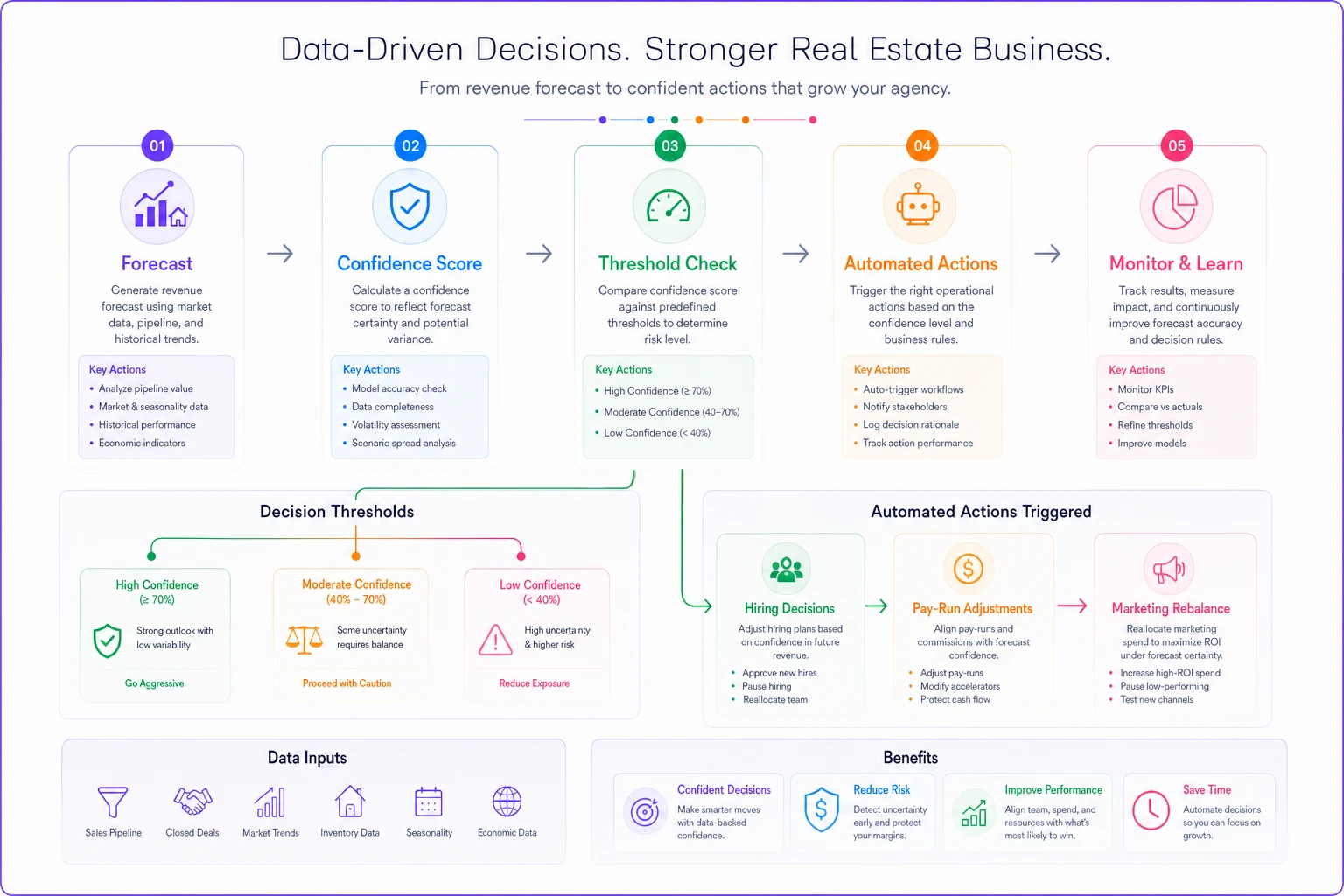
The broker isn't starting the process — they're confirming a decision the numbers already made the case for. That shifts the mental load from "should we hire?" to "do I see anything the forecast is missing?" which is a much faster, better conversation.
Sample threshold rules
Below is a starting rule set for a small agency running weekly short-cycle forecasts. The numbers are illustrative — you'll tune them to your close rate, average commission, and cash cushion.
| Trigger | Condition | Confidence needed | Auto-action |
|---|---|---|---|
| Hire a new agent | 90-day forecast ≥ 1.4x current capacity revenue | ≥ 75% | Open pre-approved req, start onboarding pipeline |
| Hire support/ops staff | Forecast shows 3+ consecutive weeks of overflow tasks | ≥ 70% | Approve part-time hire, revisit at 60 days |
| Freeze hiring | 90-day forecast falls below trailing 6-month avg | any | Pause all open reqs, notify broker |
| Increase marketing spend | Lead-based forecast trending up, cost-per-close stable | ≥ 70% | Shift budget toward top-performing channel |
| Rebalance marketing (defensive) | Forecast confidence drops below floor | < 55% | Cut experimental spend, protect proven channels |
| Pay-run caution flag | Projected cash coverage < 1.5 pay cycles | any | Trigger cash-review, delay discretionary spend |
A couple of things worth noticing. The "freeze" and "caution" triggers don't require high confidence — because when you're protecting cash, you act on the risk, not the certainty. Downside triggers should fire easily. Upside triggers (hiring, spending more) should require real confidence, because those cost money if you're wrong.
Make downside triggers easier to fire than upside triggers so you protect cash quickly while requiring stronger evidence to spend or hire.
That asymmetry is the single most important design choice in the whole system. Most agencies have it backwards: they hesitate on cuts and rush on hires.
The hiring approval loop
Hiring is where forecasts do the most damage when the loop is broken, because agent hiring is a lagging decision with a long payoff curve. A new agent rarely contributes meaningful closings for 60–90 days. So if you hire when the pipeline is already hot, you've hired late — they ramp up right as the wave passes.
The fix is tying the hire trigger to the forward forecast, not current workload. When the 90-day forecast clears your capacity threshold at sufficient confidence, the req opens. No debate about whether "it feels like the right time."
A workable approval flow looks like this:
-
Forecast crosses threshold (e.g., 90-day forecast ≥ 1.4x current capacity, confidence ≥ 75%).
-
System flags the trigger and populates a pre-filled approval template.
-
Broker gets a one-click approve/deny with the underlying numbers attached — not a blank request they have to research.
-
On approval, onboarding pipeline kicks off automatically (offer template, license check, milestone plan).
-
60-day checkpoint re-evaluates the forecast to confirm the hire still fits.
The broker isn't starting the process — they're confirming a decision the numbers already made the case for. That shifts the mental load from "should we hire?" to "do I see anything the forecast is missing?" which is a much faster, better conversation.
Sample hiring approval template
> Trigger fired: 90-day forecast at $242k (78% confidence) vs. current capacity revenue ~$170k > Recommended action: Open 1 agent req > Basis: Overflow leads averaging 40+/week unassigned for 3 weeks > Cost: ~$0 base + split structure per comp plan > Downside if wrong: Minimal — commission-only exposure > Approve / Deny / Discuss
Make sure the comp exposure line is honest. A commission-heavy hire is low-risk and should clear easily. A salaried ops hire is a real fixed cost and deserves a higher confidence bar. Your agent compensation framework should feed directly into that downside line, because the whole point is knowing exactly what you're committing to before you commit.
Pay-run planning off the forecast
Payroll planning is the least glamorous part of this and the one that quietly sinks small agencies. The classic failure: planning the pay run off closings that already happened instead of the forecast of what's coming.
Commission timing makes this worse. Money comes in lumpy — three closings in a week, then nothing for two weeks — while obligations are steady. So the relevant question isn't "how much will we make" but "how many pay cycles of coverage do we have, and how confident are we?"
The rule that matters: track projected cash coverage in pay-cycle units. If your forecast shows you dropping below around 1.5 pay cycles of coverage, that fires a caution flag regardless of confidence. You don't wait for certainty on a cash problem. You review, delay anything discretionary, and confirm which closings are actually locked versus hopeful.
Worth watching for: agencies tend to count a deal as "coming" the moment it goes under contract, but contract-to-close fallout is real. Build your coverage forecast on weighted closings — discount by the historical fallout rate at each pipeline stage — not raw contract value. An agency assuming 100% of pending deals close will plan a pay run it can't cover roughly as often as fallout actually happens.
The 90-day marketing rebalance
Marketing spend is the fastest lever to move and the one most agencies move too slowly. The forecast should trigger rebalances on a rolling 90-day view, not a calendar-year budget locked in January that nobody revisits.
Two directions to plan for:
When the forecast trends up with confidence — you're not just spending more, you're spending concentrated. Push budget toward whatever channel is producing the cheapest actual closings, not the cheapest leads. This is where lead-source attribution earns its keep; without it you'll pour money into the channel with the most volume rather than the most revenue.
When confidence drops — the defensive rebalance. Cut experimental spend first, protect your two or three proven channels, and hold. The mistake is cutting everything proportionally in a panic. That guarantees the pipeline gets thinner in 60 days, which deepens the exact slowdown you were reacting to. Protect the base, trim the edges.
90-day rebalance checklist
-
- [ ] Pull weighted forecast for next 90 days with confidence band
-
- [ ] Rank active channels by cost-per-closing, not cost-per-lead
-
- [ ] Identify bottom 20% of spend (experimental / unproven)
-
- [ ] If confidence up
reallocate toward top channel, hold experiments flat
-
- [ ] If confidence down
cut experimental spend, protect top 2–3 channels
-
- [ ] Set the next review date before closing the current one
-
- [ ] Log what you changed and why (so next quarter's decision has context)
Log what you changed and why (so next quarter's decision has context)
Calendar cadence: how the loop actually runs
A loop that only runs when someone remembers it isn't a loop. The cadence is what makes this a system instead of a good intention.
-
Weekly (15 min) Update short-cycle forecast, check for any fired triggers. Most weeks, nothing fires and this is a quick glance.
-
Every 2 weeks Pay-run coverage check against the 1.5-cycle floor.
-
Monthly Review any hiring triggers, confirm 60-day checkpoints on recent hires.
-
Every 90 days Full marketing rebalance and a review of whether the threshold rules themselves still make sense.
-
Quarterly Recalibrate confidence levels against what actually happened. If your "75% confident" forecasts only came true 60% of the time, your model is overconfident and every threshold downstream is wrong.
That last step is the one everyone skips and it's the most important. Thresholds are only as good as the confidence calibration behind them. Spend an hour each quarter comparing forecast confidence to actual outcomes. If they drift, fix the model before you trust another trigger.
A real scenario
A three-agent brokerage doing roughly $65k–$80k in monthly commissions kept getting whipsawed. They'd hire when things felt busy, then a slow stretch would hit and they'd freeze hiring and slash marketing in the same month. Cash got tight twice in a year — not because revenue was bad, but because nothing coordinated the levers.
They set up a simple version of this loop. Weekly forecast, three threshold rules: hire at ≥75% confidence over capacity, defensive marketing rebalance below 55% confidence, pay-run flag under 1.5 cycles of coverage. Nothing fancy — a shared sheet and a standing 15-minute Monday check.
The change wasn't dramatic on paper, but it was real. Over the next two quarters they made one hire that timed almost perfectly with a pipeline build, and they caught a soft patch early enough to trim only experimental spend instead of gutting the whole budget. The two cash crunches didn't repeat. The broker described it as "arguing about the numbers a lot less." That's the actual win — the loop absorbed the decisions that used to eat meetings and nerves.
When this makes sense — and when it doesn't
This works well when you already have a functioning forecast, at least a handful of agents, and enough deal flow that timing decisions actually matter. If you're regularly making hire/spend calls and getting the timing wrong, this pays for itself fast.
This is overkill when you're a solo agent or a two-person shop with predictable, small volume. You don't need auto-triggered pay-run flags when you can see your whole business in one glance. Set it up when the coordination cost starts to hurt — usually somewhere around the third or fourth agent.
Don't do this if your forecast isn't trustworthy yet. Confidence thresholds are worthless on top of a bad model. Get your forecasting stable and calibrated first, then wire the triggers to it. Building the action loop on a shaky forecast just automates your mistakes.
Where tooling fits (lightly)
You can run this entirely in spreadsheets and a shared calendar, and plenty of agencies should start exactly there. The manual version teaches you what your real thresholds are before you automate anything.
The friction shows up as you grow. Manually checking coverage floors, remembering to fire triggers, keeping the forecast, comp plan, and marketing spend in the same place — that gets fragile past a few agents. This is where operational software that centralizes the forecast and can surface a trigger automatically starts to earn its place: not to make the decision for you, but to make sure the number never gets ignored because someone forgot to open a spreadsheet. The judgment stays human. The remembering gets automated.
If you're thinking about where this fits in your broader build-out, it maps cleanly onto a 12-month operations maturity roadmap — this is a mid-stage capability, worth adding once your core forecasting and comp systems are already stable.
The takeaway
The forecast isn't the deliverable. The action it triggers is. Most small agencies already know roughly where their numbers are heading — they just don't have anything that converts that knowledge into a hire, a pay-run adjustment, or a spend change before the moment passes.
Set your thresholds ahead of time. Make downside triggers fire easily and upside triggers earn their confidence. Put it on a calendar so it runs without heroics. Do that, and the endless quarterly argument about "what should we do" mostly disappears — replaced by a much better question: "the number says do this, do we see anything it's missing?"
Ready to elevate your real estate business?
Join 2,000+ agencies using TryRealy to streamline operations, close deals faster, and deliver exceptional client experiences.