

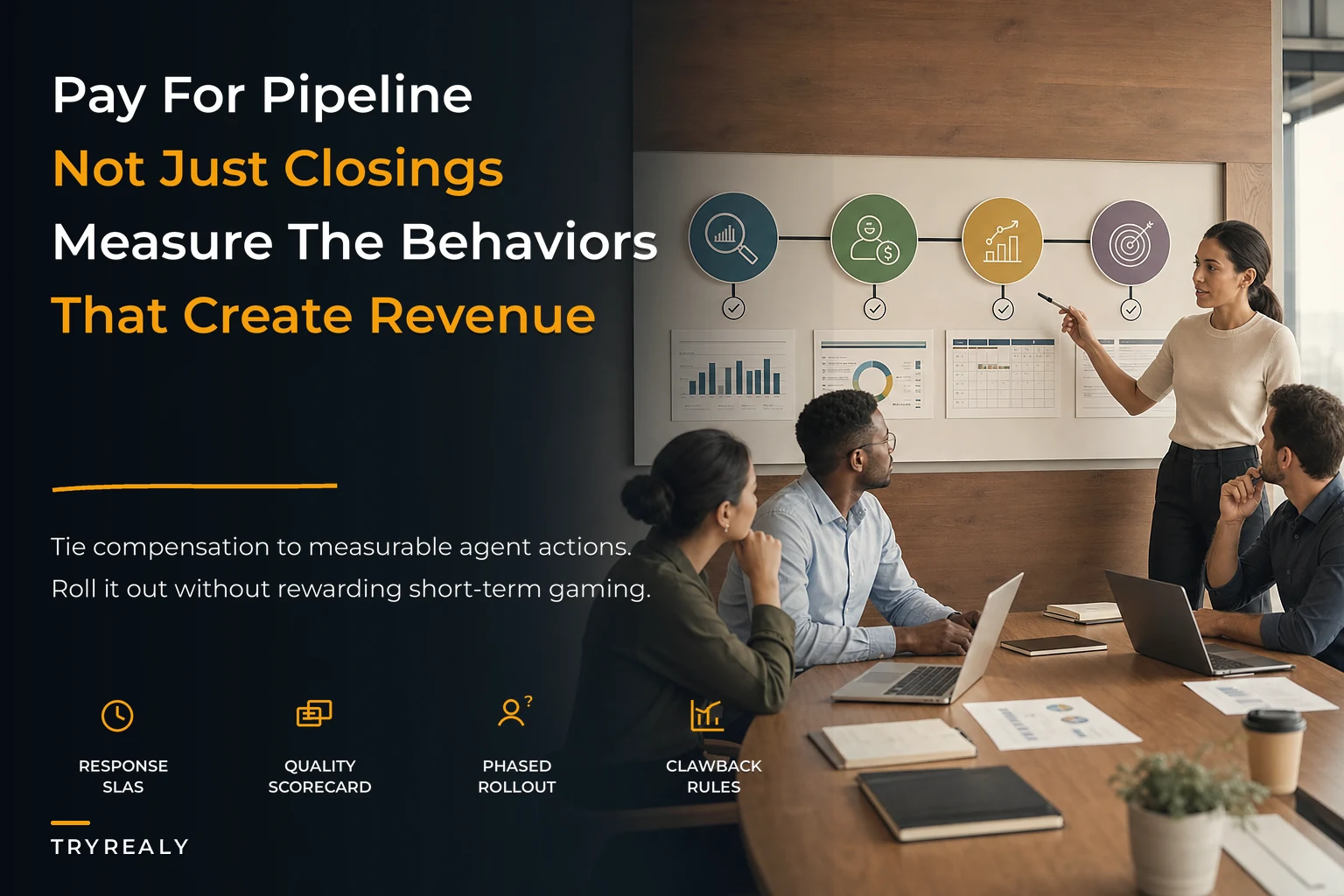

Most agencies pay agents on one thing: the closing. Deal funds, agent gets a check, everyone moves on. It feels clean because it's the only number that's undeniable. But that model has a blind spot the size of your entire pipeline. It rewards the last inch of a 90-day process and ignores every behavior that actually moved the deal there.
The practical problem looks like this. A lead comes in at 9pm. Agent A responds in four minutes with a real message and a calendar link. Agent B sees it the next morning, sends "Hi is this still available?" and never follows up. Under a pure commission model, if Agent B closes a different deal that month, they get paid the same rate as Agent A per closing. The fast response, the disciplined follow-up, the clean CRM notes — completely invisible to the pay structure. So agents optimize for what gets rewarded: chasing warm deals near the finish line while early-stage work quietly rots.
A real estate agent compensation framework that only fires at closing is basically paying for outcomes while ignoring the inputs that produce them. The fix isn't to abandon commissions. It's to layer in behavior-linked pay that rewards the pipeline actions you can actually measure and coach — response speed, SLA compliance, data quality, appointment discipline — before a single dollar of GCI shows up.
This article walks through how to build that layer: the triggers worth paying on, sample scorecards, the commission math, clawback rules, and a phased rollout that won't cause a mutiny.
The behaviors worth paying for (and the ones that just sound nice)
Before you attach money to anything, you have to separate behaviors that predict revenue from behaviors that just feel productive. Agents will game whatever you measure, so if you pay for "number of calls made," you'll get 200 pointless calls a week. The trigger has to be tied to a pipeline outcome, and it has to be hard to fake.
What works across small agencies is anchoring pay to three categories:
-
Speed/SLA triggers — first response time to new leads, time-to-first-appointment, showing confirmation cadence completed on time.
-
Quality triggers — CRM completeness (source, budget, timeline, next step logged), notes quality on handoffs, correct lead-source attribution.
-
Progression triggers — leads moved to the next stage, appointments booked and held, offers written.
Notice what's missing: activity volume. Raw call counts and email blasts don't belong in a behavior-linked comp plan because they reward motion, not progress. A single agent who books three held appointments off eight fast, well-documented conversations should out-earn the person who dialed 90 numbers and logged nothing.
The mistake most managers make is bolting on ten metrics at once. You end up with a scorecard nobody understands and pay that feels arbitrary. Pick four or five behaviors that genuinely gate revenue in your specific pipeline. If you've already built KPI thresholds through a real performance management system with coaching rhythms, pull the top predictors from there instead of inventing new ones.
What actually breaks at scale
With three agents, you don't need any of this. You can see who's responding fast because you're in the same office and you overhear the whole thing. Behavior is enforced by proximity.
Never miss a showing or follow-up again.
TryRealy helps you schedule, track, and manage every client interaction smoothly.
- Unified property and client management
- Automated client notifications
- Integrated sales pipeline tracking
No credit card required
At eight to fifteen agents, proximity dies. Leads get routed to people you're not watching. Nights and weekends become black holes. The classic failure: your portal spend is steady, lead volume is fine, but conversion quietly slips from around 6% to 4% over a quarter. When you dig in, it's not a marketing problem — it's response time. Half your leads are getting a first touch six-plus hours late, and the SLA you thought existed was never enforced because pay didn't depend on it.
-
Handoff quality collapses. A listing agent passes a buyer to a teammate with two words of context. The next agent restarts discovery, the client feels the friction, and the deal cools.
-
Attribution gets sloppy. Nobody logs the real source, so your budget decisions run on garbage data. That directly undermines any attempt to prioritize marketing spend with an ROI scoring model, because the inputs are fiction.
-
The fast responders burn out or leave. They're carrying the SLA on personal discipline while getting paid the same as people who ignore it. That's the resentment that quietly costs you your best agent.
Behavior-linked pay is really a coordination tool. It makes the invisible early-pipeline work visible enough to price, so growth doesn't erase the standards you had when the team was small.
A sample scorecard you can actually run
Keep the scorecard on a rolling monthly basis, scored per agent, capped so nobody can win on one metric alone. Here's a structure that holds up in real operations.
| Behavior | Trigger / Standard | Weight | How it's measured |
|---|---|---|---|
| First response time | ≤ 15 min (business hours), ≤ 60 min (after-hours) | 30% | CRM timestamp: lead created → first logged contact |
| Appointment set rate | ≥ 40% of qualified leads → appointment | 20% | Stage change in pipeline |
| Appointments held | ≥ 80% of set appointments actually held | 15% | Confirmation logged + outcome marked |
| CRM data completeness | Source, budget, timeline, next step all filled | 20% | Required-field audit |
| Handoff quality | Context note present on every transfer | 15% | Manager spot-check, 5 handoffs/mo |
If your CRM can auto-block stage progression until required fields are filled, the scorecard becomes largely self-enforcing.
Score each line 0–100 against the standard, apply the weight, and you get a monthly behavior score. An agent hitting 90+ is running the pipeline the way you want. Someone at 60 has a specific, coachable gap you can point to instead of telling them to "hustle more."
One thing worth saying plainly: the scorecard is only as honest as your timestamps. If agents can back-date a contact or mark a lead "worked" without evidence, the whole thing turns into theater. This is where having pipeline stages, response logging, and required fields enforced inside one system matters more than the pay math itself. When the CRM captures response time automatically and required fields block a record from advancing until they're filled, the scorecard essentially scores itself — and the arguments mostly disappear.
Sample commission math
Behavior pay should be a layer, not a replacement. The GCI split still does most of the work; the behavior component nudges daily habits. A common structure agents accept without feeling nickel-and-dimed:
-
Keep the base commission split intact (say 70/30 to the agent).
-
Add a monthly behavior bonus funded from a small pool — a flat amount per agent tied to their behavior score.
Worked example. Say you set a behavior pool of $500 per agent per month.
-
Agent scores 92 → earns 92% of the pool → about $460 that month.
-
Agent scores 68 → earns $340.
-
Agent scores below a floor of 50 → earns $0 and triggers a coaching conversation.
Over a year that's roughly $4k–$5.5k per agent riding on pipeline behavior — enough to change habits, small enough that it never feels like you're clawing back their core income. For a ten-agent office, you're spending somewhere in the $50k–$60k range annually to systematically enforce fast response and clean data. If that lifts conversion even a point or two on the same lead spend, it pays for itself several times over.
An alternative for teams that hate flat pools: a split accelerator. Hit a behavior score of 85+ for three consecutive months and your GCI split bumps from 70% to 72%. This ties the reward to the outcome agents care about most and rewards sustained behavior rather than a one-good-month spike.
Clawback rules that don't feel like traps
Clawbacks are where behavior comp plans go to die if you get the tone wrong. The point isn't to punish — it's to protect against paying for behavior that didn't actually hold up. Keep the rules narrow and predictable.
-
Data-falsification clawback. If a spot-check finds a contact was logged but never actually happened (fake timestamp, phantom appointment), that month's behavior bonus is forfeited. This is the one rule that should have teeth, because the whole system depends on honest logging.
-
Held-appointment reversal. If an appointment was marked "held" and later proven a no-show or fabricated, reverse the credit for that line item only — not the whole score.
-
No clawback on genuine effort. If an agent responded fast, documented well, and the deal still died, nothing gets clawed back. Ever. Punishing losses that came from good behavior teaches people to stop trying on hard leads.
Write these into the plan document in plain language, with examples. The fastest way to lose trust is a surprise deduction the agent didn't see coming.
Transition plan: how to roll this out without a revolt
You cannot flip a compensation model overnight and expect goodwill. Agents hear "new comp plan" and assume you're cutting their pay. The rollout has to feel additive and phased.
A sequence that works:
-
Weeks 1–4 — Measure silently. Turn on scorecard tracking with zero money attached. Let agents see their own scores. No consequences. This surfaces the honest baseline and lets people fix obvious gaps before pay is on the line.
-
Weeks 5–8 — Shadow pay. Show what each agent would have earned under the behavior pool, still without paying it. This is the moment the top performers realize they've been underpaid for their discipline, and they become your internal advocates.
-
Weeks 9–12 — Bonus goes live. Activate the pool, but fund it as new money on top of existing comp for the first quarter. Nobody loses income; some people gain.
-
Quarter 2 — Normalize. Fold the plan into standard comp with clawbacks active and the floor enforced.
Sample transition message to the team
> "Starting next month we're tracking a few pipeline behaviors — how fast we respond to leads, how completely we log them, and whether appointments actually hold. For the first four weeks this is just visibility, no money attached, so you can see your own numbers. In a couple months we're adding a monthly bonus pool that rewards these habits. This is additional pay for work the best of you are already doing — nobody's split is being cut. We'll walk through the scorecard together in Thursday's meeting."
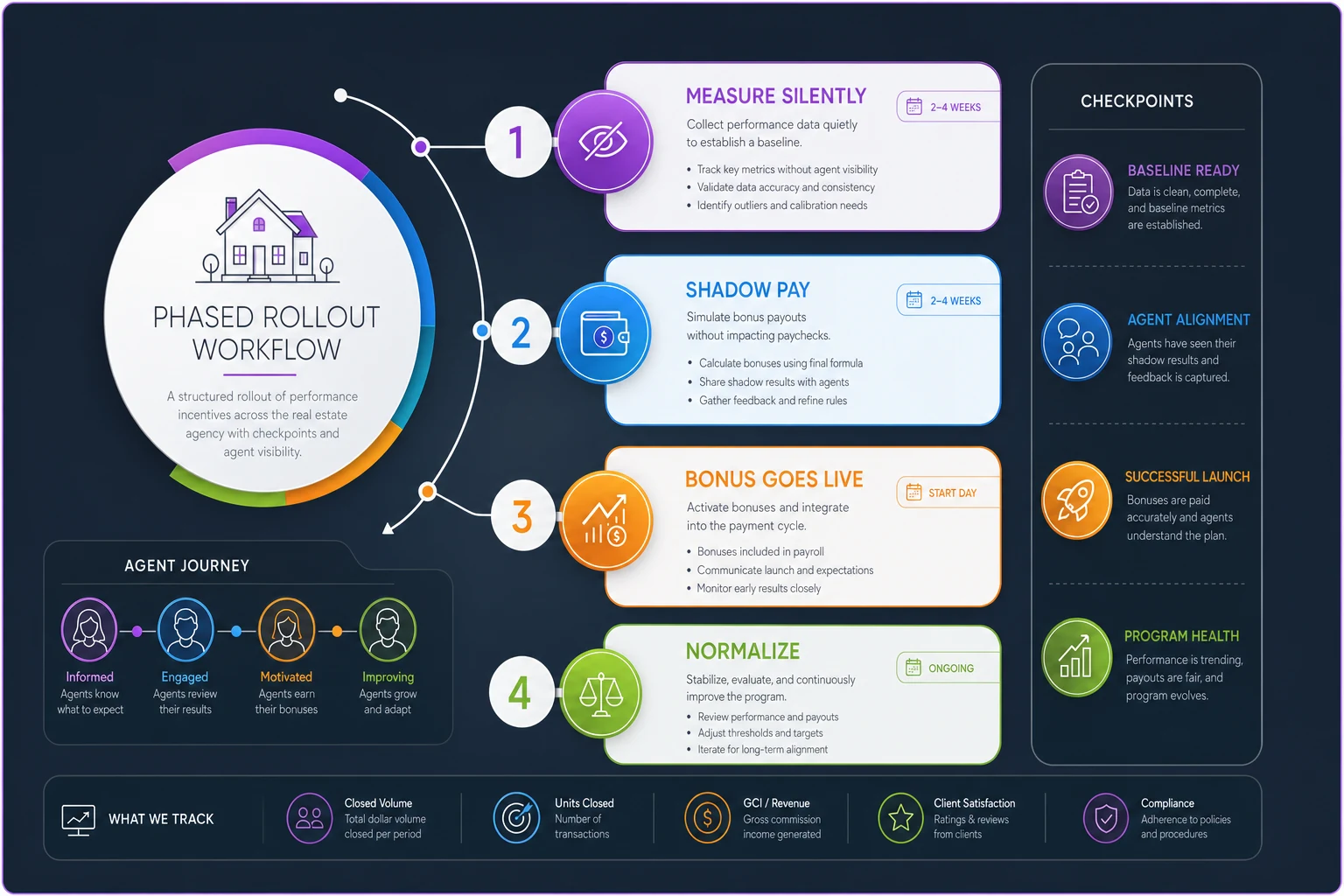
Here's a simple visual of the phased rollout to share in the announcement so people see the timeline.
When this makes sense — and when it doesn't
This approach makes sense when you're past the point of watching every lead yourself, you have real lead volume flowing to multiple agents, and your CRM can timestamp responses and enforce required fields. If those three are true, behavior-linked pay closes the gap between the standards you want and the standards you can actually see.
It's a bad idea when your data isn't trustworthy yet. If half your leads never get logged and sources are guessed, the scorecard will reward whoever games the system best. Fix data hygiene first — clean fields, consistent stages, honest timestamps — then attach money.
Solo agents and two-person teams should skip this entirely. The overhead of scoring and administering a bonus pool isn't worth it when you can see everything happening in real time. The same goes for any agency whose leaders won't hold the line on clawbacks. If you cave the first time a top producer complains about a fair deduction, you've taught everyone the rules are optional — and you're better off not having them at all.
A real scenario
A seven-agent suburban brokerage was spending roughly $6k–$7k a month on portal leads with conversion hovering around 4.5%. Straight commission, no behavior tracking. Response times were all over the place — some leads got a reply in minutes, others sat until the next afternoon.
They ran the transition above. Month one, silent tracking, revealed the median first response was close to five hours. By the end of the shadow-pay phase, just the visibility of the scorecard had pulled median response under 40 minutes — no money had even changed hands yet. People just don't like seeing themselves at the bottom of a list.
Once the bonus went live and held for a quarter, appointment-set rate climbed from the low 30s into the low 40s percent-wise, and conversion settled around 6%. Same ad spend, meaningfully more closed deals over the year. The behavior pool cost them somewhere in the $35k–$40k range annually. The added closings covered it many times over, and the two strongest agents — the ones who'd quietly been carrying the SLA on their own — finally got paid for it and stopped grumbling about leaving.
The system view
Behavior-linked pay isn't a clever bonus scheme bolted onto commissions. It's the mechanism that keeps your pipeline standards alive after you're no longer in the room to enforce them by hand.
Think about what a pure commission model actually protects: the closing. Everything upstream — response SLAs, clean data, honest handoffs, held appointments — is invisible to it. Those are the connective tissue between marketing spend and closings, and because they don't show up in the commission check, they slowly degrade as the team grows and you lose direct visibility.
Build the scorecard around four or five behaviors that genuinely gate revenue. Make the money additive before you make it standard. Keep clawbacks narrow and honest. And make sure the underlying pipeline — timestamps, required fields, stage tracking — is trustworthy enough that the scorecard scores itself. Do that, and you stop hoping your agents run the pipeline the right way and start paying for it in a way they can actually feel.
Build the scorecard around four or five behaviors that genuinely gate revenue. Make the money additive before you make it standard. Keep clawbacks narrow and honest. And make sure the underlying pipeline — timestamps, required fields, stage tracking — is trustworthy enough that the scorecard scores itself. Do that, and you stop hoping your agents run the pipeline the right way and start paying for it in a way they can actually feel.
Ready to elevate your real estate business?
Join 2,000+ agencies using TryRealy to streamline operations, close deals faster, and deliver exceptional client experiences.