


Most agencies don't actually manage agent performance. They react to it. An agent has three slow months, the broker finally notices the pipeline is empty, and now there's an awkward conversation that came out of nowhere. The agent is blindsided. The broker is frustrated. And by the time anyone acts, the damage — lost commissions, a stale sphere, months of drifting — is already done.
The problem isn't a lack of caring. Performance management in most small brokerages lives entirely in someone's head. There's no rhythm, no threshold that says "intervene now," and no clear picture of what "good" even looks like at each stage of an agent's career. So everything happens late, and everything feels personal instead of operational.
What follows is a system for fixing that: weekly scorecards that surface trouble early, KPI thresholds that automatically trigger a response, coaching sessions that follow a template instead of a mood, and career ladders that give agents something to climb toward. The goal isn't micromanagement — it's making performance visible and predictable so you stop being surprised.
Why performance management breaks in most agencies
Real estate has long feedback loops. A conversation today might close in 90 days. A neglected past client might not resurface for a year. So when you compare a producing agent to a struggling one, the outcome gap is obvious, but by then it's a lagging indicator. The behaviors that caused the gap happened months ago.
-
The broker manages by looking at the closing pipeline, which only shows problems after they've already compounded.
-
Coaching happens reactively, usually when someone is already in trouble and defensive.
-
New agents get a burst of attention during onboarding, then fall off a cliff of accountability.
-
Top producers get left alone entirely — until they plateau and nobody notices for two quarters.
There's also a measurement trap. A lot of agencies track the wrong things — vanity numbers that feel productive but don't actually predict outcomes. That specific failure is covered in more detail in which real‑estate KPIs mislead small agencies. Short version: counting activity is easy, but not all activity connects to revenue, and a dashboard full of green checkmarks can hide a pipeline that's quietly emptying.
At small scale — two to four agents — a good broker can hold most of this in their head. They know Maria's been quiet, they can feel that the new guy isn't dialing. But that intuition doesn't scale. Add a fifth and sixth agent, or a second office, and the mental model collapses. Problems only get noticed when they hit the P&L.
The leading indicators that actually predict performance
If closings are lagging, what's leading? The answer is the activity that reliably converts downstream. This varies by market, but across most residential teams the predictive chain looks roughly like this:
Never miss a showing or follow-up again.
TryRealy helps you schedule, track, and manage every client interaction smoothly.
- Unified property and client management
- Automated client notifications
- Integrated sales pipeline tracking
No credit card required
Conversations → appointments → agreements signed → active listings/buyers → pending → closed.
The further left you measure, the earlier you catch problems. An agent who stops having new conversations this week won't feel it in their income for two or three months. That lag is exactly why you need a weekly scorecard — you're watching the front of the funnel, not the back.
-
New contacts / meaningful conversations
-
Appointments set (buyer and seller)
-
Appointments held
-
New signed agreements
-
Active pipeline count
-
Follow-ups completed vs. due
The mistake most managers make is bloating this into 20 metrics. Nobody actually reviews 20 metrics every week. Five or six leading indicators, a clear definition of what "on track" looks like for each, and everything else moves to a monthly review.
One nuance worth flagging: appointments set versus appointments held is one of the most diagnostic gaps you can watch. An agent setting plenty but holding few has a confirmation and rapport problem, not a lead problem. An agent setting almost none has a prospecting problem. Same low closing number, completely different intervention. The scorecard should let you tell those two apart at a glance.
KPI thresholds that trigger interventions
Scorecards are useless if reviewing them is optional. The point of a system is that certain numbers automatically trigger a response — no debate, no "let's give it another few weeks." You define the thresholds once, calmly, and then you just follow the rule.
Below is a simplified threshold framework. The actual numbers should be calibrated to your market and your agents' experience tier, but the structure holds:
| Status | What it looks like | Trigger | Response |
|---|---|---|---|
| Green | Hitting or exceeding weekly activity targets | None | Normal weekly check-in |
| Yellow | 1–2 weeks below target on a leading metric | Flag on scorecard | Add to next 1:1, quick diagnostic |
| Orange | 3+ weeks below, or a full stage of the funnel empty | Automatic coaching session | Templated coaching + written action plan |
| Red | Sustained miss (4–6 weeks), pipeline near zero | Formal review | Performance plan with dated milestones |
The value here is that intervention stops being a judgment call. When an agent hits orange, a coaching session gets booked — not because the broker is frustrated, but because that's what orange means. It removes the emotional charge, and it gets you in early, at yellow and orange, instead of at red where it's usually too late to save the quarter.
In practice, the failure mode is thresholds that exist on paper but never get enforced. A broker sees an agent go orange, feels uncomfortable, decides to wait and see. Three weeks later it's red and now it's a much harder conversation. Acting on a threshold the week it trips is really the whole discipline.
Templated coaching sessions
Once a threshold trips, the coaching session needs structure — otherwise it turns into a vent, a pep talk, or a lecture, none of which change behavior. A template keeps the conversation focused on diagnosis and a concrete next step.
A coaching session that actually works usually runs about 30 minutes and follows a fixed sequence:
-
Review the scorecard together (5 min) — Look at the actual numbers, don't summarize them. Let the agent see the trend. This alone often produces the "oh, I didn't realize it dropped that much" moment.
-
Diagnose the bottleneck (10 min) — Walk backward through the funnel. Where did it break? Not enough conversations? Conversations not converting to appointments? Appointments not being held? Find the one stage that's the constraint.
-
Pick one behavior to change (5 min) — Resist fixing five things. One specific, observable behavior: "20 outbound touches a day," or "confirm every appointment 24 hours out with a call, not a text."
-
Set a dated checkpoint (5 min) — When do you look again, and what number are you looking for? Write it down.
-
Confirm the agent owns it (5 min) — They say the plan back in their own words. If they can't, the plan isn't real yet.
Good coaching narrows, bad coaching broadens. A struggling agent already feels overwhelmed. Handing them a ten-point improvement list guarantees nothing changes. Pick the single biggest constraint, fix that, then reassess.
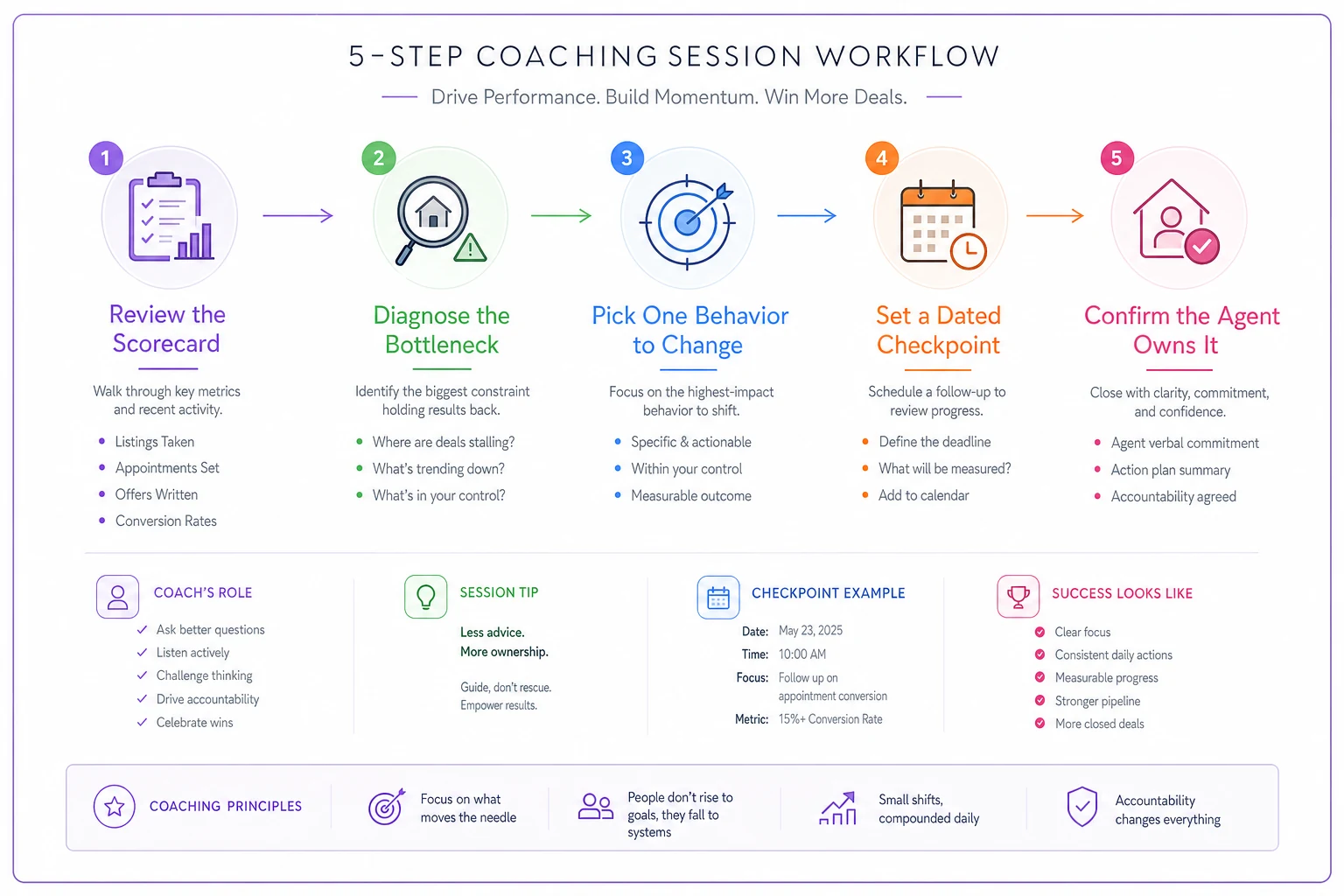
A simple flow like this keeps every coaching session consistent and time-boxed.
One more thing on tone. If the only time an agent gets a structured session is when they're in trouble, the session itself becomes a punishment signal. The best teams run the same structure with everyone periodically, so a coaching invite doesn't automatically mean "you're failing."
Career ladders by experience tier
Thresholds and coaching handle the downside. Career ladders handle the upside — and they solve a problem most brokerages don't even name: agents plateau because they can't see what's next. There's no "next level," no clear standard for what separates a competent agent from a standout one at your shop. So they drift, or they leave for somewhere that seems to offer a path.
A career ladder makes progression concrete. Here's a rough tiering that maps to how agents actually develop:
| Tier | Typical experience | Focus | What "graduating" looks like |
|---|---|---|---|
| Tier 1 — Ramp | 0–6 months | Learn the systems, build first pipeline | Consistent weekly activity, first few closings |
| Tier 2 — Producer | 6–24 months | Reliable production, sphere development | Steady pipeline, repeat/referral business starting |
| Tier 3 — Established | 2–5 years | Efficiency, higher price points, referrals | Predictable annual production, minimal oversight |
| Tier 4 — Lead / Mentor | 5+ years | Team leadership, mentoring, brand | Mentors newer agents, drives team standards |
The scorecard thresholds should differ by tier. Holding a six-month agent to a veteran's pipeline expectations is unfair and demoralizing; holding a veteran to rookie activity targets is a waste. A Tier 1 agent's green might be "15 conversations a week and 2 appointments." A Tier 3 agent's green might be entirely about pipeline value and referral ratio, with far less emphasis on raw dial counts.
This also ties back to onboarding. The Ramp tier is really just the extension of a solid first-30-days system — the same milestones and shadowing structure covered in getting new agents revenue‑ready in 30 days become the Tier 1 scorecard. The handoff from onboarding to performance management should feel seamless; it's the same funnel, just measured over a longer window.
The insight most owners miss: a career ladder isn't primarily a retention tool for top agents. It's a clarity tool for everyone. When an agent knows exactly what Tier 3 requires, ambiguity disappears. Coaching conversations get easier because you're both looking at the same standard. And underperformance becomes less about "you're not good enough" and more about "here's the specific gap between where you are and the next tier."
Where this system tends to break
A few honest failure points, because no system survives contact with a busy brokerage unchanged:
-
Data entry. Scorecards are only as good as the CRM behind them. If agents don't log conversations and appointments, your leading indicators are fiction. This is the number one reason performance systems quietly die.
-
Threshold drift. Thresholds set in a hot market become meaningless in a slow one. Recalibrate at least seasonally, and be explicit when you do.
-
Broker inconsistency. If thresholds get enforced for some agents and not others, the whole system loses legitimacy fast.
-
Over-measurement. Every metric you add is a metric someone has to maintain and someone has to review. Cap it ruthlessly.
The data entry problem is worth sitting with. Scorecards usually fail not because managers don't care but because pulling the numbers together every week is tedious manual work — exporting from the CRM, copying into a spreadsheet, color-coding cells by hand. That takes an hour or two a week, so it slips, and then the system quietly dies.
Automate the scorecard pull from your CRM to remove the manual weekly export step that causes most systems to fail.
This is where the right operational software actually earns its keep. A platform that pulls activity data directly from the CRM and computes each agent's status against their tier's thresholds — flagging yellows and oranges automatically — removes the manual burden that kills these systems. Threshold rules can trigger a coaching-session prompt on their own, so intervention happens the week a metric trips instead of whenever the broker happens to remember. It doesn't replace the coaching conversation; it just makes sure the conversation actually gets scheduled.
When this makes sense — and when it doesn't
This full system is overkill for a solo agent or a two-person shop. If you can see everyone's pipeline in your head and coach over coffee, formal thresholds add bureaucracy without much benefit.
It starts paying off around four or five agents — the point where intuition stops scaling and problems start hiding. It becomes genuinely essential at a second office or any time team leads are managing agents on your behalf, because now performance standards have to be transferable, not locked in one person's judgment.
One group that should not rush into this: brokerages whose CRM data is a mess. Building thresholds on top of unreliable activity data just automates bad conclusions. Fix the data hygiene first, then layer performance management on top of clean inputs. A scorecard built on numbers nobody trusts is worse than no scorecard at all — it manufactures false confidence.
A real scenario
A mid-size residential team — around nine agents, two of them newer — had a recurring pattern: agents would go quiet for a couple of months, and the broker wouldn't catch it until a monthly pipeline review showed an empty column. By then the agent had usually lost most of a quarter.
They set up a weekly scorecard with five leading metrics and simple color thresholds, tiered by experience. Nothing fancy at first — just a shared view everyone looked at every Monday. The immediate change was that "yellow" agents got a quick nudge in their 1:1 instead of a crisis conversation eight weeks later.
Over the following two quarters, the number of agents hitting red dropped noticeably — roughly cut in half — mostly because problems got caught at yellow and orange while they were still fixable. Two agents who'd been quietly drifting turned around after a single templated coaching session that identified their actual bottleneck: both had plenty of appointments set, almost none held. The newer agents also ramped faster because the Tier 1 scorecard gave them a concrete weekly target instead of a vague "go get business." Nobody's income jumped overnight — that's not how the funnel works — but the pipeline stopped surprising everyone, which was the whole point.
Bringing it together
Performance management works when it's a rhythm, not a reaction. Weekly scorecards make the front of the funnel visible so you're watching leading indicators instead of mourning lagging ones. KPI thresholds turn intervention into a rule rather than a mood, which gets you in early and removes the sting. Templated coaching keeps those conversations focused on the one bottleneck that matters. And career ladders give everyone — not just the strugglers — a clear standard to aim at.
None of these parts work alone. A scorecard with no thresholds is just a chart. Thresholds with no coaching template produce awkward, unproductive meetings. Coaching with no career ladder fixes this week's problem but leaves agents with nowhere to grow. The value is in the whole system: visible metrics feeding defined triggers feeding structured conversations feeding a clear path forward. Build it once, keep the metric count small, keep your data clean, and you stop being the broker who finds out about problems from the P&L.
Performance management works when it's a rhythm, not a reaction. Weekly scorecards make the front of the funnel visible so you're watching leading indicators instead of mourning lagging ones. KPI thresholds turn intervention into a rule rather than a mood, which gets you in early and removes the sting. Templated coaching keeps those conversations focused on the one bottleneck that matters. And career ladders give everyone — not just the strugglers — a clear standard to aim at.
None of these parts work alone. A scorecard with no thresholds is just a chart. Thresholds with no coaching template produce awkward, unproductive meetings. Coaching with no career ladder fixes this week's problem but leaves agents with nowhere to grow. The value is in the whole system: visible metrics feeding defined triggers feeding structured conversations feeding a clear path forward. Build it once, keep the metric count small, keep your data clean, and you stop being the broker who finds out about problems from the P&L.
Ready to elevate your real estate business?
Join 2,000+ agencies using TryRealy to streamline operations, close deals faster, and deliver exceptional client experiences.