



Most small agencies don't have a prioritization problem on paper. They have one in practice. Ask any agency manager how they decide where marketing dollars go and you'll usually hear something like "the sellers who push hardest get the most" or "we spread it around so nobody complains." Both approaches quietly bleed money.
Not every listing deserves the same effort, and treating them equally is a decision — just a bad one. A $1.2M listing in a competitive zip code and a $290K condo that's been sitting for 60 days both pulling from the same marketing pool means one of them is being overfunded and the other underfunded. Without doing the math, you can't tell which is which.
This piece is about building that math into a system. Not a spreadsheet you fill in once and forget, but a repeatable way to score listings, tier your service commitments, allocate budget with actual rules, and escalate the rare opportunity that breaks the mold. Less exciting than a new lead-gen tactic, but it's what determines whether your marketing spend compounds or evaporates.
Why "everyone gets the same package" quietly loses money
A pattern that shows up in agencies doing 40–150 transactions a year: they build one listing package. Photos, a video walkthrough, three weeks of social ads, a Zillow boost. Every seller gets it. Feels fair, easy to explain.
The problem is that listing outcomes aren't evenly distributed. A small share of your listings drive most of your commission, referrals, and future business. Some listings would sell with a yard sign. Others are borderline and need real investment to move. When you spend identically across all three groups, you overspend on the easy ones, underspend on the winnable ones, and waste the budget entirely on listings that were mispriced from the start — and needed a price conversation, not more ad spend.
A typical example: an agency puts roughly $600 of paid promotion behind every listing. Out of 20 active listings, maybe 6 were always going to close fast, 4 had pricing problems no ad could fix, and 10 were genuinely responsive to marketing. That's around $6,000 spent on listings that either didn't need help or couldn't be helped — money that should have gone toward the 10 that actually moved based on effort.
That's the core reason to prioritize your real estate listings marketing budget deliberately: your spend has wildly different return depending on the listing, and flat allocation ignores that completely.
The two things you're actually scoring
Prioritization gets messy when people try to rank listings on a single number. A pure "expected commission" ranking pushes everything toward luxury inventory and starves the mid-market listings that keep referrals flowing. A pure "how much does the seller want it" ranking rewards the loudest client, not the smartest investment.
Never miss a showing or follow-up again.
TryRealy helps you schedule, track, and manage every client interaction smoothly.
- Unified property and client management
- Automated client notifications
- Integrated sales pipeline tracking
No credit card required
Score two separate dimensions and keep them separate:
-
ROI potential — what this listing is likely to return relative to what it costs to market. Commission size, probability of closing, time-to-close, and marginal impact of spend.
-
Strategic fit — what this listing does for the business beyond the commission. A listing in a farm area you're trying to own, a repeat seller, a builder relationship, a property type that generates buyer leads.
A listing can be high ROI and low strategic fit — a one-off luxury sale from an out-of-area seller. Or low ROI and high strategic fit — a modest home from a past client who refers several people a year. You want to see both numbers before you decide anything.
An ROI + strategic-fit scoring model you can actually run
Keep the scoring light enough that a coordinator can do it in five minutes per listing. If it takes longer, nobody will do it consistently, and inconsistent scoring is worse than none.
Score each listing 1–5 on the factors below, then weight them.
| Factor | Dimension | Weight | What a 5 looks like |
|---|---|---|---|
| Expected commission | ROI | 25% | Top-tier for your market |
| Close probability | ROI | 20% | Priced right, clean condition, motivated seller |
| Time-to-close estimate | ROI | 15% | Likely under 30 days |
| Marketing responsiveness | ROI | 10% | Great photos + ads will meaningfully move interest |
| Repeat/referral source | Strategic | 15% | Past client or strong referral partner |
| Geographic/farm value | Strategic | 10% | In an area you're actively trying to dominate |
| Lead-generation value | Strategic | 5% | Property type that pulls buyer leads regardless of sale |
Multiply each score by its weight, sum it, and you get a number between roughly 1 and 5. The exact figure isn't what matters — what matters is that two people scoring the same listing land close to each other, and that you can now rank 20 listings and actually see the shape of your inventory.
One thing worth watching: "close probability" and "marketing responsiveness" are where honesty breaks down most often. Agents inflate them because they like the listing or the seller. Tie those scores to something observable — days on market for comparable listings, whether the price is within 3% of the CMA, whether the property is actually photo-ready. Once scoring becomes a feelings exercise, the model stops working.
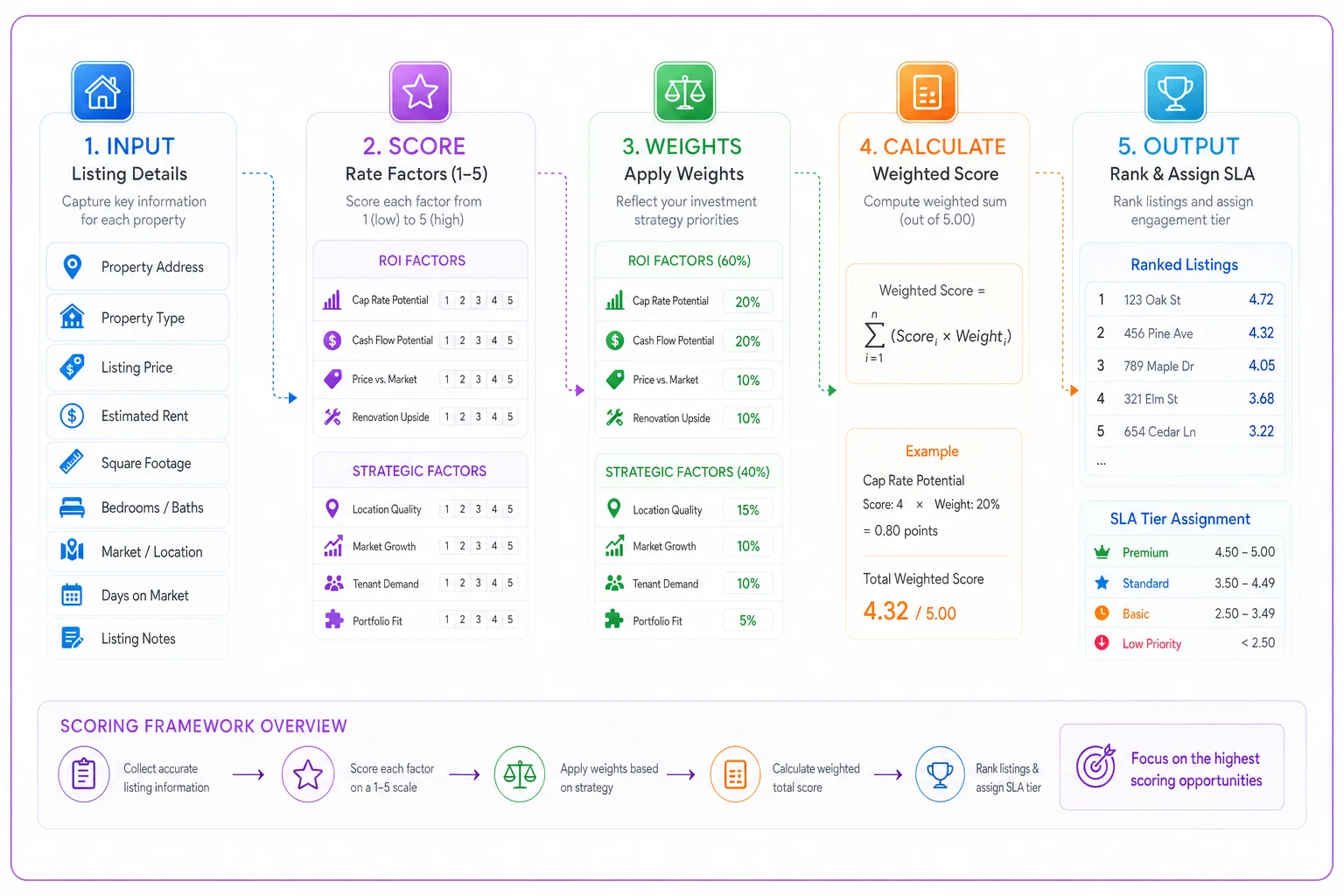
A quick visual of the scoring flow helps coordinators get the steps right and makes training fast.
Keep a short checklist (pricing check, photo-readiness, referral status) visible when scoring to keep the process objective and under five minutes.
Once scoring becomes a feelings exercise, the model stops working.
Turning scores into SLA tiers
A score by itself doesn't change anything. What changes behavior is connecting the score to a service level — a defined commitment about what the agency does, how fast, and with what resources. Three tiers is usually enough. Four gets confusing.
Tier A (Priority) — top ~20% of scores. Fastest turnaround, best vendors, largest budget share. Professional photography plus video or a floorplan, launched within 48 hours of listing agreement. Weekly performance review. Fastest inquiry response.
Tier B (Standard) — the middle ~60%. Solid photography, standard ad spend, launch within 3–4 business days. Reviewed every two weeks. This is your baseline package and where most of your inventory lives.
Tier C (Lean) — bottom ~20%. Usually mispriced, low motivation, or genuinely easy to sell. Minimal paid spend, standard photos, and — more importantly — an early price or expectation conversation rather than more marketing. Reviewed monthly unless something changes.
| Tier | Launch SLA | Photography | Paid budget share | Review cadence |
|---|---|---|---|---|
| A – Priority | ≤48 hrs | Pro + video/floorplan | ~50% of pool | Weekly |
| B – Standard | 3–4 days | Pro photos | ~40% of pool | Biweekly |
| C – Lean | 5–7 days | Standard photos | ~10% of pool | Monthly |
The launch speed on Tier A matters more than people expect. Getting a well-prepared listing live fast is its own competitive edge — the 48-hour listing prep SOP exists precisely because the first week of exposure is when most buyer interest peaks. Priority listings should never be sitting in a coordinator's backlog.
Tier C isn't punishment. Some of those listings just need a pricing decision, and pouring ad money into a mispriced home is the most common budget leak in the business. Lean treatment plus an honest seller conversation is the right call — not a smaller version of the standard package.
Sample budget allocation rules
Percentages are cleaner than fixed dollars because they scale with your monthly marketing pool. Say you run roughly $8,000 a month across active listings. Rules like these keep allocation sane:
-
Cap any single Tier B or C listing at no more than 8% of the monthly pool. Prevents one squeaky seller from vacuuming up the budget.
-
Reserve about 10% as an escalation fund — more on that below — that isn't allocated at the start of the month.
-
Never fund a Tier C listing's paid ads beyond a minimal floor until a price adjustment or condition fix happens.
-
Reallocate mid-cycle. If a Tier A listing goes under contract in week one, its remaining budget rolls to the next-highest unfunded listing, not back into a general slush pile.
-
Track spend-to-outcome per tier, not per listing. You want to know whether Tier A dollars are actually returning faster closings, or whether your scoring is off.
Rule five is the one agencies skip, and it's the one that makes the whole system improve over time. If your Tier A listings aren't closing faster or generating more, your close-probability scoring is probably inflated and needs to be recalibrated.
Escalation criteria for exceptional opportunities
Every so often something comes in that doesn't fit the model — a listing that could reset your presence in a neighborhood, a builder with 12 units coming, a referral from a source you've wanted for years. Rigid systems fail here because the coordinator applies the standard tier and the agency misses a franchise-level opportunity.
So you build an explicit escape hatch. An opportunity qualifies for escalation if it clears two or more of these:
-
Commission potential is roughly 3x your average, or it's a multi-unit or portfolio deal
-
It opens or deepens a repeatable channel — builder, relocation company, key referral partner
-
It establishes presence in a target farm area where you currently have little visibility
-
Losing it would hand a competitor a meaningful strategic foothold
When something qualifies, it goes to the agency manager — not the queue. It can draw from the reserved escalation fund, jump the launch SLA, and get resources outside normal tier limits. The key discipline: escalation requires a named decision-maker signing off, so "exceptional" doesn't quietly become "whatever the loudest agent wants this week."
A real scenario
A five-agent brokerage in a mid-size metro was running about 25 active listings and a marketing budget somewhere in the $7k–$9k range each month, spread evenly. Average days-on-market sat in the low 50s and they felt constantly behind on the listings that actually mattered.
They scored their inventory for one quarter. The exercise surfaced that roughly a third of the budget was going to listings that were either going to sell fast anyway or were mispriced and unresponsive to marketing. They shifted to the three-tier model, concentrated spend on Tier A, and had honest price conversations on most of the Tier C group.
By the end of the quarter, Tier A days-on-market had dropped into the mid-30s and total ad spend was actually a bit lower because they stopped funding listings that couldn't be helped. Two mispriced Tier C homes got price cuts within the first two weeks instead of sitting for months. Nothing dramatic overnight, but the pattern was clear: the same money, aimed better, moved the right listings faster.
Where this system breaks down at scale
At 20–30 listings, one person can score inventory and manage tiers by hand. Push past 50 active listings across multiple agents and the manual version cracks in predictable places.
-
Scoring drift. Different agents score the same factors differently, and Tier A quietly balloons because everyone thinks their listing is priority. Without a shared definition of a "5," the tiers stop meaning anything.
-
SLA slippage. Nobody's tracking whether Tier A listings actually launched in 48 hours. The commitment exists on paper and disappears in practice.
-
Budget reconciliation lag. By the time someone tallies where the money went, the month is over and the reallocation rules never fired.
-
Escalations that never get reviewed. The exceptional opportunity sits in an inbox because the sign-off step has no owner.
This is where a shared operational platform earns its place — not as a magic fix, but as the thing that keeps scoring consistent, flags SLA breaches before they compound, and shows spend-by-tier without a month-end scramble. AI-assisted workflows can handle the tedious parts: pulling comparable days-on-market to sanity-check a close-probability score, nudging when a Tier A listing hasn't launched on schedule, or rolling unspent budget to the next-priority listing automatically. The judgment stays human; the coordination and drift-catching get automated.
The point isn't the software. Prioritization only compounds when the scoring stays honest and the SLAs actually hold — and both of those get harder with every listing you add.
When this approach makes sense — and when it doesn't
This makes sense when you're consistently running more listings than your budget can fully fund, when you have a real mix of price points and seller motivations, and when you've noticed your best opportunities getting the same treatment as your throwaways.
This is overkill when you're doing a handful of listings a year and can genuinely give every one full attention. At that volume, formal scoring is just bureaucracy. Make sure your listings are actually compelling — a strong property description and a solid QA pass will do more for a small book of listings than any tiering model.
Who should be careful: agencies where the scoring will get politicized. If your agents will fight to classify every listing as Tier A, you need the scores tied to observable data and a manager willing to hold the line — otherwise you've just added a spreadsheet to the same flat-allocation problem you started with.
Bringing it together
Prioritization isn't about being stingy with certain sellers. It's about acknowledging that your marketing budget, your best vendors, and your team's attention are finite — and that spreading them evenly guarantees you underfund the listings most worth funding.
Score on ROI and strategic fit separately. Turn those scores into two or three service tiers with real launch and review commitments. Set budget rules that cap the greedy listings and protect a reserve for the rare opportunity that deserves to break the rules. Track spend-to-outcome by tier so the system actually improves over time instead of calcifying into another process nobody trusts.
The agencies that win here aren't the ones with the biggest budgets. They're the ones who aim an ordinary budget with unusual discipline.
The agencies that win here aren't the ones with the biggest budgets. They're the ones who aim an ordinary budget with unusual discipline.
Ready to elevate your real estate business?
Join 2,000+ agencies using TryRealy to streamline operations, close deals faster, and deliver exceptional client experiences.