



Most small agencies don't fail because they lack good agents. They fail because the operational load grows faster than the systems underneath it. You add three agents, close a few more deals, and suddenly nobody knows who owns the closing checklist, listings slip through cracks, and your best producer is spending Sunday nights fixing CRM data instead of prospecting.
An operations maturity roadmap for real estate isn't a binder of SOPs. It's a sequencing problem. What do you build first? What can wait? What's the point of writing a vendor scorecard if your lead intake is still leaking? This is a 12-month plan built around dependencies — where each month's work makes the next month's work possible.
The real point isn't the timeline itself. It's understanding why the order matters. Build things out of sequence and you'll waste effort documenting processes that get thrown out three months later.
Why sequencing beats "just write everything down"
The classic mistake is treating operations maturity like a documentation sprint. Somebody reads a productivity book, decides the agency needs SOPs, and spends a weekend writing 40 documents nobody opens again.
The pattern that keeps showing up: agencies stuck at 4-6 agents almost always have plenty of documentation. What they lack is a taxonomy — a way to organize processes so the right one surfaces at the right moment — plus the meeting rhythms and ownership rules that keep documents alive.
In real operations, maturity moves through rough stages:
| Stage | Team size | What's usually broken | What to build next |
|---|---|---|---|
| Founder-run | 1-3 | Everything lives in the owner's head | Core SOP taxonomy + intake ownership |
| First hires | 4-6 | Handoffs fail, data goes stale | RACI, meeting cadence, CRM guardrails |
| Structured | 7-12 | Coaching and quality inconsistent | Scorecards, KPIs tied to action, automation |
| Scaling | 12+ | Bottlenecks move to management | Delegated ownership, escalation systems |
Most of this roadmap targets the jump from founder-run to structured, because that's where the majority of agencies stall — and where a bad sequence does the most damage.
Before you touch a single SOP, get your taxonomy right. Without a naming and ownership structure, everything you write becomes clutter. The operations manual taxonomy and RACI guide covers the structural piece in detail — treat it as prerequisite reading before month one.
The prioritized backlog (build this before you build anything)
Every roadmap needs a backlog, and the mistake agencies make is prioritizing by what's annoying today instead of what's load-bearing. A load-bearing process is one that other processes depend on. Fix those first.
Never miss a showing or follow-up again.
TryRealy helps you schedule, track, and manage every client interaction smoothly.
- Unified property and client management
- Automated client notifications
- Integrated sales pipeline tracking
No credit card required
-
Lead intake and ownership — nothing downstream matters if leads leak
-
CRM data standards — every report and automation depends on clean data
-
Listing-to-close workflow — your revenue engine, the most expensive thing to get wrong
-
Onboarding SOP — determines how fast new hires become productive
-
Meeting rhythms — the connective tissue that keeps everything synced
-
Performance and coaching structure — only useful once the above exist
-
Vendor and creative pipelines — important but rarely the actual bottleneck
-
Automation targets — comes last because you automate stable processes, not chaos
That last point trips up a lot of owners. Automating a broken process just makes it break faster. You have to stabilize a workflow manually before you hand any part of it to software.
Months 1-3: Stabilize the foundation
Month 1 — Map reality, not the ideal
Don't write SOPs yet. Spend the first month documenting how things actually work, mess included. Sit with each person and trace what happens when a lead comes in, when a listing goes live, when a deal goes under contract.
You're building a taxonomy skeleton: broad categories (Lead Management, Listings, Transactions, Marketing, People) with sub-processes underneath. No detail yet — just the map.
Agencies almost always discover invisible work during this phase. Someone's been manually reconciling two calendars every morning. Someone else re-enters lead data across two systems. This invisible work is where your first automation targets will eventually come from, but for now, just catalog it.
When mapping reality, shadow a day of work with each role to surface invisible handoffs quickly.
Month 2 — Fix intake and CRM standards
Now fix the two load-bearing systems. Set intake ownership — who responds, in what time window, with what fallback — and CRM data standards: required fields, naming conventions, what "closed" actually means in your system.
Set a concrete adoption KPI here: lead response within the SLA window on 90%+ of new leads. That single number tells you whether the intake fix actually stuck.
A typical example — an agency with four agents was losing roughly 1 in 5 portal leads to slow or missed responses. After assigning intake ownership and a shared response window, missed leads dropped to the low single digits within about six weeks. No software required, just clear ownership.
Month 3 — Establish the meeting rhythm
Meetings are where coordination lives or dies. You need three rhythms:
-
Daily standup (10-15 min) blockers and today's priorities only
-
Weekly ops review (45 min) pipeline, SLA adherence, stuck deals
-
Monthly maturity review (60-90 min) roadmap progress, what shipped, what's next
The mistake most owners make is running the weekly meeting but skipping the monthly. Without it, the roadmap quietly dies. Nobody's accountable for progress and you drift back to firefighting.
First 30/60/90 checkpoint:
-
30 days taxonomy skeleton exists, invisible work catalogued
-
60 days intake ownership live, CRM standards enforced, response SLA hitting 90%+
-
90 days three meeting rhythms running, monthly review has happened at least once
The mistake most owners make is running the weekly meeting but skipping the monthly. Without it, the roadmap quietly dies. Nobody's accountable for progress and you drift back to firefighting.
Months 4-6: Build the revenue and people systems
Month 4 — Document the listing-to-close spine
This is your revenue engine, so it gets the most rigorous documentation. Map every stage from signed agreement to funded closing, with owners at each handoff. The specific failure to design against is the silent handoff — where a task moves between people and nobody explicitly owns the transition. That's where deals stall.
Assign a RACI to each stage. Responsible, Accountable, Consulted, Informed. It sounds bureaucratic for a small team, but the accountable column is what stops "I thought you had it" from killing a closing.
Month 5 — Onboarding and hiring scorecards
If you plan to grow, you need two things before you hire: an onboarding SOP that gets someone productive fast, and a hiring scorecard that defines what "good" looks like before you're emotionally attached to a candidate.
| Dimension | Weight | What you're measuring |
|---|---|---|
| Pipeline discipline | 30% | Follows process, logs activity |
| Conversion skill | 25% | Tour-to-offer, objection handling |
| Coachability | 20% | Applies feedback within weeks |
| Culture/reliability | 15% | Shows up, communicates |
| Self-sourcing | 10% | Generates own leads |
The point of weighting is to force honesty. Most agencies over-index on charisma and under-index on pipeline discipline, then wonder why the charming hire never logs anything in the CRM.
Month 6 — Performance thresholds and coaching
Now that documentation and onboarding exist, layer on performance management: KPI thresholds, coaching cadence, and a simple career ladder so agents can see a path forward.
One thing worth understanding — covered in detail in our breakdown of which real estate KPIs actually mislead small agencies — is that most agencies track vanity metrics that feel good but don't drive action. Watch leading indicators (appointments booked, pipeline added) over lagging ones (closed volume), because by the time closed volume drops, it's already three months too late to coach.
Second 30/60/90 checkpoint:
-
30 days listing-to-close spine documented with RACI
-
60 days onboarding SOP live, hiring scorecard drafted
-
90 days KPI thresholds set, first coaching cycle complete
One thing worth understanding — covered in detail in our breakdown of which real estate KPIs actually mislead small agencies — is that most agencies track vanity metrics that feel good but don't drive action. Watch leading indicators (appointments booked, pipeline added) over lagging ones (closed volume), because by the time closed volume drops, it's already three months too late to coach.
Months 7-9: Automation and coordination at scale
Now — and only now — do you start automating. Your processes are stable, your data is clean enough to trust, and you know from month one exactly which manual tasks eat the most time.
Choosing automation targets
The rule: automate the repetitive, high-frequency, low-judgment tasks first. Leave anything requiring nuance alone. Good early candidates:
-
Appointment confirmations and reminders
-
Lead routing based on source or area
-
CRM data-hygiene checks (flagging missing required fields)
-
Post-showing feedback requests
-
Nightly syncs between systems
This is where an AI-assisted operational platform starts earning its place — not as a magic button, but as a way to take the invisible work you catalogued in month one off human plates. When your workflows are already defined, automation slots into the gaps cleanly instead of bolting chaos onto chaos. The agencies that do this well treat it as removing coordination overhead, not adding a new tool to babysit.
The automation scorecard
Before you automate anything, score it:
| Task | Frequency | Time per instance | Error-prone? | Judgment needed? | Automate? |
|---|---|---|---|---|---|
| Showing confirmations | Daily | 3-5 min | Yes | Low | Yes |
| Lead routing | Hourly | 2 min | Yes | Low | Yes |
| Pricing decisions | Weekly | 30 min | No | High | No |
| Data-field checks | Daily | 10 min | Yes | Low | Yes |
Anything high-frequency and low-judgment goes to the top. High-judgment tasks stay human, always.
Months 8-9 — Coordination systems
As you cross 8-10 people, the bottleneck shifts from doing the work to coordinating who does it. This is where centralized information matters most. If your listing status, lead ownership, and task assignments live in five different places, no meeting rhythm can save you.
The goal is a single source of truth where anyone can see the state of any deal without asking. That's less a software feature and more a discipline — but a decent platform makes the discipline easier to hold.
Here's a simple workflow to visualize how automation and coordination fit together:
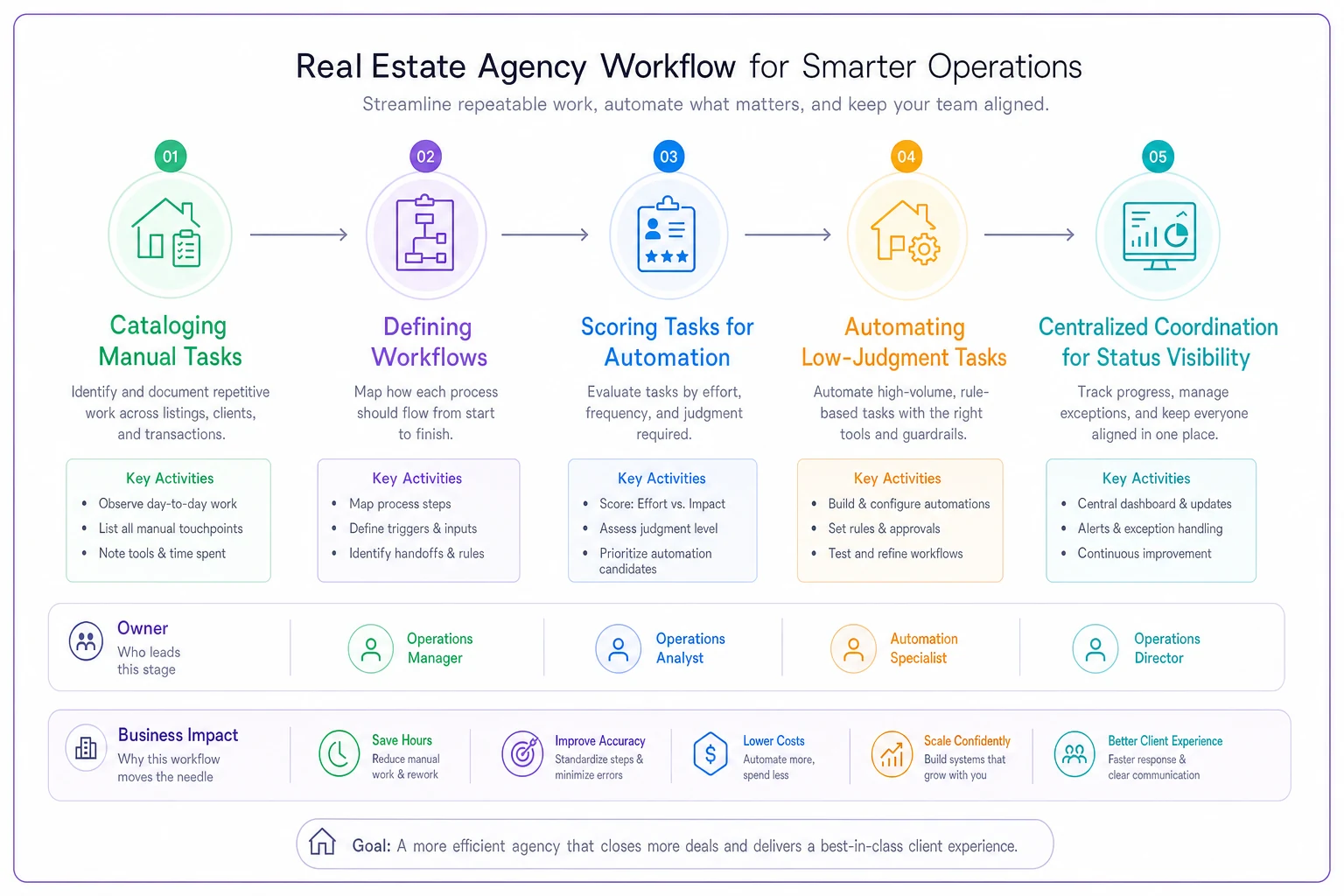
When your workflows are already defined, automation slots into the gaps cleanly instead of bolting chaos onto chaos.
Months 10-12: Delegate, measure, and harden
Month 10 — Delegate ownership
By now the owner is still the bottleneck for too many decisions. This month is about handing off entire process areas to owners who run them independently, reporting up through the monthly review rather than requiring constant sign-off.
One caveat: if you haven't built the scorecards and KPI thresholds yet, don't delegate yet. You'll just lose visibility. Delegation without measurement is abdication.
Month 11 — Adoption KPIs, seriously this time
A roadmap means nothing if people quietly ignore it. Track adoption directly:
-
SOP usage are documented processes actually being followed?
-
SLA adherence intake response, showing confirmations, closing milestones
-
Data quality score percentage of records passing required-field checks
-
Meeting attendance and follow-through are action items actually closing?
If SOP adoption is under 70%, the problem is usually that the SOP is too long or too hard to find — not that people are lazy. Fix the taxonomy and the friction, not the people.
Month 12 — Harden and plan the next cycle
The final month is a full maturity review. What held? What broke under load? Where did handoffs still fail?
Rebuild the backlog for year two based on where the new bottlenecks are — because they will have moved. The whole point of running a structured review at month twelve is that the answer to "what's next" should be obvious from the data, not from gut feel.
A real scenario
A five-agent brokerage was closing decently but the owner worked roughly 60-hour weeks and personally touched every transaction. Deals occasionally slipped past deadlines, and two closings nearly fell apart from missed contingency dates.
They ran a version of this roadmap over about ten months. The first two quarters were pure foundation — intake ownership, CRM standards, the listing-to-close spine with clear handoffs. No automation at all early on.
By month eight they'd automated confirmations, reminders, and data-hygiene flags. The owner's hours dropped from around 60 to something closer to 45, missed deadlines became rare, and — the part that actually mattered — they added two agents without the usual chaos, because onboarding and ownership were already defined.
Nothing about it was dramatic month to month. That's the honest truth of operations maturity: it's boring, sequential work that compounds.
When this roadmap makes sense (and when it doesn't)
It makes sense when you're between 3 and 12 people, feeling the strain of growth, and the owner is clearly the bottleneck. That's the sweet spot.
It's a bad idea when you're a solo agent or a two-person shop. At that scale this is overkill — you'll spend more time on process than the process saves. Build the taxonomy skeleton, fix intake, and skip the rest until you're actually hiring.
Who should avoid this entirely: anyone hoping to shortcut it. You can't jump to month nine's automation without months one through six. The sequence is the strategy. Skip the foundation and you'll end up automating your problems instead of your processes.
The real work of an operations maturity roadmap isn't the SOPs or the tools — it's building things in the order where each piece makes the next one possible. Get the sequence right and the systems hold together on their own. Get it wrong and you're just documenting the chaos in nicer fonts.
Ready to elevate your real estate business?
Join 2,000+ agencies using TryRealy to streamline operations, close deals faster, and deliver exceptional client experiences.