



Most real estate agencies run on tribal knowledge and good intentions. The experienced agent who knows every escrow quirk, the office manager who remembers which title company responds fastest, the broker keeping all the compliance dates in their head. It works fine — until that agent leaves, the office manager gets sick during closing season, or you try bringing on three new agents at once.
Building an operations manual feels like organizing your garage. You know it needs doing, but there's always something more urgent. The difference is your garage won't cost you deals when it's messy.
What makes this particularly painful in real estate is that every process touches multiple people. The listing coordinator starts something, the agent continues it, the transaction coordinator finishes it — and if any of them interprets the process differently, deals slow down or fall through. Without clear documentation, you're essentially playing telephone with commission checks.
Why real estate operations break differently than other businesses
Real estate agencies face a genuinely unusual operational challenge. Unlike restaurants where processes repeat daily or dental offices with predictable appointment flows, real estate operations swing wildly between feast and famine. One week you're managing twelve active listings, the next it's three. Processes need to scale up and down without breaking.
The independent contractor model makes this worse. Agents aren't employees you can mandate to follow procedures — they're essentially running mini-businesses under your roof, each with their own methods, tools, and communication styles. Creating an operations manual that respects that independence while still maintaining consistency is genuinely difficult.
Then there's the compliance layer. Most businesses deal with one set of regulations. Real estate agencies juggle state licensing requirements, MLS rules, fair housing laws, RESPA guidelines, local disclosure requirements, and broker-specific policies. Every process needs checkpoints that can't be skipped, even when you're rushing to meet a closing deadline.
The technology stack adds another wrinkle. Your CRM might talk to the MLS. Your transaction management software may or may not sync with document storage. There's a separate showing app, a commission tracking spreadsheet, and whatever new tool your most tech-savvy agent just discovered. Without operational guidelines, data lives in silos and nobody knows where to find anything.
Building your SOP taxonomy (without overengineering it)
The biggest mistake agencies make is trying to document everything at once. You end up with a 200-page manual nobody reads. Start with a simple taxonomy and let it grow.
Never miss a showing or follow-up again.
TryRealy helps you schedule, track, and manage every client interaction smoothly.
- Unified property and client management
- Automated client notifications
- Integrated sales pipeline tracking
No credit card required
Your core categories should mirror how work actually flows through your agency:
Lead to Client Operations Front-end processes — lead capture, initial response, qualification criteria, showing protocols, offer preparation. Keep these separate from back-end operations because they typically involve different people and need updating at different intervals.
Active Transaction Operations Everything from accepted offer to closing. Contract management, inspection coordination, appraisal processes, title and escrow communication, closing prep. These SOPs need the most detail because they involve the most moving parts and the highest stakes.
Administrative Operations Commission processing, MLS management, compliance tracking, file organization, technology management. Less urgent-feeling, but this is what keeps you legal and profitable.
Growth Operations Agent recruiting, onboarding new team members, training protocols, performance management. Most agencies ignore these until they're desperately trying to scale.
Within each category, use a simple numbering system. Lead operations might be the 100-series (101: First Contact Protocol, 102: Lead Qualification Criteria), transactions the 200-series, and so on. This makes updates easier and helps everyone reference the right procedure quickly.
Don't create subcategories until you actually need them. Some agencies build elaborate folder structures that contain three actual SOPs. Start flat, organize later.
Version control that actually works in the field
Nobody tells you this upfront: real estate agents will not check version numbers before following a procedure. They'll use whatever they downloaded six months ago or whatever's still bookmarked in their browser.
The solution isn't more sophisticated version control — it's designing around how people actually behave.
Use dates instead of version numbers in your file names. "Listing Prep SOP v2.3" means nothing to an agent in a hurry. "Listing Prep SOP - Updated Nov 2024" immediately tells them if they're working with something current. Keep that date visible in the document header too.
Maintain one source of truth. Don't let copies float around in email attachments, individual Google Drives, or desktop folders. One shared location, always current. When you update something, the old version goes into an archive folder — never deleted, but clearly marked as outdated.
Build in sunset dates. Every SOP should have a "Review by" date at the top. Not because the process will definitely change, but because it forces someone to confirm it's still accurate. Every six months initially, then annually once things stabilize.
Your change log doesn't need to be elaborate. A simple table at the bottom of each SOP is enough:
| Date | Change | Updated By | Reason |
|---|---|---|---|
| Nov 15, 2024 | Added step 4.2 for solar panel disclosures | Sarah M. | New state requirement |
| Oct 3, 2024 | Updated commission split calculation | Jim T. | Brokerage policy change |
| Sept 1, 2024 | Initial version | Maria L. | New SOP creation |
Enough context for anyone who needs it, without slowing down the people who just need to follow the process.
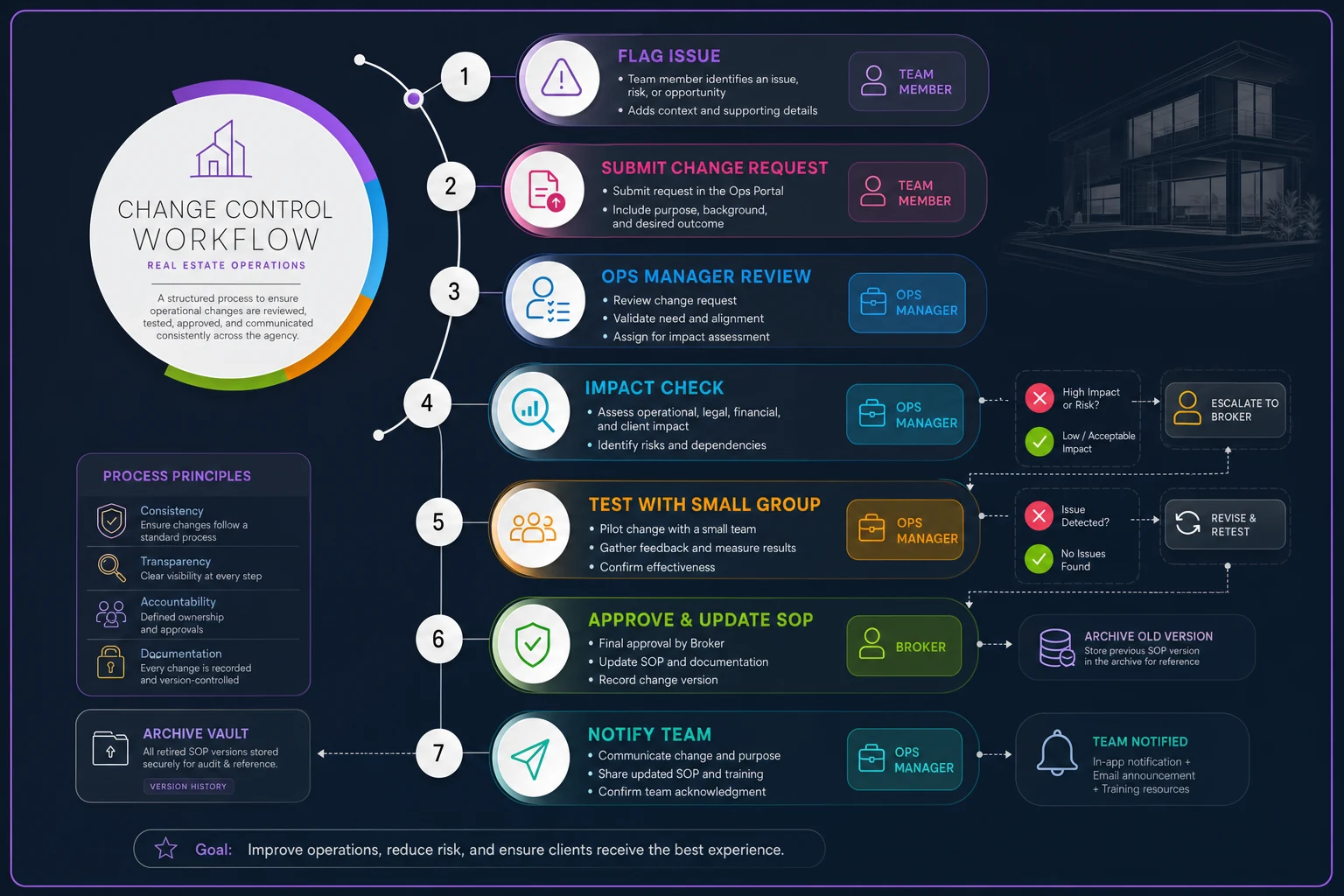
Change control workflow that prevents chaos
The fastest way to make your operations manual useless is letting anyone update it anytime. The second fastest is making updates so painful that nobody bothers reporting problems.
You need a middle ground.
Anyone can suggest changes, but they route through one person for approval — usually the broker or operations manager in smaller agencies. The request should answer three questions: What's broken? What should it do instead? Who does this affect?
Review on a monthly cycle unless something is critically broken. Batching updates prevents constant changes that confuse everyone and gives you time to think through ripple effects before they cause problems.
Before approving any change, map the downstream impacts. If you change how listings get entered into the MLS, does that affect your showing coordination process? Your photography checklist? Your metrics tracking? Real estate processes are more interconnected than they look.
-
[Team member flags issue]
-
[Submits change request]
-
[Ops manager reviews]
-
[Impact check]
-
[Test with small group]
-
[Approve & update SOP]
-
[Notify team]
Test changes with a small group first. Pick your most detail-oriented agent and your most technology-resistant one. If both can follow the new process, roll it out. If not, refine it.
Communication matters but keep it lean — a monthly "Ops Updates" email covering just what changed, not the entire procedure. Include the reasoning behind each change. Agents adopt new processes faster when they understand why, not just what.
RACI templates for real estate teams
RACI matrices feel corporate, but they solve a real problem: nobody knows who's supposed to do what. The listing agent assumes the TC is ordering the home warranty. The TC assumes the agent is. The client gets no warranty.
Here's a practical RACI template for listing preparation:
Listing Preparation RACI
| Task | Agent | Listing Coordinator | Marketing | Broker |
|---|---|---|---|---|
| Initial CMA | R | C | I | I |
| Listing agreement | A/R | C | - | C |
| Property photos scheduling | I | R | C | - |
| MLS entry | C | R | I | A |
| Marketing materials | C | C | R | A |
| Sign installation | I | R | - | - |
| Lockbox placement | R | C | - | - |
| Disclosures prep | R | A | - | C |
R = Responsible (does the work) A = Accountable (makes sure it's done right) C = Consulted (provides input) I = Informed (needs to know it's done)
Keep it simple. Not every task needs all four roles. Sometimes it's just R and A. The value comes from eliminating the assumption gaps that quietly kill deals.
Start with your five most problematic workflows — usually listing prep, offer negotiation, contract-to-close, new agent onboarding, and commission processing. These are where unclear responsibilities cost the most time and money. Update quarterly or whenever you add team members.
Mini playbook library: SOPs you can implement this week
Instead of building a comprehensive manual over several months, start with these five SOPs that solve immediate problems.
SOP #1: New Listing Intake (2-hour process)
Prevents the scramble when an agent calls saying they just signed a listing and need everything done yesterday.
Trigger: Agent notifies office of new listing agreement Timeline: All steps completed within 2 business hours
-
Agent submits listing intake form (property details, seller contact, desired list date, special instructions)
-
Listing coordinator creates shared folder with standard subfolders
-
Photography scheduled within 24 hours of desired list date
-
Compliance checklist generated based on property type
-
Marketing timeline created and shared with agent
-
MLS prep worksheet started
-
Transaction coordinator notified for pipeline planning
Handoffs: Agent → Listing Coordinator → Marketing (if applicable) → Back to Agent for review
SOP #2: Offer Presentation Protocol
Stops confusion around multiple offers and makes sure nothing falls through the cracks.
Trigger: Offer received on active listing Timeline: Seller notified within 30 minutes, presentation scheduled within 24 hours
-
All offers logged in tracking sheet with timestamp
-
Agent notified immediately via text and email
-
Offer summary sheet prepared (price, terms, contingencies, closing date)
-
Seller presentation scheduled
-
All parties notified of presentation date and time
-
Comparison matrix prepared if multiple offers
-
Follow-up communication sent to all buyer agents
Accountability: Agent accountable for seller communication, TC responsible for tracking and documentation
SOP #3: Weekly Pipeline Review
Keeps everyone aligned on what's active across all transactions.
Trigger: Every Tuesday at 9 AM Timeline: 30-minute meeting
-
Review all pending listings (expected list dates, missing items)
-
Review all properties under contract (upcoming deadlines, potential issues)
-
Flag any transactions at risk
-
Assign action items with deadlines
-
Update shared pipeline dashboard
-
Send summary email to all agents
Participants: Broker, all TCs, listing coordinator, available agents
SOP #4: Commission Disbursement Process
Eliminates delays and confusion around getting agents paid.
Trigger: Closing confirmed Timeline: Disbursement within 2 business days
-
Closing confirmation received from escrow
-
Commission statement prepared with all splits calculated
-
Outstanding fees or credits applied
-
Agent approval obtained via email
-
Checks or transfers processed
-
Commission record updated in tracking system
-
Year-to-date statement sent to agent
Controls: Broker approval required for any non-standard splits, accounting maintains all records
SOP #5: Escalation Protocol for Problem Transactions
Defines exactly when and how to raise red flags before deals die.
Trigger: Any transaction milestone missed or major issue identified Timeline: Immediate escalation
Level 1 (Agent handles): Buyer requests 24-hour extension on inspection deadline Level 2 (TC involves broker): Financing appears shaky, appraisal comes in low Level 3 (Full team response): Deal at risk of falling through, legal issues arising
Each level has specific notification requirements and response timelines. Write those out explicitly — "TC sends broker a text" is vague enough to fail at the worst moment. "TC calls broker directly and sends a written summary within 30 minutes" is something people can actually follow under pressure.
Making it stick without forcing compliance
The best operations manual in the world is worthless if nobody follows it. Real estate agencies can't rely on traditional enforcement — independent contractors will simply ignore processes they don't see value in.
Design processes that make life easier. If following the SOP takes longer than winging it, agents will wing it every time. Procedures should remove friction, not create it.
Make your operations manual part of new agent onboarding so adoption happens when habits are forming, not after bad ones are set.
New agent onboarding is a natural adoption point — they're eager to learn and haven't developed bad habits yet. Make your operations manual part of their first week, and frame it as "here's how we help you close deals faster" rather than "here are the rules you have to follow."
Start with SOPs that solve problems agents actively complain about. When they see the new listing intake process means they never have to chase down photography scheduling again, they'll buy into the system. Early wins matter.
Technology helps here too. AI-assisted workflow platforms can guide agents through processes without them needing to memorize every step. Automated reminders, task assignments, and status updates make following SOPs feel natural rather than burdensome — the software handles enforcement, but in a way that's actually useful rather than punitive.
Track adoption through outcomes, not compliance checklists. Instead of checking whether agents follow the offer presentation protocol, measure whether offers are being presented within 24 hours. Focus on results, and process adherence tends to follow.
When to systematize vs. when to stay flexible
Not everything needs an SOP. Over-documentation is just as damaging as under-documentation.
Systematize repeatable processes with legal or financial implications. Anything touching trust funds, fair housing, agency disclosure, or commission calculations needs clear documentation. These areas can't tolerate variation.
Systematize high-frequency activities. If something happens weekly, it needs a defined process. New listing intake, offer presentation, showing coordination — these repeat often enough that inconsistency creates real friction.
Stay flexible on relationship-based activities. How an agent builds rapport with clients, their personal marketing approach, their negotiation style — these don't need rigid procedures. Guidelines and best practices, sure, but not step-by-step SOPs.
Stay flexible on market-specific responses too. Your process for handling multiple offers in a seller's market should differ from a buyer's market. Build in decision points rather than rigid rules.
The test is straightforward: will variation in this process create legal risk, financial loss, or client service failures? If yes, systematize it. If not, provide guidelines and let agents adapt.
Growing from manual to platform
Google Docs and shared folders work when you're small, but they start breaking somewhere around 10 to 15 agents. Updates become a headache, nobody's sure if they're looking at the current version, and training new team members takes weeks instead of days.
Operational software built for real estate can maintain your SOPs as interactive workflows rather than static documents. Update a process once and it updates everywhere immediately. New agents can follow guided workflows without memorizing anything first.
The AI automation layer changes things further. Instead of agents having to remember to check the listing prep SOP, the system prompts them through each step at the right moment. Commission calculations happen automatically based on your documented rules. Compliance deadlines trigger without anyone consulting a calendar.
More practically, AI-powered platforms surface when your SOPs aren't matching reality. If agents consistently skip step 3 in your showing protocol, the system flags it. Either the step isn't necessary or your process needs refinement. That kind of feedback keeps your operations manual accurate rather than slowly drifting out of date.
The transition doesn't have to be abrupt. Digitize your most critical SOPs first. Run them in parallel with your existing documents for a month or so. Once agents see the efficiency gains, they'll push for the rest to follow.
Conclusion
Building a real estate operations manual isn't about perfect documentation — it's about reducing the chaos that kills deals and burns out teams. Start small, focus on processes that directly affect revenue, and build from there.
The agencies that hold up over the next few years won't necessarily be the ones with the most detailed SOPs. They'll be the ones whose SOPs actually get followed — because they're genuinely useful, regularly updated, and built into daily workflows rather than living in a binder nobody opens.
Whether you're managing this through spreadsheets and documents today or moving toward AI-assisted operational platforms, the fundamentals stay the same: clear ownership, consistent execution, and honest refinement when something isn't working.
The best time to start documenting your operations was when you first opened. The second best time is before your next busy season hits and everything falls apart again.
Ready to elevate your real estate business?
Join 2,000+ agencies using TryRealy to streamline operations, close deals faster, and deliver exceptional client experiences.