



Most small brokerages don't get a low valuation because they're bad businesses. They get a low valuation because nobody — including the owner — can actually explain how the money moves. Commissions get booked gross one month and net the next. CAC gets quoted off the top of someone's head. Churn is "we keep most of our clients, I think." And when a buyer or investor asks for a clean cohort view, the answer is three spreadsheets, a QuickBooks export, and a verbal story that doesn't reconcile.
That gap — between a real, profitable agency and a legible one — is where valuation quietly leaks. This is less about accounting and more about whether your operation can be understood by someone who wasn't in the room.
Why brokerage numbers are harder to normalize than people expect
The core problem is that real estate revenue is messy in ways most "unit economics" advice ignores. A SaaS company has clean MRR. You have commissions that split three or four ways, referral fees, team overrides, franchise royalties, and the occasional transaction where you ate half the co-op to keep a deal alive.
When you don't normalize that, two things happen. First, your margins look wildly different month to month for reasons that have nothing to do with actual performance. Second — and this is the one that kills deals — a sophisticated buyer will normalize it, and they'll do it conservatively, using assumptions that favor them.
A typical example: an agency reports "$1.4M in revenue." Dig in and about $520k of that is gross commission split with agents on an 80/20, so the brokerage kept closer to $280k on that chunk. Another $140k was referral and relocation fees with their own cost structure. If you present the gross number and let the buyer discover the splits, you've lost control of the story. If you present the normalized number first, you look like someone who knows their business cold.
The agencies that eventually sell well normalize before anyone asks. The ones that struggle wait until due diligence and then scramble to reconstruct three years of commission splits from memory and email threads.
Start with normalized commissions, not revenue
Before you can calculate anything useful, every dollar of revenue needs to be classified consistently. This is the foundation everything else sits on, and it's where most agencies get sloppy.
Never miss a showing or follow-up again.
TryRealy helps you schedule, track, and manage every client interaction smoothly.
- Unified property and client management
- Automated client notifications
- Integrated sales pipeline tracking
No credit card required
You want a standing rule for how each revenue type gets recorded:
-
Gross Commission Income (GCI) — total commission on a transaction before any split
-
Company Dollar — what the brokerage keeps after agent splits (this is your real top line for valuation)
-
Referral income — net of any outbound referral costs
-
Ancillary — mortgage, title, property management, whatever side revenue exists, each tracked separately
-
Pass-through costs — co-op concessions, marketing credits, anything that reduces net before it ever hits margin
The thing most owners miss: company dollar, not GCI, is what gets a multiple applied to it. An agency doing $3M GCI at a 70/30 split and an agency doing $1.8M GCI at a 100% split with desk fees can produce nearly identical company dollar — but the first one feels bigger, and the owner is usually surprised when the valuation comes in similar.
Normalize splits by agent tier too. A buyer cares enormously whether your profit depends on three rainmakers on 90/10 splits (fragile) or forty agents on standard splits (durable). Same company dollar, very different risk, very different multiple.
Building the unit-economics templates that actually matter
Once revenue is classified, you can build the templates that turn operations into numbers an investor trusts. Four of them carry most of the weight.
CAC that includes the stuff owners pretend isn't CAC
Most brokerages calculate CAC as "ad spend divided by closings." That number is almost always wrong because it ignores the real cost of acquiring a client: portal lead fees, the ISA or showing assistant's time, the splits paid specifically to generate business, and the marketing coordinator's salary allocated to acquisition.
A more honest CAC: total fully-loaded acquisition spend over a period, divided by the number of new clients — not transactions. A repeat seller isn't a new acquisition. When agencies run this number for the first time, blended CAC often lands somewhere in the $900–$2,400 per closed client range depending on lead mix, and portal-sourced leads are usually dramatically worse than referral-sourced.
That split is the whole point. Blended CAC hides the fact that one channel is destroying margin while another prints money.
LTV that respects how real estate repeat business works
LTV in real estate is awkward because the cycle is long and lumpy. A client might transact once every 5–8 years but refer two people in between. Count only the direct repeat transaction and you understate LTV. Count every hypothetical referral chain and you're in fantasy territory.
The defensible middle: direct repeat GCI (discounted for time) plus attributed referral GCI, where attribution is tracked, not guessed. We'll come back to why the tracking discipline matters more than the formula.
Cohort churn and retention
Group clients by the year or quarter they first transacted, then track what share come back or refer over the following years. This cohort view is the single most convincing artifact you can hand an investor, because it shows retention as a trend, not a claim.
What breaks here almost every time is data, not math. The agency grew, switched CRMs once, let two admins each invent their own tagging system, and now the 2021 cohort can't be cleanly reconstructed. Clean cohort analysis is downstream of clean data governance — if your CRM hygiene is weak, your valuation story has a hole in it that no template fixes retroactively.
Track lead attribution at the point of capture so CAC and LTV remain defensible.
The one-page view that ties it together
| Metric | Weak signal | Strong signal | Why a buyer cares |
|---|---|---|---|
| Company dollar (not GCI) | Flat or declining | Growing, diversified | It's what gets the multiple |
| Blended CAC | Unknown or guessed | Known, segmented by channel | Shows acquisition is controllable |
| CAC by channel | One channel carries everything | Balanced, no single dependency | Durability of growth |
| LTV:CAC | Below ~3:1 or unmeasured | 3:1+ with tracked referral | Proves the model works |
| Cohort retention | "We keep most" | Clear curve by cohort year | Predictability of future revenue |
| Producer concentration | Top 3 agents = 60%+ of profit | Spread across the roster | Key-person risk |
The one-page investor pack is this table, a short narrative, and the runway scenarios covered below. If it can't fit on a page, you don't understand it well enough yet.
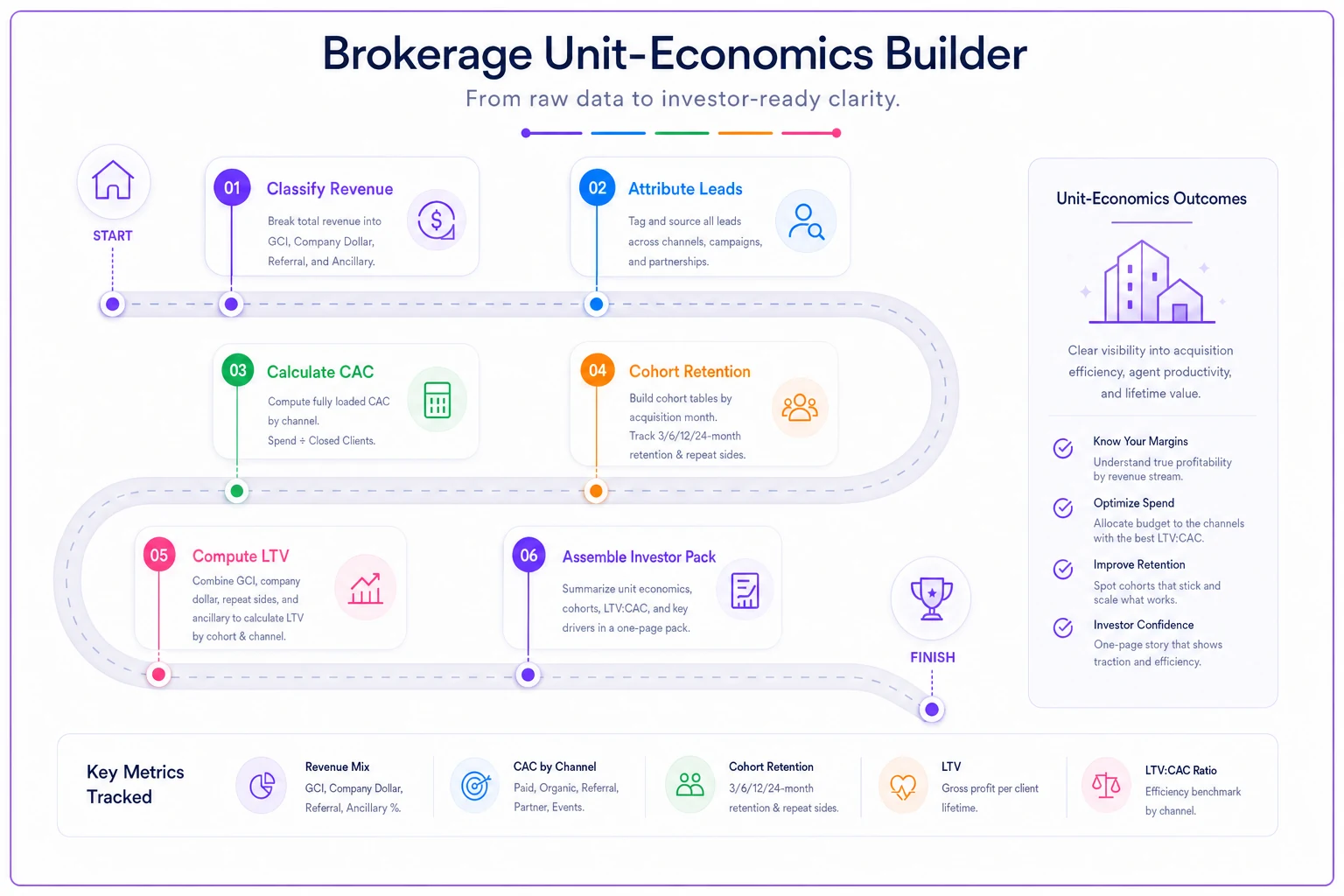
A quick visual like this makes it easier to show the steps someone should follow to reproduce the one-pager.
The due-diligence folder: build it before you need it
The agencies that get clean, fast deals are the ones whose due-diligence folder already existed on day one of conversations. The ones that get re-traded — price lowered after an offer — are the ones who assembled the folder during diligence and kept surfacing surprises.
A due-diligence folder for a small brokerage should contain, at minimum:
-
Financials — 3 years of P&L, normalized company dollar alongside GCI, monthly not just annual
-
Commission schedules — current split structure by agent tier, with any one-off arrangements flagged
-
Agent roster — tenure, production by agent, independent-contractor agreements, who's on a guarantee or draw
-
Client/transaction ledger — anonymized if needed, enough to reconstruct cohorts
-
CAC and marketing — spend by channel, contracts with portals and lead vendors, auto-renewal dates
-
Systems inventory — CRM, transaction management, accounting, and how they connect
-
Legal and compliance — E&O coverage, any open complaints, franchise agreement if applicable
-
Recurring obligations — leases, software contracts, vendor SLAs, anything that survives a sale
The mistake isn't usually a missing document. It's inconsistency between documents — the roster says 18 agents, the commission schedule lists 15, and the P&L implies splits that don't match either. Buyers don't just note the discrepancy; they start assuming everything else is equally loose. One reconciliation error can cost you more in perceived risk than the actual dollars involved.
If your underlying operation already runs on a coherent operating model that aligns listings, lead ops, marketing, and finance, this folder mostly assembles itself — because the data already reconciles across functions. If those functions each run on separate islands, the folder becomes a reconciliation project.
Runway scenarios tailored to how brokerages actually fail
Runway modeling for a brokerage isn't the same as for a startup burning a fixed monthly amount. Your costs are semi-variable, your revenue is seasonal, and your biggest risk is usually concentrated in a few producers or a few lead channels. A generic 12-month cash model misses all of that.
Build at least three scenarios, and make the assumptions explicit:
-
Base case — current pipeline converts at trailing conversion rates, seasonal pattern holds, no roster changes
-
Rate-shock / slowdown case — transaction volume drops 20–30%, days-on-market stretches, closings push a quarter out. Model what happens to cash when revenue lags but desk fees, software, and base comp don't
-
Key-person case — your top producer or your best referral partner leaves. If that single departure moves company dollar more than roughly 15%, that's not a scenario — that's a structural weakness a buyer will price in
Most owners underestimate timing, not magnitude. Revenue arrives at closing, but the costs to generate that revenue — marketing, showing time, listing prep — are spent 60 to 120 days earlier. A slowdown doesn't hit your P&L and your bank account on the same day. Your runway model needs to show cash position by month, not just annual profitability, or it'll tell you you're fine right up until you're not.
A realistic runway model also exposes something useful even if you never raise or sell: it tells you how many months of lead-gen spend you can sustain through a soft patch — which is exactly the number you want to know before the soft patch arrives.
A short real scenario
A two-office brokerage, around 22 agents, roughly $2.6M GCI. The owner believed the business was worth a premium because revenue had grown three years running. When they actually normalized, the picture shifted.
Company dollar was closer to $540k, not the GCI number the owner had been anchoring on. Blended CAC looked reasonable at about $1,400, but segmented, portal leads were running near $3,100 per closing while past-client and referral business sat under $500. And roughly 55% of company dollar traced back to three agents.
Nothing about the business got worse during this exercise — but the story changed completely. Over the following two quarters they shifted budget away from the worst-performing portal tier toward referral and database reactivation. Blended CAC came down, the LTV:CAC ratio improved, and they onboarded two mid-tier agents specifically to reduce producer concentration. When they re-ran the one-pager, the risk profile looked meaningfully different.
They didn't sell, as it turned out. But they finally understood their own economics — and the next time a slowdown hit, they knew exactly which spend to cut and which to protect. That clarity was worth more than the valuation bump.
When this work makes sense — and when it doesn't
When it's clearly worth it:
-
You're within 2–3 years of a possible sale, merger, or bringing on a partner
-
You're considering outside capital or a line of credit to fund growth
-
Your profit swings month to month and you can't explain why
-
One producer or one channel represents an uncomfortable share of income
When it's premature:
-
You're pre-revenue or in your first year and the data is too thin to cohort
-
You're a true solo agent with no team — most of this is overhead you don't need yet
-
You're mid-crisis on cash flow; stabilize first, normalize second
Who should be careful: owners who'll use this as another reason to avoid selling activity. Building the investor pack is a weekend's work spread over a few weeks, not a quarter-long project that pulls you off the floor. If you're perfecting the cohort spreadsheet instead of listing homes, you've lost the plot.
Where this fits in the bigger operational picture
This whole exercise sits near the top of operational maturity. You can't produce clean cohorts without clean CRM data. You can't segment CAC without disciplined lead-source attribution. You can't model runway without a real revenue forecast. Each of those is a capability you build over time, and the investor pack is essentially the output of having built them — which is why trying to fake it late in a deal never works.
If you're not sure where your agency sits on that curve, mapping your current state against a 12-month operations maturity roadmap is a useful reality check before you start assembling anything for investors. The agencies that find valuation prep easy are the ones who did the unglamorous data and process work months earlier.
The real point
An agency valuation playbook isn't really about valuation. It's about whether your business can be understood — by a buyer, by a lender, by a future partner, and most importantly by you. The brokerages that command strong multiples aren't always the biggest or the fastest growing. They're the ones where the numbers reconcile, the risks are named out loud, and the whole operation can be explained on a single page without a verbal patch job.
Normalize the commissions. Build the unit-econ templates off company dollar, not GCI. Keep the due-diligence folder current and consistent. Model runway by month, not by year, with key-person and slowdown cases built in. Do that, and you stop being a business someone has to decode — and start being one they can actually buy, back, or confidently run through the next downturn.
Ready to elevate your real estate business?
Join 2,000+ agencies using TryRealy to streamline operations, close deals faster, and deliver exceptional client experiences.