



Most brokerages don't have a reporting problem. They have an agreement problem.
Ask three people how many deals closed last month and you'll get three answers. The CRM says 14. QuickBooks shows 11 commissions posted. The team lead swears it was 16 because two just went pending-to-closed. Nobody's lying. They're all counting different things, at different times, from different systems that never agreed on what a "deal" even is.
That's the real reason dashboards get ignored at small agencies. Not because the numbers are missing — because they don't match, and once an owner catches one wrong total, they stop trusting the whole screen. After that, the business runs on gut and gossip.
An analytics ops playbook for real estate fixes this at the root. Not with fancier charts. With a small set of agreements about what your data means, when it gets checked, and what you fix first when it breaks. You don't need to be technical. You need to be stubborn about definitions.
The problem isn't data — it's that nobody owns the definitions
There's a pattern that shows up at almost every growing brokerage. Early on, one person — usually the owner or an office manager — knows everything in their head. They know that "the Hendricks deal" is actually two listings and one buyer-side, that the lead came from Zillow but got re-entered manually, and that the commission split is weird because it was a referral.
That tribal knowledge works fine at three agents. At eight it starts leaking. At fifteen it's gone entirely, and now you've got the same lead sitting in the CRM three times under three slightly different names, a "closed" transaction that finance has never seen, and a listing showing active on the portal but withdrawn in the MLS. The deeper issue is that your business runs across systems that were never designed to talk honestly to each other. Your MLS, CRM, transaction management tool, accounting software, ad platforms — each one has its own idea of what a lead, listing, or deal is. When those definitions drift, your reports inherit the chaos. We've written before about how that drift starts at the integration layer in the data-contract playbook for MLS, CRM and vendor integrations — this article is what you build on top of those contracts.
So before any dashboard, you need three things nobody at a small shop usually names out loud: canonical entities, reconciliation rules, and data-quality SLAs. That sounds heavy. It's actually the lightest version of analytics that still works.
Canonical entities: pick one source of truth for lead, listing, and transaction
A canonical entity is just the official version of a thing. When every system disagrees, the canonical record is the one that wins. For a brokerage you really only need three to start.
Never miss a showing or follow-up again.
TryRealy helps you schedule, track, and manage every client interaction smoothly.
- Unified property and client management
- Automated client notifications
- Integrated sales pipeline tracking
No credit card required
Lead. The canonical lead is a person, not an inquiry. This matters more than it sounds. If Maria fills out a form on your site, then texts the open-house QR code two weeks later, then calls off a yard sign — that's one lead with three touches, not three leads. Agencies that count inquiries as leads inflate their pipeline by 30–40% and then wonder why conversion rates look so bad. Define the lead as the human. Everything else is an interaction attached to that human.
Listing. The canonical listing is tied to a single property address and seller engagement, with the MLS number as the anchor ID once it exists. The trap is the pre-listing period — a property might live in your CRM as an "opportunity" for weeks before it gets an MLS number. You need a rule for stitching the pre-MLS record to the post-MLS record so you don't double-count or lose the marketing spend that happened before go-live.
Transaction. The canonical transaction is the deal that produces commission. One property can generate two transactions if you repped both sides. One lead can produce multiple transactions over years. Keep these relationships explicit — this is exactly where commission math goes sideways.
The practical move is to assign each entity one system of record and one canonical ID:
| Entity | System of record | Canonical ID | Everything else is… |
|---|---|---|---|
| Lead | CRM | Person ID (email or phone-normalized) | touches, sources, campaigns |
| Listing | MLS once live, CRM before | MLS # (or temp CRM ID pre-list) | photos, price changes, status |
| Transaction | Transaction mgmt tool | Deal ID | commissions, splits, docs |
The thing most people miss: the system of record isn't "where the data lives," it's "who wins the argument." When the CRM says a lead is dead and the ad platform still shows them active, the CRM wins because you decided it owns lead status. Without that decision, every disagreement becomes a meeting.
Nightly reconciliation: catch the disagreements before they compound
Reconciliation is the boring habit that makes the whole thing work. Every night, something compares your systems against each other and flags the records that don't line up. You're not fixing anything automatically — you're generating a short list of mismatches for a human to resolve.
A workable set of nightly rules looks like this:
-
Orphan transactions. Any closed transaction in the transaction tool with no matching canonical listing. Usually means a deal got entered without being linked.
-
Status conflicts. Listings marked active in the CRM but withdrawn or sold in the MLS, or vice versa. These are the ones that embarrass you publicly.
-
Duplicate leads. New lead records that fuzzy-match an existing person — same phone, similar name. These should surface for merge review, not auto-merge.
-
Missing commission links. Transactions flagged closed but with no commission posted in accounting after a set number of days.
-
Source gaps. Leads with no attributed source whatsoever — pure black holes that wreck your spend reporting.
For most small brokerages, keeping the nightly mismatch list under 15 items is a reasonable target. If it's consistently higher, you have a process leak upstream, not a reconciliation problem. A list of 60 mismatches every morning means nobody's going to work through it, and you're right back to ignoring the data.
Worth naming: reconciliation lists that live in someone's email get skipped. Reconciliation lists that have an owner and a Monday-morning review ritual get worked. The rule matters less than the habit around it.
A simple reconciliation workflow
-
Overnight, the comparison runs across CRM, MLS feed, transaction tool, and accounting.
-
Mismatches land in one shared queue, tagged by type and severity.
-
Each mismatch type has a pre-assigned owner — leads to the lead manager, transactions to the TC, commissions to bookkeeping.
-
Owners clear their items before the day starts; anything older than 48 hours escalates.
-
Once a week, someone counts the types of mismatches to find the recurring source.
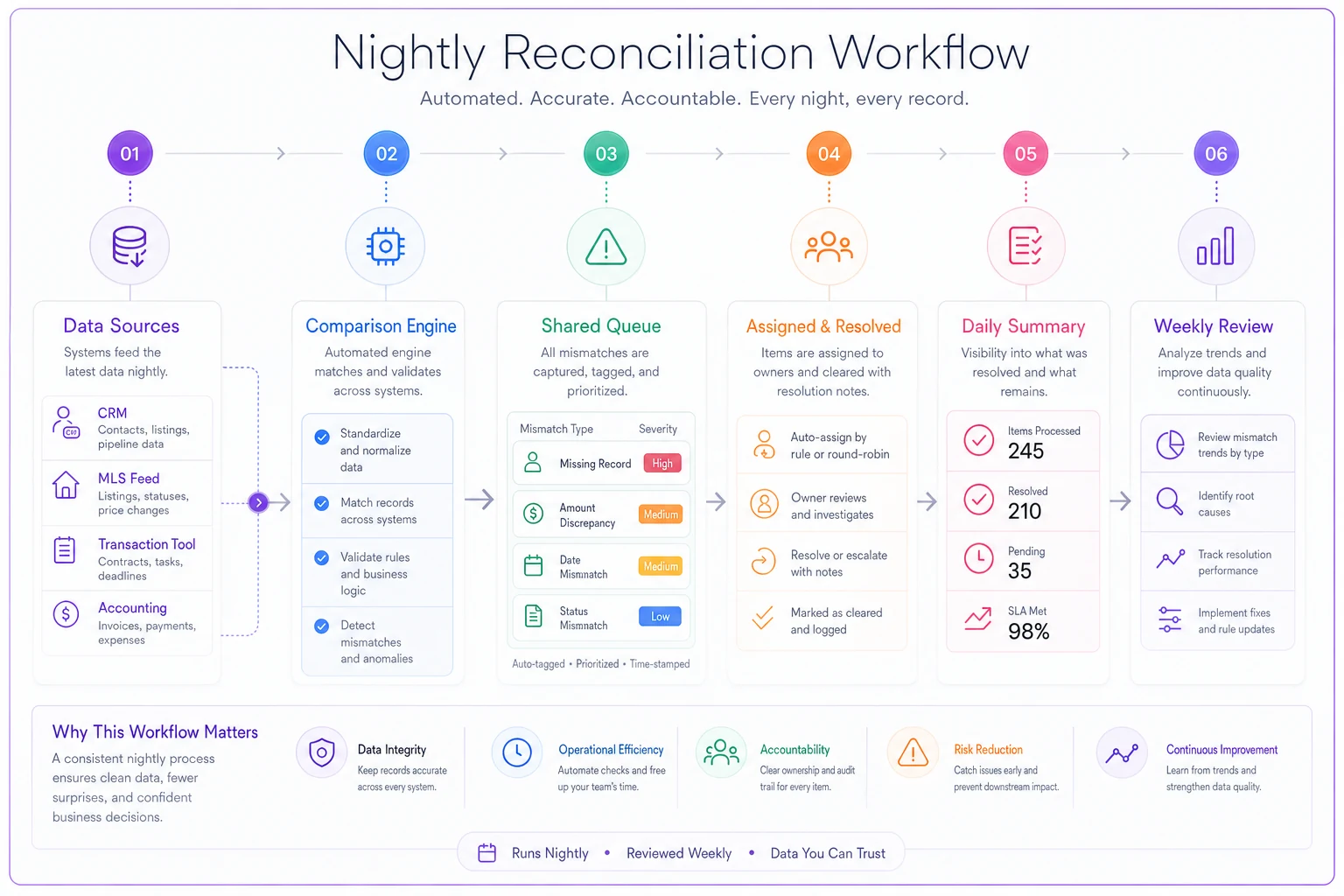
That last step is the one everybody skips and the one that actually improves things. If "duplicate leads from the website form" shows up 20 times a week, the fix isn't faster deduping — it's adding phone normalization to the form.
Data-quality SLAs: make "good data" a measurable promise, not a vibe
"Keep the CRM clean" is not a standard. It's a wish. A data-quality SLA turns that wish into something you can actually check.
Think of it as service levels for your own information. A few that earn their keep:
-
Freshness lead status must be updated within 24 hours of the last contact.
-
Completeness every transaction must have source, split, and close date before it's marked closed.
-
Uniqueness duplicate leads resolved within 48 hours of being flagged.
-
Accuracy listing status in CRM matches MLS within one business day of any change.
The reason SLAs beat "best effort" is accountability. When an agent's deals keep showing up with no source attached, that's not a mystery anymore — it's an SLA miss with a name on it, and you can coach it the same way you'd coach a slow lead response. This connects directly to the point made in which real-estate KPIs mislead small agencies: a metric is only as honest as the data feeding it, and most misleading KPIs are really data-quality failures wearing a dashboard costume.
One caution — don't SLA everything. Pick the three or four fields that actually drive decisions (source, status, split, close date) and enforce those hard. Agencies that try to enforce 25 required fields just teach agents to type garbage into the boxes to escape the warning. Guardrails on everything means guardrails on nothing.
The decision-priority backlog: fix what moves money first
Once you start reconciling, you'll find more broken stuff than you can fix at once. This is where most non-technical owners stall out — there's a list of 40 data problems and no obvious order, so nothing gets done.
Stop treating it as a data backlog and start treating it as a decision backlog. The question isn't "how broken is this field?" It's "what decision are we getting wrong because of it?" Rank every item by two things: how many decisions it touches, and how much money rides on those decisions.
| Backlog item | Decisions affected | Money at stake | Priority |
|---|---|---|---|
| Missing lead source on 40% of leads | Ad budget allocation | High (misspent spend) | 1 |
| CRM/MLS status mismatches | Public listing accuracy, agent follow-up | Medium-high | 2 |
| Commission splits entered inconsistently | Agent pay, P&L accuracy | High | 1 |
| Duplicate leads | Pipeline count, conversion rate | Medium | 3 |
| Stale lead status | Coaching, capacity planning | Medium | 3 |
If fixing a data problem wouldn't change a decision you make, deprioritize it so ops focus stays on money-moving issues.
The owner-friendly rule: if fixing a data problem wouldn't change a single decision you make, it goes to the bottom regardless of how annoying it is. Perfectionists hate this. But it keeps a three-person ops team from burning two weeks cleaning up a field nobody looks at while the ad-budget data stays broken.
A real scenario: an 11-agent brokerage that couldn't agree on its own numbers
A suburban brokerage with 11 agents had the classic split-brain problem. The owner reported roughly 130 closings the prior year. The bookkeeper could only reconcile about 118 to actual commissions. That 12-deal gap drove the owner nuts — were deals being missed, or double-counted?
When they mapped it out, the cause was completely mundane. Dual-agency deals were being counted as two transactions in the CRM but one in accounting. A handful of referral deals closed under a partner's name never got linked back. And a few pending deals that fell through were never moved out of "closed."
They didn't buy anything new. They defined the transaction as "the thing that produces a commission line," set a nightly check for closed transactions with no matching commission, and gave the TC a 10-minute morning routine to clear mismatches. Within about six weeks the two numbers were within one or two deals of each other every month.
The quieter win: the owner started trusting the dashboard again. That's worth more than the reconciliation itself — a trusted number gets used for hiring and budget decisions, a distrusted one just gets argued about.
When this is worth it — and when it's overkill
When it makes sense: you're past roughly six to eight agents, running three or more systems that don't natively agree, and you've already caught your reports contradicting each other. If hiring and ad spend decisions depend on numbers you secretly don't trust, this pays for itself quickly.
When it's a bad idea: a solo agent or two-person team. If one person holds all the context in their head and nobody's making six-figure decisions off dashboards yet, building canonical entities and SLAs is premature structure. Spend that energy on lead follow-up instead.
Who should not do this yet: teams whose underlying integrations aren't stable. If your CRM and MLS feed are breaking weekly, reconciliation will just surface endless noise. Fix the data contracts first, then layer analytics ops on top.
Where the software layer quietly helps
None of this requires special software — plenty of small brokerages run the first version on a spreadsheet and a disciplined morning routine. But the habit gets fragile as volume grows, because manual reconciliation depends on one person remembering to do it every single day.
This is where AI-assisted operational platforms earn their place without much drama. A system that pulls from your CRM, MLS feed, and transaction tool overnight, normalizes the IDs, runs the comparison rules, and hands your ops owner a clean queue in the morning — that turns a fragile human habit into a reliable one. The automation isn't doing anything clever. It's just doing the boring comparison consistently, every night, surfacing only the records a human actually needs to judge. The decisions stay with your people; the tedious matching doesn't.
The goal was never a prettier dashboard. It's that when you look at a number, you believe it — and you make the hiring call, the budget call, and the pricing call on data that three different systems finally agree on.
Ready to elevate your real estate business?
Join 2,000+ agencies using TryRealy to streamline operations, close deals faster, and deliver exceptional client experiences.