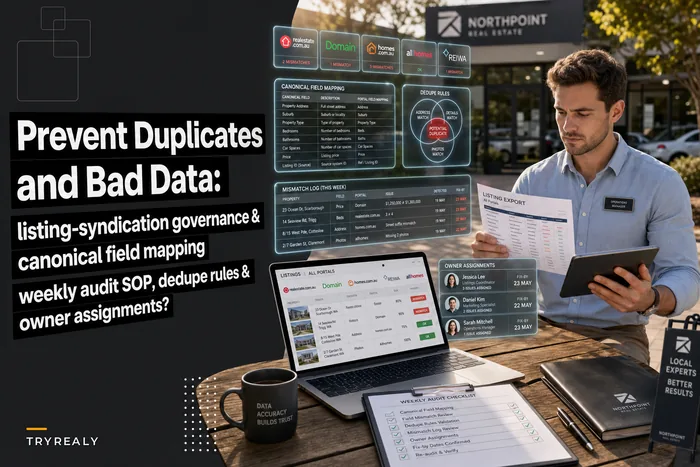



Here's a question most agency managers can't answer cleanly: when your MLS says a listing is "Active," your CRM says "Pending," your transaction platform says "Under Contract," and your marketing tool is still running ads for it — which one is right?
Nobody knows. And that's the actual problem. Not the wrong status. The fact that four systems hold four versions of the same truth with no agreement about which one wins, when they should sync, or who fixes it when they don't.
This is what people mean when they say their data is "messy." It's rarely messy inside one system. It gets messy between systems. The gaps live in the handoffs — MLS to CRM, CRM to transaction management, transaction to accounting, vendor portals feeding back photos and status. Each connection is a place where fields quietly disagree, and over a few months those small disagreements compound into something nobody can trace back to a cause.
A data contract fixes this by making the agreements explicit. It says: this field is called this, it lives here, this system owns it, it syncs on this schedule, and here's exactly what we do when two systems disagree. Boring? Yes. But it's the difference between an ops team that spends Friday afternoons chasing "why is this address different everywhere" and one that doesn't.
Why drift is a structural problem, not a data-entry problem
Most agencies treat bad cross-system data as a discipline issue. "Agents aren't updating the CRM." "Someone typed the wrong price." So they add training, add a required field, send another reminder. It helps for about three weeks.
-
The listing coordinator enters it in the MLS with the MLS's field names and formatting rules
-
A sync — or a manual copy-paste — pushes some of it into the CRM, which uses different field names and its own dropdowns
-
The transaction platform pulls a subset, renames things again, and adds its own status field
-
A syndication feed pushes to portals, which reformat everything a fourth way
-
A vendor uploads photos and marks a task "done" in a portal nobody checks daily
At no point did anyone decide that "list price" in the MLS and "asking price" in the CRM are the same field. They just look similar. So when someone drops the price by $10k, they update one place, and three systems are wrong until someone notices.
What tends to happen across small agencies is that the drift stays invisible until it costs money — a stale price in an ad, a closing date wrong in two calendars, a commission split that doesn't reconcile because the CRM and the accounting export used different deal amounts. By then it's not a data problem, it's a trust problem. People stop believing any system and start keeping their own spreadsheets. That's the death spiral.
The four pieces of a working data contract
A data contract isn't one document. It's four artifacts that work together. Skip any one and the whole thing leaks.
Never miss a showing or follow-up again.
TryRealy helps you schedule, track, and manage every client interaction smoothly.
- Unified property and client management
- Automated client notifications
- Integrated sales pipeline tracking
No credit card required
-
A canonical field map — the master list of every field that matters, its official name, and which system owns it
-
Sync cadence rules — how often each connection runs and in which direction
-
Reconciliation templates — the check you run to catch drift before it spreads
-
An ownership/RACI matrix — who's responsible when something breaks
The important thing is that these are built to be enforced by non-technical ops people. You should not need to understand APIs to know that the address in the MLS is the source of truth and the CRM copies it. That's a business rule, not an engineering decision.
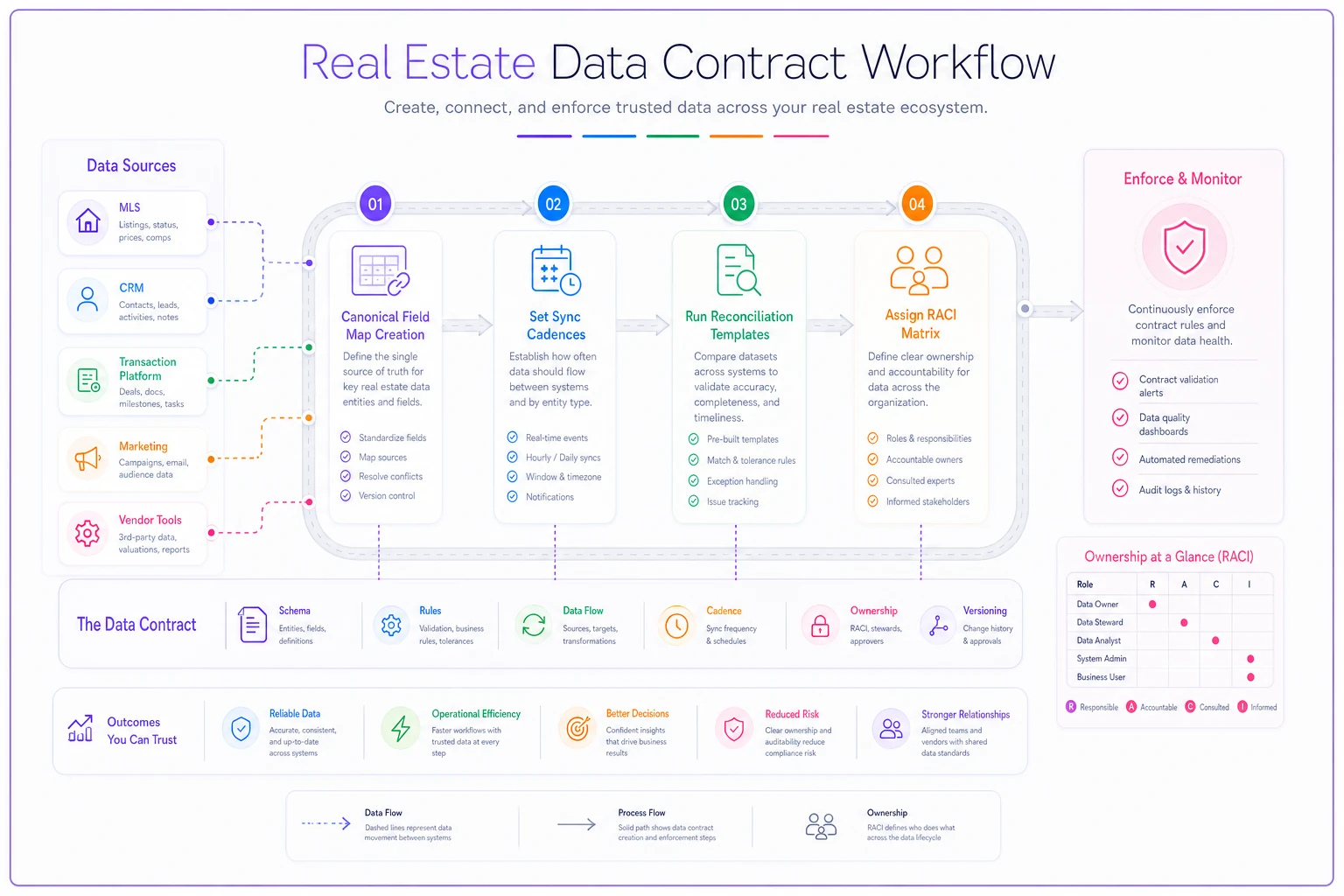
A simple diagram like this helps ops understand where each artifact sits and who owns which handoff.
If your team already did the work of cleaning up individual systems — and if you haven't, the CRM data hygiene approach with dedupe rules and required-field guardrails is the right place to start — the data contract is what keeps those systems aligned with each other over time.
Start with the canonical field map
The canonical field map is a single spreadsheet that answers, for every important field: what do we call it, where does it live, who owns it, and where does it flow.
The word that matters here is canonical. It means "the official version." For every field, exactly one system is the source of truth. Everyone else copies from it and never overrides it. This one decision prevents most drift, and most agencies have never made it.
Here's what a slice of a real field map looks like:
| Canonical field | Source of truth | Copies to | Direction | Notes |
|---|---|---|---|---|
| Property address | MLS | CRM, TXN, Marketing | One-way (MLS → all) | Standardized to USPS format |
| List price | MLS | CRM, Marketing, Portals | One-way (MLS → all) | Changes originate in MLS only |
| Listing status | MLS | CRM, TXN | One-way (MLS → all) | Mapped values (see status map) |
| Deal amount (contract) | TXN platform | CRM, Accounting | One-way (TXN → all) | Not the same as list price |
| Buyer/seller name | CRM | TXN | One-way (CRM → all) | Deduped in CRM first |
| Close date | TXN platform | CRM, Calendar | One-way (TXN → all) | TXN wins over agent calendar |
| Commission split | TXN platform | Accounting | One-way (TXN → all) | Reconciled monthly |
| Photos / media | Vendor portal | MLS, Marketing | Vendor → MLS → rest | MLS is the distribution hub |
Two things people get wrong when they build this.
First, they let a field have two owners "because both teams update it." That's not a source of truth, that's a race condition. Pick one. If both genuinely need to write to it, you need a rule about who wins — and that field should be flagged as high-risk on your reconciliation check.
Second, they forget the value maps. It's not enough to say status syncs from MLS to CRM. The MLS might use "Active," "Active Contingent," "Pending," "Sold." Your CRM might use "Live," "Offer In," "Under Contract," "Closed." You need a translation table that says exactly which MLS value maps to which CRM value. Without it, the sync either fails silently or dumps raw MLS values into a field the CRM doesn't understand, and now your pipeline reports are garbage.
Flag fields that multiple systems can write to as high-risk on your reconciliation checklist.
This canonical thinking is the same principle behind clean listing syndication — the deep dive on canonical field mapping for syndication and preventing duplicate listings covers the outbound-to-portals side of the same idea. The data contract just extends it to every system, not only your feeds.
Sync cadence rules: not everything needs to be real-time
The instinct is to make everything sync instantly. Don't. Real-time sync on every field is expensive, fragile, and propagates mistakes just as fast as good data. If someone fat-fingers a price and it's real-time, it's wrong everywhere before they hit undo.
The better approach is to match cadence to how fast a field actually changes and how much damage a stale value causes. A few tiers:
-
Real-time / near-real-time (minutes) listing status, price. These are public-facing and a stale value here embarrasses you or misleads a buyer.
-
Hourly new listings, new leads, media uploads. Fast enough that nothing feels broken, slow enough to absorb corrections.
-
Nightly batch contact details, notes, task completions, most CRM enrichment. Nobody's hurt if a note takes a few hours to appear.
-
Weekly / on-event commission and accounting fields, which are better reconciled deliberately than streamed continuously.
A sample cadence sheet for a small agency might look like this:
| Connection | What flows | Cadence | Direction |
|---|---|---|---|
| MLS → CRM | Status, price, address, new listings | Every 15 min | One-way |
| MLS → Marketing | Status, price, media | Hourly | One-way |
| CRM → TXN | Client names, contacts | Nightly | One-way |
| TXN → CRM | Deal amount, close date, stage | Hourly | One-way |
| Vendor portal → MLS | Photos, floor plans | On upload + hourly check | One-way |
| TXN → Accounting | Commission, splits | Weekly (Fri) | One-way |
The pattern worth noticing: money and legal fields sync slowest and get reconciled by hand, while public-facing fields sync fastest. That's backwards from what most people assume, but it's right. A stale price costs you a bad buyer experience today. A wrong commission number costs you a dispute next month — and you want a human looking at that one anyway.
Reconciliation: the check that catches what the sync missed
Syncs fail. Vendors update the wrong field. Someone turns off an integration during a tool migration and forgets to turn it back on. Reconciliation is the routine that catches drift before it costs you.
A reconciliation template is just a report that puts the same field from two systems side by side and flags where they disagree. You run it on a schedule, and anything flagged gets fixed and — this is the part people skip — traced back to why it drifted.
-
Pull the field from both systems (e.g., list price from MLS and from CRM) into two columns of a spreadsheet, keyed by listing ID.
-
Add a match column that flags any row where the two values differ.
-
Sort by mismatches so you're only looking at exceptions, not all 60 active listings.
-
Apply the source-of-truth rule for each mismatch — the MLS wins on price, so the CRM value gets corrected, never the other way.
-
Log the cause in a "reason" column
sync failed, manual override, value-map gap, vendor error.
-
Escalate repeat causes. If the same integration causes three mismatches in a month, that's not a reconciliation task anymore — it's a broken connection someone needs to fix.
That last step is what turns reconciliation from busywork into an early-warning system. If you're just fixing the same mismatches every week without asking why, you're mopping the floor with the faucet running.
Your reconciliation checklist, at minimum, should cover:
-
Price match
MLS vs CRM vs any active ads
-
Status match
MLS vs CRM vs transaction platform
-
Close date match
transaction platform vs CRM vs shared calendar
-
Deal amount match
transaction platform vs accounting export
-
Media count
number of photos in MLS vs vendor portal (catches uploads that didn't propagate)
-
Orphan check
any deal in the transaction platform with no matching CRM contact
Run the fast, cheap checks weekly. Run the money checks — deal amount, commission — monthly, right before you close the books.
The one-page RACI that makes it enforceable
Every artifact above is useless if nobody owns it. This is where most data-quality efforts die — everyone agrees the data should be clean, nobody is specifically on the hook when it isn't.
RACI keeps it simple: for each area, who is Responsible (does the work), Accountable (owns the outcome, one person only), Consulted, and Informed. Keep it to one page. If it needs two pages, it's too complicated to follow.
| Area | Responsible | Accountable | Consulted | Informed |
|---|---|---|---|---|
| Canonical field map upkeep | Ops manager | Agency owner | Team leads | All agents |
| Weekly reconciliation run | Listing coordinator | Ops manager | — | Team leads |
| Fixing a flagged mismatch | Field's data owner | Ops manager | — | — |
| Broken integration escalation | Ops manager | Agency owner | Vendor/IT | Team leads |
| Value-map changes (status, etc.) | Ops manager | Agency owner | Team leads | All agents |
| Monthly money reconciliation | Bookkeeper | Agency owner | Ops manager | — |
One rule that makes RACI actually work: only one Accountable person per row. The moment two people are accountable, nobody is. If price drift keeps happening, there's exactly one name to talk to, and that person can't say "I thought Sarah had it."
Also worth noting — the "Responsible" for fixing a mismatch is "the field's data owner," which points straight back to your canonical field map. That's the whole system clicking together: the field map says who owns price, so when price drifts, the RACI already tells you who fixes it. No "whose job is this" conversation required.
A real scenario: the four-status listing
A small agency running somewhere around 55–70 active listings kept getting caught with stale prices in their portal ads. A seller had approved a price drop, the coordinator updated the MLS, but the marketing tool kept running the old number for days. A buyer flagged the discrepancy on a showing, and the agent had no idea anything was wrong.
When they dug in, the cause wasn't laziness. The marketing tool synced nightly and only pulled from the CRM — and the CRM sync from the MLS had quietly broken during a plugin update a couple weeks earlier. So the chain was: MLS updated correctly, CRM stuck on old prices, marketing faithfully copying the stale CRM value every night. Three systems all "working," all wrong.
They built a basic version of everything above. A canonical map that made the MLS the sole owner of price. A cadence change moving price to hourly and pointing marketing directly at the MLS instead of the CRM. And a short weekly price reconciliation the coordinator ran every Monday.
The stale-price incidents essentially stopped. They caught the next broken sync within a week instead of finding out from a buyer. The coordinator estimated it added maybe 30–40 minutes a week, against the hours they used to lose untangling "why is this wrong everywhere" fire drills. Not a dramatic transformation — just a system that told them when something broke instead of waiting for a client to tell them.
When a formal data contract makes sense — and when it's overkill
You don't always need this level of structure.
This makes sense when:
-
You run three or more connected systems (MLS, CRM, transaction, marketing, accounting)
-
You've had at least one incident where wrong data reached a client or a closing
-
You're growing and adding tools faster than you're documenting how they connect
-
People have started keeping private spreadsheets because they don't trust the systems
This is overkill when:
-
You're a solo agent with a CRM and not much else — a source-of-truth rule in your head is enough
-
Your "integrations" are all manual and low volume, where a person is already the sync
-
You're mid-migration and about to change tools anyway — wait until the dust settles, then document the new stack
One group that should not attempt the full version yet: agencies whose individual systems are still dirty. If your CRM is full of duplicates and half-empty records, a data contract will faithfully sync the mess across everything. Clean the source systems first, then wire up the contract to keep them clean. Order matters.
How this connects to everything else you run
The data contract isn't a standalone project. It's the plumbing underneath your reporting, your forecasting, your commission accounting, and every client-facing SLA you've promised. If your pipeline report is wrong, it's usually because the status field drifted. If a commission dispute shows up, it's usually because deal amount didn't reconcile between two systems. If a listing runs a stale price, it's usually a broken sync nobody was watching.
Fix the contract and a lot of downstream problems quietly go away — not because you attacked each one, but because you stopped the systems from lying to each other. Most agencies fight the symptoms one at a time: the wrong ad, the double-booked showing, the reconciliation that doesn't balance. The data contract addresses the shared cause.
Start small. Pick your five most painful fields — price, status, address, deal amount, close date. Decide who owns each. Set a cadence. Build one reconciliation spreadsheet. Assign one accountable person. That's a working data contract you can have running by Friday, and it'll catch more drift than another round of "please remember to update the CRM" ever will.
Ready to elevate your real estate business?
Join 2,000+ agencies using TryRealy to streamline operations, close deals faster, and deliver exceptional client experiences.