



Every real estate CRM starts clean. Six months later, you've got John Smith, J. Smith, and Johnny Smith as three different contacts, all with the same phone number. One has an email, one has property preferences, one has showing history. None of them get your follow-ups because your automation rules can't figure out which record to use.
This isn't about being organized for organization's sake. Bad CRM data means agents waste a huge chunk of their prospecting time chasing duplicates, missing hot leads buried in messy records, and sending the wrong property alerts to the wrong segments. Agencies lose six-figure deals because their "hot lead" from an open house three months ago was sitting in a duplicate record that never got the follow-up sequence.
The real damage shows up in your conversion funnel. When your tracking dashboard shows misleading metrics because half your leads exist as duplicates, you start making bad decisions about marketing spend. You think that Facebook campaign brought in 200 leads when it actually brought in 140—the rest were already in your system from other sources.
The duplicate problem multiplies faster than you realize
Most agencies only discover the duplicate problem during a crisis. An agent calls a lead who says "someone from your office already called me three times this week." You check the CRM and find four different agents have been working the same person under different records. Now you look disorganized and the lead goes dark.
Here's what actually creates duplicates in real estate CRMs:
Multiple entry points without validation Open house sign-ins create one record. Your website form creates another. The agent manually entering a referral creates a third. Each uses slightly different formatting—Bob vs Robert, 555-1234 vs (555) 123-4567. Your CRM treats them as unique contacts.
Agent territory changes When agents leave or territories get reassigned, contacts get duplicated during the handoff. The new agent imports their inherited leads without realizing half already exist under variant spellings. You've doubled your fake pipeline overnight.
Property-based duplication A couple looking at homes becomes two leads when one spouse fills out a showing request and the other calls directly. Both get entered separately, tagged to the same property interest, but nobody connects them as a household. Your showing coordinator ends up scheduling two separate tours for the same family.
The fuzzy match rules that actually work Standard exact-match deduplication catches maybe 20% of real duplicates. You need fuzzy matching that understands how real estate data actually gets messy.
Phone number matching (highest confidence) Strip all formatting from phone numbers—parentheses, dashes, spaces, country codes. Match on the core 10 digits. This alone catches a large portion of duplicates immediately. When you find matches, merge keeping the record with the most complete data.
Email domain + fuzzy name match Match records where the email domain is identical and the first three letters of the first name match. This catches Bob/Robert at bob@gmail vs robert@gmail. Flag these for manual review if the last names differ by more than two characters.
Address proximity matching For residential clients, match records with addresses within 0.1 miles of each other with similar last names. This catches household members and spelling variations of street names. Set up a review queue for these rather than auto-merging.
The three-field verification rule Never auto-merge unless at least two fields match with high confidence. Phone + name, email + name, or address + name. Single-field matches go to a weekly review queue.
Building required-field guardrails that agents won't bypass
Requiring fields sounds simple until agents start entering "NA" or "123" just to save the record. The guardrails that actually work respect agent workflow while still protecting data quality.
Never miss a showing or follow-up again.
TryRealy helps you schedule, track, and manage every client interaction smoothly.
- Unified property and client management
- Automated client notifications
- Integrated sales pipeline tracking
No credit card required
Progressive field requirements Don't require everything upfront. Require only phone OR email for initial entry. After first contact, require one property preference. After showing, require budget range. This matches how agents actually gather information.
Smart validation rules
-
Phone numbers must be 10 digits when stripped of formatting
-
Emails must contain @ and a valid domain extension
-
Zip codes must match the selected city (catches typos immediately)
-
Price ranges can't have min higher than max
The override audit trail Let agents bypass requirements with a reason code, but track it. "Client refused to provide," "Inheritance situation—budget unknown," "Corporate relocation—address pending." Review these monthly to spot training needs.
Show potential duplicates inline on forms so merging is the obvious choice over creating a new contact.
Duplicate prevention at entry Show potential duplicates in real-time as agents type. Something like "Sarah Johnson (555-1234) already exists—is this the same person?" before they create a new record. Make merging easier than creating new.
The monthly audit checklist that takes 2 hours, not 2 days
Running a solid audit monthly prevents the six-month disaster cleanup. Here's the sequence:
Here’s a simple visual of the monthly audit workflow to share with your team.
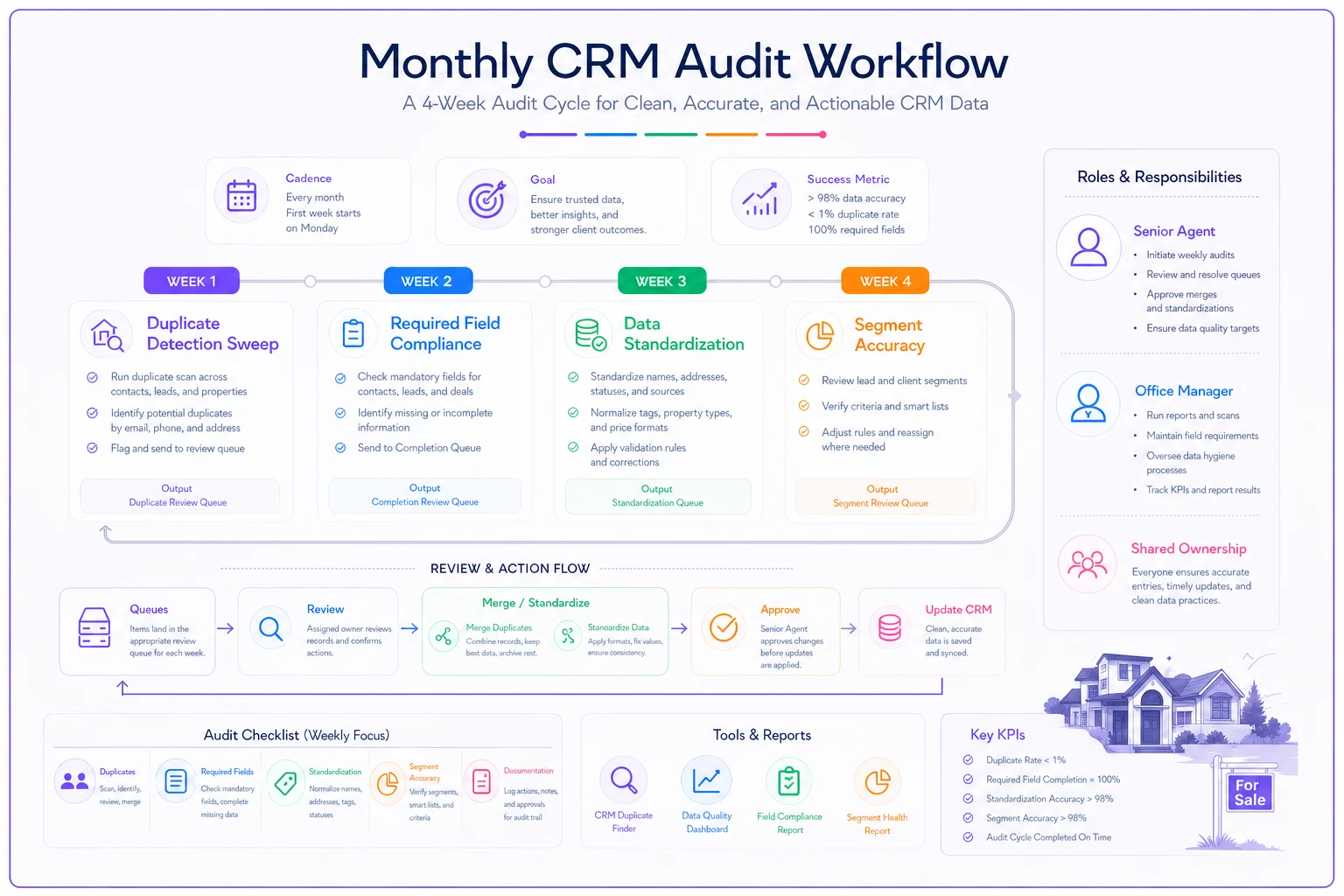
Week 1: Duplicate detection sweep (30 minutes)
-
Run phone number duplicate report
-
Run email domain + name fuzzy match
-
Export both to review queue
-
Assign top 20 to senior agent for verification
-
Merge confirmed duplicates, keeping most complete record
Week 2: Required field compliance (30 minutes)
-
Pull records missing phone AND email
-
Pull records over 30 days old missing budget range
-
Pull showing-complete records missing property type
-
Generate agent-specific reports showing their incomplete records
-
Set 7-day deadline for updates
Week 3: Data standardization (45 minutes)
-
Bulk-update phone formatting to (XXX) XXX-XXXX
-
Proper-case all names (fix JOHN SMITH and john smith)
-
Standardize state abbreviations
-
Fix common city misspellings for your market
-
Update source tracking for consistency
Week 4: Segment accuracy (15 minutes)
-
Verify hot leads have contact in last 14 days
-
Move cold leads with no contact in 60 days
-
Check that closed clients aren't in active campaigns
-
Validate that sphere contacts have relationship tags
-
Ensure investors and residential buyers are separated
This isn't about perfection. It's about catching problems before they compound. A contact with a slight name variation is fixable. That same contact after six months of duplicate communications and split history is basically an archaeological project.
Automation recipes that prevent decay (not just fix it)
The best CRM hygiene happens automatically. These automation rules work across common real estate CRMs:
New lead standardization flow Trigger: New contact created Actions:
-
Format phone to (XXX) XXX-XXXX
-
Proper-case name fields
-
If email domain is common (gmail, yahoo), check for existing contacts with same domain and similar name
-
If source is "Website" and property address exists, check for other leads on same property
-
Auto-tag with entry date and initial source
The 48-hour enrichment reminder Trigger: Contact created 48 hours ago Conditions: Missing phone OR email OR budget Actions:
-
Task to assigned agent
"Complete required fields for [Contact Name]"
-
Include link to CRM record
-
Escalate to team lead if not complete in 7 days
Duplicate alert workflow Trigger: Daily at 6am Actions:
-
Query for contacts created yesterday
-
Check each against existing database using phone and email
-
Generate report of potential duplicates
-
Email to office manager with merge recommendations
Monthly segment validator Trigger: First Monday of month Actions:
-
Move contacts with last activity >90 days from Hot to Warm
-
Flag Sphere contacts missing birthday or home anniversary
-
Alert on Active Buyers with no showing in 30 days
-
Generate "data quality score" per agent
These automation rules work across common real estate CRMs:
Who owns your data catastrophe when deals fall through
Data hygiene fails because nobody owns it until something breaks. The agent who lost the deal blames the CRM. The admin who manages the CRM blames agents for bad data entry. The broker blames everyone while calculating the lost commission.
Assign explicit ownership:
| Role | Responsibility |
|---|---|
| Office Manager/Operations | Owns the monthly audit execution, duplicate merging, and bulk standardization. Runs the Week 1 and Week 3 tasks. Reports metrics to broker monthly. |
| Lead Agent or Team Lead | Reviews and approves proposed merges, validates segment moves, assigns incomplete records to agents. Makes judgment calls on edge cases. |
| Individual Agents | Responsible for their assigned contacts meeting required fields within 48 hours. Must review and clean their pipeline before monthly one-on-ones. |
| Transaction Coordinator | Ensures closed deals update CRM status, archives active buyer records, and moves clients to past-client nurture campaigns. |
Without clear ownership, your CRM becomes a shared storage unit where everyone dumps stuff and nobody organizes it. The monthly audit becomes "someone should do that" instead of "Sarah runs that every first Monday."
Beyond the basics: advanced cleanup for growing agencies
Household relationship mapping Link spouses, partners, and co-buyers as related contacts instead of treating them as duplicates. Track who's the decision maker, who prefers texts vs calls, and who actually shows up to showings. Prevents the awkward situation of calling both spouses separately about the same property.
Source attribution accuracy Your "Website" source probably lumps together Zillow leads, Realtor.com syncs, direct site visits, and IDX captures. Break them apart. Create specific sources like "Zillow-Buy," "Website-Sell," "Realtor-Rent." Now you actually know which marketing is working.
Property preference evolution tracking Instead of overwriting property preferences, track how they change over time. The client who started looking at condos but shifted to single-family homes tells you something about where they are in their search. Keep the history, update the current state.
Communication preference segmentation Beyond "prefers email," track actual response rates by channel. Some clients only respond to texts. Others only answer calls after 6pm. Build segments based on real engagement, not just stated preference.
The ROI nobody calculates: what clean data actually delivers
Everyone talks about CRM importance but nobody quantifies the cost of bad data.
A 100-person contact list with 25% duplicates means you're paying for extra licenses, sending more marketing emails (which hurts your sender reputation), and your agents are burning time on bad leads. Rough estimate: around $400 monthly in direct costs plus several hours of lost productivity per agent, every week.
More importantly, clean data lets AI-powered operational software actually do its job. When your agent onboarding system tries to assign territories but half the contacts have wrong addresses, new agents inherit a mess from day one. When automation tries to trigger follow-ups but can't determine the right contact record, leads go cold before anyone notices.
Agencies that maintain CRM hygiene see meaningfully better conversion rates—not because their agents are better salespeople, but because they're actually reaching the right people with the right message at the right time. They're not sending luxury property alerts to first-time buyers. They're not double-calling leads and looking disorganized.
Your cleanup roadmap starts with admitting the mess
If your CRM hasn't been audited in six months, assume around 30% of your data is compromised. Don't try to fix everything at once. Start with phone number deduplication—it has the highest ROI and most immediate impact. Then standardize formats. Then tackle required fields. Then segment accuracy.
The first cleanup will realistically take 10-12 hours spread over two weeks. After that, monthly maintenance runs around 2 hours. Agencies that fail at CRM hygiene almost always treat it as a one-time project instead of an ongoing operational requirement.
Stop letting perfect be the enemy of good. You don't need 100% clean data. You need 85% clean data with systems in place to catch problems before they cascade. The difference between 60% and 85% accuracy is the difference between a CRM that frustrates everyone and one that actually drives deals forward.
Your CRM should be an operational asset that helps agents close more deals—not a digital filing cabinet full of conflicting information. The playbook above turns data hygiene from a painful quarterly cleanup into a systematic monthly process that takes less time than a team meeting.
The agencies winning in this market aren't necessarily the ones with the most leads. They're the ones who can actually work the leads they have because their data tells the truth.
Ready to elevate your real estate business?
Join 2,000+ agencies using TryRealy to streamline operations, close deals faster, and deliver exceptional client experiences.