

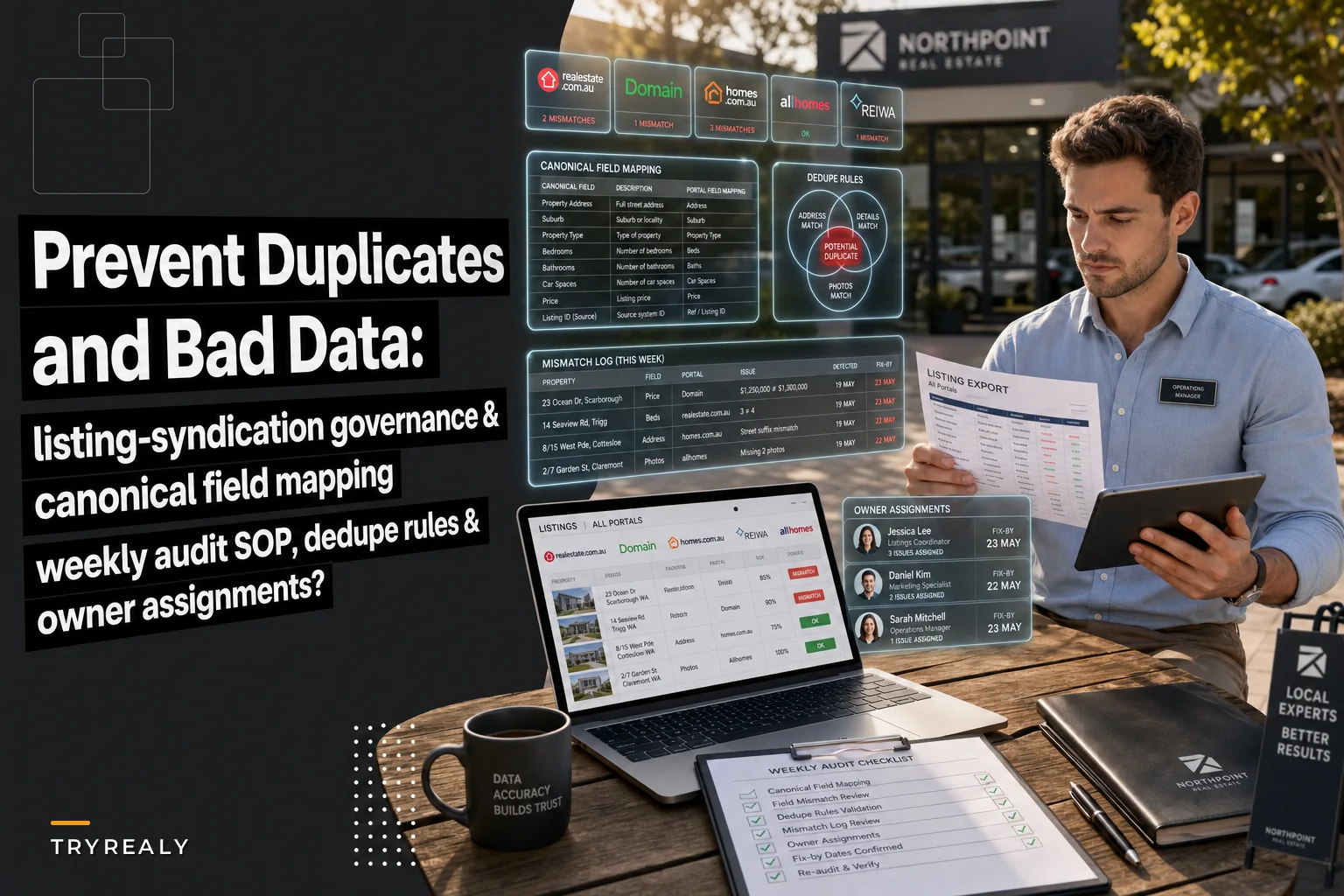

The listing looks perfect in your CRM. Beds, baths, square footage, price, remarks — all correct. Then someone searches the property on Zillow and it shows up twice. One version says 2,150 sqft. The other says 2,100. The price on Realtor.com is $10k higher than what you reduced it to yesterday. And on Homes.com, the primary photo is the bathroom instead of the front exterior.
None of this is a fluke. It's what happens when listings flow from your source system out to five, six, seven portals through different feeds, each with its own field rules, refresh timing, and quirks. Without governance, every portal becomes its own version of the truth — and buyers see the mess before you do.
This is the part of listing syndication governance real estate teams almost never build until something breaks. Usually a duplicate that a seller finds and screenshots into an angry text at 9pm.
The core problem: your source of truth isn't actually the source
Most agencies assume the CRM or MLS is the master record and everything downstream just mirrors it. In practice, syndication doesn't work like copy-paste. It works more like translation.
Each portal maps your fields into their own schema. Your "MLS #" might land in their "ListingKey." Your "Half Baths" gets folded into a combined "Bathrooms" field. Your remarks get truncated at 1,000 characters. And when a portal can't cleanly match an incoming record to an existing one, it doesn't error out — it just creates a new listing. That's where duplicates are born.
A typical scenario: an agent fixes a typo in the address ("123 Oak St" → "123 Oak Street"). The feed pushes the update. The portal's matching logic keys off the address string, doesn't recognize "Oak Street" as the same record as "Oak St," and spins up a second listing. Now you have two live listings, split view counts, split leads, and no idea until a buyer asks why there are two.
The root issue is that nobody defined, in writing, what each field means and which system wins when two systems disagree. Without that, syndication is just hope with a schedule.
Why cross-portal inconsistencies compound faster than you think
There are three things that turn one small mismatch into a real operational headache.
Never miss a showing or follow-up again.
TryRealy helps you schedule, track, and manage every client interaction smoothly.
- Unified property and client management
- Automated client notifications
- Integrated sales pipeline tracking
No credit card required
Refresh timing. Portals don't all pull at the same interval. Some refresh hourly, some every few hours, some overnight. During a price change, you'll have portals showing the old price and portals showing the new one simultaneously for most of a day. Buyers comparison-shop across tabs. They notice.
Field truncation and reformatting. A remarks section that reads well in your CRM gets cut mid-sentence on one portal and stripped of line breaks on another. Your carefully formatted bullet points turn into a wall of text. Not technically a data error, but an inconsistency your seller will read as sloppiness.
Silent match failures. This is the dangerous one. When a portal can't match an update to the original record, it doesn't fail loudly — it creates a duplicate quietly. You're still maintaining the original through the feed, but the duplicate is orphaned, frozen at whatever data it had when it was created. Often a stale price and old photos.
The compounding effect is real. A mispriced duplicate can outrank your actual listing, collect leads that go nowhere, and display a days-on-market figure that makes the property look stale. There are cases where the ghost duplicate had more views than the live listing because it was indexed first.
What canonical field definitions actually look like
"Canonical" just means one agreed-upon definition per field, documented, that everything else maps back to. It's not glamorous, and it's probably the highest-leverage thing you can build here.
You're defining three things per field: the exact name, the format and rules, and the system of record — who wins in a conflict.
Here's a partial example of what a canonical field table looks like for a small agency:
| Canonical Field | Format / Rule | System of Record | Common Portal Mismatch |
|---|---|---|---|
| Street Address | USPS-standardized, spelled out ("Street" not "St") | MLS | Abbreviations cause duplicate creation |
| List Price | Integer, no cents, current active price | CRM | Portal shows stale price during refresh lag |
| Living Area (sqft) | Above-grade finished only, integer | MLS | Some portals include basement/garage |
| Bedrooms | Legal bedrooms only (closet + egress) | MLS | Bonus rooms counted inconsistently |
| Bathrooms | Full and half tracked separately | MLS | Portals combine into a single decimal |
| Public Remarks | Max 950 chars, no line-break dependency | CRM | Truncation and formatting loss |
| Primary Photo | Kitchen or exterior front, position 1 locked | CRM | Photo order shuffles on re-sync |
The two columns people skip are the last two. Writing down the common mismatch for each field is what turns this from a glossary into something actually useful — it tells whoever runs your audit exactly what to check.
Worth calling out specifically: square footage disputes cause more seller complaints than almost any other field, because sellers know their number and get upset when a portal shows something different. Define "above-grade finished only" once, apply it everywhere, and you kill a recurring argument.
Field-mapping templates: one per portal, no exceptions
Once you have canonical definitions, you build a mapping template for each portal that translates your fields into theirs. This lives in a shared doc, not in someone's head.
-
Canonical field (your master name)
-
Portal field (their name for it)
-
Transformation rule (what happens in translation — truncate to X characters, split into two fields, reformat the date)
-
Owner (who's responsible when this mapping breaks)
The transformation rule column is where prevention actually happens. If you know a portal truncates remarks at 1,000 characters, your rule says to front-load the key selling points in the first 900. If a portal combines full and half baths into a decimal, your rule specifies exactly how — 2 full + 1 half = 2.5, not 3.
Where teams go wrong: they build the mapping once during setup and never revisit it. Portals change their schemas. A field that mapped cleanly last year now has a new required attribute, and your feed starts dropping records or filling them with defaults. The mapping template needs an owner and a review date, same as any other operational document.
If your agency has already invested in building a solid data foundation — the kind of taxonomy and required-field discipline covered in our writeup on CRM data hygiene for real estate — the mapping layer sits right on top of that. Clean source data with no canonical mapping still produces portal chaos, though. You need both.
Dedupe rules that actually catch ghosts
Deduplication for syndication is different from CRM contact dedupe. You're not matching people, you're matching property records across systems that each assign their own IDs.
The reliable approach is a matching hierarchy — try the strongest key first, fall back only when it's missing.
-
MLS number (strongest — if present and identical, it's the same listing)
-
Parcel / APN number (strong, survives address reformatting)
-
Normalized address + unit (address run through standardization before comparing)
-
Geocoordinates within a tight radius + list price band (last-resort fuzzy match)
The critical rule: never let a raw address string be the only match key. That's exactly what causes the "Oak St vs Oak Street" duplicate. Normalize addresses before comparison — strip punctuation, expand abbreviations, standardize unit notation — so "123 Oak St #4" and "123 Oak Street Unit 4" resolve to the same string.
For the fuzzy fallback tier, set thresholds carefully. Two listings within roughly 50 feet, same bedroom count, and a list price within a small band are almost certainly the same property double-fed. Loosen it too much and you'll accidentally merge two legitimately different condos in the same building. Same fuzzy-match balancing act we broke down for contact records — same logic, different objects.
A dedupe rule set worth having also defines the action: when a duplicate is detected, does the system suppress the newer record, flag it for human review, or auto-merge? For syndicated listings, flag-for-review is usually safer than auto-merge. Merging the wrong two records is harder to undo than deleting a duplicate.
The weekly audit SOP
Governance documents don't prevent anything on their own. The audit is what keeps reality aligned with the canonical definition. Weekly is the right cadence for syndication because portal refresh lags and match failures accumulate over days — monthly is too slow and you'll find duplicates that already burned a week of leads.
Here's a workable weekly audit SOP for a small team. Budget 30–45 minutes.
-
Pull a list of all active listings from the source system
-
For each, search the property manually or via tool on your top 3–4 traffic portals
-
Confirm price matches the canonical value on every portal (flag any lag older than 24 hours)
-
Confirm sqft, beds, and baths match canonical definitions
-
Check for duplicate live listings on each portal (this is where ghosts hide)
-
Verify primary photo is correct and in position 1
-
Confirm any listings marked pending/sold in the last week are reflected across all portals
-
Log every mismatch with
portal, field, expected value, actual value, and detected date
-
Assign each mismatch an owner and a fix-by date
The log is not optional and not busywork. After four or five weeks, patterns start surfacing. You'll notice one portal is responsible for the majority of your mismatches, or that price lags always come from the same feed. That's when you stop firefighting individual errors and go fix the mapping or feed configuration that's generating them.
One overlooked check worth emphasizing: status propagation. Listings that went pending or sold but still show active on a lagging portal generate the most frustrating leads — buyers inquiring on a property that's already gone. Auditing status across portals is often more valuable than auditing price.
Export the audit log weekly to a simple CSV so you can filter by portal and spot recurring mismatch patterns quickly.
Here's a quick workflow diagram of the weekly audit process.
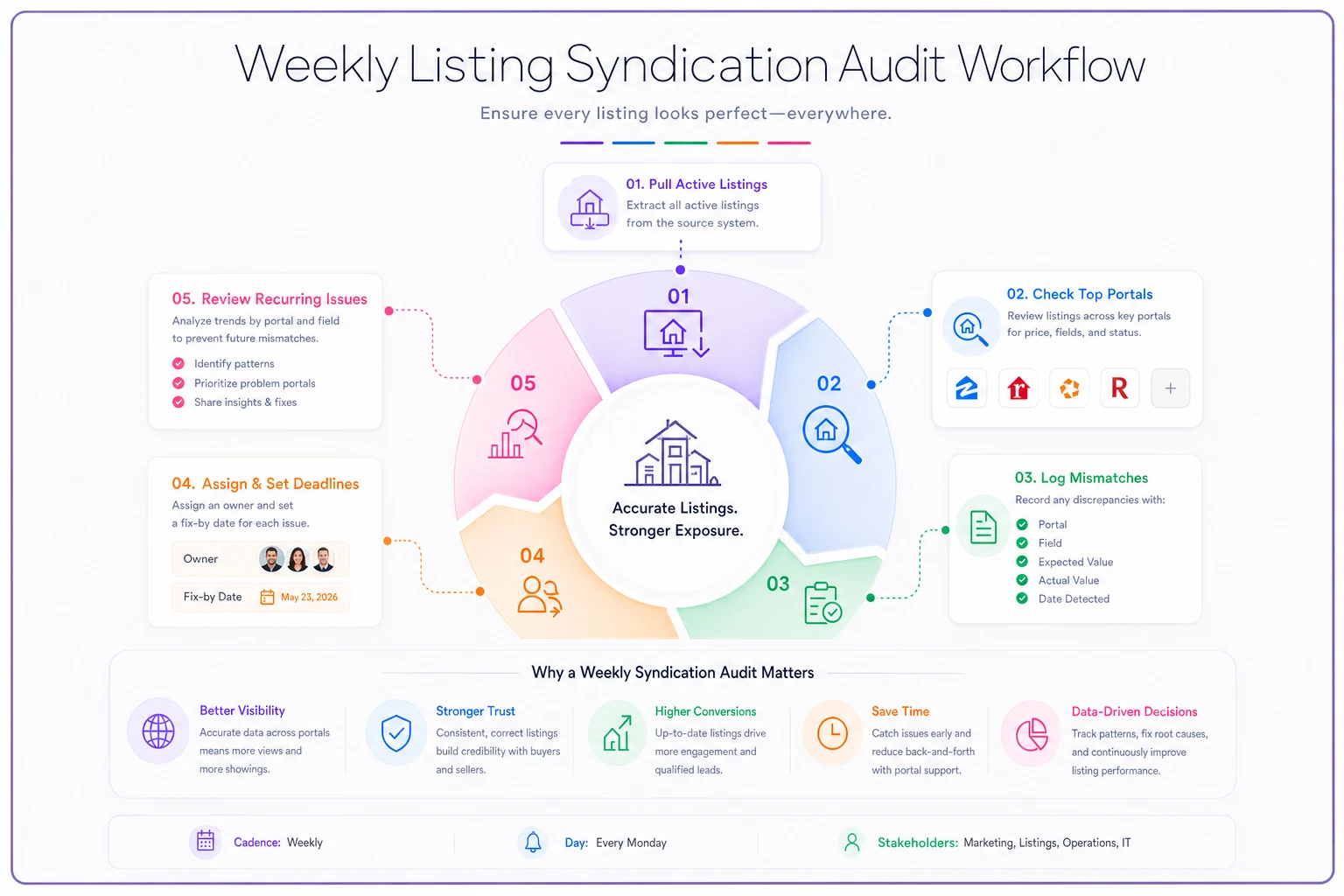
This visual maps the steps into a simple sequence so teammates can follow the audit without needing extra explanation.
A real scenario
A four-agent brokerage running around 60–70 active listings kept getting seller complaints about wrong square footage and occasional duplicates on two major portals. No canonical definitions existed — each agent entered sqft however the appraisal or tax record read, inconsistently including or excluding basement space.
They spent one afternoon writing canonical definitions for the ten fields causing the most complaints, built mapping notes for their four active portals, and blocked off Friday afternoons for a 30-minute audit. Simple stuff.
Over roughly the first six weeks, they found and killed 9 duplicate listings — several of which had been quietly collecting inquiries nobody was answering. Seller complaints about listing data dropped to near zero the following quarter. The subtler win: their audit log showed one portal was responsible for most of the price-lag issues, so they adjusted how they timed price-change pushes to that feed. Fewer "why is the price different" calls, less back-and-forth.
Nothing fancy. A shared doc, a matching hierarchy, and 30 minutes on the calendar every week.
Where automation earns its place — and where it doesn't
Manual auditing works at 60–70 listings. It starts breaking down somewhere around a few hundred, or when you're syndicating to seven-plus portals, because no one can eyeball that many cross-portal comparisons weekly without missing things.
This is where AI-assisted operational tooling genuinely helps: pulling listing data across portals, running the normalized-address and MLS-number matching automatically, and surfacing only the exceptions — the mismatches and suspected duplicates — for a human to review. Instead of manually searching every property on every portal, your audit becomes reviewing a short flagged list. The canonical definitions and mapping rules you wrote become the logic the automation enforces.
The important part: automation enforces governance, it doesn't replace it. If you skip the canonical definitions and just point a tool at your portals, it has no reference for which value is supposed to be correct. The doc comes first.
When this level of governance makes sense
-
You syndicate to four or more portals
-
You carry enough active inventory that duplicates hide easily (roughly 40+)
-
You've had at least one seller complaint about wrong or duplicated data
-
Multiple people enter listing data with no shared field standards
When it's overkill
-
Solo agent with a handful of listings feeding one or two portals — a quick manual check when you list and when you change price is genuinely enough
-
You syndicate through a single tightly-controlled feed with no history of match failures
Don't build a governance binder for a problem you don't have. The framework scales down as easily as it scales up.
Closing thought
Duplicate listings and cross-portal data drift feel like technology problems, but they're almost always definition problems. The systems aren't broken — they're faithfully translating fields that were never clearly defined, resolving conflicts with rules nobody wrote down.
Write the canonical definitions. Map each portal explicitly. Set a real dedupe hierarchy that doesn't hinge on a raw address string. Run the audit every week and log what you find so patterns surface over time. Do those four things and the angry 9pm seller texts about duplicate listings quietly stop.
Once your listing data is trustworthy across portals, everything downstream gets easier — including the hyperlocal work we covered in what makes neighborhood pages win hyperlocal searches, because you're finally building on data you can actually trust.
Ready to elevate your real estate business?
Join 2,000+ agencies using TryRealy to streamline operations, close deals faster, and deliver exceptional client experiences.