


Most deals that crater during the inspection window didn't fail because the house had problems. They failed because the seller found out about the problems at the same time the buyer did. That's the whole game. The inspector is going to find whatever's there — the question is whether you knew about it three weeks ago and had a plan, or whether you're standing in the kitchen reading a repair request at 9pm trying to figure out if $4,800 in findings just blew up your deal.
This post is about building the prep system that moves discovery earlier. Not a generic "clean the house and change the HVAC filter" list — an actual operational SOP with a pre-inspection checklist, vendor coordination timelines you can hold people to, and decision trees for the findings that actually tank deals, with seller scripts for each branch.
The real problem: discovery timing, not property condition
There's a pattern that repeats across listings. A seller preps for photos, the home shows well, it goes under contract, and everyone exhales. Then the buyer's inspector spends three hours in the attic and crawlspace and produces a 40-page report. Now the agent is reacting. The buyer's agent is leveraging. And the seller — who genuinely didn't know the water heater was 14 years old or that there was active moisture under the sink — feels ambushed and starts making emotional decisions.
The condition of the house is mostly fixed by the time you list. What isn't fixed is when each party learns about it. A good inspection prep checklist for sellers is really a timing tool. It front-loads discovery so that by the time the buyer's inspector arrives, there are no new facts — only facts you already priced in, disclosed, or repaired.
A typical example: a 1998 build goes under contract at $412k. The buyer's inspection flags a failing water heater, two GFCI outlets not tripping, minor roof flashing separation, and elevated moisture at a bathroom vanity. Total actual repair cost? Maybe $1,400 if you line up your own vendors. But because the seller found out through the buyer's report, the buyer's agent requested a $9,000 credit "to be safe." That $7,600 gap is the cost of late discovery, not the cost of repairs.
The pre-inspection checklist (what actually gets flagged)
Inspectors are predictable. They hit the same categories on nearly every report, and a huge share of "findings" come from a short list of cheap, visible issues that sellers could have cleared in an afternoon. The point of the pre-inspection walkthrough is to catch those before they become negotiation ammunition. Run this on every listing before it hits the market, ideally the same week you're staging and shooting. For context on holding vendors to tight listing-prep windows, this pairs well with the approach in Vendor SLAs that stop last‑minute delays: staging, photography and inspection scorecards for agencies.
Never miss a showing or follow-up again.
TryRealy helps you schedule, track, and manage every client interaction smoothly.
- Unified property and client management
- Automated client notifications
- Integrated sales pipeline tracking
No credit card required
Pre-inspection seller checklist:
-
[ ] Every GFCI outlet tests and trips (kitchen, baths, garage, exterior)
-
[ ] All smoke/CO detectors present, mounted, and chirp-free
-
[ ] Water heater
note age from serial, check for corrosion and a working TPR drain line
-
[ ] HVAC
replace filter, confirm both heat and cool cycle, note service sticker date
-
[ ] Under every sink
dry, no active drip, no warped cabinet base
-
[ ] Toilets don't rock; no running fill valves
-
[ ] Caulk at tub/shower surrounds intact (a top-5 moisture flag)
-
[ ] Attic
no obvious staining, bath fans vent outside not into the attic
-
[ ] Exterior
downspouts extended away from foundation, no soil above siding line
-
[ ] Garage
auto-reverse on the opener works, firewall door self-closes
-
[ ] Windows and exterior doors open, lock, and latch
-
[ ] Visible roof
no obvious lifted shingles or flashing gaps from the ground
-
[ ] Crawlspace (if applicable)
dry, vapor barrier intact, no standing water
-
[ ] Panel
labeled, cover on, no double-tapped breakers you can see
Most of this is under $300 to clear if you catch it early. The ones that aren't — water heater age, roof condition, moisture — are exactly the ones you want decision trees for.
Vendor coordination with SLAs that actually hold
The reason prep falls apart isn't the checklist. It's that the seller says "sure, I'll get someone out," and then nothing happens for nine days because the handyman ghosted and the HVAC company couldn't come until next Thursday. By the time repairs are scheduled, you're already under contract and reacting.
| Vendor type | Trigger | Response SLA | Completion SLA | Fallback if missed |
|---|---|---|---|---|
| General handyman | Checklist punch list | Quote within 48 hrs | Work done in 4 business days | Pre-approved backup vendor auto-contacted |
| HVAC | Filter + cycle test fail | On-site within 3 days | Report + quote same visit | Second vendor on retainer |
| Plumber | Active leak / moisture | On-site within 24 hrs | Stop-leak same day, repair in 3 | Emergency rate authorized |
| Roofer | Visible flashing/shingle issue | Inspection within 5 days | Written scope within 7 | Defer to credit if timeline slips |
| Electrician | GFCI / panel findings | On-site within 3 days | Fix in single visit | Licensed backup contact |
The fallback column is the part people skip, and it's the most important one. A vendor SLA without a defined fallback is just a wish. When your plumber can't make the 24-hour window, the question "who do we call instead" should already be answered — not discovered under pressure.
Pre-approve backup vendors so fallback contacts are automatic and work can start immediately.
If you're already running vendor scorecards, extend them to track prep response times and missed SLAs so your fallback decisions get smarter over time.
Decision trees for the findings that actually kill deals
Not every finding needs the same response. A dead GFCI is a $12 fix. A 14-year-old water heater is a judgment call. Active moisture is a different animal entirely. The mistake agents make is treating all findings with the same energy — either panicking at everything or dismissing everything. You need branching logic so the seller knows, in advance, how each category gets handled.
Here are the four findings that generate the most negotiation friction, with the decision logic for each.
1. Water heater near end of life
Finding: Unit is 10+ years old, visible corrosion, or no functional TPR drain.
-
Under 10 years, working, no corrosion → disclose age, no action. Script: "The water heater is X years old and fully functional; typical lifespan runs 12–15 years."
-
10–12 years, working → get a quote now, keep it in your back pocket. Don't replace preemptively, but be ready to offer a credit at your cost (~$1,200–$1,800) instead of the buyer's inflated number.
-
12+ years or any leak → replace before listing. A $1,500 replacement you control beats a $3,500 "concession" negotiated under pressure.
2. Roof age and visible wear
Finding: Shingles 15+ years old, flashing separation, granule loss.
-
Minor flashing/caulk issue → repair now, document it, attach the invoice to disclosures.
-
Aging roof, no active leak → get a written roofer assessment before listing so you control the narrative. A roofer saying "5–7 years of life remaining" is worth far more than a buyer's inspector writing "roof at end of life."
-
Active leak or failed decking → this is a price-the-house-accordingly conversation, not a last-minute credit scramble. Handle it at listing, not at inspection.
3. Moisture, water intrusion, and the mold word
Finding: Elevated moisture reading, staining, musty smell, suspect growth.
-
Surface moisture from a fixable source (bad caulk, loose supply line) → fix the source, dry it, document.
-
Suspected growth of any kind → get an independent assessment proactively. A clearance letter you commissioned carries weight. A buyer discovering suspected growth on their own turns into a credit request 3–5x the actual remediation cost.
-
Structural or recurring intrusion → disclose at listing and price it in. Trying to hide it is how deals collapse in the final week.
4. Electrical and safety findings
Finding: Non-tripping GFCIs, double-tapped breakers, missing detectors.
-
GFCIs, detectors, minor → just fix them. These are cheap and they clutter the report, making the whole house feel neglected.
-
Panel issues (double-taps, Federal Pacific, etc.) → licensed electrician assessment before listing. Panel findings spook buyers and lenders disproportionately to their actual cost.
The pattern across all four: you want to be the one who commissions the second opinion. A report you ordered reframes the finding. A report the buyer ordered becomes leverage. The decision trees exist to make that reframing automatic instead of something you remember to do under stress.
Contingency-mitigation workflow
Here's how the pieces run together once you're under contract and the buyer's report lands — assuming you did the prep.
Buyer's report received │ ▼ Cross-reference against pre-inspection notes │ ├──► Already repaired? → Respond with invoice + date → Item closed │ ├──► Already disclosed? → Point to disclosure → Buyer priced it in, can't double-dip │ └──► Genuinely new finding? │ ├──► Safety or structural → Triage immediately, pull vendor quote at your cost │ └──► Cosmetic → Note it, low priority, don't trade dollars over paint
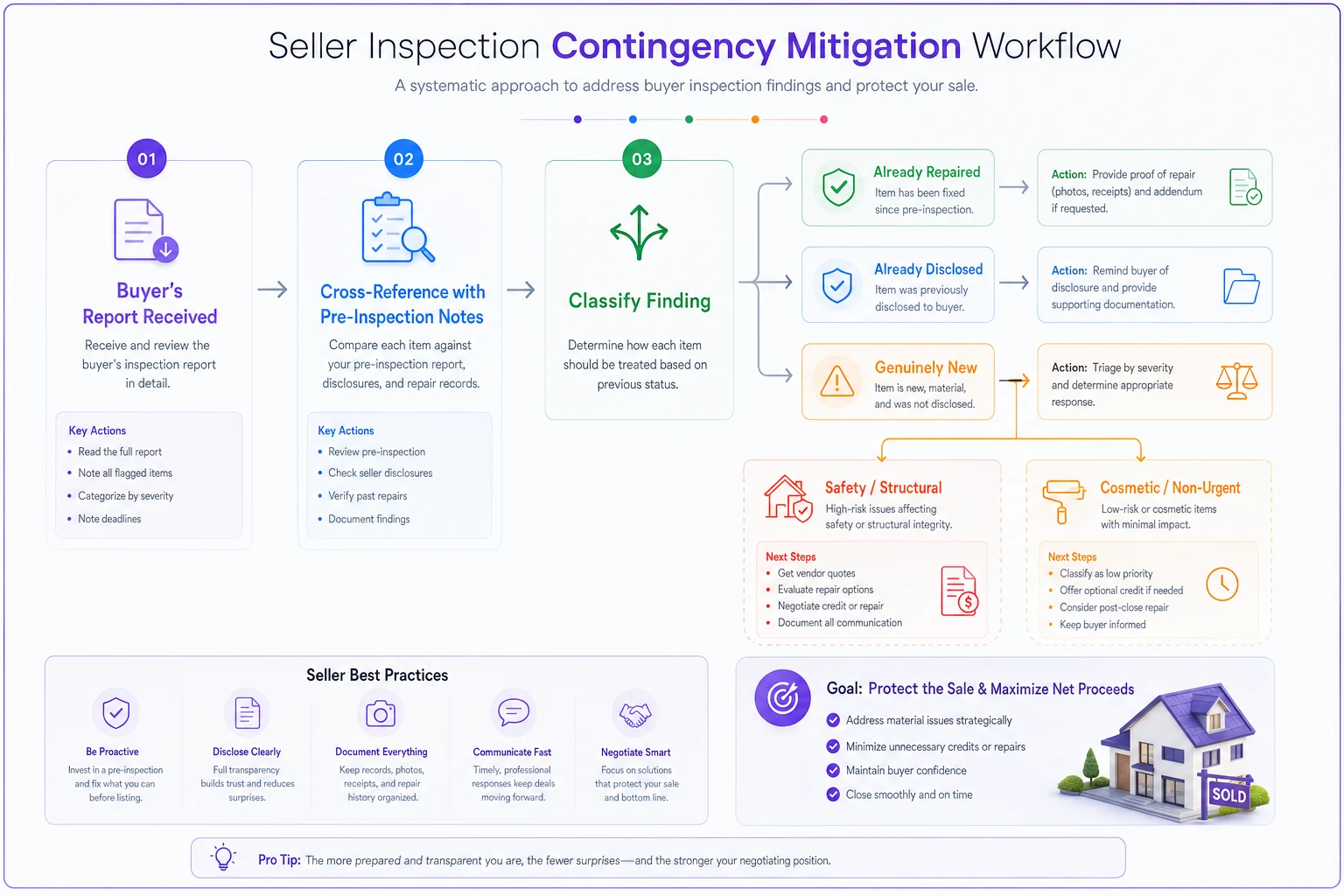
The report comes in. Because you ran your own pre-inspection, you open it and cross-reference every item against your prep notes. Items you already repaired? Respond with the invoice attached — "this was addressed on [date], see attached." That single move kills a large chunk of the request before negotiation even starts.
Items you disclosed at listing, the buyer knew, priced their offer around it, and can't double-dip. Items that are genuinely new (and there should be very few if your prep was thorough) go into a triage bucket: safety and structural first, cosmetic last. For each new item you should already have a vendor quote at your cost, so when the buyer requests a credit, you're negotiating against a real number instead of their padded estimate.
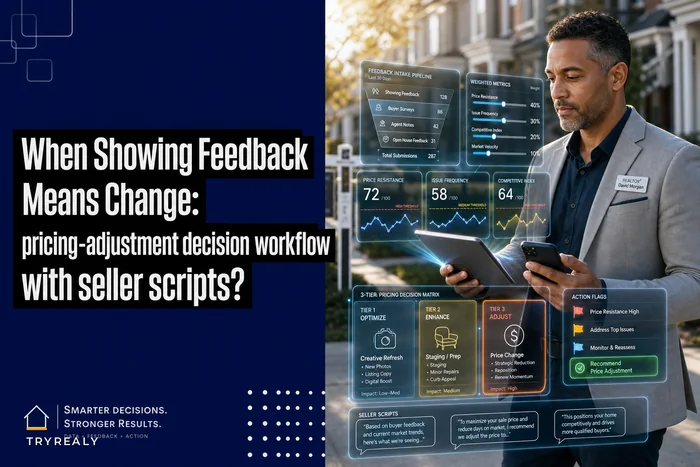
The decision workflow for how far to move on price when feedback and findings pile up is its own discipline — the logic in When showing feedback means change: a pricing‑adjustment decision workflow with seller scripts maps cleanly onto deciding whether to credit, repair, or hold firm when a report pushes back.
Seller scripts for the hard conversations
The seller's emotional state during the inspection window is half the battle. These are the lines that keep deals calm.
When presenting the pre-inspection plan: "We're going to find the problems before the buyer's inspector does. Not because we're hiding anything — the opposite. If we know what's there and either fix it or disclose it, the buyer has nothing to negotiate against. Surprises cost you money. Facts don't."
When a finding comes back and the seller wants to fight everything: "Let's separate the report into three piles: already fixed, already disclosed, and actually new. Most of this report is the first two. The 'new' pile is small, and we have our own quotes for it, so we're negotiating from numbers, not fear."
When a buyer over-asks on a credit: "The buyer requested $9,000. Our licensed vendor quoted the same work at $1,600 and I have it in writing. We're happy to credit the real cost or do the repair ourselves — but we're not funding a number that isn't tied to an actual estimate."
When heavy prep makes sense — and when it doesn't
When this makes sense:
-
Older housing stock (pre-2005)
-
Sellers who can't absorb a surprise credit
-
Hot-but-cooling markets where buyers are regaining leverage
-
Any listing where you suspect moisture, roof, or system age issues
When it's overkill:
-
New construction under warranty
-
Recent full renovations with documented permits
-
A genuine seller's market with multiple offers waiving inspection entirely
-
Running a full pre-inspection on a two-year-old home is wasted motion
Who should NOT lean on this: Agents who'll use pre-inspection findings to pressure a seller into unnecessary repairs that don't move the deal. The goal is controlled disclosure and smart repairs — not spending the seller's money to feel thorough. If a finding won't realistically affect negotiation or financing, note it and move on.
A real scenario
A three-agent office listed a 1996 split-level at $389k. Instead of their usual list-and-pray approach, they ran the pre-inspection checklist during staging week. They caught two dead GFCIs, a bath fan venting into the attic, and a water heater pushing 13 years. They fixed the GFCIs and fan for about $340 total, got a water heater replacement quote at roughly $1,500, and disclosed the heater's age up front with the quote attached.
House went under contract in nine days. The buyer's inspector found essentially the same items — but the GFCIs and fan were already fixed with invoices attached, and the water heater was already disclosed with a quote in hand. The buyer's agent asked for a credit; the seller countered with the documented $1,500 figure and settled there.
On a comparable listing the same office had closed a few months earlier, a nearly identical set of findings turned into a credit north of $6,000 because the seller found out through the buyer's report. Same house profile, same findings — roughly a $4,500 swing driven entirely by when discovery happened. Not the condition of the house. Not the market. Just timing.
The takeaway
The inspection contingency isn't where deals die. Late discovery is where deals die. Every part of this system — the checklist, the vendor SLAs with real fallbacks, the decision trees, the scripts — exists to pull discovery forward so you're never reacting to a buyer's report, only confirming what you already handled.
Build the prep once, run it on every older listing, and the inspection window stops being the scary part of the transaction. It becomes the part where your preparation quietly pays off.
Ready to elevate your real estate business?
Join 2,000+ agencies using TryRealy to streamline operations, close deals faster, and deliver exceptional client experiences.