

You've got a listing going live Friday. Thursday afternoon rolls around and the photographer still hasn't sent edited photos. The stager pulled their inventory Tuesday but never confirmed. The inspector flagged issues Wednesday night that should have been flagged days earlier. Now you're scrambling to push the listing date, disappointing your seller and losing the whole weekend of buyer traffic.
This mess happens when vendor relationships run on handshake agreements and text message promises. Without clear performance standards, vendors treat your deadlines as suggestions. Without scorecards, you can't tell which vendors consistently deliver versus which ones coast on past reputation. And without real remediation steps, problem vendors keep getting work because switching feels harder than just dealing with it.
The hidden math behind vendor delays
Every vendor delay creates a cascade. A photographer running 24 hours late pushes your listing from Friday to Monday. That's three prime showing days gone. If your average home sells around $425,000 with a 2.5% commission, those three days represent roughly $890 in lost exposure per day during peak season.
But the real damage runs deeper than commission math. Sellers lose confidence when you can't hold a timeline. They start questioning everything—your marketing, your pricing, your ability to manage offers. One vendor screwup can unravel months of relationship-building.
The pattern compounds with volume. Three active listings means juggling nine vendor relationships if you're coordinating stagers, photographers, and inspectors. At ten listings, you're tracking thirty deliverables. Without real systems, something always falls through the cracks.
Why standard vendor contracts fail agencies
Generic service agreements protect you legally but don't drive performance. They cover liability and payment terms but ignore the operational details that actually matter week to week. A contract that says "photos delivered promptly" is meaningless when promptly can mean 24 hours or 5 business days depending on who's reading it.
Never miss a showing or follow-up again.
TryRealy helps you schedule, track, and manage every client interaction smoothly.
- Unified property and client management
- Automated client notifications
- Integrated sales pipeline tracking
No credit card required
Real estate vendor SLAs need teeth. Specific turnaround times, quality benchmarks, communication requirements, escalation procedures. More importantly, they need measurement and consequences. Vendors who consistently miss SLAs should face reduced work allocation or contract termination—not just a stern conversation they'll forget by next week.
Most agencies avoid this structure because it feels confrontational. They worry about damaging vendor relationships built over years. Professional vendors actually prefer clear expectations though. The reliable ones want to stand out from their flaky competitors. SLAs give them that opportunity.
Building photographer scorecards that prevent listing delays
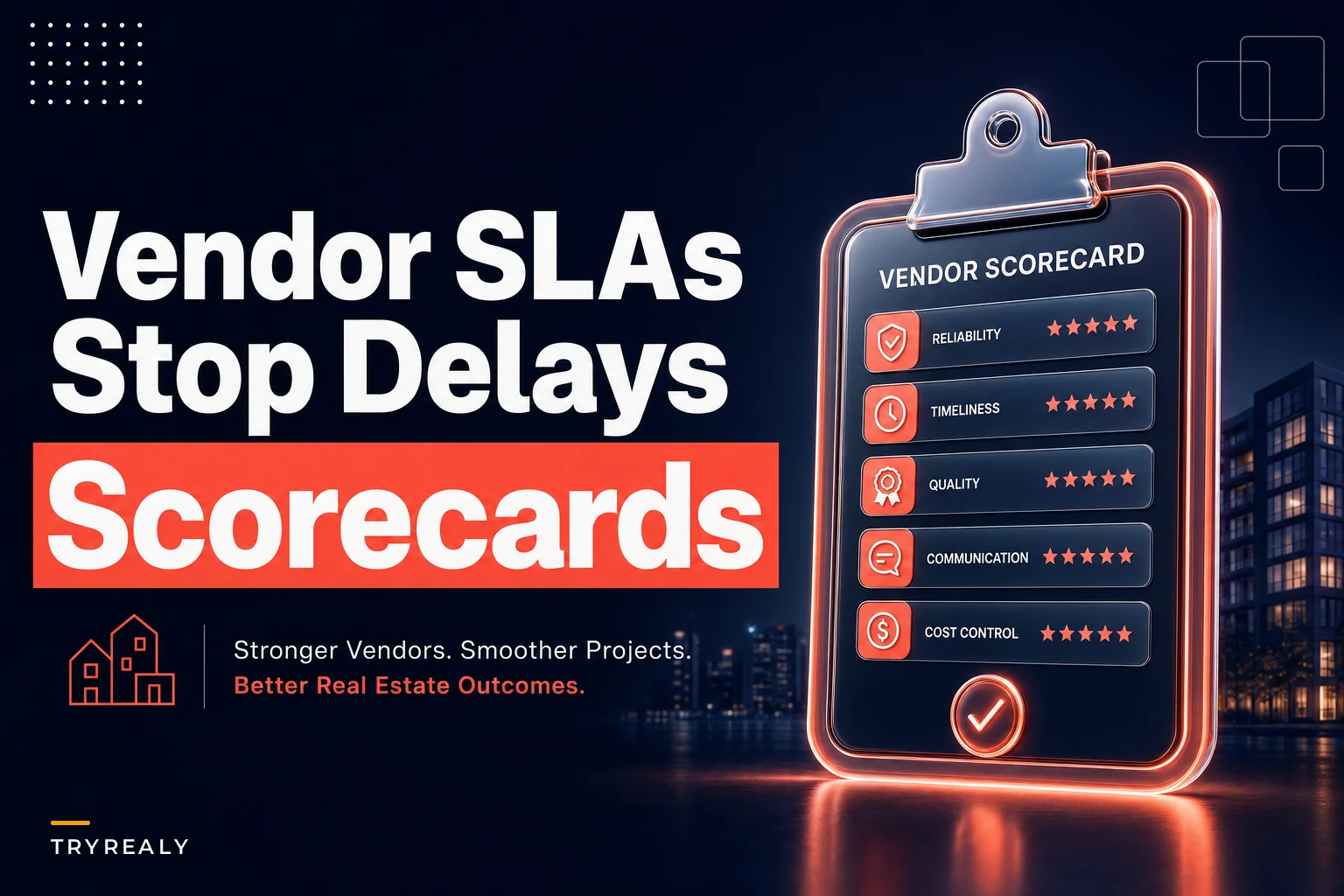
Photography delays kill more listing timelines than any other vendor issue. Here's a scorecard framework that tracks what matters:
Turnaround Metrics
-
Scheduled within 24 hours of request
Target 95%
-
Arrival within 15 minutes of appointment
Target 90%
-
Raw previews delivered same day
Target 100%
-
Final edits delivered within 48 hours
Target 95%
-
Reshoot availability within 24 hours
Target 85%
Quality Standards
-
All rooms captured per shot list
Pass/Fail
-
Proper lighting adjustments
Scored 1-5
-
Straight vertical lines
Pass/Fail
-
Color accuracy
Scored 1-5
-
Detail shots included
Pass/Fail
Communication Requirements
-
Booking confirmation within 2 hours
-
Day-before reminder sent
-
Arrival notification sent
-
Completion notification sent
-
Delivery notification with download link
Track these monthly. Photographers scoring below 85% overall get a remediation meeting. Below 75% for two consecutive months triggers work reduction. Below 70% means finding a replacement.
Sample SLA clause for photographer contracts:
"\"Vendor agrees to deliver fully edited, high-resolution images within 48 hours of photography session completion. Late delivery incurs a $100 daily penalty up to 50% of total service fee. Vendor must maintain 90% on-time delivery rate measured monthly. Failure to meet this standard for two consecutive months constitutes breach of contract.\""
Staging vendor accountability that protects showing schedules
Stagers create different problems than photographers. Their delays hit at both ends—installation and removal. A stager running late on Friday installation can force you to cancel weekend showings. Delayed removal blocks buyer walkthroughs or move-in dates.
Installation Standards
-
Setup completed by 2 PM the day before first showing
-
All items match the approved design board
-
Damage-free installation verified by walkthrough
-
Contact info cards placed in staged home
-
Photo documentation sent upon completion
Removal Requirements
-
24-hour advance scheduling required
-
Removal within 48 hours of sale or request
-
Property restoration to original condition
-
Damage documentation if discovered
-
Confirmation sent with time-stamped photos
Inventory Management
-
Minimum 85% availability on standard packages
-
48-hour notice for special requests
-
Backup items available for high-wear pieces
-
Seasonal rotation schedule maintained
The enforcement clause needs actual consequences:
"\"Installation delays that prevent scheduled showings incur $200 per missed showing day. Removal delays beyond 48 hours incur $150 daily storage fees payable to seller. Vendor maintains insurance covering all damage during staging period with maximum $500 deductible paid by vendor.\""
One agency had stagers consistently running 4-6 hours late on installations. After scored SLAs with financial penalties went into effect, on-time installation jumped to 92% within two months. The stagers who couldn't meet the new standards got replaced by hungrier competitors who were happy to sign on.
Inspector reliability scoring beyond just showing up
Home inspections create a unique SLA challenge because buyers choose their own inspectors. But you control your preferred vendor list and any pre-listing inspection relationships—and those relationships need structure.
Scheduling Timeline
-
Available within 72 hours of request
-
Morning slots available at least 3 days per week
-
Rescheduling notice minimum 24 hours
-
Emergency availability for rush listings
Report Delivery
-
Verbal summary before leaving the property
-
Written report within 24 hours
-
High-priority issues flagged immediately, not buried
-
Photos included for all noted defects
-
Plain-English summary for sellers
Communication Standards
-
Respond to scheduling requests within 4 hours
-
Provide accurate arrival windows (2-hour max)
-
Send completion confirmation
-
Available for follow-up questions 48 hours post-inspection
Score inspectors quarterly on report turnaround time (40% weight), report thoroughness (30% weight), communication responsiveness (20%), and scheduling flexibility (10%).
Below 80% gets a coaching conversation. Below 70% gets them removed from the preferred list. Sellers frequently ask for inspector recommendations, and buyer agents notice which agencies maintain quality vendor lists. Your preferred list is part of your reputation.
Monthly vendor review cadence that drives improvement
Random vendor evaluations waste everyone's time. A systematic monthly review that takes 90 minutes and produces real decisions is worth a lot more than quarterly gut-check conversations.
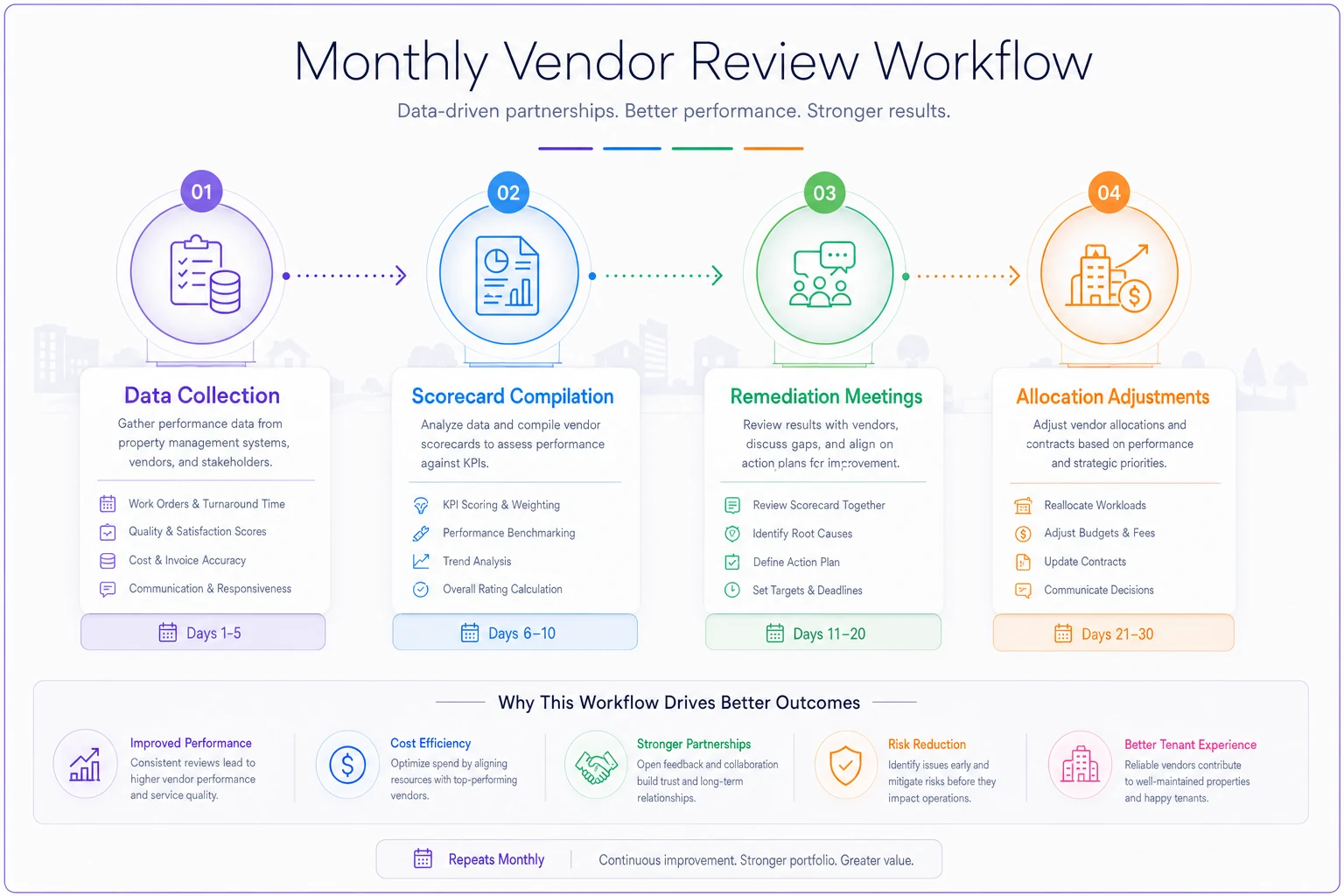
Week 1: Data Collection
Pull performance metrics from your listing preparation system. Every vendor interaction should generate trackable data—turnaround time, quality scores, communication flags.
Week 2: Scorecard Compilation
| Vendor | Type | Jobs | On-Time % | Quality Score | Issues | Trend |
|---|---|---|---|---|---|---|
| ProPhoto LLC | Photography | 12 | 83% | 4.2/5 | 2 delays | ↓ |
| StageRight | Staging | 8 | 100% | 4.8/5 | None | → |
| QuickInspect | Inspection | 5 | 60% | 3.9/5 | 3 delays | ↓ |
Here's a simple review workflow that keeps the month moving: data collection, scorecard compilation, remediation meetings, allocation adjustments.
Week 3: Remediation Meetings
Schedule 15-minute calls with underperforming vendors. Keep these focused—specific failures, not general complaints. End with clear improvement targets and a timeline. Frame it as alignment, not a performance review.
Week 4: Allocation Adjustments
Shift work toward consistent performers. If ProPhoto LLC keeps missing deadlines while another vendor delivers every time, gradually move bookings. Don't cut vendors immediately—give them 60 days to improve at reduced volume.
This monthly rhythm keeps vendor problems from festering. Issues get caught within a month, not after six months of seller complaints.
Onboarding checklist for new vendor relationships
Adding vendors without proper onboarding guarantees early problems. They don't know your standards, you don't know their real capabilities, and the first failure lands on a live listing.
Pre-Contract Verification
-
Insurance documentation verified
-
Three client references contacted
-
Sample work reviewed against your standards
-
Pricing structure documented
-
Availability windows confirmed
-
Communication preferences established
Trial Period Structure
-
Complete a minimum of 3 jobs before full integration
-
Run full scorecard tracking from day one
-
Weekly check-ins during the first month
-
Detailed quality reviews after each job
-
Collect direct agent feedback throughout
Systems Integration
-
Added to vendor management platform
-
SLA documents signed
-
Payment terms configured
-
Communication channels established
-
Emergency contact recorded
-
Backup vendor identified
Performance Benchmarks
-
Set trial targets slightly below your ongoing expectations
80% on-time delivery (vs. 90% ongoing)
-
4.0/5 quality score (vs. 4.5 ongoing)
-
24-hour response time (vs. 4-hour ongoing)
Vendors who can't hit trial benchmarks won't improve with volume. Cut them before they're embedded in your operations.
Remediation steps that salvage vendor relationships
Not every underperforming vendor needs immediate termination. Some face temporary challenges—equipment problems, staffing transitions, personal situations. The key is structured remediation that either fixes the problem or builds a documented case for termination.
Level 1: Performance Notice (First month below standards)
-
Written notice with specific gaps outlined
-
Request for an improvement plan
-
Offer of process consultation
-
No work reduction yet
Level 2: Probation Period (Second consecutive month below standards)
-
Formal probation letter
-
25% work reduction
-
Weekly performance reviews
-
Specific improvement milestones set
Level 3: Final Warning (Third month or critical failure)
-
50% work reduction
-
Daily check-ins on active jobs
-
Transition plan initiated
-
Backup vendor activated
Level 4: Contract Termination
-
30-day termination notice
-
Removed from all new bookings immediately
-
Existing commitments completed only
-
Full documentation retained for potential disputes
This graduated approach protects you legally while giving decent vendors a real chance to recover. It also signals to the rest of your vendor roster that standards are serious without being arbitrary.
Technology integration for vendor scorecarding
Manual vendor tracking starts breaking down somewhere around 15-20 active listings. You're juggling too many relationships across too many properties for spreadsheets to hold up.
Operational software built for this kind of work can handle the tedious parts automatically—tracking turnaround times, calculating scores, flagging SLA violations before they cascade, generating monthly scorecards without anyone touching a formula. More importantly, it creates accountability through visibility. When vendors can see their own performance data in real-time, scores improve without you chasing anyone down.
The process automation typically handles:
-
Deadline tracking from booking through delivery
-
Quality score aggregation from agent feedback
-
SLA violation alerts before they impact listings
-
Monthly scorecard generation with trend data
-
Vendor portal access for self-monitoring
Automate SLA breach alerts so vendors can fix issues before they impact listings.
That frees you to focus on relationship management rather than spreadsheet math. You coach underperformers and recognize your best vendors, instead of spending Tuesday afternoons calculating on-time percentages manually.
Implementing financial consequences that vendors respect
SLA penalties without enforcement are just decorative. Most agencies hesitate to actually invoke financial consequences, worried about damaging the relationship. Professional vendors expect accountability—they price their services with some penalty risk built in.
Structure penalties to be automatic, not discretionary. Proportional to the impact. Capped at reasonable levels. And offset by performance bonuses.
For example: "Photography delivered more than 48 hours after session incurs automatic 5% daily fee reduction, maximum 25%. Vendors maintaining 95%+ on-time delivery for 3 consecutive months receive a 10% bonus on their next invoice."
Carrot and stick. Good vendors earn more. Unreliable ones earn less. The market sorts itself out.
One brokerage rolled this out across 12 photographer vendors. Within four months, on-time delivery went from 72% to 91%. Two photographers quit rather than meet the standards. Three new ones stepped in quickly, drawn by the performance bonus potential.
Vendor communication templates that eliminate excuses
Vague communication creates vendor delays. They claim they didn't know the deadline, didn't understand the requirement, didn't get the message. Standardized templates remove those excuses entirely.
Booking Confirmation Template
"This confirms your [SERVICE] booking for [ADDRESS] on [DATE] at [TIME]. Deliverables due: [SPECIFIC DEADLINE]. Late delivery triggers SLA penalties per contract section 4.2. Reply CONFIRMED to acknowledge."
48-Hour Reminder
"Reminder: [SERVICE] scheduled for [DATE/TIME] at [ADDRESS]. Arrival window: [TIME RANGE]. Contact [AGENT] at [PHONE] with any issues. Deliverables due [DEADLINE]."
SLA Violation Notice
"Your [DATE] service at [ADDRESS] missed the following SLA requirement: [SPECIFIC VIOLATION]. Per contract, this triggers [CONSEQUENCE]. Your current monthly score: [SCORE]. Please respond with a corrective action plan."
Performance Review Summary
"Monthly Performance — [VENDOR NAME] Jobs completed: [NUMBER] On-time delivery: [PERCENTAGE] Quality score: [SCORE] SLA violations: [COUNT] Current status: [STANDING] Next review: [DATE]"
Every interaction follows the same format. Vendors can't claim confusion, and you have a paper trail if things escalate.
Making vendor governance sustainable
The system you build needs to run without constant attention. Otherwise it becomes another administrative burden that quietly gets abandoned when listing volume picks up.
Keep it automated wherever possible, delegatable to assistants, and integrated with existing workflows. If it's not valuable enough that agents actually enforce it, it won't last.
The scorecarding and monthly review cycle should take a maximum of 4 hours per month for up to 20 vendors. If it's taking longer, you're either tracking too much detail or haven't systemized the process enough.
Signs your vendor governance is actually working:
-
Listing delays drop below 5%
-
Agent complaints about vendors decrease noticeably
-
Vendor performance improves without you calling meetings
-
New vendors eagerly accept SLA terms upfront
-
Property descriptions go live on schedule
The discipline you build with vendors cascades through the whole agency. Agents understand that deadlines matter. Sellers see professional execution. Buyers move through smooth transactions.
Most agencies muddle through vendor relationships and accept delays as part of the business. They treat quality issues as unfortunate, communication gaps as normal. Structured vendor governance changes that dynamic. When vendors know they're being measured, they perform differently. When consequences are real, standards hold. When a system tracks everything automatically, accountability stops depending on someone's memory.
The agencies winning in competitive markets don't necessarily have better vendors—they have better vendor management. They've turned contractor relationships from an operational weak spot into something that actually runs. Their listings go live on schedule, reliably, because their SLAs have teeth and their scorecards drive real decisions.
Ready to elevate your real estate business?
Join 2,000+ agencies using TryRealy to streamline operations, close deals faster, and deliver exceptional client experiences.