

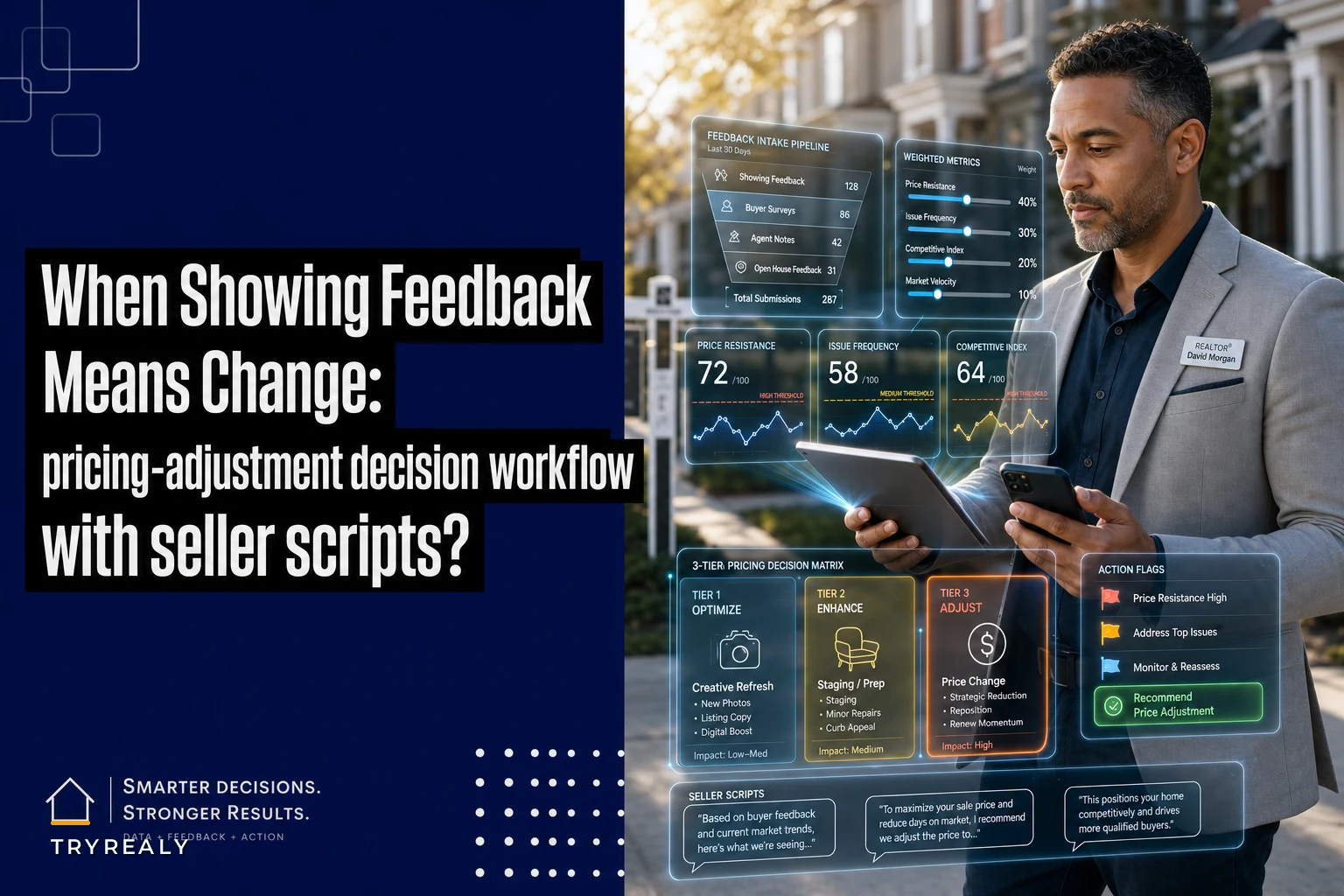

Showing feedback sits in your CRM like a pile of unread receipts. Agents dutifully send their post-showing surveys, buyers' agents half-heartedly fill them out, and somewhere between "needs updating" and "overpriced" lies actionable intelligence that could've moved the property three weeks ago.
The operational gap isn't collecting feedback—most agencies have that part handled. The breakdown happens in the translation from raw feedback to actual pricing decisions. Without structured aggregation rules and clear decision thresholds, you're essentially asking listing agents to become data scientists while juggling a dozen other properties.
The feedback forms that agents actually complete
Generic feedback forms generate generic responses. The standard "rate 1-5" format with an open comment box produces things like "nice property" or "buyers weren't feeling it"—useless for making real pricing calls.
Forms that actually drive decisions need specific trigger questions. Instead of asking for overall impressions, you're capturing comparative market position. The structure should force specificity without creating friction for the showing agent who's already running late to their next appointment.
Your core feedback questions should map directly to decision triggers:
Price perception relative to recent comparables
-
Priced competitively vs similar properties shown this week
-
Appears overpriced by roughly 5-10%
-
Appears overpriced by more than 10%
-
Unsure/no recent comparables shown
Specific deterrents observed
-
Dated fixtures/finishes mentioned unprompted
-
Layout concerns raised
-
Location/lot issues discussed
-
Condition issues beyond normal wear
-
None mentioned
Buyer's stated next steps
-
Will submit offer within 48 hours
-
Considering among top 3 properties
-
Keeping as backup option
-
Ruled out due to price
-
Ruled out due to property issues
These questions take maybe 90 seconds to complete but give you actual decision data instead of vague sentiment. You're not asking for opinions—you're documenting observed buyer behavior and explicit statements.
Aggregation rules that filter signal from noise
Raw feedback only becomes useful when you aggregate it properly. Three showings where buyers mentioned outdated kitchens might mean nothing individually, but together they form a pattern that demands a response.
Never miss a showing or follow-up again.
TryRealy helps you schedule, track, and manage every client interaction smoothly.
- Unified property and client management
- Automated client notifications
- Integrated sales pipeline tracking
No credit card required
The aggregation framework needs clear rules about which feedback counts and how it's weighted. Not all feedback carries equal weight. A cash buyer's price objection matters more than someone barely qualified at asking. An agent who showed four similar properties that day gives you better comparative insight than someone bouncing between price ranges.
Here's the weighting structure that actually works:
| Feedback Source | Weight Multiplier | Rationale |
|---|---|---|
| Qualified cash buyers | 2.0x | Ready to move, price-focused |
| Buyers who saw 3+ comparables same day | 1.5x | Direct market comparison |
| Second showing feedback | 1.5x | Serious interest despite concerns |
| Pre-approved buyers at asking price | 1.0x | Standard weight |
| Buyers stretching budget | 0.5x | Price sensitivity expected |
| First-time buyers | 0.5x | Limited market context |
Your aggregation period matters too. In normal markets, aggregate weekly. Hot markets, every 3-4 days. Slow seasons, extend to 10-day windows. You want enough data points to spot patterns while still staying responsive enough to act.
Once weighted, feedback rolls up into three key metrics:
-
Price resistance score (percentage mentioning price concerns)
-
Property issue frequency (specific issues mentioned in 40%+ of showings)
-
Competitive position index (how often chosen vs. comparable properties)
A quick visual outlines the aggregation and weighting workflow.
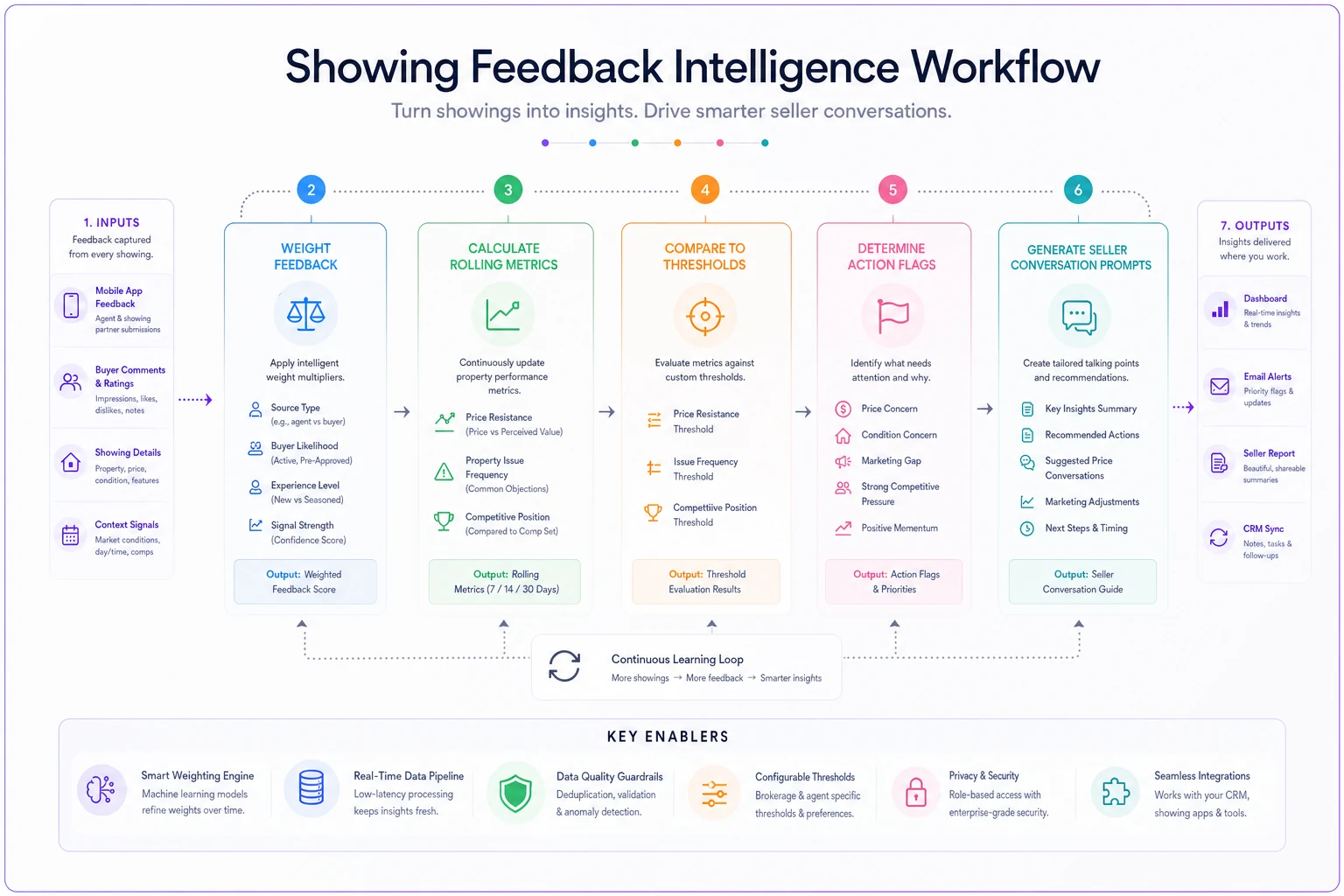
Prioritize feedback from buyers who viewed multiple comparables the same day to accelerate pattern recognition.
You want enough data points to spot patterns while still staying responsive enough to act.
Trend thresholds that trigger action
Patterns only matter when they cross decision thresholds. Otherwise you're collecting data for its own sake. The threshold framework needs to balance responsiveness against overreacting to one or two pieces of isolated feedback.
Your primary thresholds operate on a rolling basis:
Week 1-2 (Early market response)
-
60% of qualified feedback mentions overpricing → Immediate seller conversation
-
3+ showings with no follow-up interest → Review staging/presentation
-
Any cash buyer feedback about price → Flag for discussion
Week 3-4 (Market position assessment)
-
50% price resistance from qualified buyers → Price adjustment recommended
-
Specific issue mentioned in 40% of showings → Address or adjust pricing
-
Zero second showings → Major strategy review needed
Week 5+ (Stale listing prevention)
-
Any pattern continuing from weeks 3-4 → Mandatory adjustment
-
Showing volume drops 30% week-over-week → Refresh strategy required
-
Competitor properties moving while yours sits → Price realignment
The thresholds tighten over time because market perception compounds. A property that seemed slightly overpriced in week one becomes "that house that's been sitting" by week five. Acting on thresholds systematically—not waiting for seller consensus—is what separates agencies that move inventory from ones that manage stale listings all quarter.
The three-tier decision matrix
When thresholds trigger, you need clear decision paths, not more deliberation. The three-tier matrix maps specific feedback patterns to specific responses.
Tier 1: Creative Refresh
Deploy when feedback indicates presentation issues but price acceptance
Triggers:
-
Property issues mentioned but price rarely questioned
-
"Needs updating" appears in 30-40% of feedback
-
Showing volume steady but no offers
Actions:
-
Virtual staging for empty rooms
-
Professional photography retake focusing on strengths
-
Revised listing description emphasizing potential
-
Social media campaign highlighting lifestyle benefits
-
Broker caravan with refreshments to regenerate buzz
Timeline: Execute within 72 hours of trigger
Tier 2: Staging Intervention
Deploy when specific presentation issues block buyer visualization
Triggers:
-
Layout concerns in 40%+ of feedback
-
"Can't see past" comments about current furnishing/decor
-
Buyers spending less than 15 minutes on showings
Actions:
-
Professional staging consultation within 48 hours
-
Remove/replace problematic furniture
-
Neutral paint for bold-colored rooms
-
Declutter and depersonalize aggressively
-
Add strategic lighting for dark spaces
-
Update curb appeal elements
Timeline: Complete within 5-7 days of trigger
Tier 3: Price Adjustment
Deploy when market feedback clearly indicates overpricing
Triggers:
-
50%+ qualified feedback mentions price
-
Zero offers after 15+ showings
-
Comparable properties selling while yours sits
-
Cash buyers explicitly state price gap
Actions:
-
3-5% reduction for first adjustment
-
5-7% reduction if no response to Tier 1/2 actions
-
8-10% reduction for 45+ day listings
-
Consider auction or "submit best offer" strategy
Timeline: Implement at next week boundary for maximum visibility
The matrix removes emotion from the decision. When feedback patterns hit the trigger, you execute. No negotiating with reality, no "let's wait one more week."
Seller scripts for presenting adjustments
Identifying what needs to change isn't the hard part. Getting sellers to accept it is. The conversation shifts from opinion to data when you present feedback systematically, but framing still matters—especially for sellers who've been emotionally invested in a number for weeks.
Script for Tier 1 (Creative Refresh):
"Looking at our showing feedback from the past few weeks, we're seeing strong interest but buyers need help visualizing the property's potential. The good news: price acceptance is solid. We've had a solid number of showings with very few mentioning price as a concern.
The pattern we keep seeing is [specific feedback theme]. That tells me buyers like what's here, they just need better presentation. I want to move on [specific refresh action] in the next 72 hours. With similar properties I've worked on, this kind of refresh tends to generate renewed interest pretty quickly.
The cost is relatively modest—and it either speeds up the sale or protects our current price point. Without it, we risk the property starting to feel stale in buyers' minds. Can I get [specific action] arranged for tomorrow?"
Script for Tier 2 (Staging):
"After going through the showing feedback, there's a clear pattern that's holding us back from getting offers. Buyers are spending very little time inside, and a consistent portion mentioned [specific issue].
This isn't a problem with the property—it's a presentation issue. Buyers can't visualize themselves in the space. What's interesting is that price barely comes up, which means we're positioned correctly. We just need to remove the visualization barriers.
I have a stager I trust who can address the main spaces for a reasonable monthly cost. Based on what the feedback is telling us, focusing on [specific rooms] would directly address most of the concerns raised. If we move on this now, we can have it done by [date] and capture the next weekend's showing traffic.
The alternative is a price reduction—and based on current feedback, it would need to be significant enough to overcome the presentation problem. Staging protects the price while fixing the actual issue. Want me to schedule the consultation?"
Script for Tier 3 (Price Adjustment):
"I need to walk you through something based on the feedback we've been collecting. Over the past few weeks, a majority of qualified buyers have explicitly mentioned price as their main concern. And we've had a solid number of showings with zero offers—that combination is telling us something clear.
Here's what the market data shows: comparable properties nearby went under contract in a fraction of the time, both priced below us with similar specs. The showing agents are consistently reporting buyers choosing those properties over ours because of price.
Based on what we're seeing, I'm recommending an adjustment that brings us in line with where the market is actually sitting right now. Without making this move, we're looking at more time on market, which weakens our negotiating position considerably. Properties that sit past a certain point typically need even larger reductions to generate fresh interest.
At the adjusted price, you're still netting a strong number after commissions and closing costs. I'd like to implement this by Thursday so we capture the weekend buyers. Does that work for you?"
Preventing feedback paralysis
The biggest operational failure happens when agencies collect showing feedback but never act on it. It sits in spreadsheets, gets mentioned in passing during listing reviews, and never actually drives decisions. Metrics without action create the illusion of data-driven operations while properties quietly stagnate.
The fix requires operational discipline more than anything else:
Weekly feedback review protocol:
-
Export all showing feedback from past 7 days
-
Apply weighting multipliers
-
Calculate aggregate scores
-
Compare against thresholds
-
Identify required actions per decision matrix
-
Schedule seller conversations within 24 hours
-
Document decisions and rationale
This review should take around 20 minutes per listing. If it's taking longer, the process is too complicated. The goal is fast pattern recognition and decisive action—not exhaustive analysis.
Monthly calibration check:
-
Review properties that sold after adjustments
-
Compare feedback predictions to actual outcomes
-
Adjust thresholds if market conditions shifted
-
Update weighting factors based on success patterns
Markets change. Your decision framework should adapt without losing its systematic structure.
Operational software that aggregates automatically
Manual feedback aggregation kills consistency. By the time someone compiles the spreadsheet, weights the responses, and checks against thresholds, another week has passed and the property has drifted further into stale territory.
AI-powered operational software changes this from reactive to proactive. Showing agents submit feedback through mobile forms that automatically weight and aggregate responses. The system tracks patterns across all your listings simultaneously—separating market-wide trends from property-specific issues that actually warrant action.
The automation handles the routine mechanics: calculating weighted scores, comparing against your defined thresholds, flagging properties that need attention, and even drafting initial seller communication based on feedback patterns. Agents spend their time having adjustment conversations and executing changes, not wrangling spreadsheets.
More importantly, operational software enforces consistency across the agency. Every listing gets the same systematic review, the same threshold applied, the same decision framework. You're not dependent on whether a particular listing agent remembers to check feedback or has the pattern-recognition experience to interpret it correctly.
The compound effect of systematic decisions
Properties priced correctly from showing feedback don't just sell faster—they change your agency's operational rhythm. Instead of listings dragging for months and consuming marketing budgets and agent bandwidth, properties move predictably through the pipeline.
Think about the actual burden of a stale listing: weekly conversations with sellers that go nowhere, explaining to new buyers why it's been sitting, defending your agency's judgment to sellers watching neighboring properties sell. Each stale listing creates compounding drag, pulling resources from opportunities that could actually close.
Systematic feedback decisions break that cycle. Properties adjust quickly, sellers receive data-driven recommendations instead of agent opinions, and pipeline velocity picks up. An agent managing five stale listings can handle eight properties that move predictably once the framework is running.
Sellers talk to each other too. When you present clear feedback data and a systematic recommendation, word spreads that you operate differently—not the agent making excuses, but the one with a process that keeps things moving.
Getting started without overwhelming your team
You don't need to overhaul the entire operation to make this work. Start with structured feedback forms for new listings only. Test the weighted aggregation on one or two properties. Refine your thresholds based on actual outcomes before rolling it out agency-wide.
The implementation sequence:
-
Design your structured feedback form (one afternoon)
-
Test with your most disciplined agents (one week)
-
Build simple aggregation spreadsheet (two hours)
-
Define your initial thresholds (use the suggestions above as a starting point)
-
Practice seller scripts with role-play (one meeting)
-
Run parallel test on 3-5 listings (two weeks)
-
Refine based on outcomes
-
Roll out to all listings
Most agencies can get basic showing feedback decisions operational within a month. Start with structure, not perfection. Rough thresholds beat gut-feeling pricing calls. Basic aggregation beats ignoring feedback patterns entirely.
Your listing descriptions might be strong, your staging solid, your marketing aggressive—but if you're not systematically translating showing feedback into pricing decisions, properties will sit anyway. The framework above removes guesswork, gives you scripts for the hard seller conversations, and creates the kind of operational consistency that keeps inventory moving even when the market gets choppy.
The agencies doing well right now aren't necessarily better at marketing or negotiation. They're better at recognizing patterns early and acting decisively when data demands it. Your showing feedback already contains those patterns. The only question is whether you build the discipline to act on them.
Ready to elevate your real estate business?
Join 2,000+ agencies using TryRealy to streamline operations, close deals faster, and deliver exceptional client experiences.