

Most agents don't lose the sale during the tour. They lose it in the 30 seconds after a buyer says something like "we're just getting a feel for the market" — and the agent nods, smiles, and lets the moment die. The tour goes fine, everyone shakes hands in the driveway, and then the buyer ghosts for three weeks and eventually buys with someone who followed up sharper.
The problem isn't charisma. It's that the same objection sounds completely different coming from a first-time buyer versus a relocating executive versus an investor running numbers on his phone. A generic response ("great question, let me look into that") works on none of them.
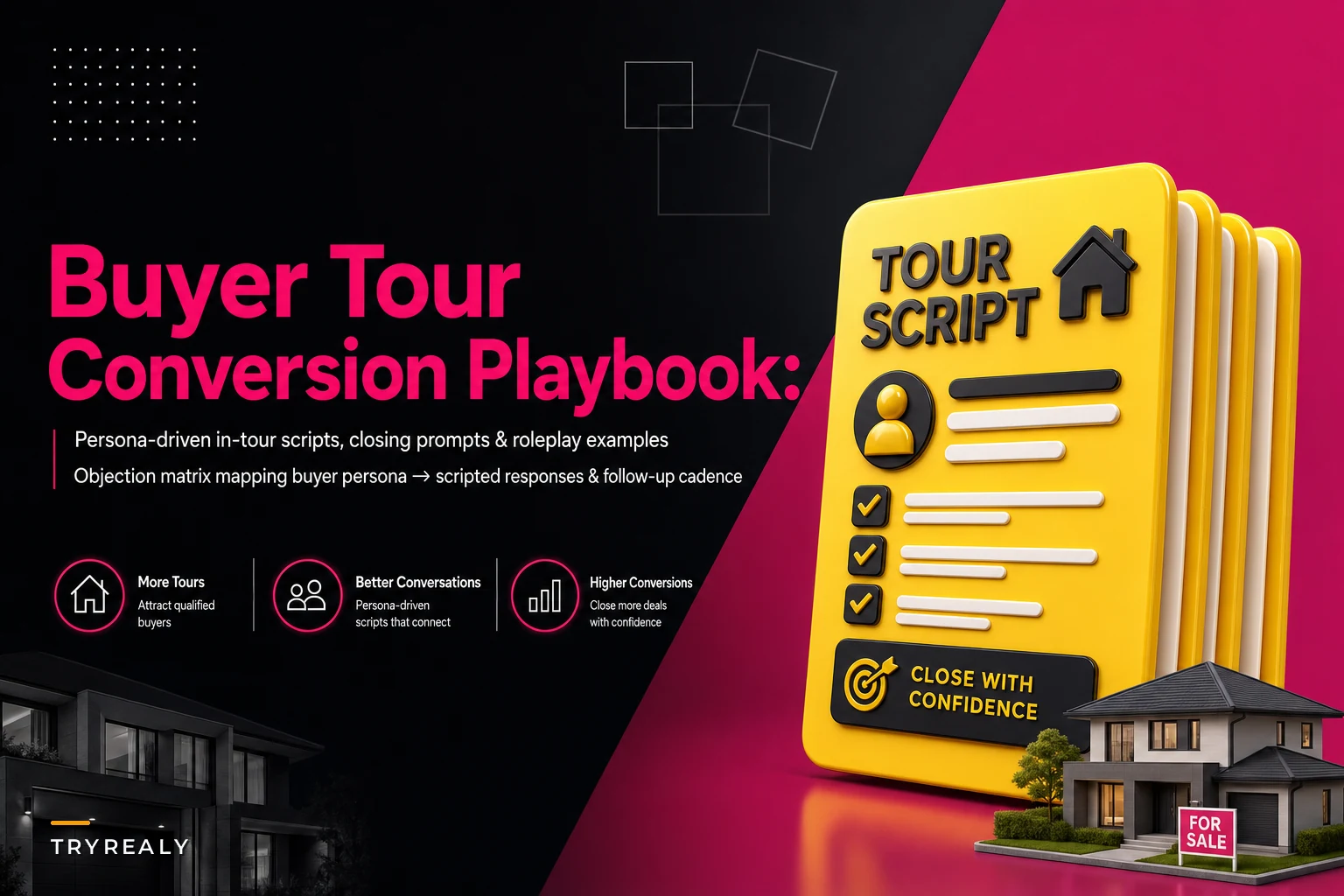
This is a working script library organized by buyer persona: how to open the walkthrough, when and how to attempt a close, and a mapped objection matrix so you're not improvising. There are downloadable script cards and roleplay setups at the end so your newer agents can drill this before they're standing in a stranger's kitchen.
Why one script fails across different buyers
The core mistake with most buyer tour conversion scripts in real estate is treating every buyer the same. There isn't one buyer.
Watch what happens on a Saturday of back-to-back showings. A first-time buyer walks in nervous, over-asks about the water heater, and needs reassurance more than data. Ninety minutes later a relocating buyer walks the same house, doesn't care about the water heater at all, and wants commute times and school boundaries yesterday. If you run the identical open — "So, what do you think?" — you get a shrug from both, but for completely different reasons.
The breakdown usually happens because the agent is reacting to the house instead of the person. They narrate features ("granite counters, updated HVAC") when the relocating buyer needs decision-making structure and the investor needs a cap-rate conversation. Features are the easy thing to talk about, so that's where nervous agents retreat.
The pattern across a lot of small teams: agents who convert consistently aren't smoother talkers. They've just pre-decided what to say to this type of person before they unlock the door.
The four personas worth scripting for
You don't need twelve personas. Most small-agency buyer volume collapses into four, and each has a signature objection and a signature close.
Never miss a showing or follow-up again.
TryRealy helps you schedule, track, and manage every client interaction smoothly.
- Unified property and client management
- Automated client notifications
- Integrated sales pipeline tracking
No credit card required
| Persona | What they actually want | Signature objection | Close that works |
|---|---|---|---|
| First-time buyer | Reassurance + a clear next step | "We need to think about it / talk to family" | Micro-commitment close (book a second look) |
| Relocating buyer | Speed, logistics, local context | "We're still comparing neighborhoods" | Timeline-anchored close |
| Move-up / trade-up buyer | Justifying the jump, protecting equity | "We haven't sold ours yet" | Contingency-path close |
| Investor | Numbers, exit, tenant demand | "The margin's too thin at this price" | Terms-based close (not price) |
The part most people miss: the objection is rarely the real objection. A first-time buyer saying "we need to think about it" almost never means they need more information — it means they're scared and nobody gave them permission to move forward. An investor saying "margin's too thin" isn't done; he's opening a negotiation. Treating those two the same way is how deals die.
Opening the walkthrough (the first 90 seconds)
The open determines whether the buyer actually talks to you or just performs politeness at you. Skip the "isn't this a lovely foyer" narration. Set the frame and hand them a job.
Universal open (all personas):
> "Before we walk through — what would have to be true about this house for it to make your shortlist today? I'll point out anything that lines up or doesn't as we go, so we're not wasting your Saturday."
-
- First-time buyer "And just so you know how this normally goes — most people look at three to five before it clicks. No pressure to decide anything today." (Removes fear early.)
-
- Relocating buyer "I've pre-pulled commute times from here to the two areas you mentioned. Want those now or after we walk it?" (Signals you did homework.)
-
- Move-up buyer "How's your current place positioned — are you thinking sell-first or buy-first?" (Surfaces the contingency early, not at the offer stage.)
-
- Investor "You want the numbers before or after the walkthrough? I've got rent comps and the last two sales on the street." (Respects their time and speaks their language.)
That question does three things: it surfaces real criteria, it positions you as a filter instead of a cheerleader, and it gives you the exact ammunition you'll need at the close.
The objection matrix
Print this section and keep it in the car. For each persona, the scripted response is not a rebuttal — it's a redirect toward a decision.
First-time buyer
"We need to think about it / talk to my parents."
> "Totally normal. What specifically do you want to run by them — the price, the location, or whether the house itself is right? Because if it's the house, I'd love to know what's giving you pause while we're standing in it."
This splits a vague stall into a solvable question. If they say "the house is great, it's just the price," you now have a pricing conversation instead of a ghosting problem.
"What if we buy and rates drop?"
> "Fair concern. You can refinance a rate — you can't refinance the house you missed. If a place ticks your boxes, we solve the rate later. Want me to loop in a lender to show you the refi math?"
Relocating buyer
"We're still comparing neighborhoods."
> "Smart — let's make that comparison real instead of a feeling. If I sent you a one-page side-by-side of this area versus the other two by tomorrow morning, would that help you narrow it before your trip ends?"
Relocating buyers are on a clock. Anchor to their timeline and offer to do the analysis for them.
"We can't decide without seeing it again in daylight / with our spouse."
> "Let's book that now while your travel window's open — what's better, tomorrow at 9 or Sunday at 4?" (Assumptive scheduling beats "let me know.")
Move-up buyer
"We haven't sold our current place yet."
> "Right, that's the real question then. Do you want to walk through what a sell-first versus buy-first path looks like for you? Because in this inventory, buyers who wait until they've sold sometimes miss the exact house they wanted. Ten minutes and I'll show you both."
The move-up buyer's objection is a sequencing problem disguised as hesitation. Solve the sequence.
Investor
"The margin's too thin at this price."
> "Agreed at asking. What number makes it work for your model — and are you flexible on close timing or repairs if we get there? Sellers here have moved more on terms than price lately."
Never argue price with an investor. Pivot to terms, timeline, and structure — that's where they actually flex.
Close attempts that don't feel gross
The word "close" scares newer agents into avoiding it entirely, so tours end with "let me know if you have questions" — which is not a close, it's an exit.
A close is just proposing the next concrete step. Match it to persona:
-
1. Micro-commitment (first-timers) "Want me to hold a second showing so you can bring your dad?" — small yes, keeps momentum.
-
2. Timeline-anchored (relocating) "Your offer deadline for the corporate package is Friday, right? If this is the one, we'd want to write it by Wednesday. Should I draft terms so you can react to something real?"
-
3. Contingency-path (move-up) "If I can structure a sale-contingent offer that protects you, is this the house you'd want me to write it on?"
-
4. Terms-based (investor) "If the seller takes X with a 30-day close, are you in? Let me test it."
High-converting agents attempt the close, get a soft no, handle the objection, then attempt a smaller close. The stall is data, not defeat.
Follow-up cadence mapped to the objection
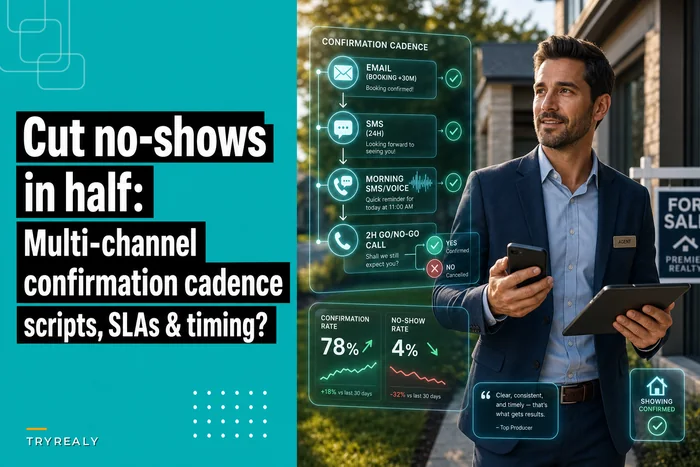
The tour close is only half the system. What happens in the 48 hours after determines whether the objection you heard actually gets resolved or hardens into silence. This ties directly into keeping showings from evaporating — the same discipline that helps cut showing no-shows in half with a multi-channel confirmation cadence applies to post-tour follow-up.
A simple persona-mapped cadence:
-
- First-time buyer → same-day text with a "you did great, no rush" tone + a resource on the buying steps. Day 2: call to ask what their family said. Day 5: soft check-in with a comparable listing.
-
- Relocating buyer → deliver the promised neighborhood one-pager within 12 hours (this is the whole ballgame — they judge you on speed). Day 2: confirm the second showing or offer timeline.
-
- Move-up buyer → within 24 hours send the sell-first vs buy-first breakdown you promised. Day 3: check on their current-home valuation.
-
- Investor → send the rent comps and a quick pro-forma same day. Day 2: report back on the terms test if you floated one.
The mistake most teams make is running the same cadence for everyone — usually a generic "just following up!" text that says nothing. If the follow-up doesn't advance the specific objection raised on the tour, it's noise.
A real scenario
A three-agent brokerage in a mid-size suburban market was running roughly 40–50 buyer tours a month and converting somewhere around 8–10% of first-time-buyer tours into a written offer within 30 days. Their tours weren't bad — buyers liked the agents. Deals just stalled after the showing.
They did one thing: built persona cards for the two buyer types that made up most of their volume (first-timers and move-ups), drilled the objection responses in a Friday roleplay for about three weeks, and mapped a distinct follow-up cadence to each. No new leads, no new tech.
Over the next quarter, first-time-buyer tour-to-offer conversion moved into the mid-teens, and move-up buyers stopped disappearing at the "we haven't sold yet" wall because agents were surfacing the sequencing question on the tour instead of a week later. Nothing dramatic on paper — a handful of extra deals — but for a small team that's a meaningful revenue swing, and it came almost entirely from not fumbling the objection.
Where scripts connect to pricing reality
Scripts handle the buyer's objections, but sometimes tour feedback is telling you the listing is the problem, not the pitch. If three buyers in a row raise the same objection on the same house, that's not a scripting issue — that's the market talking.
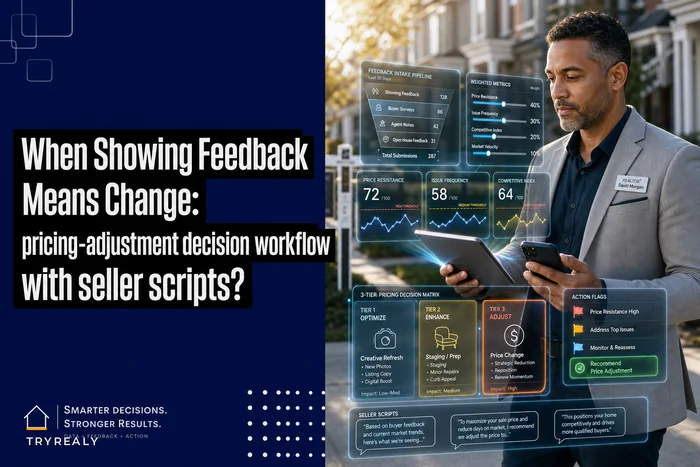
Knowing when to translate that pattern into a pricing conversation with the seller is its own workflow, and it's worth pairing this with a clear process for turning showing feedback into a pricing-adjustment decision.
Below is a simple workflow to decide when showing feedback should trigger a pricing discussion.
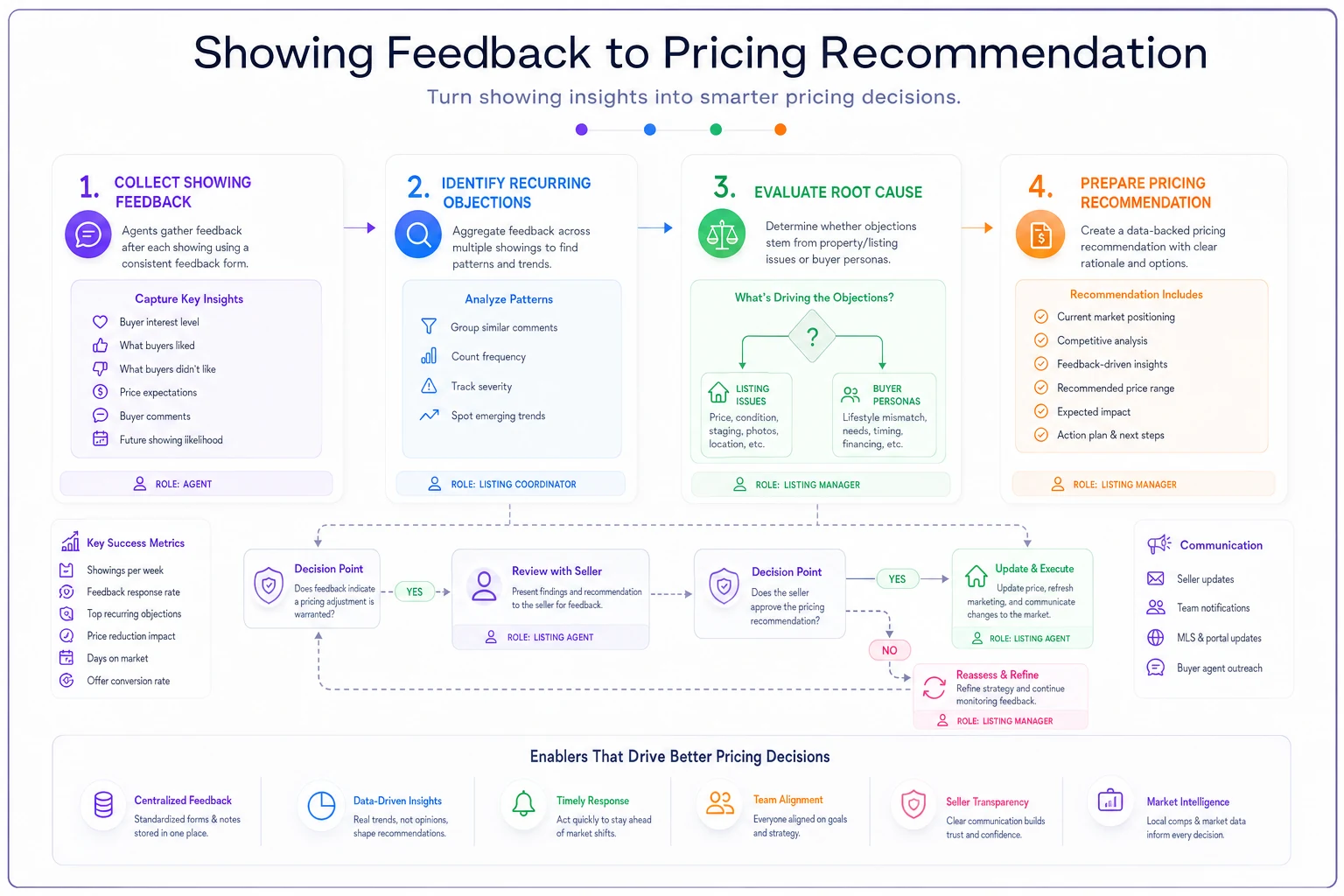
The two systems reinforce each other: good scripts get you honest feedback, and honest feedback tells you whether to keep selling or to adjust the price.
When persona scripting is worth it — and when it isn't
When it makes sense:
-
- You have newer agents who freeze on objections.
-
- Your tour-to-offer conversion is fine on likeable buyers but collapses on analytical ones.
-
- Your team's follow-up is generic and buyers go quiet after showings.
When it's a bad idea:
-
- If your real problem is lead quality or booking speed, scripts won't save you — fix the top of the funnel first.
-
- If you force veteran agents with their own working style into rigid word-for-word scripts, you'll flatten what already works. Give them the objection matrix, not the exact wording.
Who should skip this entirely:
solo agents doing four or five deals a year with a warm referral base. The overhead of maintaining a script library isn't worth it at that volume — just internalize the four persona questions and move on.
Keeping the library usable
Scripts rot. The market shifts, a rate move changes what buyers say, and cards written last spring reference concerns nobody has anymore. Teams that actually benefit review their objection matrix once a quarter — pull the three most common stalls agents heard and check whether the scripted response still lands.
Some agencies keep these cards inside whatever platform already runs their showing workflow, so the persona tag on a lead pulls up the right opening question and follow-up cadence automatically instead of living in a Google Doc nobody opens. That's a nice-to-have, not the point. The point is that the words exist, they're matched to the person, and your newest agent knows what to say when a buyer says "we're just looking."
Review the top three stalls each quarter and update the cards in one focused session after a roleplay.
Some agencies keep these cards inside whatever platform already runs their showing workflow, so the persona tag on a lead pulls up the right opening question and follow-up cadence automatically instead of living in a Google Doc nobody opens. That's a nice-to-have, not the point. The point is that the words exist, they're matched to the person, and your newest agent knows what to say when a buyer says "we're just looking."
Downloadable script cards & roleplay setup
Print these four cards, one per persona, and keep them in the car or in your showing app:
-
- Card 1 — First-Time Buyer open question, top 3 objections + responses, micro-commitment close, 5-day cadence.
-
- Card 2 — Relocating Buyer open question, logistics objections + responses, timeline close, 12-hour one-pager rule.
-
- Card 3 — Move-Up Buyer sequencing open, contingency objections + responses, sale-contingent close.
-
- Card 4 — Investor numbers-first open, terms-based objection handling, terms close.
Roleplay drill (20 minutes, weekly):
-
1. One agent plays the buyer persona and commits to the objection — no going easy.
-
2. The other runs the open, hits the objection, attempts a close.
-
3. Whole room grades one thing
did the response redirect toward a decision or just answer the question?
-
4. Swap personas. Rotate the "hard" objection each week.
Do that four Fridays in a row and your team stops improvising in the driveway.
Buyer tours don't convert because of one magic line. They convert because the agent knew who was walking in, expected the objection, and had already decided what the next step would be. Everything above is just making that decision before the door opens instead of after the buyer's gone.
Ready to elevate your real estate business?
Join 2,000+ agencies using TryRealy to streamline operations, close deals faster, and deliver exceptional client experiences.