


Most small real estate agencies run on hope. Hope that agents remember to follow up. Hope that clients don't slip through the cracks during handoffs. Hope that everyone delivers a consistent level of service. But when you're competing against mega-brokerages with dedicated client success teams, hope isn't a strategy.
A real estate client experience blueprint isn't about creating more work for your team. It's about mapping exactly what happens at each stage, who owns what, and what triggers the next step — or an escalation. When you nail this, small teams can deliver the kind of consistency clients expect from agencies ten times their size.
Why client journeys break down in real estate
Real estate transactions involve too many moving parts for informal coordination to work reliably. A typical buyer journey touches seven to nine different people inside your agency, plus another dozen external parties. Without clear handoff points and defined ownership, clients experience your agency as a series of disconnected interactions rather than one cohesive process.
The breakdown usually starts small. An agent shows properties but doesn't update the admin about scheduling conflicts. The transaction coordinator receives an offer but doesn't know the client's negotiation priorities because that conversation happened over text. The closing specialist discovers a title issue that should have been flagged during the initial paperwork review.
Each dropped ball erodes trust. Clients start wondering if you're organized enough to handle their biggest financial transaction. They question whether choosing a smaller agency was a mistake. By the time they reach closing, even successful transactions leave clients feeling like they survived the process rather than enjoyed it.
What makes this worse is that most agencies try to fix these problems reactively. They add more check-ins, create longer forms, schedule more meetings. But without understanding the full journey and where it actually breaks, you're just adding complexity to an already broken system.
Mapping the real buyer journey (not the one in your head)
The buyer journey you think you deliver rarely matches what actually happens. Most agencies have an idealized version that assumes perfect execution at every step. Reality includes forgotten follow-ups, miscommunicated priorities, and clients who get different answers depending on who they ask.
Never miss a showing or follow-up again.
TryRealy helps you schedule, track, and manage every client interaction smoothly.
- Unified property and client management
- Automated client notifications
- Integrated sales pipeline tracking
No credit card required
Start by documenting what actually happens, not what should happen. Pull ten recent buyer transactions from first contact to six months post-closing. Note every touchpoint, every handoff, every delay. Include the awkward parts — the times clients had to call three times for an update, the showings that got double-booked, the offers that sat unsigned because nobody confirmed receipt.
Here's what a realistic buyer journey looks like for a typical small agency:
Initial Contact to First Meeting (0–48 hours)
-
Lead comes through website, portal, or referral
-
Response time varies from 5 minutes to 2 days depending on who's "on duty"
-
Initial qualifier questions asked differently by each agent
-
Meeting scheduled through personal calendars with no central visibility
-
No standard for what gets captured in CRM
First Meeting to Showing Schedule (2–7 days)
-
Buyer preferences documented inconsistently (some in CRM, some in email, some in an agent's notebook)
-
Pre-approval verification happens sometimes
-
Search setup varies wildly between agents
-
Showing coordination runs through a mix of text, email, and showing apps
-
Client communication preferences rarely documented
Active Showing Phase (2–12 weeks)
-
Feedback collection sporadic
-
Search criteria adjustments not systematically tracked
-
Showing notes stored in the agent's personal system
-
Handoffs to showing assistants happen informally
-
Client fatigue indicators missed
Offer Through Closing (30–60 days)
-
Offer strategy discussed but not documented
-
Transaction coordinator receives incomplete information
-
Inspection issues communicated through multiple channels
-
Closing timeline updates inconsistent
-
Post-closing follow-up happens if the agent remembers
This messy reality is your starting point. Until you acknowledge where things actually break, you can't build systems to prevent those breaks.
Service level objectives that actually matter
SLOs in real estate need to balance speed with quality. Responding to a lead in 5 minutes means nothing if your response is generic and unhelpful. Promising same-day showing bookings sounds great until you're double-booking properties and irritating listing agents.
The goal is identifying the moments that genuinely impact client outcomes and satisfaction. Certain response times and quality standards consistently separate agencies that grow from those that stagnate.
Critical SLOs for Buyer Journey:
| Touchpoint | Maximum Time | Quality Standard | Escalation Trigger |
|---|---|---|---|
| New lead response | 15 minutes (business hours) | Personalized, address specific inquiry | Manager notified at 30 minutes |
| Showing request to confirmation | 4 hours | All requested properties or alternatives | Client notified of delays at 2 hours |
| Offer decision to submission | 2 hours | Complete, accurate, all signatures | Broker review if complex terms |
| Inspection report to response | 24 hours | Detailed recommendations, cost estimates | Automatic escalation for major issues |
| Contract to close updates | Weekly | Proactive, includes next steps | Daily updates if issues arise |
These aren't arbitrary numbers. Properties that receive offers within 48 hours of listing often attract multiple bids. Buyers who wait more than 4 hours for showing confirmations are significantly more likely to contact another agent. Inspection negotiations that drag past 48 hours fall apart at roughly twice the rate of those resolved quickly.
Build SLO enforcement into your operational software as automated triggers to reduce manual oversight.
SLOs without enforcement are just wishful thinking. Build them into your operational software as automated triggers. When an SLO is approaching a breach, the system should alert the responsible party and their backup. When it's actually breached, escalation should be automatic — not dependent on someone noticing.
Role handoffs that prevent dropped balls
The most dangerous moment in any client journey is the handoff. Information gets lost, context disappears, accountability becomes unclear. In agencies where agents wear multiple hats, these handoffs happen constantly — often without anyone realizing a handoff has even occurred.
Clear handoff protocols need three things: a trigger, a package, and confirmation. The trigger defines when a handoff occurs. The package specifies what information must transfer. The confirmation ensures both parties agree the handoff is complete.
Take the transition from active showings to making an offer. In most agencies, this happens informally when a buyer says they're interested in a property. Without a structured handoff, critical details get missed. The showing agent might not communicate the buyer's hesitations. The offer strategy might not reflect conversations from previous showings. The client might not understand what happens next.
A proper handoff protocol looks like this:
Showing to Offer Handoff
-
Trigger
Client expresses interest in making an offer
-
Package Required
- Property address and MLS number - Client's specific interests and concerns about the property - Competing offer intelligence - Client's max price (from earlier conversations) - Preferred closing timeline - Any special terms discussed - Documentation of pre-approval status
-
Confirmation
Transaction coordinator acknowledges receipt and reviews with client before drafting
This same structure applies to every transition: new lead to showing agent, showing agent to transaction coordinator, transaction coordinator to closing specialist, closing specialist back to relationship manager for post-closing retention systems.
Visualizing the handoff workflow clarifies responsibilities and triggers.
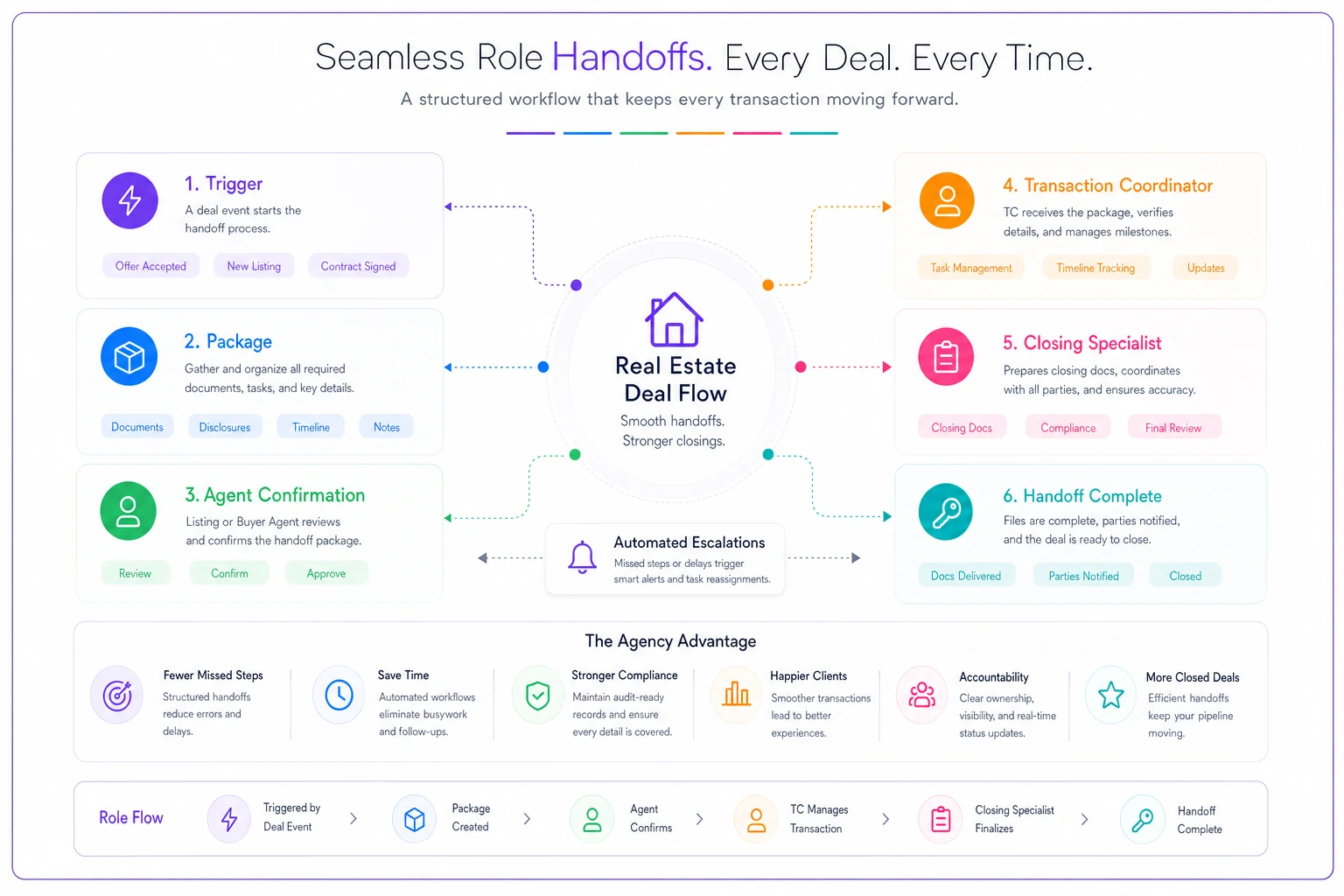
Without formal handoffs, you're essentially playing telephone with your clients' biggest financial transaction. Each person fills in missing information with assumptions. By the time those assumptions surface as problems, it's usually too late to fix them without damaging the client relationship.
Required touchpoints vs. optional check-ins
Not all client communication carries the same weight. Some touchpoints are non-negotiable — miss them and you've fundamentally failed your service delivery. Others can flex based on client preferences and team capacity.
Required touchpoints protect both the transaction and the relationship. They ensure clients never wonder what's happening with their purchase and catch problems before they become deal-killers.
Non-Negotiable Buyer Touchpoints:
-
Lead acknowledgment (within SLO)
-
Post-meeting recap with next steps
-
Weekly update during active search
-
Pre-offer strategy session
-
Offer submission confirmation
-
Offer result communication
-
Inspection scheduling confirmation
-
Inspection findings review
-
Weekly closing progress updates
-
24-hour pre-closing check-in
-
Post-closing thank you
-
30-day post-closing follow-up
Each of these serves a specific purpose. The pre-offer strategy session prevents surprise negotiations. The inspection findings review prevents emotional reactions from killing deals. The 30-day follow-up catches early issues before they turn into bad reviews.
Optional touchpoints should adapt to client preferences. Some buyers want daily updates during negotiations. Others find constant contact annoying. Some sellers want to know about every showing. Others just want to hear about offers. Ask explicitly about communication preferences during onboarding, then build those into your client journey map. A simple preference form covers:
-
Preferred communication method (text, email, phone)
-
Update frequency desires
-
Best times for calls
-
Whether they want all details or just major updates
This kind of customization within structure is what separates boutique service from cookie-cutter experiences.
Escalation triggers that catch problems early
Problems in real estate compound fast. A delayed inspection becomes a rushed negotiation. A missed deadline becomes a contract violation. An unhappy client becomes a negative review that shows up on Google for years.
Escalation triggers act as early warning systems, catching issues while they're still fixable. Most agencies only escalate when things are already on fire — by then, you're in damage control mode rather than problem-solving mode.
Effective escalation happens at three levels: operational, relational, and reputational.
Operational Escalation Triggers:
-
Any SLO breach
-
Third-party delays (lender, inspector, title company)
-
Document errors discovered after submission
-
Showing access problems
-
Technology failures affecting client service
-
Agent unavailability during critical periods
Relational Escalation Triggers:
-
Client mentions considering other agents
-
Emotional language in communications ("frustrated," "disappointed," "concerned")
-
Requests to speak with broker/owner
-
Delayed responses from previously engaged clients
-
Complaints about the same issue twice
-
Radio silence after normally active communication
Reputational Escalation Triggers:
-
Threats of legal action
-
Mentions of online reviews
-
Involvement of regulatory bodies
-
Media interest in a transaction
-
High-profile client issues
-
Pattern complaints across multiple clients
When triggered, escalation should be automatic. The responsible party gets notified first, with a specific timeframe to respond. If they don't, their manager gets looped in. If the manager doesn't respond, it goes to ownership. This cascade ensures nothing falls through the cracks just because someone's having a busy day.
Track every escalation. Patterns reveal systematic problems. If the same agent repeatedly triggers relational escalations, they need coaching. If inspection delays keep showing up, you need better vendor relationships. If document errors keep appearing, your review process needs work.
Measuring what moves the needle
Most agencies measure what's easy rather than what matters. Lead volume but not lead quality. Days on market but not client satisfaction. Transaction count but not referral rates. These metrics feel good but don't actually improve your business.
The metrics that matter connect directly to outcomes. Happy clients refer more. Smooth transactions close more reliably. Consistent service delivery reduces firefighting time.
Client Journey Metrics That Matter:
Speed metrics tell you about operational efficiency:
-
Lead to first contact time
-
Showing request to booking time
-
Offer decision to submission time
-
Average transaction coordination duration
Quality metrics reveal service delivery consistency:
-
First-call resolution rate
-
Handoff completion rate
-
SLO achievement percentage
-
Escalation frequency by type
Outcome metrics show business impact:
-
Client satisfaction scores at journey milestones
-
Transaction fall-through rate by stage
-
Referral generation rate
-
Client lifetime value
-
Review scores and response patterns
Metrics without context mislead, though. A 5-minute lead response time means nothing if the responses are generic templates. A 95% SLO achievement rate hides serious problems if the 5% failures all involve high-value clients. By measuring performance at each journey stage, you identify which parts of your process actually impact outcomes — and when everyone knows what's being tracked and why, behavior naturally aligns with what drives results.
Small team implementation without overwhelming anyone
The gap between theory and execution kills most client experience initiatives. Small agencies read about journey mapping, get excited, spend weeks building elaborate documents, then watch them collect digital dust because no one has time to follow them.
Real implementation happens gradually. Start with your biggest pain point — usually whatever's causing the most client complaints or deal failures. Map just that portion of the journey. Define clear handoffs, SLOs, and escalations for that section only. Get it working before expanding.
For most agencies, the natural starting point is the first 48 hours after lead contact. This is where you win or lose clients, where first impressions set expectations, where small improvements show immediate results.
Build the foundation for new team members to learn your client journey from day one. Instead of hoping new agents absorb your approach through osmosis, make the journey map part of onboarding. Show them exactly what happens when, who owns what, and what good looks like at each stage.
The tech stack matters, but not the way most people think. You don't need expensive journey mapping software or complex automation platforms. Start with your existing CRM and a shared document. What matters is that everyone can see the current journey map, knows the SLOs and escalation triggers, and understands their role. Once the basic process works, layer in automation carefully. Automated SLO reminders prevent breaches. Automated handoff checklists ensure nothing gets missed. Automated client updates free up time for actual relationship building. But automation without a solid process underneath just makes bad things happen faster.
The compound effect of consistent execution
When every client experiences your agency the same way — the right way — something shifts. Word spreads that you're the agency that doesn't drop balls. Clients choose you not because you're the biggest or cheapest, but because you're reliable. Agents want to work for you because systems mean less stress and more success.
One agency I worked with struggled with this for years. Seven agents, around 180 transactions annually, but constantly fighting fires — client complaints, agent burnout, deals falling apart over preventable issues. They tried hiring more people, buying better technology, spending more on leads. Nothing stuck because the underlying journey was broken.
They started small — just the offer process. Clear triggers for when to engage transaction coordination. Required information packages. Automatic escalations for approaching deadlines. Within two months, offer-to-close delays dropped by around 40%. Client complaints about "not knowing what's happening" essentially disappeared.
Encouraged, they expanded piece by piece. Lead handling. Showing coordination. Closing preparation. Each section took about two weeks to map, test, and refine. Six months in, they were handling roughly 20% more transactions with the same team. Agent retention improved because work became more predictable. Reviews climbed from 4.2 to 4.8 stars.
The real gain wasn't efficiency — it was capacity for growth. With consistent execution, agents spent less time firefighting and more time building relationships. The owner spent less time managing escalations and more time actually running the business.
Building your own blueprint
Your client experience blueprint won't look exactly like anyone else's, because your agency isn't exactly like anyone else's. Your market has unique characteristics. Your team has specific strengths. Your clients have particular expectations.
Start with an honest assessment. Where do deals typically fall apart? When do clients get frustrated? Which handoffs consistently fail? What triggers the most escalations? These pain points become your implementation priorities.
Involve your whole team in mapping the current journey. Admins know where paperwork bottlenecks. Agents know where client confidence wavers. Transaction coordinators know where external parties cause delays. Collaborative mapping reveals the full picture — no one person sees all of it.
Define your non-negotiables. Which touchpoints absolutely must happen? What SLOs actually impact deal success? Which escalations need immediate attention? Be realistic — if everything is critical, nothing is. Then build measurement into daily operations. Not monthly reports nobody reads, but visible dashboards everyone sees. When metrics are tied to specific journey points, teams naturally adjust behavior to improve them.
Commit to continuous refinement. Your journey map isn't a one-time project — it's a living document. Each quarter, pick one section to optimize based on data and feedback. Small improvements compound into real transformation.
The technology amplifier
Modern AI-powered operational software turns journey management from manual tracking into something that largely runs itself. Instead of hoping agents remember SLOs, the platform sends automatic reminders. Instead of searching emails for handoff information, everything lives in one place. Instead of manually pulling metrics, dashboards update in real time.
But technology amplifies what exists — it doesn't create what doesn't. If your journey isn't mapped, software just digitizes chaos. If handoffs aren't defined, automation can't enforce them. If SLOs aren't realistic, alerts become noise everyone ignores.
Map your process first. Test it manually. Refine based on results. Then identify where automation actually eliminates friction — automatic lead distribution based on availability, triggered handoff checklists when deals reach certain stages, escalation workflows that ensure nothing slips through.
AI automation enhances this further by handling routine communications within your journey framework. Instead of agents typing the same follow-up emails repeatedly, the system generates personalized messages based on journey stage and client history. Instead of manually tracking SLO compliance, it monitors interactions and flags delays before they become real problems. This isn't about replacing human judgment — it's about freeing people to focus on what actually moves the needle. When agents aren't worried about missed follow-ups, they build better relationships. When coordinators aren't chasing documents, they prevent closing delays.
Making guarantees you can actually keep
Once your client experience blueprint consistently delivers, you can make guarantees that competitors can't match. Not vague promises about "excellent service" — specific commitments tied to measurable outcomes. These become your actual competitive advantage.
A 15-minute response time for new inquiries during business hours. Showing confirmations within 4 hours. Weekly updates during active transactions. Post-closing follow-up within 30 days. When these flow naturally from your journey map, they're not stretch goals — they're standard operating procedure.
Guarantees without consequences, though, are just marketing fluff. If you promise 15-minute responses but regularly take an hour, clients notice. Trust erodes. Reviews reflect it.
This is why the journey map, SLOs, handoffs, and escalations matter so much — they're the operational infrastructure that makes guarantees possible. When everyone knows their role, when systems track compliance, when problems trigger immediate action, keeping promises becomes the default rather than the exception.
Start with internal guarantees to your team, then expand to client-facing promises as systems prove reliable. Each kept promise builds credibility for bigger commitments. Eventually, your guarantees become the reason clients choose you over larger competitors.
The real estate client experience blueprint isn't about perfection — it's about consistency. When clients know what to expect and you consistently deliver, size stops mattering. Small agencies with solid journey execution beat large agencies with chaotic operations every time.
Ready to elevate your real estate business?
Join 2,000+ agencies using TryRealy to streamline operations, close deals faster, and deliver exceptional client experiences.