

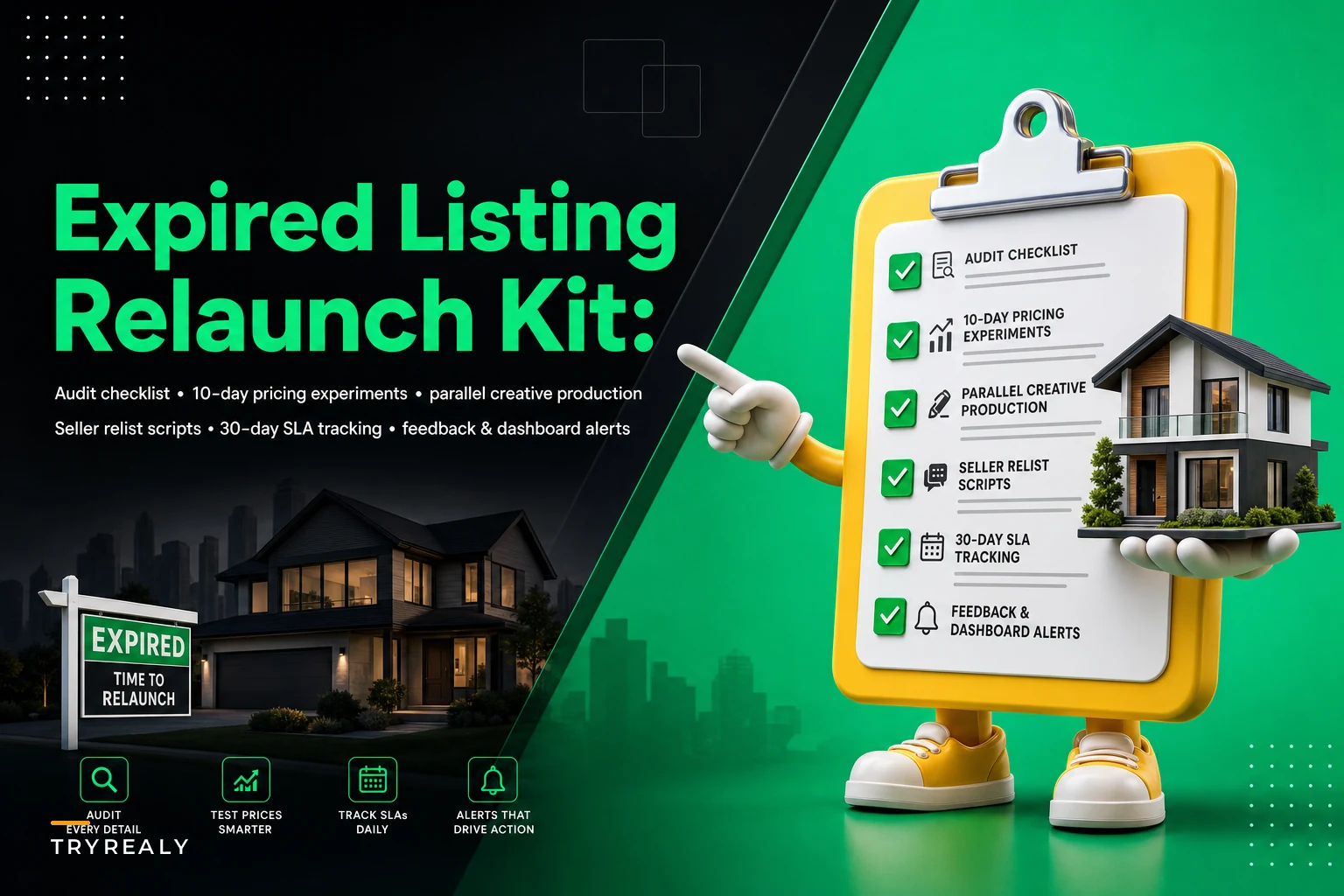

Expired listings are weird. Agents treat them like damaged goods when they're actually data goldmines. Every expired listing tells you exactly what went wrong—pricing disconnect, marketing gaps, seller expectations, market timing. The problem is most agents approach these listings emotionally instead of diagnostically.
I've watched agents lose winnable expired listings because they rushed into the "let me relist you" conversation without understanding why the property failed. They promise better photos or more marketing when the actual issue was a $40k pricing problem and zero buyer feedback collection during the first listing period.
The difference between agents who consistently win expired listings and those who don't comes down to process. Not charm, not promises—just a systematic approach to diagnosing failure points and presenting clear solutions.
The expired listing audit framework
An expired listing isn't just one failure—it's usually four or five small operational breakdowns that compound. The audit needs to catch all of them, not just the obvious pricing issue.
Start with market data reconciliation. Pull every comparable sale from the original listing period, not just the three months before listing. Properties that sold during that window tell you what buyers actually valued. Look at days on market across price bands—if everything below $650k sold in 12 days but the expired sat at $675k for 90 days, you've found your first diagnosis point.
Then examine the listing's digital footprint. Screenshot the property on every major portal—Zillow, Realtor.com, local MLS feeds. Check photo order, description accuracy, feature highlights. Roughly 40% of expired listings have fundamental presentation problems that nobody caught because the listing agent never audited their own work post-upload.
Showing feedback reveals the operational gaps. Request all feedback from the previous agent (most won't have it systematically collected). When feedback doesn't exist, that's diagnostic data too—it means the listing ran without any real buyer intelligence.
The audit checklist divides into five categories:
Pricing Forensics
-
Original list price vs. final price
-
Price reduction timing and amounts
-
Comparable sales during listing period
-
Active competition analysis
-
Buyer search threshold analysis
Marketing Execution
-
Photo quality and staging assessment
-
Description keyword optimization
-
Portal accuracy verification
-
Open house frequency and attendance
-
Digital advertising spend and targeting
Showing Operations
-
Total showing count
-
Showing-to-offer ratio
-
Feedback collection rate
-
Showing availability windows
-
Response time to showing requests
Seller Behavior Patterns
-
Price adjustment resistance points
-
Showing accommodation level
-
Feedback reception patterns
-
Communication frequency preferences
Market Timing Factors
-
Seasonal patterns for the neighborhood
-
Inventory levels during listing period
-
Interest rate changes during listing
-
Local market events or changes
This diagnostic approach transforms your first seller conversation from "trust me to do better" to "here's exactly what went wrong and how we fix it."
Pricing experiment methodology for relaunches
Relaunching at the same failed price wastes everyone's time. But dropping price blindly can leave money on the table. The solution is structured pricing experimentation with clear decision points.
Never miss a showing or follow-up again.
TryRealy helps you schedule, track, and manage every client interaction smoothly.
- Unified property and client management
- Automated client notifications
- Integrated sales pipeline tracking
No credit card required
The 30-day pricing ladder starts with strategic positioning just below a key search threshold. If the property expired at $425,000 and the next threshold down is $400,000, you test at $399,900 for exactly 10 days. This isn't about tricking buyers—it's about maximizing visibility to measure true market interest at different price points.
During each 10-day window, track:
-
Unique views vs. market average
-
Showing requests per day
-
Save rates on major portals
-
Agent feedback themes
After 10 days, evaluate. Strong activity (5+ showings, multiple saves) means you hold or make a minor adjustment. Weak activity triggers the next rung down—usually 2–3% drops that cross psychological thresholds.
The pricing conversation with sellers needs structure. Don't negotiate endlessly. Present three scenarios:
Aggressive Price (5–7% below expired price)
"This price generates immediate activity. Based on current inventory, we expect 8–10 showings in week one, likely offers by week two. Risk: leaving some money on the table. Benefit: quick sale, momentum."
Test Price (2–3% below expired price)
"We test market response for 10 days. If we get 5+ showings, we know buyers see value. If not, we adjust quickly. Risk: another slow start. Benefit: data-driven pricing."
Stretch Price (at or near expired price)
"We can try this if you're not time-sensitive. Success requires perfect execution—new staging, video tour, targeted ads. Probability of sale in 30 days: roughly 20% based on current market data."
Most sellers choose the test price once they see it framed as an experiment, not a failure.
The creative packet overhaul
New photos alone don't fix expired listings. The entire creative packet needs strategic reconstruction based on what failed before.
The photo audit comes first. Compare the expired listing's photos against the top three sales in the same price band. Count lifestyle shots vs. empty rooms. Note lighting consistency. Check if photos follow buyer priority—kitchen within the first five images, primary bedroom before basement, outdoor living prominently featured.
Your relaunch creative packet should include:
Visual Assets
-
25–30 professional photos (vs. the typical 15–20)
-
Twilight exterior shot
-
Aerial footage showing neighborhood context
-
Video walkthrough (60–90 seconds)
-
Floor plan with room dimensions
Written Assets
-
Compelling listing description (avoid generic superlatives)
-
Neighborhood lifestyle paragraph
-
Commute times to major employers
-
School performance data
-
Recent neighborhood sales context
Marketing Collateral
-
Property website URL
-
Social media templates (3 versions)
-
Email blast template
-
"Coming Soon" teaser assets
-
Open house promotional kit
| Asset Type | Items |
|---|---|
| Visual Assets | 25–30 professional photos (vs. the typical 15–20); Twilight exterior shot; Aerial footage showing neighborhood context; Video walkthrough (60–90 seconds); Floor plan with room dimensions |
| Written Assets | Compelling listing description (avoid generic superlatives); Neighborhood lifestyle paragraph; Commute times to major employers; School performance data; Recent neighborhood sales context |
| Marketing Collateral | Property website URL; Social media templates (3 versions); Email blast template; "Coming Soon" teaser assets; Open house promotional kit |
The creative timeline runs parallel to your pricing strategy. While you're negotiating price points, your photographer shoots, your writer crafts descriptions, and your designer builds marketing assets. This parallel processing means you can launch within 72 hours of agreement, not the typical 7–10 days that kills momentum.
Seller conversation scripts and objection handling
Expired listing conversations fall apart when agents wing it. The sellers are frustrated, skeptical, and probably talking to five other agents. Scripts create consistency and confidence.
The diagnostic opening changes the dynamic entirely:
"I've completed a detailed analysis of why your home didn't sell. Not generic reasons—specific issues I found in the listing data, showing patterns, and market response. Before we discuss relisting, would you like to understand exactly what happened?"
This positions you as an analyst, not another salesperson.
Common objection handlers:
"We already tried everything"
"I found seven specific issues in my audit. For example, your listing went live on a Thursday, missing the prime Tuesday/Wednesday buyer surge. Your photos were uploaded in reverse order on Zillow, showing the garage before the kitchen. These seem small, but combined they reduced your buyer pool by roughly 30%."
"The market is just slow"
"Actually, 14 homes in your price range sold during your listing period. The median days on market was 22. Your home sat for 94 days. This isn't a market problem—it's an execution problem we can fix."
"We won't reduce the price"
"I'm not asking you to. I'm suggesting we test buyer response at strategic price points in 10-day windows. If buyers respond, we know we're close. If they don't, we adjust. This is data collection, not capitulation."
"Other agents promise more marketing"
"Marketing amplifies interest—it doesn't create it. If pricing and presentation are wrong, more marketing just shows more people a home they won't buy. My focus is fixing the fundamental issues first, then marketing aggressively."
Specificity wins. Vague promises lose to specific diagnoses every time.
The 30-day relaunch guarantee structure
A service level agreement for expired listings builds trust through accountability. But most agents promise vague "communication" or "marketing efforts." Real SLAs have measurable commitments with consequences.
The 30-day relaunch SLA framework:
Week 1 Commitments
-
Property goes live within 72 hours
-
Minimum 10 agent showings scheduled
-
3 different marketing campaigns launched
-
First showing feedback report delivered
Week 2 Commitments
-
Open house with minimum 25 attendees (or second open house free)
-
Video tour reaches 500 views
-
Showing feedback analysis and recommendations
-
First pricing strategy checkpoint
Week 3 Commitments
-
Buyer agent incentive campaign launches
-
Minimum 15 total showings completed
-
Social media campaign reaches 10,000 local impressions
-
Price adjustment recommendation (if needed)
Week 4 Commitments
-
Complete market position analysis
-
Seller strategy session with three scenarios
-
If no offers
commission reduction of 0.5%
-
Go-forward plan with specific next steps
The enforcement mechanism matters. If you miss an SLA milestone, the seller can cancel immediately with no further obligation. This seems risky, but it forces operational discipline—and that discipline is exactly what most expired listings were missing the first time around.
Track these metrics in a simple spreadsheet:
-
Daily showing count
-
Weekly feedback summary
-
Marketing metrics (views, clicks, impressions)
-
Agent outreach tallies
-
Seller communication log
When sellers see daily progress against specific commitments, trust builds naturally.
Integration with operational software
Managing expired listing relaunches manually means dropped balls. The audit checklist gets half-completed, follow-up calls get missed, and pricing experiments run too long because nobody tracked the 10-day window.
AI-powered operational software changes this. Instead of juggling spreadsheets and calendar reminders, you get automated workflows that enforce your SLA commitments without micromanaging yourself.
The software tracks showing feedback in real-time, automatically triggering analysis reports at each pricing checkpoint. When showing counts fall below SLA thresholds, it alerts you to schedule additional agent tours or adjust marketing spend before the window closes.
Most importantly, it centralizes everything—seller updates, showing feedback, vendor coordination—into one platform. When a seller asks why showings dropped in week two, you have the data immediately instead of scrambling through texts and email threads.
The listing relaunch dashboard shows:
-
Days since relaunch
-
Showings vs. SLA commitment
-
Price experiment status
-
Marketing metric performance
-
Next required actions
Automate 10-day pricing checkpoints to avoid manual misses.
The workflow below shows how operational software enforces SLA checkpoints.
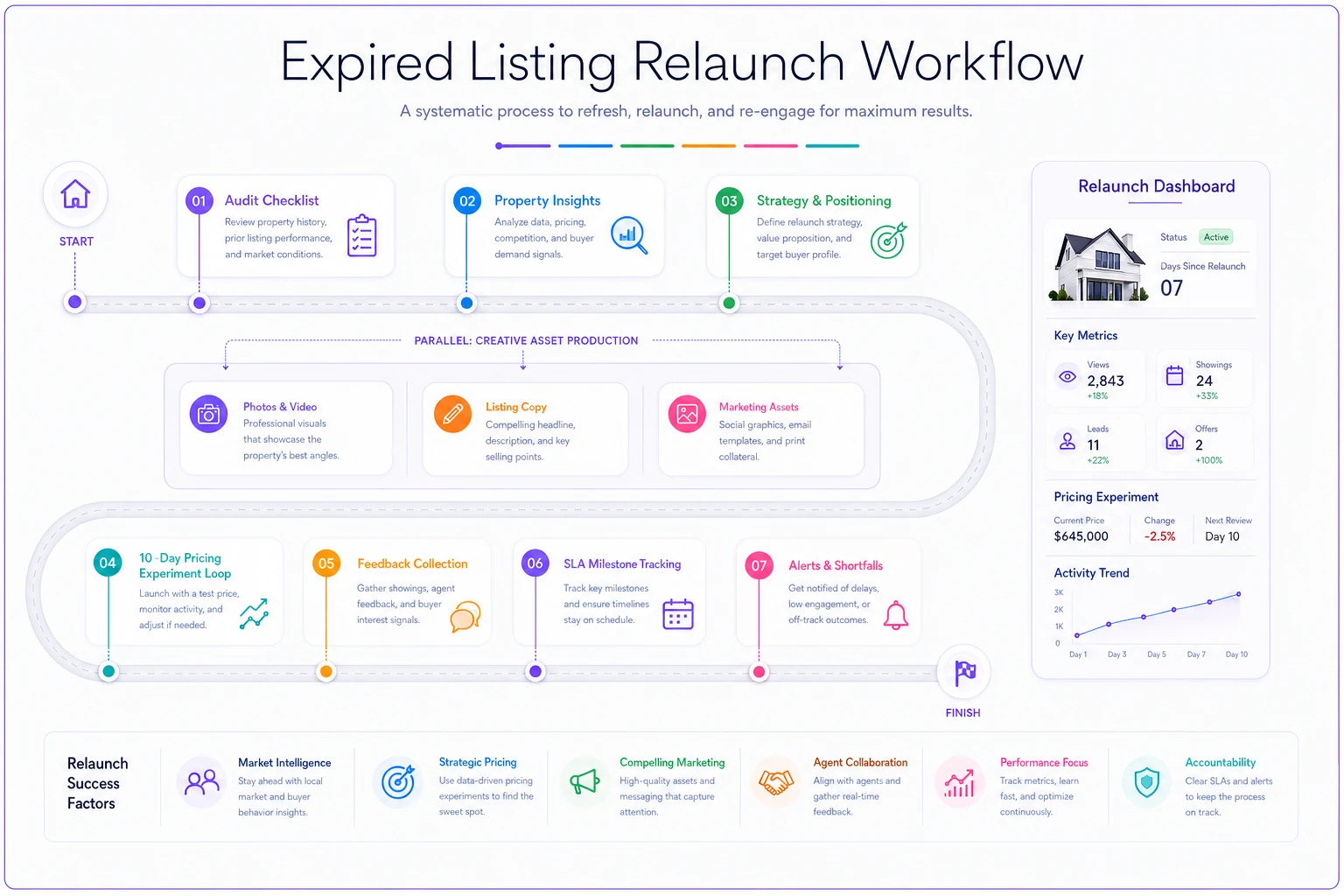
This operational backbone means you can run multiple expired listing relaunches simultaneously without things slipping. The software enforces your preparation timeline, tracks vendor deliverables, and keeps the critical first 30 days on track.
Common relaunch mistakes and recovery tactics
Even with solid planning, relaunches hit snags. The difference between a sale and another expiration is how quickly you identify and correct course.
The premature price drop is the most common mistake. Agents panic when the first week is slow and immediately suggest cutting price. But relaunched listings need 10–14 days to gain algorithmic momentum on portals. Dropping price too early resets that momentum and signals desperation to anyone watching.
Instead, boost exposure through agent outreach. Call the top 20 agents in your market personally. Offer a showing tour with lunch. Create an agent-only preview event. These activities generate immediate traffic while portal algorithms catch up.
Over-promising on timeline kills trust fast. When sellers expect offers in week one and none arrive, they check out. Set realistic expectations upfront: week one is exposure, week two generates showings, week three builds serious interest, week four is where offers come in. This framing manages anxiety and creates achievable milestones sellers can actually track.
Insufficient seller preparation causes friction throughout. Sellers who aren't ready for frequent showings, quick feedback integration, and rapid decisions slow the entire process. Before relaunching, run a quick readiness check:
-
Can you accommodate showings with 2 hours notice?
-
Will you review feedback weekly and discuss adjustments?
-
Are you prepared to negotiate when offers arrive?
-
Can you make pricing decisions within 24 hours when needed?
If sellers hesitate on any of these, address it before going live. Better to delay a week than relaunch with an uncooperative seller and blow your SLA in the first 10 days.
The "definition of insanity" problem happens when agents relaunch with minimal changes—same photos, similar price, identical description. Buyers who rejected the property once won't reconsider without substantial changes. The relaunch has to feel like a different listing to generate fresh interest.
Measuring relaunch success beyond the sale
Most agents measure expired listing success in binary terms—sold or didn't sell. But the operational data you collect compounds across your entire practice if you're tracking it properly.
Track these metrics across all relaunches:
Efficiency Metrics
-
Average days from agreement to go-live
-
Seller conversation to signature ratio
-
Relaunch to offer timeline
-
Price adjustment frequency
Quality Metrics
-
Showing to offer ratio improvement
-
List to sale price variance
-
Seller satisfaction scores
-
Repeat/referral rate from expired listing sellers
Operational Metrics
-
SLA achievement rate
-
Vendor delivery performance
-
Marketing cost per showing
-
Time invested per transaction
After 10 relaunches, patterns start emerging. Maybe video tours don't move the needle on showings but agent preview events do. Maybe Friday launches outperform Monday launches in your market. This data shapes your actual standard operating procedure—not best practices you read somewhere, but what works in your specific market with your specific approach.
A simple tracking system works fine:
-
Pre-launch checklist completion rate
-
Week-by-week SLA performance
-
Final outcome (sold/expired again/withdrawn)
-
Seller feedback survey
-
Lessons learned log
Each relaunch becomes operational intelligence for the next one.
Expired listings aren't salvage operations—they're optimization exercises. The diagnostic-first approach eliminates guesswork and builds seller confidence through specific, measurable improvements.
The expired listing winback checklist isn't about doing more—it's about doing the right things in the right order. Audit thoroughly, price strategically, execute cleanly, and track relentlessly. When sellers see systematic competence instead of desperate promises, they choose process over personality every time.
Most agents avoid expired listings because they seem hard. But with the right operational framework—clear checklists, proven scripts, measurable SLAs, and software that enforces consistency—they become a predictable revenue stream rather than a source of frustration.
The 30-day relaunch SLA isn't just a seller tool—it's your operational discipline system. When you commit to specific outcomes with real consequences, your execution sharpens. The software helps, but the mindset shift matters more: treat every expired listing as a chance to prove operational excellence, not just sales ability.
Your next expired listing conversation will look different. Instead of competing on commission or marketing promises, you'll walk in with a diagnostic report, a clear action plan, and a 30-day guarantee backed by real operational structure. That's how you turn the market's failures into your competitive advantage.
Ready to elevate your real estate business?
Join 2,000+ agencies using TryRealy to streamline operations, close deals faster, and deliver exceptional client experiences.