


Most small real estate agencies spend somewhere between $8,000 and $12,000 monthly on marketing without a clear picture of which channels actually generate closings. You've got Zillow leads mixed with Facebook ads, open house walk-ins blending with referrals, and phone calls from who-knows-where. Agents claim every lead came from "their network" while Google Ads burn through budget on tire-kickers.
The attribution mess eating your marketing dollars alive
The real damage happens when you start cutting budgets blindly. One agency slashed their direct mail budget by 70% to fund more online ads, only to discover six months later that their highest-value listings had been coming from those "outdated" mailers. Another doubled down on portal subscriptions while their best converter—a local community newsletter sponsorship costing $400 a month—got quietly axed.
Lead source attribution for real estate isn't about fancy dashboards or enterprise tracking systems. It's about building simple, consistent rules that agents actually follow, then making budget decisions based on real conversion data instead of gut feelings.
Why attribution breaks in real estate operations
Real estate attribution fails differently than other industries. You're not tracking a simple online purchase or a one-call close. Deals involve multiple touchpoints across weeks or months, with buyers and sellers jumping between online research, drive-bys, open houses, and agent conversations.
Never miss a showing or follow-up again.
TryRealy helps you schedule, track, and manage every client interaction smoothly.
- Unified property and client management
- Automated client notifications
- Integrated sales pipeline tracking
No credit card required
The typical journey looks chaotic: someone sees your Facebook ad, drives by the property, attends an open house three weeks later, then calls from a different number claiming they "found you online." Which source gets credit? Most agencies default to the last touchpoint and miss the entire picture.
Then there's the agent resistance problem. Experienced agents protect their lead sources like trade secrets, especially when commission splits might change based on lead origin. They'll mark everything as "sphere of influence" or "referral" to avoid sharing credit with the brokerage's marketing spend. New agents, desperate to show value, claim every interaction as self-generated.
Office coordination makes things worse. Your admin enters leads one way, agents update them differently, and your transaction coordinator uses another system entirely. By closing time, the original source data has been overwritten three times. One brokerage found that around 60% of their closed deals showed "unknown" as the lead source—after spending $180,000 annually on marketing.
Building attribution rules that agents actually follow
Forget complex attribution models. Small agencies need dead-simple rules that work across online and offline channels without creating extra work for agents already juggling twenty things.
Start with mandatory source capture at first contact. Not "sometime today" or "when you get around to the CRM"—at the moment a lead makes contact. That means:
Physical sign-ins at open houses: QR codes linked to forms that auto-populate source data. Skip the paper sheets that never get entered. Include fields for how they heard about the open house, whether they're working with an agent, and their timeline. Three questions, 15 seconds, done.
Phone call opening scripts: Every inbound call starts with "Thanks for calling about [property/service]. Quick question—how did you hear about us?" Train your team to probe past vague answers. "Online" becomes "Which website?" and "A friend" becomes "May I ask who so we can thank them?"
Email and text templates with source tracking: Embed source questions in your response templates. When someone texts about a listing, your auto-response includes: "We'll get you scheduled right away. Mind sharing how you found this property?" Most people answer without thinking twice.
The trick is making source capture feel conversational rather than administrative. Agents resist anything that slows down rapport-building, so frame it as relationship-building: "We love knowing how clients find us so we can keep bringing you the best properties."
Offline attribution without the guesswork
Offline lead tracking makes most agencies nervous because it feels unmeasurable. A few simple conventions make it nearly as trackable as digital.
Unique phone numbers for everything: A different tracking number for every offline campaign. Bus bench ads, mailers, newspaper ads—each gets a distinct number that forwards to your main line. These run about $30 per number monthly, which is negligible compared to knowing which $3,000 billboard actually drives calls. One agency discovered their "worthless" shopping center billboard was generating 12 listing appointments per quarter, worth roughly $45,000 in GCI.
Assign unique forwarding numbers per offline campaign so call volume and source are clear without manual logging.
Campaign-specific short codes: Every offline piece needs a response mechanism beyond "call us." Add text keywords like "Text PINE47 to 555-0100 for details" on your Pine Street listing flyers. Now you know exactly which property marketing is driving interest.
Referral source documentation: Build a simple rule—no referral fee without source documentation. When agents claim referral credit, they must provide the referrer's name, the original connection date, and how the referrer knows the client. This stops the "everyone's a referral" problem while creating useful data about which partners actually send closeable leads.
Open house batch coding: Assign each weekend's open houses a campaign code in your system. "OH-1124" for November 24th open houses, for example. All sign-ins from that date get tagged consistently, letting you track conversion rates across different open house strategies. Did switching from Sunday afternoon to Saturday morning improve qualified attendance? Now you'll actually know.
UTM conventions that survive agent chaos
UTM parameters only work when everyone uses them consistently. Most agencies fail here because they either make UTMs too complex or don't enforce any standards at all.
Your UTM structure needs three components maximum:
| Parameter | Purpose | Example |
|---|---|---|
| Source | Where traffic originates | facebook, google, newsletter |
| Medium | Type of traffic | cpc, email, social |
| Campaign | Specific campaign name | luxury-homes-nov, first-time-buyer-guide |
Skip the other parameters. Nobody maintains them properly anyway.
Build a simple URL generator spreadsheet that agents can't easily break. Column A is the property URL. Column B has dropdown menus for common sources. Column C auto-generates the tagged URL. Lock the formulas.
More importantly, build UTMs into your workflows rather than just your training. Your listing launch checklist includes "Generate UTM links for all channels." Social media templates come with UTMs pre-built. Your email platform automatically appends UTMs to every link.
One agency cut UTM errors by roughly 80% just by creating pre-built link sets for every new listing. Instead of agents building URLs on the fly, they copy from a master sheet with every variation ready—Facebook post link, Instagram bio link, email campaign link, paid ad link. Agents pick the right one instead of improvising. It's one of those changes that sounds almost too simple until you see how many errors were happening before.
Call tracking that shows true conversion paths
Call tracking in real estate requires different thinking than most businesses. You're not just counting calls—you're tracking multi-month relationships across multiple properties.
Implement dynamic number insertion on your website, but with property-specific logic. Each listing page shows a different number, so you know which property sparked initial interest. Use consistent numbers per visitor session so that when someone browses five properties then calls, you know the last property viewed but also see their full browsing path.
-
Personal website number
-
Social media number
-
Print marketing number
-
Sign rider number
This splits credit appropriately. When a lead sees an agent's Instagram post then calls from their business card, you track both touchpoints without confusion.
Record calls—and actually review them. A weekly 30-minute session sampling 10 random recordings will catch attribution errors fast. "I saw your sign" might actually mean "I Googled the address after seeing your sign," which changes your attribution completely.
The real value comes from connecting call tracking to your CRM properly. Most agencies log calls manually and lose critical data in the process. Call tracking software that pushes call data directly into your CRM—including duration, recording link, and caller ID—eliminates the "I forgot to log it" problem while preserving attribution accuracy.
LTV versus CAC experiments that matter
Measuring lifetime value against customer acquisition cost in real estate gets complicated because timelines stretch so long. Rough calculations still beat no calculations.
-
Immediate CAC
Marketing spend to generate a lead that closes within 90 days
-
Extended CAC
Total cost including nurture time for deals closing after 90 days
-
Single transaction value
Immediate commission from one deal
-
Relationship value
Total commission from all transactions with that client over three years
Most agencies find pretty striking disparities when they actually run these numbers. Portal leads might cost $300 to acquire and close quickly, generating $8,000 in commission. But their three-year value stays flat—these clients rarely return or refer anyone. Meanwhile, newsletter subscribers might cost $50 to acquire, take six months to close, but generate $24,000 over three years through repeat business and referrals.
Run CAC experiments on narrow segments:
-
First-time buyers from Facebook ads versus Google ads
-
Luxury sellers from direct mail versus listing portals
-
Investor leads from different source combinations
Test one variable for 90 days minimum. Shorter tests produce noise, not patterns. Track both immediate conversions and pipeline building—that expensive LinkedIn campaign might show terrible 30-day CAC but solid 180-day returns.
Document failure thresholds before you start. If Facebook ads exceed $500 CAC after 60 days, pause and pivot. If direct mail drops below 0.5% response rate, redesign the campaign. Pre-set rules prevent emotional decisions when campaigns underperform.
The 90-day budget reallocation framework
Budget reallocation without data is expensive gambling. This framework tests changes systematically while protecting your pipeline.
Start with your baseline: document current spending, lead volume, and conversion rates across all channels for the past six months. Include everything—portal subscriptions, advertising, sponsorships, print materials, sign installation, all of it.
Pick one hypothesis to test: "Moving 30% of portal budget to Google Ads will reduce cost per closing by 20%" or "Doubling open house marketing budget will increase attendance by 40%."
Never shift more than 30% of any channel's budget in one test. Dramatic swings create chaos and make results impossible to read. That agency that cut direct mail by 70% learned this the hard way.
Your 90-day test runs in three phases:
-
Days 1–30
Ramp phase
— Gradually shift budget while monitoring early indicators. Don't just flip a switch. If you're moving $3,000 from portals to Google Ads, shift $1,000 in week one, another in week two, the final $1,000 in week three. This gives you time to adjust targeting and spot immediate problems before they compound. -
Days 31–60
Observation phase
— Run at full test allocation. Resist tweaking unless something breaks badly. You need stable data, not perfect optimization. Track leading indicators weekly: lead volume, lead quality scores, appointment sets, and pipeline value. -
Days 61–90
Validation phase
— Continue the test while preparing for next steps. If metrics improve, document the specific changes for permanent implementation. If they decline, plan your rollback.
Here's a simple visual of the 90-day test workflow.
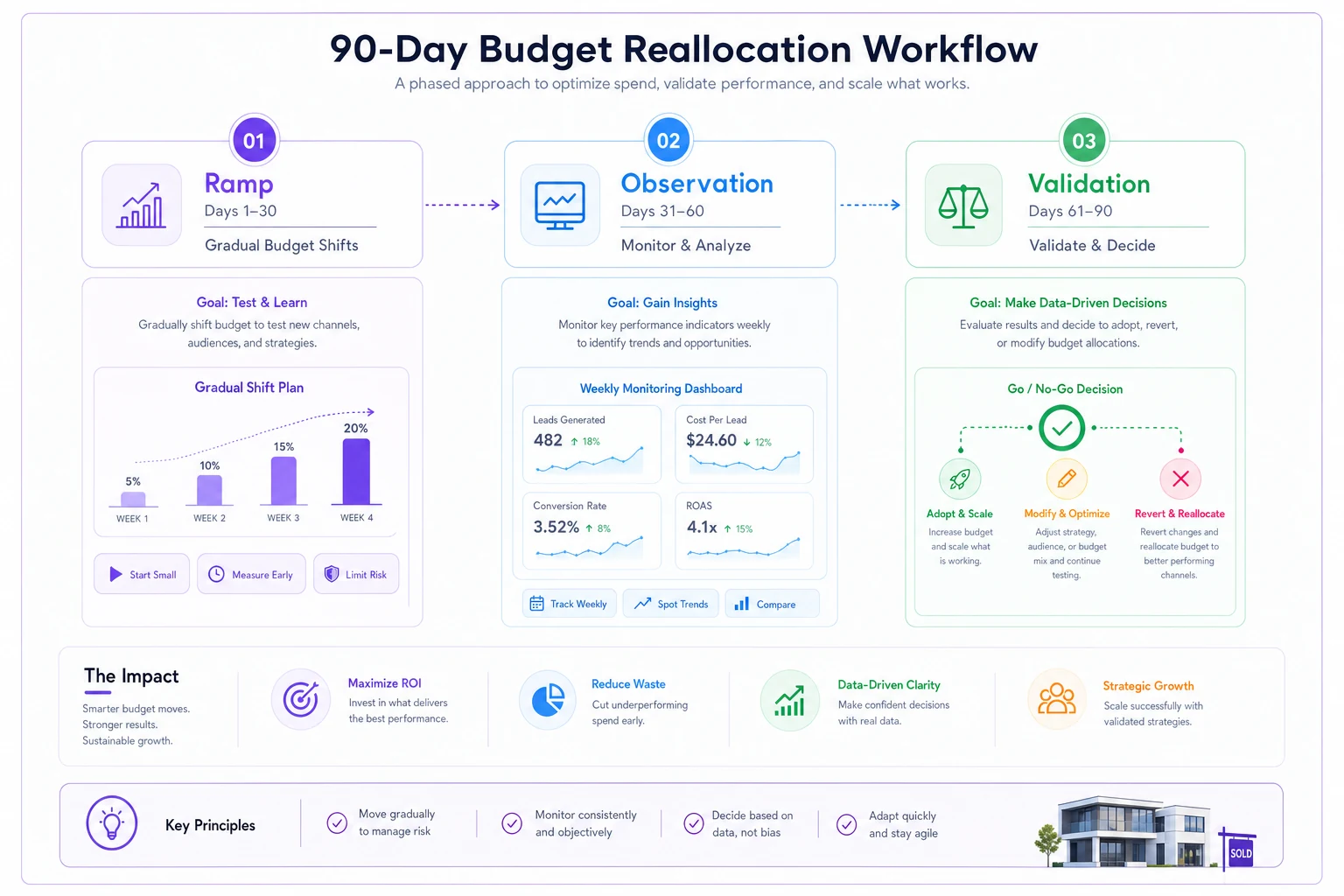
After 90 days, you either adopt the change, revert, or test a modified version. Never run multiple allocation tests at the same time—you'll create attribution chaos and learn nothing.
Common attribution mistakes that burn budgets
The "last click gets everything" trap: Agencies credit the final touchpoint before closing and ignore the entire journey. Your Google Ad might get credit, but the three open houses, five property tours, and a dozen nurture emails did most of the work. Track assist conversions—touchpoints that influenced the deal but didn't technically close it.
Crediting brand searches as new acquisition: Someone types "ABC Realty Houston" after seeing your billboard. Google Analytics records it as organic search. It's not—that's brand awareness generated somewhere else. Separate branded search from true discovery traffic in your attribution.
The portal lead quality fallacy: Counting all leads equally wrecks ROI calculations. Portal leads might cost $50 each while referrals cost $200 in relationship maintenance. But if portals convert at 2% and referrals at 25%, your actual cost per closing flips completely. Weight lead sources by quality, not volume.
Ignoring view-through conversions: Someone sees your Facebook ad, doesn't click, but calls two days later after driving by your sign. Facebook shows zero conversions. Your sign gets all the credit. Both channels contributed. Track impression data alongside direct response metrics.
The "everything is referral" problem: Without clear definitions, agents mark any warm lead as a referral. Past clients, sphere of influence, professional network, actual referrals—they all need different attribution. Build your referral tracking system properly with specific categories and commission structures for each.
Making attribution stick in daily operations
Attribution only works when it becomes automatic, not an add-on task. Build tracking into existing workflows rather than creating new processes from scratch.
Your listing launch sequence already includes photography scheduling and description writing. Add "Generate tracking URLs" right after "Upload to MLS" and make it a dependency—social media posts don't go live until tracking URLs exist.
Weekly pipeline reviews should include source performance metrics. A simple dashboard showing leads by source, appointments by source, and contracts by source takes two minutes to review but keeps attribution visible. Agents see which sources actually feed their pipeline versus which ones create busywork.
Transaction coordination checklists get an attribution verification step before commission disbursement. Verify and lock the lead source while the details are still fresh. One agency found attribution error rates around 40% before implementing closing verification—after, it dropped under 5%.
Most importantly, reward attribution accuracy rather than punishing mistakes. Agents who maintain clean source data get first choice on portal leads or preferred placement in rotation. Make good attribution work in agents' favor, not just management's.
When attribution intelligence actually drives growth
A well-tracked agency makes completely different decisions than one flying blind. You start spotting patterns that aren't obvious from the surface: geographic farming in specific neighborhoods consistently outperforms broad digital advertising, luxury listing video tours generate showings but rarely closings, newsletter readers close at three times the rate of social media followers, Thursday afternoon calls convert better than Monday morning calls.
These insights compound over time. Better attribution leads to smarter budget allocation, which improves ROI, which frees up budget to test new channels, which reveals new opportunities. The cycle accelerates growth while competitors keep guessing.
AI-powered operational software can automate a meaningful chunk of this tracking—automatic call transcription captures source mentions, UTM generation happens programmatically, and lead scoring flags quality patterns across sources. But the foundation has to exist first. Software amplifies a good process; it doesn't build one from nothing.
Start with one source category. Pick either offline attribution, call tracking, or UTM standardization. Implement it thoroughly for 30 days. Once it runs smoothly, add the next layer.
Within six months, you'll have full attribution coverage without overwhelming your team.
The agencies that survive the next market shift won't necessarily be the ones with the biggest budgets. They'll be the ones who know exactly which marketing dollars drive real revenue—and which ones have been quietly burning for years.
Ready to elevate your real estate business?
Join 2,000+ agencies using TryRealy to streamline operations, close deals faster, and deliver exceptional client experiences.