

Open houses generate plenty of foot traffic, but what kills me is watching agents spend their entire Sunday hosting, collect a stack of sign-in sheets, then let those leads go cold while scrambling through Monday morning. By Tuesday, those visitors have already toured three other properties and forgotten which house was which.
Open house visitors who don't hear from you within 4 hours are basically gone. Either another agent texted them immediately, or they've mentally moved on for the week. Yet most agents still treat open house follow-up like it's 2010—manually entering contacts into their CRM days later, sending generic "thanks for visiting" emails, wondering why nobody responds.
The QR code setup that captures real buyer intent
Forget clipboards and paper sign-in sheets. The moment someone walks through your open house door, they should see a prominently displayed QR code leading to a mobile-optimized form. Not buried behind a table of flyers—eye-level at the entrance, maybe multiple codes throughout the property.
The critical part: limit your form to three fields max. Name, phone, and one qualifying question. Every additional field drops your capture rate by roughly 15%. That qualifying question should be something like "Are you looking to buy in the next..." with options for 30 days, 3 months, 6 months, or just browsing. That one data point determines your entire follow-up sequence.
The form should take under 20 seconds to complete. Test it yourself—if you're fumbling with dropdowns on a phone, you've already lost them.
What most agents miss: the QR landing page needs to offer immediate value. Don't collect their info and show a generic "thanks" screen. Give them something useful right away—neighborhood comps, a first-time buyer guide, a mortgage calculator, whatever makes sense for your market. That reciprocity makes them actually want to engage when you follow up.
The immediate SMS template sequence
The second someone submits that form, they should get an SMS within 60 seconds. Not an email sitting in their promotions folder—a text that lands on their lock screen.
Never miss a showing or follow-up again.
TryRealy helps you schedule, track, and manage every client interaction smoothly.
- Unified property and client management
- Automated client notifications
- Integrated sales pipeline tracking
No credit card required
| Lead Type | SMS Template |
|---|---|
| Hot leads (buying within 30 days) | "Hi [Name], thanks for visiting [Property Address] today! I noticed you're actively looking—are you free for a quick call this afternoon to discuss what you're looking for? I have access to several properties that aren't on the market yet." |
| Warm leads (3-6 months) | "Hi [Name], appreciate you checking out the open house today! Since you're planning to buy in the next few months, I'll send you similar properties as they come up. Quick question—was today's house close to what you're looking for, or should I adjust my search?" |
| Browsers | "Hi [Name], thanks for stopping by today's open house! I'll keep you updated on the market without being pushy. Reply STOP anytime if you'd rather not hear from me." |
Notice how each message acknowledges their timeline? Generic "thanks for coming" texts get ignored because they could come from any agent about any house. Specificity is what creates a real connection.
The 24-hour appointment booking sequence
This is where most open house lead follow up SOPs completely fall apart. Agents either go radio silent after the initial text, or they blast everyone with the same "just checking in" messages for weeks. Both kill conversion rates.
-
Hour 1-4 Initial SMS goes out automatically. If they respond, you move to a manual conversation immediately. If not, the system continues.
-
Hour 6 Send a value-add email with a subject line like "3 homes similar to [Property Address] you visited today." Include actual listings, not generic market updates. Make it hard to ignore.
-
Hour 20-24 Final push through a different channel than your first contact. If you started with SMS, try a quick call. Open with "I know you're busy, this'll take 30 seconds..." then mention something specific about the house they visited and ask one qualifying question.
The psychology matters here. Most buyers visit multiple open houses in a weekend, and by Monday morning everything blurs together. Your job is to be the agent they remember—because you followed up while the house was still fresh in their mind.
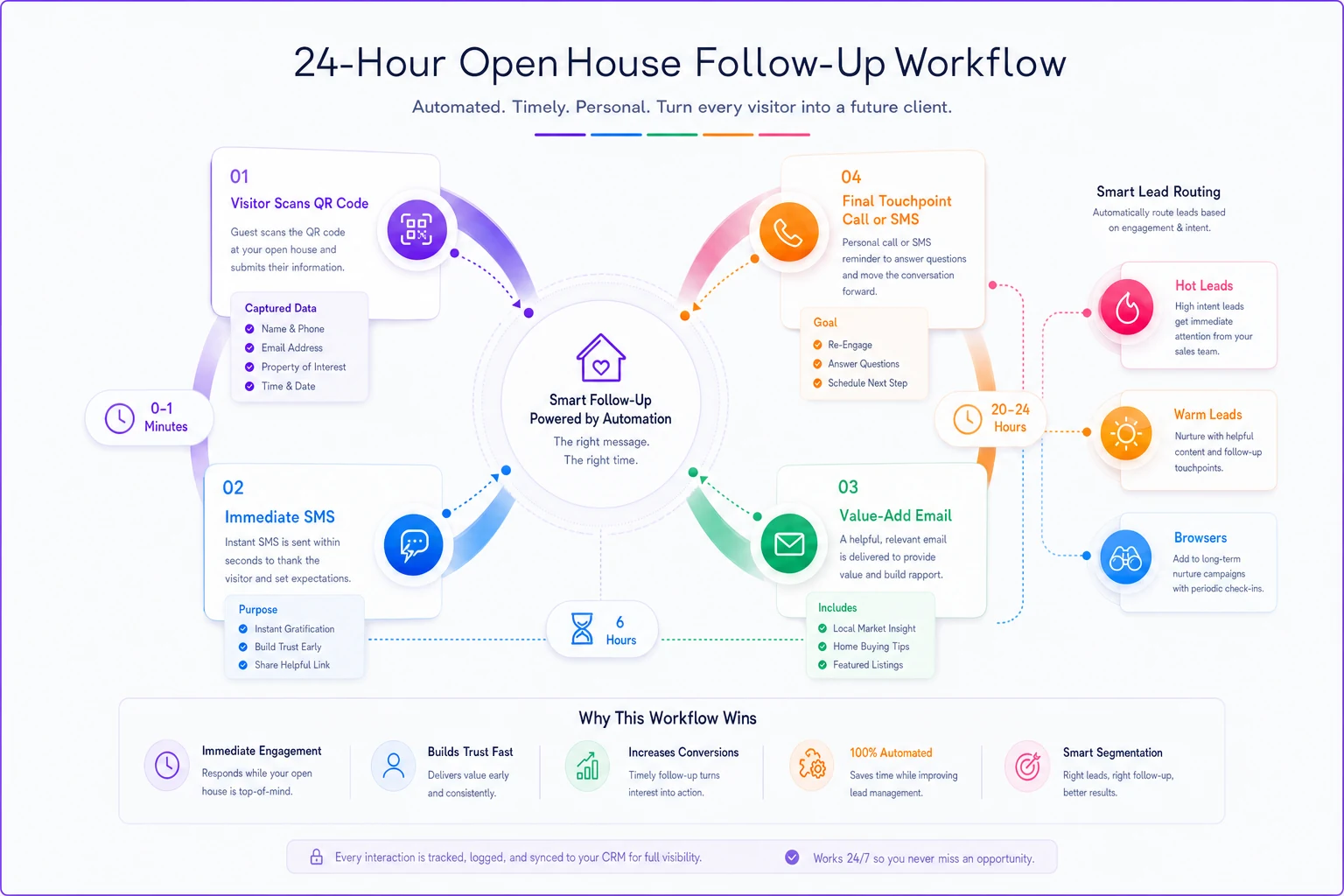
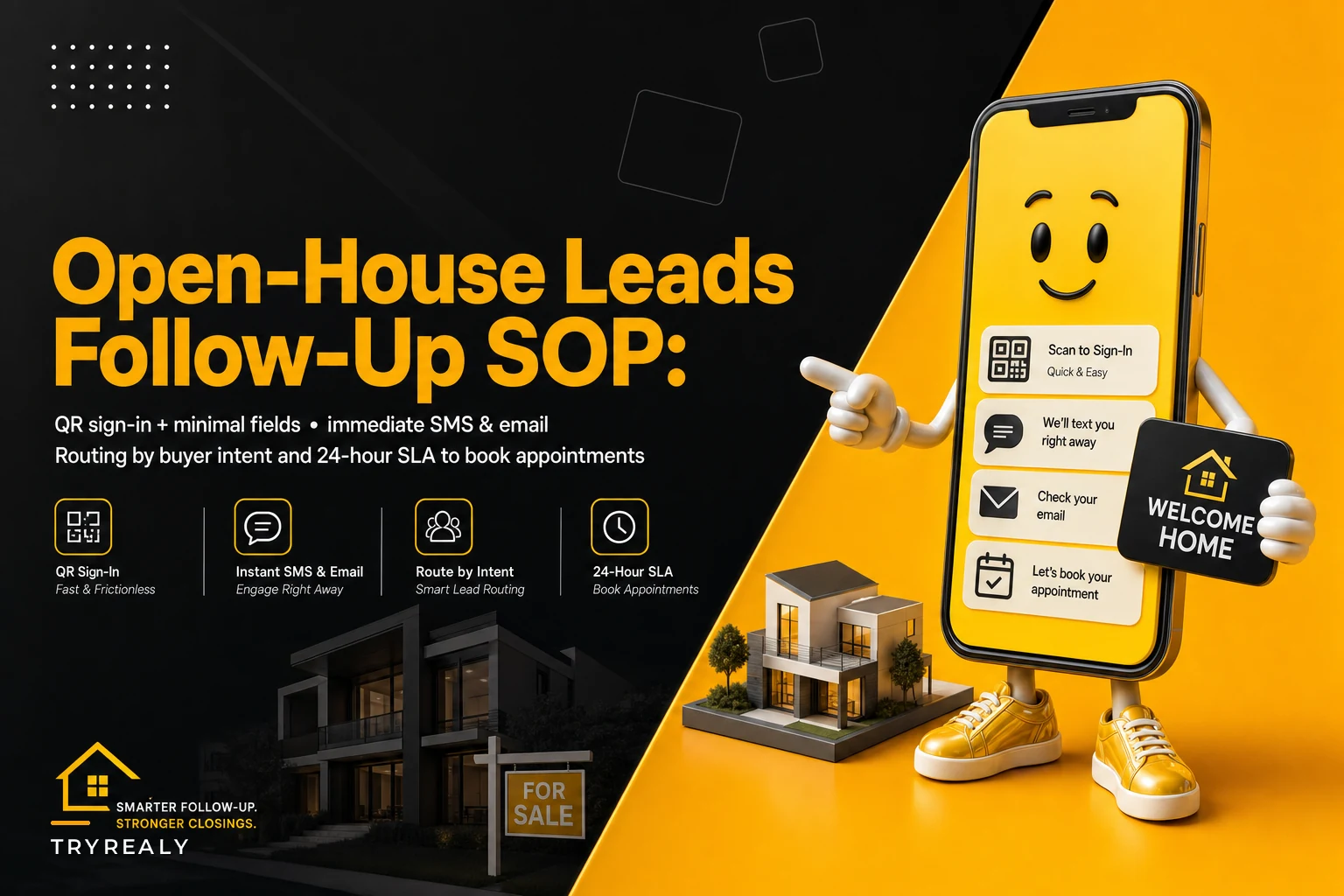
A quick visual of that 24-hour cadence.
The psychology matters here. Most buyers visit multiple open houses in a weekend, and by Monday morning everything blurs together. Your job is to be the agent they remember—because you followed up while the house was still fresh in their mind.
Routing by buyer intent (the part everyone screws up)
Not all open house visitors deserve the same follow-up intensity. Someone actively shopping with pre-approval needs a completely different sequence than a neighbor who wandered in out of curiosity.
Hot leads get the full press: immediate SMS, same-day call attempt, personalized property matches within 24 hours, and a calendar invite for a buyer consultation. These people are writing offers somewhere in the next two weeks. If you're not moving fast, another agent will be.
Set your CRM to automatically tag and route leads based on the qualifying answer so you never have to sort them manually.
Warm leads need nurturing, not harassment. Weekly market updates, new listing alerts that actually match their criteria, occasional check-ins about their timeline. The goal is staying relevant without becoming annoying.
Browsers and neighbors get added to your general sphere campaign—monthly market reports, quarterly just-sold postcards, annual home value updates. Low touch, high value. Many agents completely ignore this group, but neighbors regularly know someone looking to move into the area.
The routing logic should be automatic. Based on their initial qualifying answer, they flow into the appropriate campaign without you having to think about it.
Scripts that actually book appointments
Generic scripts sound like garbage and everyone knows it. "I'm following up from the open house" might as well be "I'm calling to waste your time." Your scripts need to create urgency without coming off as pushy.
For immediate callbacks to hot leads: "Hey [Name], I saw you were at [Property Address] earlier—I'm actually showing a similar place tomorrow that's not on MLS yet. The seller wants to avoid a bidding war, so they're doing private showings first. Would morning or afternoon work better for you?"
For day-two follow-up with warm leads: "Hi [Name], quick question about your visit yesterday—I noticed you spent a while in the kitchen. Is that a big priority for you? I ask because there's another property hitting the market Thursday with a completely renovated kitchen, and I could get you in before the open house."
For re-engagement after a week: "Hey [Name], the house you visited last Sunday just had a price adjustment. Not sure if you're still interested, but I wanted you to know before it goes wide. The sellers are motivated because [specific reason]."
Each script references something specific, creates timeline pressure, and offers exclusive value. No "just touching base" or "checking in to see if you have any questions" nonsense.
Common failure points in open house follow-up
The biggest mistake? Agents treat follow-up like they're doing visitors a favor. These people walked into your listing—they're actively shopping. They want to hear from you, just not with generic garbage.
Waiting until Monday is another killer. By then, they've visited four more houses, talked to three other agents, and can barely remember your property. The window is within 4 hours, not 48.
Sending the same follow-up sequence to everyone basically signals that you didn't care enough to segment. A cash buyer looking at investment properties needs completely different information than a first-time buyer who's nervous about the whole process.
And most agents give up after one or two attempts. Open house visitors often need 5-7 touches before they'll commit to working with you. Not aggressive stalking—strategic value-adds that keep you relevant without burning them out.
The tech stack that makes this work
Running this level of follow-up manually is nearly impossible unless you're doing one open house a month. You need systems that capture, segment, and trigger communications automatically.
Your QR code platform needs to integrate directly with your CRM and SMS platform. No manual exports, no CSV uploads, no "I'll enter these tomorrow" promises to yourself. The moment someone submits that form, the workflow begins.
SMS automation is non-negotiable. But it needs to feel personal, not robotic—merge fields, property references, their specific timeline. And the second someone responds, you jump in personally. Automation starts the conversation; you close it.
Email sequences should be built in advance but feel specific. Instead of generic templates, create property-relevant campaigns for each open house. More work upfront, but the conversion difference is real.
The actual game-changer is operational software with AI-powered routing logic that tracks response rates and adjusts follow-up intensity based on engagement. Instead of guessing who's interested, behavioral data guides where you spend your effort. Someone who opens every email and clicks every listing gets treated differently than someone who hasn't engaged at all.
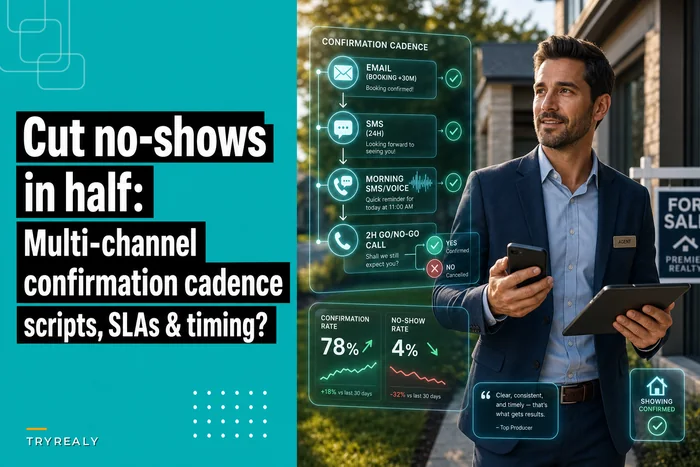
This same principle applies to the multi-channel confirmation systems we've covered for reducing showing no-shows—the key is meeting buyers where they actually engage, not where you assume they will.
What this looks like in practice
You're hosting an open house for a 3-bedroom suburban property on Sunday. Throughout the day, 23 groups walk through. Old system: maybe 15 signatures on a clipboard, half with illegible email addresses.
New system: 21 groups scan the QR code (two older couples prefer paper—fine, you manually enter them later). Within an hour, all 21 have received personalized SMS messages. Seven respond immediately—three hot leads wanting to schedule showings, four warm leads asking questions.
By Sunday evening, you've already booked two Monday showings and one Tuesday buyer consultation. The hot leads who didn't respond get your "exclusive property" call Monday morning. Warm leads start receiving your weekly sequence of matched listings.
One week later: of the 21 digital captures, you've had meaningful conversations with 14, booked five showings, and have two offers being written. The paper sign-ins? Still sitting on your desk because Monday got crazy.
Three months later, one of those "just browsing" visitors texts you out of the blue. Their situation changed, they're ready to buy, and you're the only agent who stayed in touch without being obnoxious. That's a $400k sale from someone most agents would've completely ignored.
The 80/20 rule for open house conversion
What actually moves the needle: speed of first contact, relevance of follow-up, and consistency without annoyance. Everything else is mostly noise.
You don't need a 47-step email campaign or fancy video messages. You need to text them fast, reference what they actually looked at, and follow up with value until they either buy or tell you to stop.
Most open house lead follow up SOPs fail because they're either too aggressive or too passive. The sweet spot is systematic but human—automated enough to be consistent, personal enough to build trust.
Teams getting 12-15% conversion from open house leads aren't doing anything magical. They're just executing the basics while everyone else is still debating whether to call or email first.
Track your open house to appointment ratio for the next month. If you're not booking meetings with at least 20% of your captures, something in your sequence is broken—your capture method, your messages, your timing, or your value proposition. Until you have clear metrics, you're guessing.
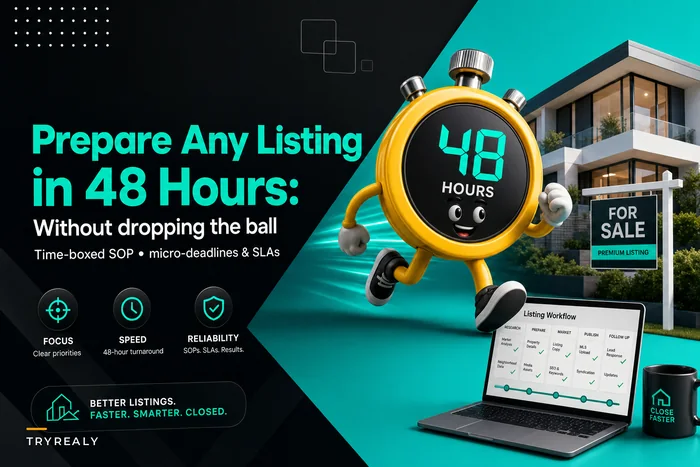
When you nail this process, open houses stop being a hopeful lead generation exercise and become a predictable pipeline. The same systematic thinking that helps agencies prepare listings efficiently can turn your open house operations from a Sunday time sink into your most reliable source of qualified buyers.
Every open house visitor is a potential commission, but only if you have the systems to capture, qualify, and convert them before your competition does. Without a real follow-up SOP, you're just running free property tours for other agents' future clients.
Ready to elevate your real estate business?
Join 2,000+ agencies using TryRealy to streamline operations, close deals faster, and deliver exceptional client experiences.