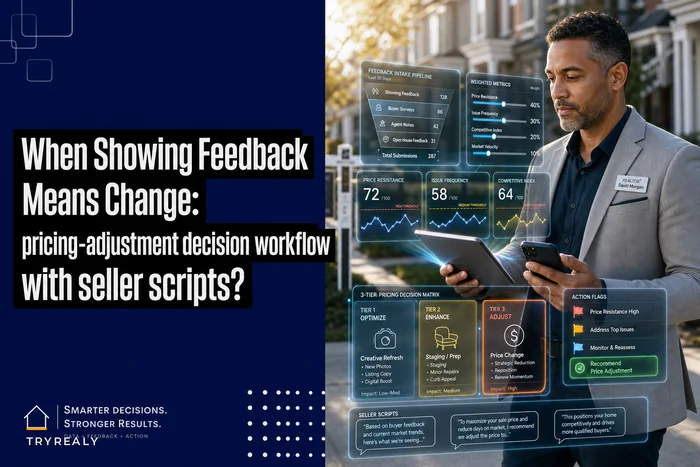



Most agencies treat listing prices like sacred numbers. Once a seller agrees to $485,000, that price sticks until the market forces a reduction weeks later. Between those two points, something predictable happens: dozens of potential buyers scroll past, showing requests drop off around day 14, and the listing starts picking up that stale reputation that makes even genuinely interested buyers lowball.
Stop treating listing prices like they're set in stone
Most agencies treat listing prices like sacred numbers. Once a seller agrees to $485,000, that price sticks until the market forces a reduction weeks later. Between those two points, something predictable happens: dozens of potential buyers scroll past, showing requests drop off around day 14, and the listing starts picking up that stale reputation that makes even genuinely interested buyers lowball.
The agencies that consistently move inventory faster aren't necessarily better at initial pricing. They're better at treating prices as hypotheses that need testing — not wild swings based on panic, but structured experiments with clear rules about what to test, how to measure impact, and when to pull back.
Why traditional pricing adjustments fail agencies
The standard approach follows a predictable pattern. List high to make the seller happy. Wait three weeks for minimal activity. Have an awkward conversation about dropping $15,000. Watch another two weeks pass. Repeat until someone bites at 12% below the original ask.
Never miss a showing or follow-up again.
TryRealy helps you schedule, track, and manage every client interaction smoothly.
- Unified property and client management
- Automated client notifications
- Integrated sales pipeline tracking
No credit card required
This reactive cycle creates real operational chaos. Agents burn time defending stale prices. Marketing dollars get spent promoting properties at the wrong price point. Transaction coordinators deal with sellers who feel blindsided by market reality.
The damage compounds across a portfolio. When 40% of your active listings are overpriced, showing-to-offer conversion tanks. Buyers' agents start routing clients to agencies with more realistic inventory. Your reputation shifts from "they get deals done" to "they always start too high."
What makes this worse is that agencies typically have no systematic way to test pricing assumptions before committing to them. They rely on CMAs that look backward, seller emotions that skew high, and agent intuition that varies wildly across the team.
Building experiment infrastructure without enterprise tools
Running pricing experiments sounds complex, but the core mechanics are pretty straightforward when you break them into operational pieces.
Start with cohort definitions that actually matter for testing. Geographic clusters work better than random sampling — test new pricing strategies on all downtown condos while keeping suburban single-families as your control group. Time-based cohorts make sense too. Properties listed the 1st through 7th of each month become your test group; listings from the 15th through 21st stay at traditional pricing.
Your trigger rules need teeth but shouldn't require a statistics degree. Set minimal thresholds before making decisions: at least 25 unique property views, minimum 5 showing requests, or 10 days on market — whichever comes first. These aren't perfect statistical samples, but they give you enough signal to act without waiting so long that opportunities disappear.
The rollout sequence matters more than most agencies realize. Never flip pricing strategies on your entire portfolio at once. Start with 3-5 properties that share similar characteristics. If those perform better after one week, expand to 10-15 properties. Only after seeing consistent improvement across that larger set should you consider portfolio-wide implementation.
Start with 3-5 properties that share similar characteristics.
Build guardrails that prevent experiments from damaging client relationships. Hard stops include: seller explicitly refuses participation, property already under contract, price adjustment made within the last 14 days, or an upcoming open house within 72 hours. These protect both operational efficiency and agent credibility.
The technical mechanics of tracking experiments
You don't need sophisticated software to track pricing experiments, but you do need consistent data capture that doesn't rely on agent memory or scattered spreadsheets.
Create a simple experiment log that tracks:
| Listing ID | Original Price | Test Price | Start Date | Cohort | Key Metrics (Day 7) | Decision |
|---|---|---|---|---|---|---|
| MLS-4847 | $525,000 | $509,900 | March 1 | Downtown-A | Views: 47, Shows: 6 | Continue |
| MLS-4852 | $380,000 | $374,900 | March 1 | Downtown-A | Views: 31, Shows: 3 | Rollback |
| MLS-4861 | $445,000 | $429,000 | March 3 | Suburban-B | Views: 72, Shows: 11 | Expand |
The tracking system needs clear ownership. One person updates the log daily, not multiple agents adding data whenever they remember. This prevents the common pattern where experiments start strong then fade into undocumented chaos after two weeks.
Pull metrics from wherever your data actually lives — MLS view counts, showing feedback from your scheduling system, inquiry sources from your CRM. Don't create new data collection burdens; work with what you already capture but rarely analyze systematically.
Your comparison baselines need to account for market movement too. Comparing this week's test properties to last month's traditional listings tells you nothing useful if rates jumped 50 basis points between those periods. Maintain concurrent control groups or use recent historical averages from the same week and season.
A typical experiment cycle from start to decision
Most pricing experiments follow a fairly consistent pattern once you've run a few. Here's what the flow looks like in practice:
[Define Cohort] ↓ [Set Baseline Metrics from Control Group] ↓ [Launch Test Price on Cohort Properties] ↓ [Day 3 — Initial Signal Check] ↓ [Day 7 — Primary Decision Point] ↙ ↘ Continue Rollback / Modify ↓ [Day 14 — Final Assessment] ↓ [Document Outcomes to Experiment Archive]
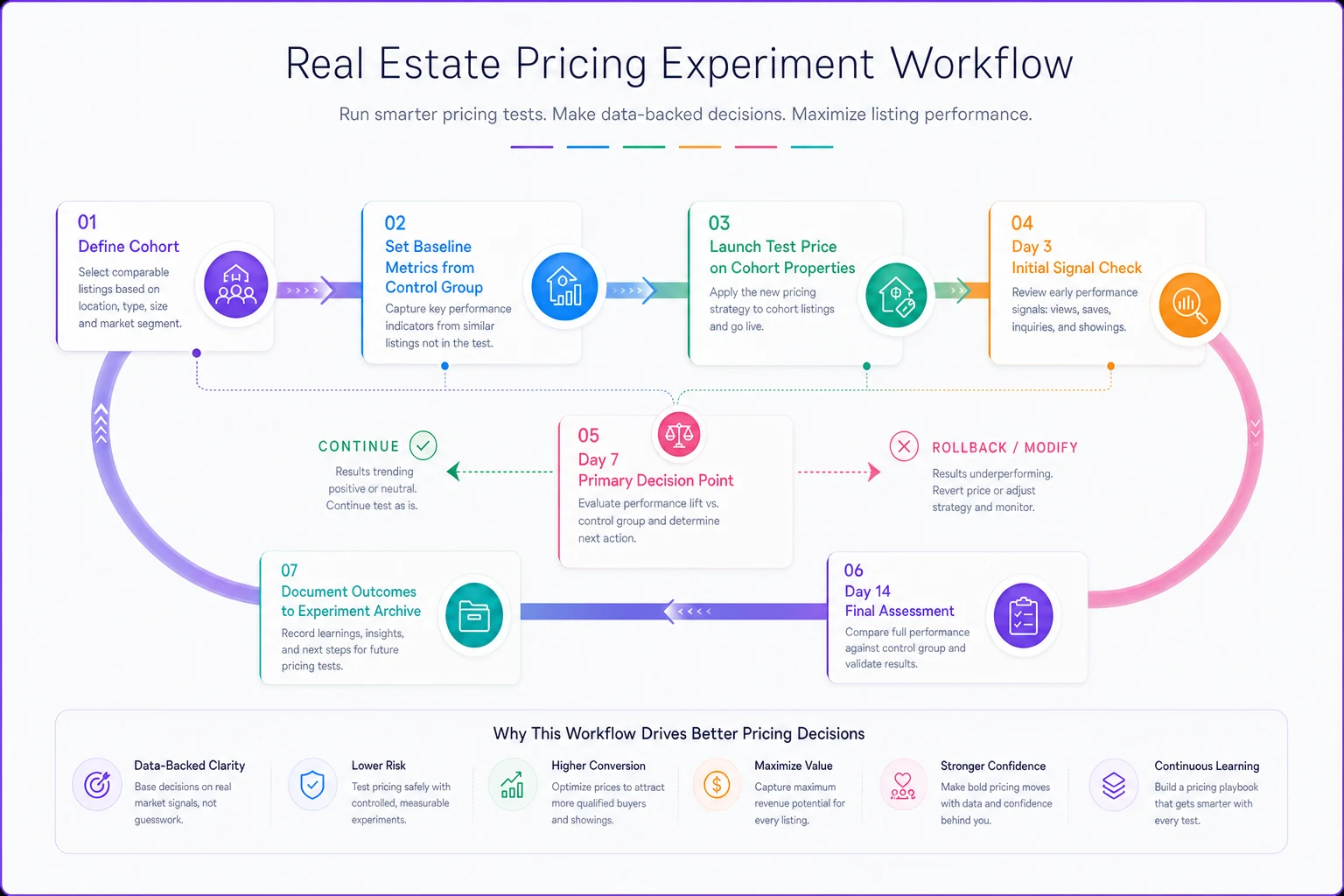
This isn't a rigid playbook — some properties need an extra few days, some markets move faster. But having a default sequence keeps experiments from drifting indefinitely without a clear outcome.
Rollback protocols that preserve relationships
The hardest part about pricing experiments isn't starting them — it's knowing when and how to reverse course without damaging seller trust or agent credibility.
Build rollback triggers around objective thresholds, not gut feel. Automatic rollback conditions might include: showing-to-view ratio drops below 10%, negative feedback explicitly mentions price in three or more showing reports, or days-on-market exceeds neighborhood average by 40%.
The rollback conversation with sellers needs careful framing. Don't present it as failure. "We tested a strategic price point to gauge buyer interest at this level. The response data suggests we'll generate stronger offers at the original price, so we're adjusting back while incorporating what we learned about buyer priorities."
Timing matters here too. Rolling back within 72 hours looks like panic. Waiting three weeks looks like incompetence. The window between days 7 and 12 generally works — enough time for the market to respond, not so long that buyers assume something's wrong with the property.
Document rollback lessons carefully. Which property types respond poorly to aggressive pricing? Which neighborhoods have sharp price sensitivity thresholds? This institutional knowledge prevents repeating expensive mistakes and helps refine future experiment parameters.
Scripts for seller buy-in without overselling
Getting sellers to participate in pricing experiments requires positioning them as strategic advantages, not desperate measures.
Initial experiment pitch
"We've developed a systematic approach to identify your property's optimal market position. Instead of guessing where buyers see value, we run controlled tests with specific measurement points. This typically accelerates serious buyer interest by a few weeks compared to traditional pricing strategies."
Mid-experiment update
"The first week's data shows strong engagement at this test price — we're seeing roughly 40% more showing requests than comparable properties. We'll continue monitoring through day 10 to confirm this pattern holds before making any final recommendations."
Successful result conversation
"The test confirmed buyers see exceptional value at the $X price point. Properties priced here are generating offers significantly faster than market average. I recommend we maintain this positioning to capitalize on current buyer interest."
Rollback conversation
"Our test revealed important information about buyer priorities in your neighborhood. The data suggests we'll generate stronger, more competitive offers at the original price point. We're adjusting back with valuable insights about how to position your property's unique features."
These scripts work because they focus on data and market intelligence rather than emotion or speculation. Sellers appreciate feeling like they're using a real strategy, not just throwing numbers at the wall.
Cohort rules that actually predict behavior
Random cohorts sound scientific but ignore how real estate markets actually work. Buyer behavior clusters around property characteristics, not random selection.
Property-type cohorts produce cleaner experiment results. All two-bedroom condos in your portfolio become one test group. Three-bedroom suburban homes under $500k become another. This grouping reflects how buyers actually search and compare options.
Temporal cohorts leverage natural market rhythms. Properties listed the first week of each month face different buyer pools than those listed mid-month. Weekend versus weekday listings see different initial engagement patterns. Use these natural breaks to create experiment boundaries.
Geographic clustering respects neighborhood dynamics. Test new pricing strategies on all listings within a specific school district or HOA. These properties share buyer pools and comparable pressures that random selection would miss.
Mix characteristics carefully when needed. Testing luxury condo pricing? Include only buildings with similar amenity packages. Testing starter home approaches? Group by square footage ranges and bedroom counts, not just price points.
Statistical triggers simplified for small agencies
You don't need a data science background to run meaningful experiments, but you do need consistent thresholds that prevent both premature decisions and endless waiting.
The minimum viable sample for listing experiments typically requires:
-
At least 30 unique property views (not repeat visitors)
-
Minimum 5 showing requests (scheduled, not just inquiries)
-
7 full days on market including one weekend
-
At least 3 comparable properties for baseline comparison
These aren't statistically perfect, but they provide enough signal to make operational decisions. Waiting for 95% confidence would mean most experiments never conclude before properties sell.
Continue experiment if:
-
Showing request rate exceeds control group by 20%+
-
Views-to-inquiry conversion improves by 15%+
-
Average showing feedback scores increase by 0.5+ points
Modify experiment if:
-
Metrics match control group within 10% margin
-
Showing feedback suggests issues beyond price
-
Market conditions shifted significantly since start
Rollback immediately if:
-
Showing requests drop below 50% of control group
-
Negative price feedback from 3+ independent showings
-
Seller expresses discomfort with continued testing
These thresholds give clear direction without requiring complex analysis that delays decision-making.
The cascade effect of better pricing discipline
When pricing experiments become systematic rather than reactive, the improvements show up across the whole agency workflow — not just in individual listings.
Marketing allocation improves. Instead of burning ad spend on overpriced listings that won't convert, you concentrate budget on properties priced at tested sweet spots. Cost per qualified lead drops while conversion rates climb.
Agent time shifts toward productive activities — less time defending unrealistic prices to sellers, more time managing competitive offer situations. The feedback loops you've built for pricing adjustments become proactive rather than reactive damage control.
Transaction coordination smooths out too. When properties price correctly from tested data, the period from listing to under-contract shrinks. This reduces the administrative burden of managing stale inventory while improving cash flow predictability.
Your market reputation changes gradually but meaningfully. Buyers' agents start routing serious clients your way because your inventory prices align with market reality.
Building institutional knowledge from experiment data
Most agencies run informal pricing experiments constantly — they just don't capture the learning. Every price reduction is an experiment. Every fast sale suggests the price was right. But without systematic capture, those lessons evaporate within a few months.
Create an experiment archive that captures:
-
Original hypothesis ("$10k reduction will trigger multiple offers")
-
Actual outcome ("Generated one offer after 8 days")
-
Market context ("Spring selling season, rates at 6.5%")
-
Lessons learned ("This neighborhood has sharp sensitivity at the $500k threshold")
Review patterns quarterly to identify:
-
Which property types respond best to aggressive pricing
-
Seasonal patterns in price sensitivity
-
Neighborhood-specific threshold points
-
Agent-specific biases in pricing recommendations
This institutional knowledge becomes genuinely useful for new agent training and market strategy. Instead of every agent learning expensive lessons individually, the agency builds collective pricing intelligence that actually sticks.
Common experiment failures to avoid
The most frequent failure: running experiments without clear success criteria. Agencies start testing lower prices, see some activity increase, but can't determine if it's meaningful or just noise. Define success thresholds before starting, not after seeing results.
Contamination between test and control groups kills experiment validity. Don't test new pricing on half the condos in a building while keeping others at original prices. Buyers will notice and use the lower-priced units to negotiate everything else down.
Experimenting during abnormal market conditions wastes effort. Testing during holiday weeks, major local events, or bad weather produces misleading data. Wait for conditions that represent normal market dynamics.
Changing multiple variables at once makes results meaningless. Test price changes independently from staging updates, new photography, or listing description rewrites. Otherwise you won't know what actually drove performance changes.
Overreacting to early signals creates whipsaw effects. A slow first three days doesn't mean failure. A busy first weekend doesn't guarantee success. Let experiments run their minimum duration before making decisions.
Technology coordination without complex integration
Running pricing experiments doesn't require expensive software, but it does demand coordination across your existing tools. Your KPI dashboard needs modification to track experiment cohorts separately from general portfolio metrics.
Use your CRM's tagging system to mark experiment participants. Tags like "Price-Test-March-Cohort-A" make filtering performance reports straightforward. This beats maintaining separate spreadsheets that nobody updates consistently.
Modify showing feedback forms to include price perception questions: "Did the asking price align with your expectations?" and "How would you rate price versus value?" This captures qualitative data that pure metrics miss.
Set calendar reminders for experiment checkpoints — day 3 initial review, day 7 decision point, day 14 final assessment. These force evaluation discipline instead of letting experiments drift indefinitely.
Configure automated alerts for rollback triggers. When showing activity drops below threshold rates, the responsible agent gets notified immediately rather than discovering problems during a weekly review.
AI-powered operational software can handle a lot of these moving pieces without manual coordination — automated experiment tracking, integrated feedback analysis, threshold-based alerts — removing the administrative burden that typically kills testing programs. But even basic tools work when properly configured and consistently used.
Scaling experiments as portfolio grows
Small portfolios allow manual experiment management. Track 5-10 property tests in a spreadsheet, hold weekly reviews, make individual decisions. This hands-on approach actually teaches you what metrics matter and how your specific markets respond.
Around 20+ active listings, manual tracking starts breaking down. Experiment groups overlap, decision points get missed, documentation becomes spotty. That's when systematic processes stop being optional.
Create experiment templates for common scenarios:
-
New construction premium testing
-
Seasonal pricing adjustments
-
Neighborhood boundary price exploration
-
Feature value validation (pool, view, garage)
Batch similar experiments to reduce complexity. Instead of random individual tests, run quarterly campaigns where all eligible properties participate in structured tests. This concentrates effort and makes pattern recognition easier.
Delegate execution while maintaining central oversight. Individual agents run experiments on their listings following templates, but one person reviews all results and identifies patterns. This balances autonomy with consistency.
The compound advantage of systematic pricing
Agencies that run disciplined pricing experiments don't just sell properties faster — they build competitive advantages that compound over time.
Market knowledge accumulates into pricing intuition that's actually backed by data. New listings price more accurately from day one because past experiments revealed specific threshold points and buyer sensitivities.
Seller conversations shift from defensive to consultative. Instead of justifying market feedback after the fact, agents present data-driven pricing strategies upfront. This positions the agency as strategic advisors rather than order-takers.
Marketing efficiency improves continuously. Each experiment reveals which price points generate maximum buyer interest, allowing more precise campaign targeting and budget allocation.
Team capability grows through shared learning. Junior agents benefit from senior agents' experiment results. The entire agency gets smarter about pricing, not just the individual superstars.
Most importantly, systematic experimentation changes how the agency relates to uncertainty. Instead of fearing market shifts, you have tools to quickly test and adapt. That operational agility becomes increasingly valuable as markets get more volatile and traditional pricing wisdom becomes less reliable.
The agencies still pricing by intuition will increasingly lose ground to those treating prices as testable hypotheses. The question isn't whether to run pricing experiments — it's whether you'll build the discipline to run them well.
Ready to elevate your real estate business?
Join 2,000+ agencies using TryRealy to streamline operations, close deals faster, and deliver exceptional client experiences.