



Most agents think their listing creative workflow problems come from bad photographers or slow videographers. They're wrong. The actual problem sits between booking the vendor and publishing the assets—that messy middle where files get lost, quality checks get skipped, and your $800 video package ends up sitting unused on someone's hard drive for three weeks.
Running operations for a 12-agent team in Phoenix taught me this the hard way. We'd burn through $4,000+ monthly on listing media and still constantly miss MLS deadlines because our creative pipeline was basically "hope the photos show up" and "remember to download the floorplan PDF." One agent had 47 virtual tour links saved in her email drafts because she didn't know where else to put them. Another spent six hours hunting for drone footage on a luxury listing going live the next morning.
The breaking point came when we lost a $2.3M listing because the seller saw their neighbor's property—listed three days after theirs—already had professional video, a 3D tour, and a custom landing page live while we were still waiting on our photographer to upload files. That's when it clicked: creative production isn't about vendor quality anymore. Everyone has access to decent photographers. What separates strong agencies is how fast they can turn raw assets into published, optimized listing content across every platform.
The creative production bottleneck that's killing your listing velocity
Most agents think their listing creative workflow problems come from bad photographers or slow videographers. They're wrong. The actual problem sits between booking the vendor and publishing the assets—that messy middle where files get lost, quality checks get skipped, and your $800 video package ends up sitting unused on someone's hard drive for three weeks.
Running operations for a 12-agent team in Phoenix taught me this the hard way. We'd burn through $4,000+ monthly on listing media and still constantly miss MLS deadlines because our creative pipeline was basically "hope the photos show up" and "remember to download the floorplan PDF." One agent had 47 virtual tour links saved in her email drafts because she didn't know where else to put them. Another spent six hours hunting for drone footage on a luxury listing going live the next morning.
The breaking point came when we lost a $2.3M listing because the seller saw their neighbor's property—listed three days after theirs—already had professional video, a 3D tour, and a custom landing page live while we were still waiting on our photographer to upload files. That's when it clicked: creative production isn't about vendor quality anymore. Everyone has access to decent photographers. What separates strong agencies is how fast they can turn raw assets into published, optimized listing content across every platform.
Why traditional handoffs create a 72-hour black hole
Real estate creative production fails at the handoff points. Photographer shoots Tuesday morning, uploads files Wednesday night, agent downloads Thursday, realizes half the shots are missing Friday, emails the photographer over the weekend, gets files Monday, starts editing Tuesday. Seven days gone and you haven't touched post-production yet.
Never miss a showing or follow-up again.
TryRealy helps you schedule, track, and manage every client interaction smoothly.
- Unified property and client management
- Automated client notifications
- Integrated sales pipeline tracking
No credit card required
This happens because most teams treat creative production like a relay race where each person runs their leg independently. Photographer does their thing. Agent does their thing. VA maybe helps with uploads. Nobody owns the full pipeline, so everybody assumes someone else is handling quality control.
The compounding issue: every listing needs a different creative package. Your $400k starter home gets basic photos and maybe a floorplan. The $1.2M waterfront property needs drone video, twilight shots, a 3D tour, a custom website, social media cuts, and print materials. Without standardized workflows for each tier, agents waste hours figuring out what to order, what to check, and where to publish.
Multiply that across multiple active listings—three properties shooting this week, two in post-production, four ready to publish—and you can see how quickly it unravels. No wonder agents end up with iPhone photos on million-dollar listings. They literally can't track what professional assets they've already paid for.
The hidden cost of unstructured creative workflows
Disorganized listing creative workflows cost more than just time. They directly impact listing performance and client satisfaction.
Start with asset utilization. Most agencies use less than 40% of the creative content they purchase. That $500 video package? The main edit might make it to YouTube. The social media cuts, highlight reel, and agent introduction segments sit untouched. The floorplan PDF never gets uploaded to Zillow. The twilight photos don't make it into the listing presentation.
Then there are revision cycles. Without clear shot lists and quality standards, you get assets that technically fulfill the contract but miss critical selling points. The photographer didn't capture the wine cellar. The videographer focused on the dated kitchen instead of the renovated primary suite. The virtual tour starts in the wrong room. Each of those fix requests adds 48-72 hours to your timeline.
Platform optimization suffers too. MLS wants images at 1024x768. Instagram needs 1:1 squares. Facebook prefers 1200x630. YouTube thumbnails require 1280x720. Your listing website needs high-res originals. Without a systematic approach to formatting, agents either skip platforms entirely or upload wrong dimensions that get auto-cropped badly.
The reputation damage compounds over time. Sellers talk. They notice when their listing looks amateur compared to the house two doors down. They screenshot your delayed go-live. They share examples of better-marketed properties. Eventually they start demanding specific photographers or threatening to list with someone who "takes marketing seriously."
Building a timeboxed creative pipeline that actually works
A functional creative pipeline needs rigid timeboxes at every stage. Not suggestions or loose goals—hard deadlines with automatic escalations.
Day 0 (Listing Agreement): Creative package selection happens during listing paperwork, not after. Build three standard tiers—Essential ($300-500), Professional ($600-900), and Luxury ($1000+). Each tier has a locked shot list, defined deliverables, and preset vendor assignments. No custom negotiations that delay booking.
Day 1 (Morning): Vendor booking window opens at 8 AM, closes at noon. Use a standardized booking form that includes property access details, the shot list link, special instructions, and required delivery timelines. Any booking after noon rolls to the next day's window. This stops the "emergency booking at 9 PM" scramble.
Day 1 (Afternoon): Prep package goes to vendor by 3 PM. This includes the official shot list, a property highlights document (pre-written using listing description templates), access instructions, and branded overlay files. Vendor confirms receipt and shoot time by 5 PM or the booking auto-cancels.
Day 2-3: Shoot window. All photography and videography happens within this 48-hour block. If weather or access issues come up, the shoot moves to next week's pipeline—not tomorrow. This protects your downstream timeline.
Day 4 (Morning): Raw asset delivery deadline at 10 AM. Vendor uploads to a designated folder using the agreed naming convention. An automated check validates minimum file count and format compliance. Missing items trigger an immediate vendor notification.
Day 4 (Afternoon): Quality control review from 2-4 PM. A designated team member—not the listing agent—validates against the shot list, checks technical specs, flags missing shots, and approves or requests fixes. Approval must happen by 5 PM.
Day 5: Post-production and formatting. Edit videos, resize images, create derivative assets, and generate platform-specific versions. Virtual tours get configured. Floorplans get vectorized. Everything outputs into structured folders.
Day 6: Publishing sprint. All assets go live across MLS, Zillow, Realtor.com, the agency website, and social channels between 8-11 AM. This synchronized launch maximizes algorithmic exposure. Print materials go to production. Email campaigns get queued.
Below is a simple workflow visualization of this timeboxed pipeline.
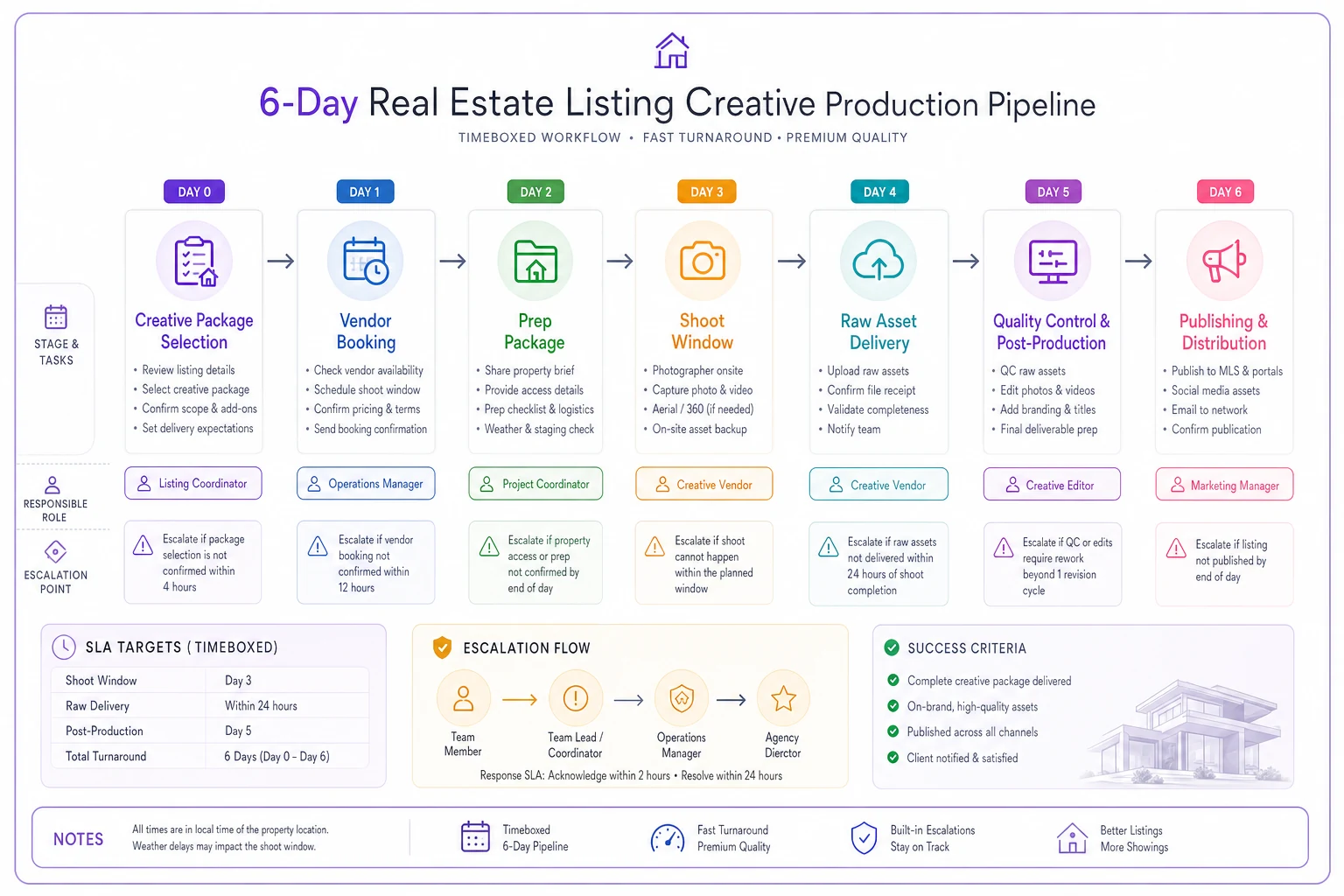
The pipeline above is a standard six-day track. Adjust the shoot window for luxury listings that need twilight sessions or multi-day access, but keep everything else fixed.
Critical control points: where pipelines actually break
The timeboxed structure looks clean on paper. Real operations reveal three specific failure points that need explicit controls.
Vendor accountability gaps: Photographers agree to Tuesday delivery, then go silent until Thursday with excuses. Build contractual SLAs with financial penalties—a 24-hour delay triggers a 10% fee reduction. Sounds harsh until you see how fast delivery improves when there's money on the line.
Quality control bottlenecks: Routing all asset reviews through one person creates a single point of failure. Use rotating QC assignments with standardized checklists instead. Anyone can verify "living room shot present" or "video includes exterior drone footage." This distributed approach keeps the pipeline moving even when someone calls in sick.
Platform publishing delays: Agents procrastinate on the tedious part—actually uploading content. Remove that friction entirely. Create a VA role or use operational software that handles all publishing based on approved assets. Agents shouldn't be touching upload interfaces.
File naming and folder structures that prevent chaos
Messy files kill creative pipelines faster than vendor delays. When an agent spends 20 minutes hunting for "that twilight photo from last week," the system has already failed.
Photos: PropertyAddressRoomShotType_Number.jpg
-
123MainStKitchenWide_01.jpg
-
123MainStPrimaryDetail_03.jpg
-
123MainStExteriorTwilight_02.jpg
Videos: PropertyAddressVideoTypeDuration_Platform.mp4
-
123MainStFull3min_YouTube.mp4
-
123MainStHighlight60sec_Instagram.mp4
-
123MainStWalkthrough5min_Website.mp4
Supporting Files: PropertyAddressFileTypeVersion.ext
-
123MainStFloorplanv2.pdf
-
123MainStVirtualTourMatterport.link
-
123MainStDroneWaiverSigned.pdf
/123MainSt/ /01Raw/ /02Edited/ /03PlatformReady/ /MLS/ /Zillow/ /Instagram/ /Print/ /04Archives/
Standardize the naming convention in your booking form so vendors upload with the correct names from day one.
This structure scales without thinking about it. New team members figure it out immediately. Files stop disappearing into personal downloads folders. And automated systems can actually find and process assets reliably.
Quality checkpoints that catch problems before clients do
Quality control in listing creative workflows can't be subjective. "Looks good to me" doesn't hold up when your seller expects magazine-quality marketing.
Build objective quality criteria:
| Asset Type | Technical Specs | Composition Requirements | Rejection Triggers |
|---|---|---|---|
| Photos | Min 2000px wide, <5MB | Level horizons, no lens distortion | Visible clutter, closed blinds, poor lighting |
| Video | 1080p minimum, 60fps+ | Smooth movements, color-graded | Shaky footage, audio issues, wrong aspect ratio |
| Floorplan | Vector format, to scale | Room labels, dimensions, compass | Missing rooms, incorrect square footage |
| Virtual Tour | 4K capture, all rooms | Logical flow, proper lighting | Dead ends, missed spaces, loading errors |
Beyond technical specs, validate marketing effectiveness. Does the kitchen photo showcase upgraded appliances or just show a room with cabinets? Does the primary suite video emphasize space and natural light or focus on furniture? These subjective elements need specific review prompts—"luxury features visible," "natural light emphasized," "spatial flow demonstrated."
Use a two-stage review process. Stage one validates technical compliance—anyone can check resolution and file formats. Stage two assesses marketing impact—experienced team members evaluate whether assets actually sell the property's strengths. This split prevents bottlenecks while keeping quality standards high.
Vendor handoff protocols that eliminate miscommunication
The handoff between vendor shoot and asset delivery determines whether your pipeline holds together. Vague instructions create revision cycles. Specific protocols eliminate most of them.
Pre-shoot handoff package:
-
Standardized shot list (not "get good photos")
-
Completed property preparation checklist
-
Access details including lockbox codes, parking, and pet information
-
Three "must-capture" features with explanations
-
Brand guidelines including watermarks and color preferences
-
Delivery specifications with folder structure
Post-shoot handoff requirements:
-
Upload notification within 2 hours of shoot completion
-
Minimum deliverable count confirmed
-
Contact sheet or preview gallery provided
-
Missing shots documented with explanations
-
Raw files included for premium packages
-
Next steps clearly communicated
Build these into vendor contracts, not casual agreements. Use specific language: "Vendor must provide Lightroom catalog with all edits" rather than "provide edited photos." Specificity prevents interpretation disputes later.
Track vendor performance metrics: on-time delivery rate, revision request frequency, quality score average. This data drives vendor selection for premium listings. Your $3M property deserves your 95%-rated photographer, not whoever happens to be available.
Multi-platform publishing without duplication or delays
Publishing across platforms sounds simple until you're managing 15 active listings, each needing updates on 8+ channels. The complexity adds up fast.
Map platform requirements upfront:
-
MLS 25 photos max, specific order, 1024x768 minimum, no branding
-
Zillow 50 photos allowed, video tours preferred, floorplans boost ranking
-
Instagram Square crops, 10-image carousels, Stories-optimized verticals
-
Facebook Link previews at 1200x630, video under 90 seconds
-
Agency Website Unlimited photos, HD video, virtual tour embeds, PDF downloads
-
YouTube 16:9 video, custom thumbnail, optimized descriptions
-
Email Compressed images, HTML compatibility, mobile-responsive
Rather than uploading to each platform one at a time, batch process everything. Export all versions simultaneously from editing software. Use scheduling tools to coordinate launches. Create platform-specific folders so assets are staged before publishing windows open.
Establish publishing priority. MLS goes first for syndication. Zillow and Realtor.com within 2 hours. Social media same day. Email campaigns within 48 hours. This sequencing maximizes exposure while the listing is still fresh.
Scaling beyond single listings: the portfolio problem
Managing one listing's creative pipeline is manageable. Managing twelve simultaneously is a different problem entirely.
The challenge compounds with portfolio variety. Your Tuesday pipeline might include a $300k condo (basic photos only), a $750k suburban home (photos, video, floorplan), and a $2M estate (full luxury package with twilight shoots and aerial footage). Each needs different vendors, timelines, and quality standards.
Build capacity planning into your system. Track your typical weekly listing volume, identify seasonal patterns, and maintain vendor relationships accordingly. If you average 3-4 listings per week, you need at least two primary photographers, one backup, and established relationships with specialty vendors for video, drone, and virtual tours.
Keep a master pipeline calendar visible to everyone. Every listing gets slotted into the appropriate track based on tier. When an agent wants to list a property next week, you can immediately see whether your creative pipeline has room—rather than finding out it doesn't three days before the shoot.
ROI tracking: proving creative investment pays off
Agents resist systematic creative workflows when they can't see direct ROI. Spending $800 on photography feels hard to justify if you're unsure it's moving the needle.
Track metrics that actually tell the story:
-
Days on market reduction for listings with video versus photos only
-
Showing requests within 48 hours of publishing premium creative
-
Online engagement rates by creative package tier
-
Seller satisfaction scores correlated with marketing investment
-
List-to-sale price ratio for properties with virtual tours
One agency found that properties with drone footage sold roughly 11 days faster and averaged around 2.3% higher sale prices. That data made drone shots standard for any listing over $500k. Another found that floorplans increased Zillow inquiries by close to 40% but had no measurable impact on direct website leads—which changed how they thought about platform-specific strategy.
Build this tracking into your operational flow from the start. Every listing should have creative investment amount, package details, publication dates, and performance metrics captured in the same place. After six months, patterns emerge that guide future decisions.
Software automation opportunities in creative management
The manual coordination involved in listing creative workflows—booking vendors, tracking deliverables, managing revisions, formatting assets, publishing across platforms—is exactly the kind of work that falls apart at scale.
AI-powered operational platforms now handle the repetitive coordination while preserving human judgment for quality and creativity. Automated booking systems match available vendors with property requirements. File processing workflows detect uploads, validate naming conventions, and trigger quality review assignments. Publishing automation takes approved assets and distributes them across every platform with proper formatting.
The throughput difference is real. One brokerage reduced their creative turnaround from 8 days down to 3.5 after implementing operational software. Their listing coordinator went from managing 8 properties monthly to handling 25+, mostly because the system eliminated manual tracking and vendor follow-ups.
These platforms also solve the institutional knowledge problem. When your experienced listing coordinator leaves, their mental workflows leave with them. But systematized processes with clear preparation timelines embedded in software persist regardless of who's on the team.
Common creative pipeline failures to avoid
Knowing how other agencies fail is useful for not repeating it.
-
The perfectionist trap Waiting for perfect weather, ideal vendor availability, or complete staging before booking a shoot. Meanwhile the listing sits inactive. Set good-enough standards and stick to shoot windows.
-
The budget squeeze Cutting creative investment on "easy sells" thinking they don't need much marketing—then watching them sit for months because buyers couldn't visualize the potential. Hold minimum creative standards across all listings.
-
The revision spiral Allowing unlimited revision requests from sellers who want to "adjust just one more thing." Set a clear boundary: one revision round within 24 hours of initial delivery, then assets are locked for publishing.
-
The platform proliferation Adding every new marketing channel without removing old ones until you're publishing to 20+ places, most generating zero leads. Focus on 6-8 platforms that actually drive buyer interest.
-
The storage disaster Running operations out of personal Google Drives, Dropbox accounts, and email attachments. One account closure or forgotten password wipes out months of work. Centralized storage with backups isn't optional.
Avoid these and you'll remove the low-hanging operational issues that create most delays.
Building your creative production system
Turning chaotic creative operations into a predictable pipeline takes deliberate work upfront, but it pays back quickly.
Start with standardization. Define your three creative tiers, lock in shot lists, and set non-negotiable timelines. Document every step so the whole team knows exactly what happens when.
Then establish vendor relationships with clear SLAs. Three reliable partners beat chasing whoever's available each week. Build backup options before you need them, not during a peak week when your primary photographer is booked out.
Implement measurement from day one. Track turnaround times, revision rates, and publishing delays. You can't improve what you're not watching.
Finally, use tools that reduce friction. Whether that's simple templates or a full operational platform, the goal is the same—let technology handle the repetitive coordination so your team can stay focused on quality and client relationships.
The agencies winning right now aren't necessarily the ones with the best photographers or the biggest creative budgets. They're the ones who've turned creative production from a weekly scramble into a predictable system that delivers strong marketing assets on time. Your sellers don't care about your vendor relationships or your folder naming conventions. They care that their property looks great online within 72 hours of listing. Build the operational backbone that makes that happen reliably, and the referrals will follow.
Ready to elevate your real estate business?
Join 2,000+ agencies using TryRealy to streamline operations, close deals faster, and deliver exceptional client experiences.