


Most agencies don't have a lead generation problem. They have a lead governance problem. The leads are coming in — from portals, Facebook forms, the sign rider, a partner referral, an old client texting your personal cell. What's missing is a clear, enforced answer to three boring questions: who owns this lead, how fast do they have to respond, and what happens when they don't.
When those questions go unanswered, leads rot. Not dramatically — quietly. A Zillow inquiry sits in a shared inbox over the weekend. A referral text gets a "thanks, I'll call them Monday" that never actually happens. Two agents both call the same open-house sign-in and the prospect thinks your agency is disorganized. None of these feel like emergencies in the moment. Added up over a quarter, they're the difference between a healthy pipeline and a leaky bucket you keep pouring ad spend into.
This is a systems article, not a tips list. The goal is to build a lead-governance layer that sits above your CRM and channels — an ownership matrix by source, SLA tiers that match lead value, escalation rules that fire automatically, and an audit routine that catches leakage before it becomes a pattern. If you've already tightened your portal-lead-to-appointment workflow, this is the governance frame that makes it stick across every source, not just portals.
The real problem: nobody owns the moment a lead arrives
There's a pattern that shows up in almost every small agency once they pass three or four agents. Each channel gets managed by whoever set it up. The Zillow account is tied to the top producer. The website form dumps into a Gmail inbox two people check. Facebook leads go to a spreadsheet the marketing coordinator "keeps an eye on." Referrals go straight to whichever agent has the relationship. Open-house sheets get photographed and… sometimes entered, sometimes not.
Each of these micro-systems works fine on its own. The failure happens between them. There's no single place that says "a lead exists, it belongs to this person, and the clock started at 2:14pm." So ownership is assumed, not assigned. And assumed ownership is where leads die — because everyone thinks someone else has it.
What breaks as you scale
At two agents, governance is a group text. "Hey, did you call the Maple Street lead?" "Yeah, got it." That works. The problem is it doesn't survive growth, and most owners don't notice the moment it stops working.
Never miss a showing or follow-up again.
TryRealy helps you schedule, track, and manage every client interaction smoothly.
- Unified property and client management
- Automated client notifications
- Integrated sales pipeline tracking
No credit card required
-
1–3 agents Informal. Everyone sees everything. Leakage is low because visibility is total. The downside is it's entirely dependent on memory and goodwill.
-
4–8 agents The group text breaks. Multiple channels, multiple people, no shared source of truth. This is where leakage quietly spikes and nobody can explain why conversion dropped even though lead volume went up.
-
8+ agents plus an ISA or admin Now you have handoffs. Lead comes in, someone qualifies, someone else works it. Every handoff is a fresh chance to lose the thread if ownership and timing aren't explicit.
The thing most owners miss: your leakage rate gets worse as your business gets better. More spend, more channels, more agents, more referral partners — every one of those adds surface area for leads to slip through. Growth doesn't fix leakage. It amplifies it. That's why the agencies that scale cleanly build governance before they think they need it, usually around that 4-agent mark when the cracks first appear.
The four pieces of a lead-governance system
A real governance layer has four parts that reinforce each other. Skip any one and the whole thing gets soft.
1. The ownership matrix (by source)
Every lead source needs a documented, single owner and a documented fallback. Not "the team" — a name. The matrix answers: when a lead comes from this source, who is responsible for the first touch, and who catches it if that person is unavailable?
| Lead source | Primary owner | Fallback | Routing rule | Notes |
|---|---|---|---|---|
| Zillow / portal | Rotation (round-robin) | Team lead | Auto-assign next in rotation | Skip agents flagged out-of-office |
| Website form | ISA | Rotation | ISA qualifies, then assigns | Buyer vs. seller split matters here |
| Facebook / paid social | ISA | Marketing coordinator | ISA qualifies within SLA | Often lower intent, needs faster nurture |
| Referral (partner) | Named agent per partner | Team lead | Direct to relationship owner | Governed by partner SLA agreement |
| Open house | Hosting agent | Listing agent | Same-day entry required | Sign-in must be entered before agent leaves site |
| Sphere / past client | Original agent | Team lead | Stays with relationship | Retention leads, not new-lead SLA |
The most common mistake here is treating all sources the same. A referral lead and a cold Facebook lead do not deserve the same routing or the same urgency. Referrals are warm and relationship-bound — they should never go into a round-robin. Paid social is high-volume and low-intent — it needs a fast, structured qualification step or it eats agent time for nothing. Your matrix has to reflect those differences.
2. SLA tiers (matched to lead value, not one flat rule)
A single "call every lead in 5 minutes" rule sounds disciplined but falls apart in practice. Agents burn out chasing low-intent leads at the same speed as high-value ones. Tier your SLAs.
-
Tier 1 — Hot (referrals, past-client inquiries, high-intent seller leads): First touch within 15 minutes during business hours, within 1 hour otherwise. These convert, and speed matters.
-
Tier 2 — Warm (portal buyer leads, website form with property inquiry) First touch within 1 hour, minimum three contact attempts across channels in the first 48 hours.
-
Tier 3 — Cold (paid social, general newsletter signups) First touch within the same business day, structured nurture sequence if no answer.
Most conversions in the warm tier happen on attempt two through five — bake that into your SLA.
The SLA isn't just "call fast." It defines the contact cadence too — how many attempts, across which channels, over what window. A lead you called once and never again is only marginally better than one you never called. The cadence is the SLA.
One thing worth flagging: agencies obsess over first-response time and completely ignore the second, third, and fourth attempts. Most conversions in the warm tier happen on attempt two through five. If your SLA stops at "made first contact," you're governing the least valuable part of the follow-up.
3. Automated escalation rules
An SLA with no consequence is just a suggestion. Escalation is what turns it into a system. If a lead sits untouched past its SLA window, it should escalate automatically — without anyone having to notice.
-
At 75% of SLA window Reminder to the assigned agent.
-
At 100% (SLA breached) Alert to the team lead and re-notify the agent.
-
At 150% Lead auto-reassigns to the fallback owner. The original agent gets a note that it was pulled.
-
Repeated breaches Flagged in a weekly report for a coaching conversation, not a public callout.
The critical design choice here is that escalation should reassign the lead, not just nag the person. A reminder pinging an agent who's genuinely swamped does nothing for the prospect sitting there waiting. Moving the lead to someone who can actually work it protects the customer experience, which is the whole point.
This is also where manual governance quietly dies. Someone has to watch the queue for breaches, and no owner has time to babysit a lead board all day. Routing, timers, and escalation alerts running in the background mean your team only gets pulled in when a decision genuinely needs a person. The tooling does the watching so your agents can do the selling.
4. The audit checklist
Governance drifts. Agents find workarounds, new channels get bolted on without matrix entries, someone starts working leads out of their personal texts again. A monthly audit catches the drift before it becomes the new normal.
-
- [ ] Pull all leads from the past 30 days across every source — reconcile the CRM total against each channel's native reporting. Gaps here are leads that never got entered.
-
- [ ] Check for duplicate leads that arrived via two channels and confirm each was worked, not double-worked or ignored.
-
- [ ] Measure actual first-response times against SLA by tier. Look at the median and the worst 10%, not just the average.
-
- [ ] Count SLA breaches by agent and by source. Is one channel structurally breaking, or is it one overloaded person?
-
- [ ] Verify every active lead source has a current matrix entry with a named owner and fallback.
-
- [ ] Review escalated and reassigned leads — did the fallback actually work them?
-
- [ ] Spot-check five closed-lost leads. Were they truly lost, or just neglected past the point of recovery?
That last item is the one people skip, and it's the most revealing. A pile of "lost" leads that were actually just never followed up tells you your problem isn't lead quality — it's governance. Attribution matters here too; if you can't trust where leads came from, your audit is mostly guesswork. Cleaning up your lead-source attribution before running this makes the whole thing far more honest.
How the pieces work together (the actual workflow)
A quick visual of the workflow:
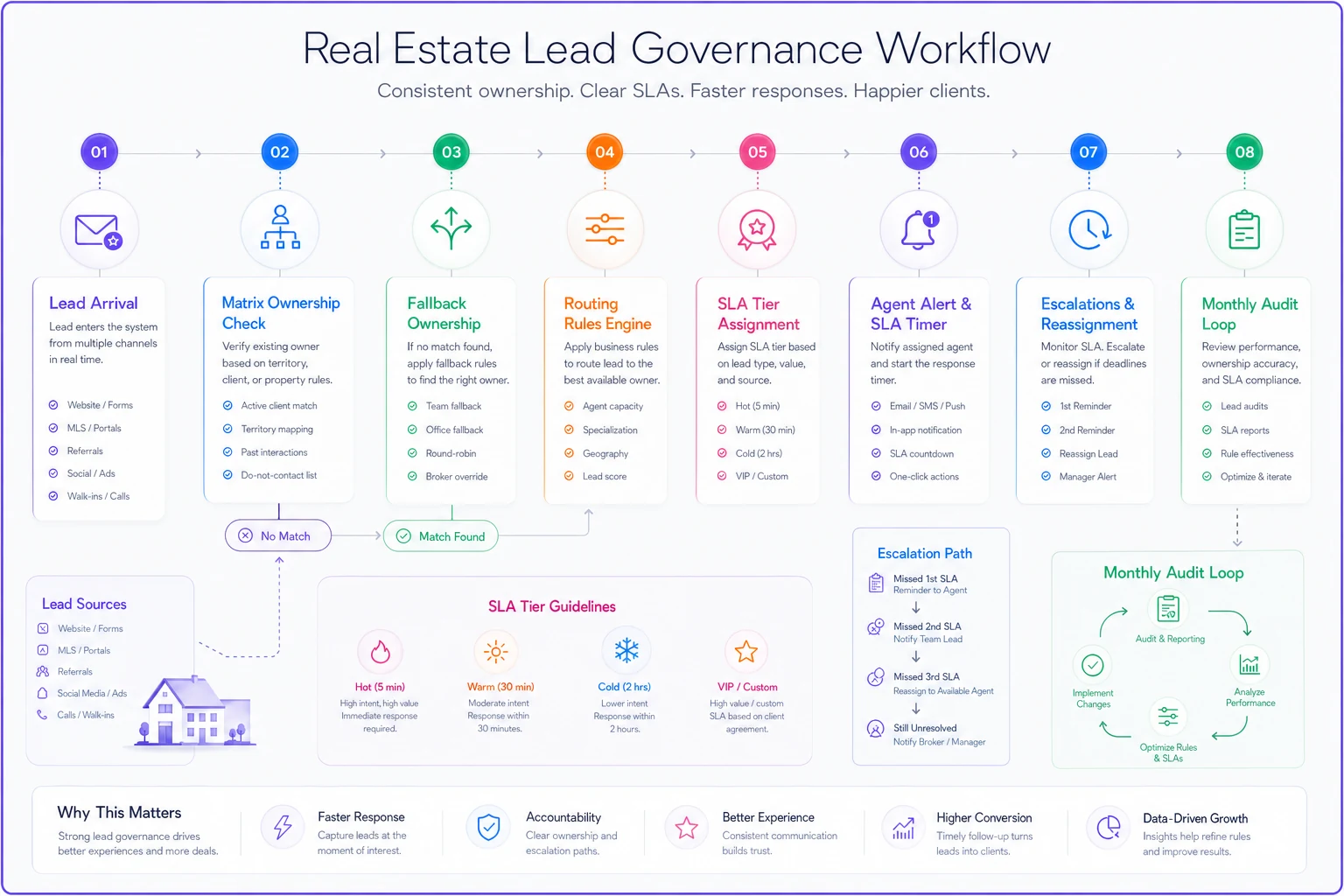
-
Seller inquiry arrives (website form, 6
40pm Saturday)
-
Matrix check
ISA = primary owner → ISA flagged out-of-office
-
Routing rule
drop to next agent in rotation
-
SLA tier assigned
seller inquiry + property address = Tier 1 (1-hour after-hours window)
-
Agent receives alert — clock starts
-
At 45 minutes, no touch logged → escalation reminder fires to agent
-
At 60 minutes (SLA breached) → team lead alerted, lead reassigns to fallback
-
Fallback agent calls seller at 8
05pm → listing appointment booked
-
Monthly audit flags
after-hours seller leads breached SLA twice → coverage fix initiated
No part of that worked in isolation. The matrix decided who, the SLA decided how fast, escalation caught the miss, and the audit turned a near-miss into a structural fix. That's the difference between a lead-governance system and a pile of good intentions.
A real scenario: the 6-agent agency losing referrals it never saw
A residential team — 6 agents, one part-time admin, somewhere around 180–220 new leads a month across portals, website, paid social, and partner referrals. Their close rate looked fine on the leads they tracked. The problem was they weren't tracking all of them.
When they finally reconciled channel reports against the CRM for one month, roughly 30 leads had never been entered at all — mostly referral texts and open-house sign-ins that lived on someone's phone. Median first-response on portal leads was sitting above 3 hours, and after-hours leads routinely waited until the next morning. No ownership matrix existed; referrals went "to whoever."
They built the four-part system over about six weeks — matrix first, then tiers, then escalation, then the audit routine. Nothing glamorous. Hot leads got a 15-minute SLA with real escalation behind it. Referrals got named owners per partner. Open-house sheets had to be entered before the hosting agent left the property.
Within two months, median first-response on hot leads dropped under 20 minutes, the "never entered" pile shrank to a handful, and they closed a couple of extra deals that quarter from referral leads that would have previously leaked. Nobody worked more hours. They just stopped losing what they already had.
When this makes sense — and when it doesn't
When to build this: You're at 4+ agents, running more than two lead channels, or you've added an ISA or admin handoff. If leads pass through more than one pair of hands, you need governance. Also build it before you increase ad spend — governance before scale, not after, or you'll just leak faster.
When it's overkill: Solo agent or a tight two-person team with a single dominant channel. At that size the formality of a matrix and escalation ladder costs more than the leakage it prevents. A shared board and a consistent habit will do.
Who should not do this yet: Teams whose CRM data is a mess. If your records are full of duplicates, missing fields, and phantom leads, a governance layer on top just formalizes the chaos. Fix data hygiene first. Layering SLAs onto unreliable data produces confident-looking reports that are quietly wrong — which is worse than no reports at all.
The mistake that undoes all of this
The most common failure isn't in the design — it's leaving escalation to human vigilance. Owners build a solid matrix and tier structure, then rely on someone to notice when SLAs get breached. That person is always busy. Within a few weeks the queue-watching stops, breaches go unseen, and the whole system quietly reverts to the group-text era with extra steps.
Governance only holds when the watching is automatic and escalation moves the lead, not just the guilt. Everything else — the matrix, the tiers, the audit — is the framework. The escalation engine is what keeps it alive on the busy Tuesdays when your team is showing four houses and nobody has time to check a board.
Get the four pieces working together and lead leakage stops being a mystery you rediscover every quarter. It becomes a number you watch, a report you trust, and most of the time, a problem you've already solved before it costs you a deal.
Ready to elevate your real estate business?
Join 2,000+ agencies using TryRealy to streamline operations, close deals faster, and deliver exceptional client experiences.