


Most agencies don't lose referral leads because their partners are bad. They lose them because nobody defined what happens after the handoff. A lender sends over a pre-approved buyer. It lands in an agent's inbox at 6pm on a Thursday. The agent is at a showing. By the time anyone circles back Monday, the buyer already toured three houses with someone else.
That's not a relationship problem. That's an operations problem, and it's fixable with a few unglamorous documents.
This post is about building an agency-grade partner referral program for real estate — the onboarding packet, the lead-handling SLA, the co-marketing rhythm, and the scorecard that tells you which partners are actually worth your time. Not the fluffy "let's grab coffee" version. The version where a referral gets contacted in under an hour and both sides can see the numbers.
## Why referral leads leak — and it's rarely who you think
The instinct is to blame the receiving agent for being slow. But when you actually trace a dropped referral backward, the failure almost always happened before the lead ever arrived.
The pattern repeats constantly. A partnership starts casually — two people who like each other agree to "send business back and forth." Nobody writes down:
-
Where referrals get sent (which email, which form, which person)
-
What information comes with the lead
-
How fast the receiving side is expected to respond
-
Who owns follow-up if the first agent is unavailable
-
How either side knows the deal closed and commission is owed
So the referral shows up as a text: "Hey, calling you about the Hendersons, they're looking in Maple Grove, super nice couple." No phone number. No timeline. No budget. The agent has to reply, wait, chase details — and by then the momentum is gone.
The other silent killer is one-sided partnerships. One person sends 12 leads a year and gets 2 back, notices, gets quietly resentful, and stops sending. Nobody had a scorecard, so nobody caught it until the pipeline dried up.
A referral program without documented handoff rules isn't a program. It's a hopeful vibe.
## The onboarding packet: what every new partner gets on day one
The onboarding packet is the single highest-leverage thing you can build, and most agencies skip it entirely. It removes ambiguity before the first lead ever changes hands.
Never miss a showing or follow-up again.
TryRealy helps you schedule, track, and manage every client interaction smoothly.
- Unified property and client management
- Automated client notifications
- Integrated sales pipeline tracking
No credit card required
Keep it short. Nobody reads a 40-page partner manual. What you actually need is a 3–4 page document a new lender, contractor, inspector, or fellow agent can absorb in ten minutes.
-
The single intake path. One form or one dedicated email. Not "text me or email me or call the front desk." One. When a referral can arrive five different ways, it will eventually arrive in the one nobody's watching.
-
The required-info checklist. Name, best contact number, preferred contact time, rough budget, timeline, and what the person actually needs. If a partner can't fill this in, the lead isn't ready.
-
The response promise. Your SLA in plain language
"We contact every referred lead within 60 minutes during business hours, and by 9am the next morning otherwise."
-
The commission and reciprocity terms. What a referral is worth, when it's paid, and whether reciprocity is expected. Write it down so nobody feels weird bringing it up later.
-
The escalation contact. One name and number for "the lead went cold and I want to know why."
Agencies have cut their referral response time from "sometime this week" to under an hour just by handing partners a form with five required fields instead of accepting freeform texts. The structure does the work.
## The lead‑handling SLA: the part everyone under-builds
Speed is the whole game with referrals, because a referred lead is usually already warm. Someone they trust vouched for you. That trust has a shelf life measured in hours, not days.
A good lead-handling SLA answers three questions: how fast, by whom, and what happens if that fails.
| Stage | Target | Owner | Fallback if missed |
|---|---|---|---|
| First contact attempt | Within 60 min (business hours) | Assigned agent | Team lead gets alert, reassigns |
| Second attempt (if no answer) | Within 4 hours | Assigned agent | Auto-escalates to backup agent |
| Appointment or clear next step | Within 24 hours | Assigned agent | Partner notified of status |
| Status update back to partner | Within 24 hours | Ops/coordinator | Weekly digest catches stragglers |
The column people ignore is the last one — the fallback. An SLA without a defined "what happens when we miss it" isn't an SLA, it's a wish. The whole point is that a slow response triggers something automatically instead of a lead silently rotting in an inbox.
This also connects to your broader lead pipeline. The same discipline you'd apply to portal or open-house leads applies here, and if you've already built a system for turning inbound leads into booked appointments, referrals just plug into it. The difference is you owe the partner a status update, not just the client.
One thing worth flagging: don't set a 15-minute SLA to look impressive if your team can't hit it. A 60-minute SLA you hit 95% of the time builds far more partner trust than a 15-minute one you hit 40% of the time. Partners remember reliability, not ambition.
## Co‑marketing cadence: keeping the partnership alive between deals
Referral relationships die in the quiet stretches. Two months go by with no leads either direction, and the partnership fades from everyone's mind. A light, predictable co-marketing rhythm keeps you top of mind without turning into a second job.
You don't need a content machine. You need a cadence you'll actually maintain:
-
Monthly One shared piece of value — a co-branded market snapshot email, a joint neighborhood update, or a quick "here's what we're seeing" note to both your lists.
-
Quarterly One real touchpoint — coffee, a lunch, a joint open house, or a co-hosted first-time-buyer session with your lender partner.
-
Twice a year A short partnership review. Fifteen minutes with the scorecard open. What worked, what didn't, are we still a good fit.
The mistake here is going too big. Agencies announce an ambitious co-marketing plan — weekly reels, a joint podcast, monthly seminars — and burn out inside six weeks. A modest cadence you keep beats an aggressive one you abandon. When you send past clients back into a referral loop, the same principle applies: consistency over intensity. If you're building that side out too, the approach in turning past clients into a predictable referral pipeline pairs naturally with partner co-marketing.
## The partner scorecard: how you find out who's actually worth it
Here's the uncomfortable truth about referral partners: most of your referral revenue comes from a handful of them, and you probably can't name which ones without checking. A scorecard fixes that.
Track it monthly, per partner. Keep it to metrics you can actually pull:
-
Referrals sent to them vs. received from them (the reciprocity balance)
-
Referred leads that turned into appointments
-
Referred leads that closed
-
Average response time on the leads they sent you
-
Revenue attributed to that partner
The reciprocity balance is the one that opens eyes. A typical example: an agency reviews the year and finds one lender sent them 18 leads while receiving only 4 back. That's not a partnership — that's a slow-motion breakup. The scorecard catches it while there's still time to rebalance, either by sending more their way or having an honest conversation.
Attribution connects directly to how you tag lead sources across the whole business. If your referral leads aren't tagged distinctly, they get absorbed into "word of mouth" and you never see the pattern. The lead-source attribution playbook covers the tagging conventions that make a partner scorecard possible in the first place.
## The monthly health report: one page, five minutes
The scorecard tracks individual partners. The health report zooms out to the whole program so you can see if it's growing, flat, or quietly dying.
A workable monthly health report is one page and answers:
-
Total referrals in and out this month vs. last
-
Program-wide SLA compliance (what % of referrals hit the 60-minute target)
-
Conversion rate from referred lead to closed deal
-
Top 3 partners by revenue
-
Any partner who went from active to silent
-
Any SLA breaches and why
The "went silent" line is the most valuable and the most ignored. A partner rarely announces they've stopped. They just... stop. The referrals taper off, and if you're not watching month over month, you notice six months too late. One line comparing this month's active partners to last month's catches it early enough to send a "hey, everything good?" message before the relationship is actually gone.
## Where this quietly breaks down at scale
All of this works fine on paper. It breaks in practice when volume grows and everything's still living in someone's head and a shared spreadsheet.
In real operations, this usually happens somewhere around 15–20 active partners. Response-time promises slip because nobody's tracking the clock. The scorecard doesn't get updated because it's manual. The partner who went silent isn't caught because updating the health report keeps sliding to next week.
This is where a workflow platform earns its place — not as some magic fix, but as the thing that quietly enforces what your documents already say. A shared system can timestamp when a referral arrives, route it to the assigned agent, and escalate automatically if the 60-minute window passes without a first contact. Platforms with built-in automation can flag a partner whose referrals have dropped to zero, or pull together the monthly health report from data that's already being captured instead of someone rebuilding it by hand.
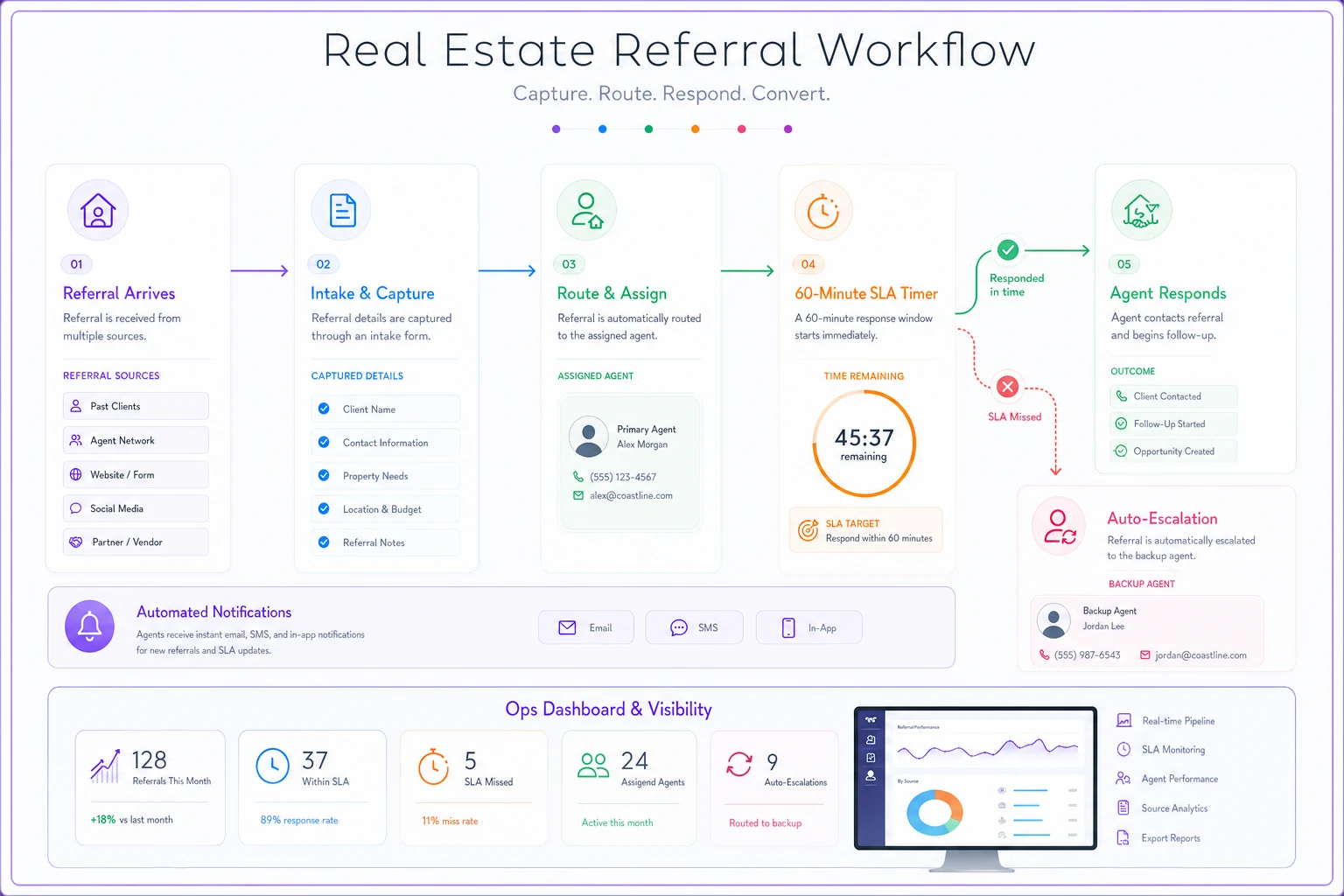
Below is a diagram of the referral routing and escalation process.
The rules still come from you. The software just makes sure a busy Thursday doesn't quietly break the SLA you promised.
## When a formal partner program makes sense — and when it doesn't
When it's worth building: You have three or more real referral relationships, referrals make up a meaningful slice of your business, and you've already lost at least one deal to a slow handoff. If any of that is true, the documents pay for themselves fast.
When it's premature: You have one casual partner and a handful of referrals a year. You don't need an SLA and a scorecard for that — you need a phone. Building heavy process around tiny volume is its own kind of waste.
Who should not bother yet: Solo agents in their first year still figuring out their own follow-up. Fix your own lead response before you promise partners a 60-minute SLA you can't personally staff.
## A quick real scenario
A four-agent residential team relied heavily on two lenders and a home inspector for referrals but had no defined process. Leads came in by text, response times were inconsistent, and they had no real sense of how the reciprocity balanced out.
They built a one-page intake form, a 60-minute business-hours SLA with a backup-agent fallback, and a monthly scorecard. Nothing fancy.
Within about three months, referred-lead response time dropped from "sometimes a full day" to under an hour on most leads. The scorecard surfaced that one lender was sending them roughly three times more business than they were returning — so they corrected it, and that lender's referral volume actually grew instead of quietly fading. Referral closings went from a handful to somewhere in the low double digits. Nothing revolutionary happened. They just stopped dropping leads on the floor.
The one thing to take away
A partner referral program lives or dies on the boring stuff: a single intake path, a response promise you can actually keep, and a monthly look at who's holding up their end. The agencies that lose referral leads aren't unlucky — they just never wrote down what happens after the handoff.
Start with the intake form and the 60-minute SLA. Those two alone will stop most of the leaking. The scorecard and health report come next, once you've got leads landing somewhere consistent. Build it in that order and you'll spend a lot less time wondering why a warm, pre-vouched-for buyer went and toured houses with somebody else.
Ready to elevate your real estate business?
Join 2,000+ agencies using TryRealy to streamline operations, close deals faster, and deliver exceptional client experiences.