

Most agencies don't have a vendor escalation problem. They have a "we didn't do anything about it until it was too late" problem.
The photographer is six hours late delivering edited photos. The stager swore the furniture would arrive Thursday and it's Friday morning. The inspector rescheduled twice. Everyone on the team knows something went wrong, but nobody knows who decides what happens next, or when the clock on a consequence actually starts. So the missed SLA just sits there until the listing goes live three days late and the seller is furious.
This playbook fixes the decision gap. Not the vendor relationships, not the contracts — the gap between "this vendor missed the deadline" and "here's exactly what we do about it, starting now." If you already have SLAs in place (and if you don't, the vendor SLA scorecards post is where you want to start), this is the enforcement layer that sits on top.
Why missed SLAs rot inside small agencies
The failure almost never happens at the moment the vendor misses the deadline. It happens in the 24–48 hours after, when nobody owns the response.
The pattern is pretty consistent: a transaction coordinator notices the photos are late. They text the photographer. Photographer says "running behind, I'll have them by end of day." TC relays that to the agent. Agent is in a showing and doesn't respond. End of day comes, still no photos. Now it's 7pm, the listing was supposed to go live at 8am, and the only person who can approve finding a backup photographer is the agency manager, who is at dinner and doesn't check email until morning.
Every link in that chain was a reasonable human doing a reasonable thing. The problem is there was no remediation window (a defined amount of time the vendor gets to fix the miss before escalation), no trigger (what specifically moves this to the next level), and no pre-approved decision about when you stop waiting and go find someone else.
Without those three things, every late delivery becomes a fresh negotiation. And fresh negotiations inside a busy office always lose to whatever else is on fire.
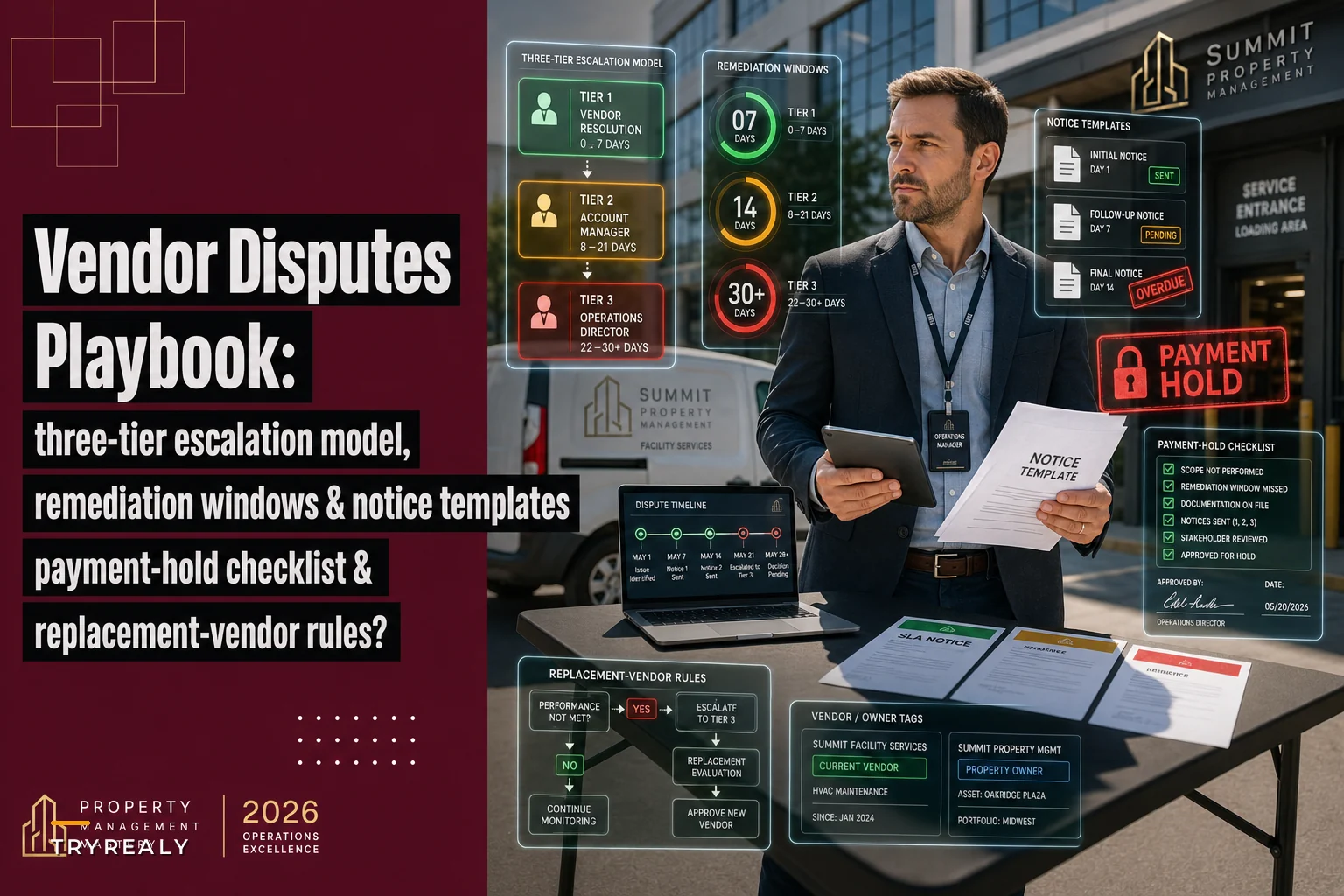
The three-tier escalation structure
Keep it to three tiers. More than that and nobody remembers which level they're on. Each tier has its own owner, its own communication, and its own hard time limit before it rolls to the next.
Never miss a showing or follow-up again.
TryRealy helps you schedule, track, and manage every client interaction smoothly.
- Unified property and client management
- Automated client notifications
- Integrated sales pipeline tracking
No credit card required
| Tier | Trigger | Owner | Remediation window | Action if window closes |
|---|---|---|---|---|
| Tier 1 — Nudge | SLA missed by any amount | TC or assistant | 2–4 hours (same-day deliverables) or next business morning | Escalate to Tier 2, log the miss |
| Tier 2 — Formal notice | Tier 1 window closed, or second miss in 30 days | Agent / ops lead | 4–8 hours or end of next business day | Trigger payment hold review, escalate to Tier 3 |
| Tier 3 — Replace + hold | Tier 2 window closed, or critical-path delivery at risk | Agency manager | Immediate decision | Activate backup vendor, hold payment, open vendor review |
The remediation windows look short because they are. These windows are calibrated to the deliverable, not the vendor's convenience. A photographer who's late on day-of listing photos gets hours, not days, because the whole downstream schedule depends on it. An inspector delivering a report for a closing three weeks out gets more room.
A quick note on what counts as a "miss." Vague SLAs produce arguments every time. "Photos delivered promptly" means nothing. "Edited photos delivered within 24 hours of the shoot, by 5pm" means something you can actually trigger an escalation against. If your vendor agreements aren't written that tight, fix it before you roll out the tiers — otherwise Tier 1 turns into a debate about whether the vendor was even late.
What each tier owner actually does
Tier 1 is the lightest touch and the most important. The person who first notices the miss sends a short, non-accusatory note and logs it. The logging is the part everyone skips, and it's the part that makes the whole system work. A single late photo delivery isn't a crisis. Four late deliveries in two months is a pattern, and you can only see the pattern if someone wrote down the first three.
Tier 2 is where tone shifts from "hey, checking in" to "this is now a documented issue." The owner sends the formal notice (template below), starts the remediation clock in writing, and flags the transaction coordinator to prep a backup option in parallel — not to use it yet, just to have it ready.
Tier 3 is a decision, not a conversation. By the time something hits Tier 3, the agency manager isn't asking "should we wait a little longer?" They're executing a pre-made decision rule: activate the backup, hold the payment, decide whether this vendor stays on the roster.
Log every Tier 1 miss in a shared tracker so patterns are visible before repeats accumulate.
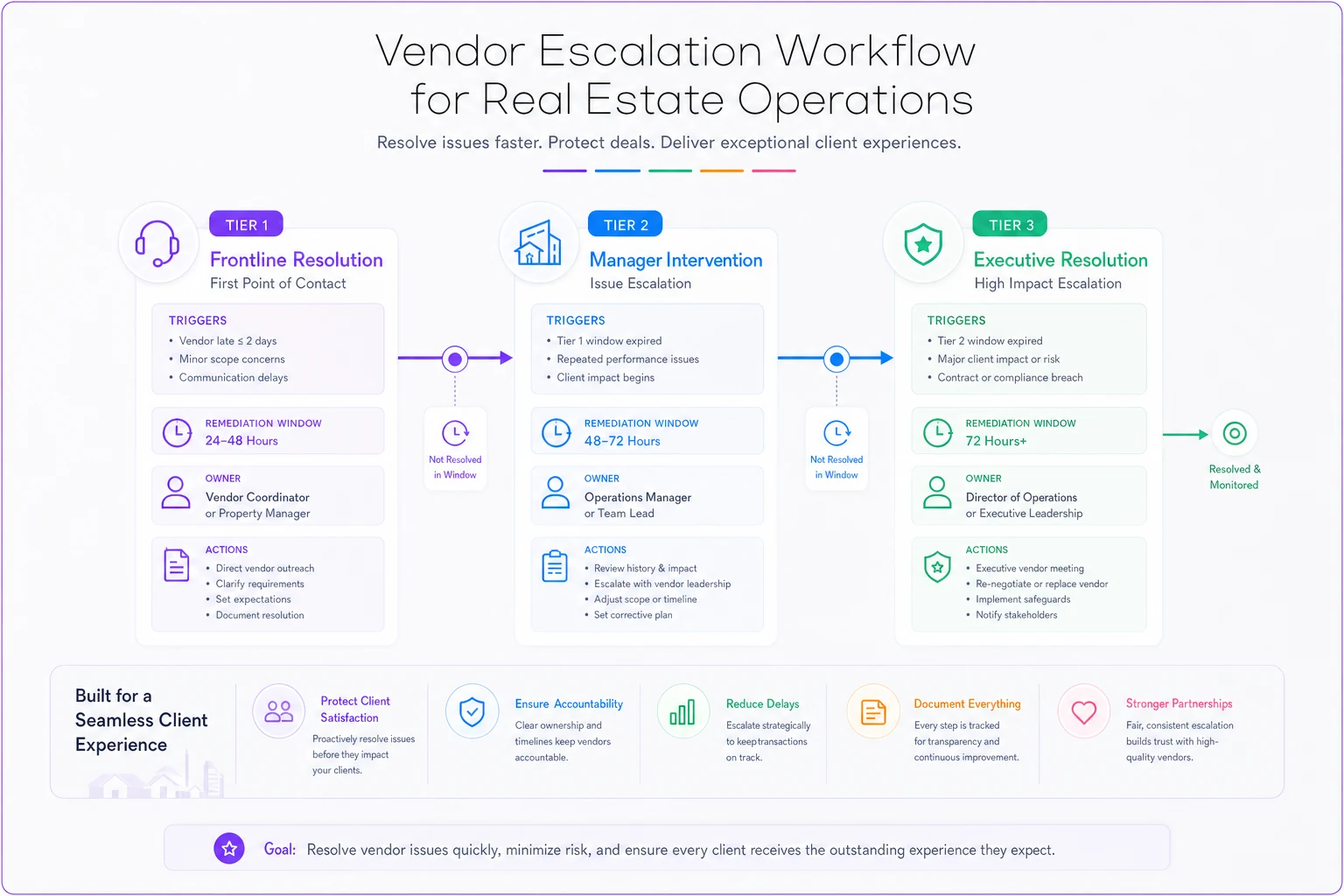
This diagram shows the escalation flow from Tier 1 to Tier 3 and the handoffs between owners.
Communication templates
The templates matter because the wrong tone at the wrong tier burns a vendor you actually need, and the right tone creates a clean paper trail if you end up disputing payment.
Tier 1 — Nudge (text or email, friendly):
> Hi [Name] — the [deliverable] for [address] was due at [time]. Haven't seen it come through yet. Can you confirm it's on the way and give me a realistic ETA? We've got a hard 8am go-live on this one.
Tier 2 — Formal notice (email, documented):
> Hi [Name], > > Following up on my earlier message. Per our agreement, [deliverable] for [address] was due [date/time] and has not been delivered. This is now a formal service notice. > > We need delivery by [specific time, within the remediation window]. If we don't receive it by then, we'll need to source an alternate vendor for this listing, and this delivery will be reviewed against our payment terms. > > Please confirm you can meet the above deadline.
Tier 3 — Replacement + payment hold (email, firm):
> Hi [Name], > > We did not receive [deliverable] for [address] within the agreed remediation window. We've sourced the work elsewhere to keep this listing on schedule. > > Payment for this specific deliverable is on hold pending review. [If repeated:] Given this is the [second/third] missed SLA in [timeframe], we're also reviewing our ongoing arrangement. I'll follow up separately on that.
None of these threaten, insult, or editorialize. The firmness comes from specific deadlines and documented facts, not from emotion. A vendor who reads the Tier 2 email knows exactly what happens if they miss again, and that clarity alone fixes a surprising number of repeat offenders.
The payment-hold approval checklist
Holding payment is the single most effective enforcement tool you have, and it's the one small agencies are most afraid to use — usually because they're not sure they're allowed to, or they worry about blowing up a relationship.
-
[ ] The SLA was written clearly and the vendor agreed to it (not assumed, documented)
-
[ ] The specific miss is logged with a timestamp
-
[ ] Tier 1 and Tier 2 notices were sent and the remediation window closed
-
[ ] The deliverable is genuinely unusable or undelivered — not just "we didn't love it"
-
[ ] A backup was sourced only after the remediation window closed, so you're not double-paying out of impatience
-
[ ] The hold applies to the specific deliverable, not the vendor's entire outstanding balance
-
[ ] Someone with authority (ops lead or manager) approved the hold in writing
That last point prevents the most common mess: a frustrated agent unilaterally refusing to pay a vendor, the vendor going scorched-earth, and the agency losing a reliable partner over a one-time slip. Holds go through one approval path. Always.
Replacement vendor decision rules
Most playbooks get vague here. "Use your judgment" is not a rule. Here's a decision framework that removes the guesswork.
-
Is this deliverable on the critical path? If the listing can't go live or the closing can't proceed without it, you don't wait past the remediation window. Period. A delayed virtual tour is annoying; delayed listing photos stop everything.
-
Do you have a pre-vetted backup for this service? You should have at least one backup per category — photographer, stager, inspector, videographer — already onboarded with pricing agreed. If you're scrambling to find a backup during a miss, you've already lost. This is the same discipline that keeps your creative production pipeline from collapsing under volume: capacity you lined up in advance is the only capacity you can actually use in a pinch.
-
Is this a first miss or a pattern? First miss on a non-critical deliverable: give the full window, document it, move on. Second miss in 30 days, or any miss on a critical deliverable: activate backup and open a roster review.
-
What's the cost delta? If the backup costs 15–20% more, that's usually worth it to protect the listing timeline and the seller relationship. If the backup costs double, the manager makes a judgment call weighted toward the value of the specific transaction.
The underlying principle: the decision to replace should already be made before the miss happens. You're not deciding whether to replace in the moment — you're just checking which pre-set condition got triggered.
When replacing is the wrong call
Don't replace a vendor over a single weather delay, a genuine emergency, or a miss that your own team caused — late access, wrong address, changed scope after they started. Roughly a third of "vendor misses" at most agencies trace back to the agency's own intake. The stager showed up and the house wasn't ready. The photographer got the lockbox code late. If you escalate those, you'll churn through good vendors and still have the same problem, because the problem is internal.
Run a quick gut check before Tier 3: Did we give this vendor everything they needed, on time, to succeed? If the answer is no, handle it as an internal process fix, not a vendor escalation.
A sample timeline, start to finish
Here's how a photographer missing a same-day deadline actually plays out under this system.
-
5
00pm
— Edited photos due for an 8am next-day listing. Nothing delivered. -
5
10pm
— TC sends Tier 1 nudge, logs the miss. Photographer replies: "sorry, swamped, by 9pm." -
9
00pm
— Still nothing. Tier 1 window closed. TC escalates to the agent/ops lead and flags the backup photographer to be on standby for an early morning shoot. -
9
15pm
— Ops lead sends Tier 2 formal notice: deliver by 7am or we re-shoot with a backup. -
7
00am
— Nothing. Tier 2 window closed. Manager makes the Tier 3 call: activate backup, open the payment-hold checklist for the original photographer, note the miss in the vendor record. -
8
45am
— Backup shoots and delivers by early afternoon. Listing goes live a few hours late instead of two days late. Seller barely notices.
The entire difference between that outcome and a two-day disaster is that nobody had to decide anything from scratch at 9pm or 7am. The triggers decided for them.
Real scenario: a three-agent office that was quietly bleeding listing days
A small residential agency — three agents, one transaction coordinator — was averaging about 2.5 days of delay per listing that involved an outside vendor, mostly from photography and staging slips. The delays weren't catastrophic individually, but across roughly 40 listings a quarter, that's a lot of sellers watching their property sit "coming soon" longer than promised.
They had SLAs. What they didn't have was an escalation path, so every miss became a one-off text thread that died in someone's inbox. Vendors knew, consciously or not, that a late delivery had no real consequence.
After putting the three-tier structure in place — remediation windows, logging, two pre-vetted backups per category — average vendor-related delay dropped to under a day within about two months. More telling: the number of misses that reached Tier 3 fell sharply after the first few weeks, because once vendors got one Tier 2 formal notice, they adjusted. The escalation path wasn't really about replacing vendors. It was about making the SLA mean something.
The one vendor who kept missing got cycled out, and the backup became the primary. No drama, no awkward confrontation — just a decision rule that ran on schedule.
Where this fits in your operations
The whole point of this playbook is to convert vendor accountability from a personality-driven, in-the-moment negotiation into a system that runs the same way every time, regardless of who's holding the phone. The logging feeds your vendor scorecards. The tiers protect your listing timelines. The decision rules protect your relationships with the vendors worth keeping.
Tracking missed SLAs, managing remediation windows, and making sure the right person gets notified at each tier is exactly the kind of coordination that quietly eats a transaction coordinator's day when it all lives in texts and memory. Centralizing it — one place where a missed SLA logs automatically, the remediation clock starts, and the next owner gets pinged when a window closes — means nothing waits on someone remembering to check. Whether that's a shared tracker or an operational platform that handles reminders, the principle is the same: the system carries the discipline, not the individual.
Start with one vendor category. Photography is usually the best place, because the misses are frequent, the deadlines are tight, and the consequences are visible. Write the tight SLA, set the three windows, line up one backup, and run it for a month. Once the office sees how much calmer late deliveries feel when the response is already decided, rolling it out to staging and inspection is easy.
Ready to elevate your real estate business?
Join 2,000+ agencies using TryRealy to streamline operations, close deals faster, and deliver exceptional client experiences.