



Most small agencies don't have a marketing problem. They have a marketing memory problem.
You tried Facebook lead ads two years ago. Did they work? Nobody's totally sure. Someone tried a new listing video style last spring — was it better than the old one? Depends who you ask. You spent a chunk of budget on a neighborhood postcard drop and it "felt fine," so you either kept doing it forever or quietly stopped for no clear reason.
That's the real cost of having no experiment governance. It's not that agencies don't test things — they test constantly. It's that nothing gets recorded, nothing gets decided cleanly, and the same debates happen over and over. The team ends up with strong opinions and weak evidence.
Marketing experiment governance for a real estate agency is just the lightweight system that turns scattered "let's try this" moments into structured tests you can actually learn from. Not a corporate approval process. Not a data-science department. Something a five-to-fifteen-person shop can run without hiring anyone.
Here's how the whole thing connects — and where it usually falls apart.
The core problem: agencies test like gamblers, not operators
Marketing decisions in most small agencies get made three ways: whoever spoke loudest in the Monday meeting, whatever a competitor is visibly doing, or whatever the broker read about last week. None of those are terrible instincts. The problem is there's no structure holding them accountable to results.
So you get what I'd call the "always-on graveyard." Campaigns start, nobody sets a kill date, and they just keep running because turning something off feels like admitting it failed. Six months later you're spending roughly $2k–$4k a month across channels and only two or three people vaguely remember why any individual line item exists.
The deeper issue is that a single agency's marketing is actually a system of interconnected pieces:
-
Lead generation (portals, ads, referrals, SEO)
-
Creative production (photos, video, descriptions)
-
Follow-up and nurture (CRM sequences, SMS, calls)
-
Attribution (which source actually produced the closing)
When you change one part without a controlled way to measure it, you can't tell whether a result came from your new Instagram reels or the fact that inventory tightened that month. Everything is entangled. Governance is what lets you isolate one variable at a time so you're learning something real instead of collecting anecdotes.
Why this breaks down as agencies grow
At two or three agents, informal works fine. The broker sees everything, remembers everything, and makes the call. Fast and good enough.
Never miss a showing or follow-up again.
TryRealy helps you schedule, track, and manage every client interaction smoothly.
- Unified property and client management
- Automated client notifications
- Integrated sales pipeline tracking
No credit card required
Then you add agents. Now three people are running their own listing promotions with their own styles. One agent swears by boosted posts, another only trusts open houses, a third is quietly spending team money on a tool nobody approved. There's no shared definition of what a "test" even is, so nothing rolls up into agency-wide knowledge.
What breaks at scale isn't the testing — it's the coordination and the memory.
-
No control group. Someone changes the listing description template for all new listings at once. Now there's nothing to compare against. Did conversion go up because of the copy, or the market?
-
Moving multiple variables together. New photos + new pricing + new headline, all in the same week. Even if results improve, you'll never know which change did it.
-
Ending tests emotionally. A campaign gets killed after eight days because it "feels slow," before it ever collected enough data to mean anything.
-
Winners that never become standard. Something works, everyone's excited, and then it just... doesn't get written down or rolled out to the rest of the team.
That last one is the quiet killer. Agencies re-discover the same winning tactic every 18 months because it never made it into a repeatable playbook.
The five pieces of a lightweight governance model
You don't need software or a statistician to fix this. You need five simple components working together.
1. The experiment template (one page, non-negotiable)
Every test starts with the same short form. If it doesn't fit on one page, it's too complicated for a small team to actually run.
A workable template captures:
-
Hypothesis — "We believe switching listing videos to vertical short-form will increase inquiries per listing." Specific and falsifiable.
-
The single variable you're changing (just one)
-
Success metric — pick one primary number, not five
-
Sample size / duration — how many listings, leads, or how many weeks
-
Cost — budget and staff time
-
Decision rule — written before you start, so you can't move the goalposts
The decision rule matters most. Deciding what "success" means after you see the data is how agencies fool themselves into keeping things that don't work.
2. Statistical-lite decision rules
You are not running a clinical trial. You don't need p-values. You need rules simple enough that a busy team lead will actually follow them, but strict enough to prevent self-deception.
Here's the practical version that works for agency-scale numbers:
| Situation | Practical rule of thumb |
|---|---|
| Small sample (under ~30 leads or listings) | Treat results as directional only. Don't crown a winner. Extend or repeat. |
| Improvement under ~10–15% | Likely noise. Keep the current approach unless it repeats across two cycles. |
| Improvement of ~20–30%+ and consistent | Real enough to act on. Roll out. |
| Mixed or contradictory results | Something's confounded. Check whether more than one thing changed. |
The point isn't statistical rigor. It's protecting the team from two classic errors: killing something good too early because of a bad first week, and celebrating random luck as a breakthrough. A rough guardrail that everyone follows beats a perfect formula nobody uses.
For anything money-related — like adjusting spend by channel — pair this with a real attribution setup so you're measuring the right endpoint. The approach in the lead-source attribution playbook covers the UTM conventions and offline rules that make these decision rules trustworthy in the first place. Bad attribution turns even disciplined tests into garbage-in, garbage-out.
3. A 90-day test calendar
This is the piece most agencies skip, and it's what turns random experimentation into a rhythm.
The idea: you can only run so many meaningful tests at once. A small team can realistically manage two or three concurrent experiments before results start contaminating each other and nobody has time to monitor them properly. So you plan a rolling 90-day window.
A simple quarter might look like:
-
Weeks 1–4 Test A (new SMS follow-up cadence) + Test B (vertical listing videos)
-
Weeks 5–8 Test A concludes, decision made. Test C (neighborhood landing page variant) begins.
-
Weeks 9–12 Test B and C conclude. Winners documented. Next quarter planned.
Why 90 days? It's long enough for real estate cycles to give you usable signal — listings don't turn over in a week — but short enough that you review and reset regularly. Anything longer and the market shifts underneath you.
Limit active experiments to two or three so monitoring and isolation stay realistic.
The calendar also forces prioritization. When you can only run three tests a quarter, you stop wasting slots on trivial questions and start testing things that actually move revenue.
4. Rollout and rollback guardrails
A test that "wins" isn't done. Now you have to deploy it to the whole team without breaking anything — and be able to reverse it if the win doesn't hold at scale.
This is where the discipline from operational pricing experiments carries directly over: start with a small cohort, expand in stages, and keep a written rollback path.
-
Winner confirmed on the test cohort.
-
Staged rollout — apply it to the next 25–30% of listings or leads, not all at once.
-
Watch for two weeks. Does the improvement survive contact with a bigger, messier sample?
-
Full rollout if it holds.
-
Rollback trigger written down — the specific condition that means "kill it and revert." For example: "If inquiry rate drops below the old baseline for two consecutive weeks, revert to the previous template."
The rollback trigger is the part people forget. Without a pre-written condition, a struggling rollout limps along for months because nobody wants to be the one to call it. Deciding the failure condition in advance removes the ego from the decision.
5. The experiment archive
Everything you learn goes into one place. This is the memory layer that fixes the original problem.
An archive entry is dead simple — hypothesis, what you changed, result, decision, and date. The value compounds over time. After a year you have a searchable record of what actually worked, what didn't, and what's not worth re-testing. New agents can read it during onboarding instead of re-litigating decisions the team settled two years ago.
The archive also feeds your playbooks. Every confirmed winner becomes a standard operating procedure. Your creative production process gets sharper each quarter as tested formats become defaults — which is exactly the kind of repeatability the timeboxed listing creative pipeline depends on. Tests find the winners; the pipeline scales them.
A quick real scenario
A seven-agent suburban brokerage was spending roughly $3k–$3.5k a month on lead gen split across a portal, boosted social, and occasional postcards. No one could confidently say which channel produced closings. Every budget conversation turned into an argument.
They started running one structured test per month with a written decision rule. First test: pause postcards for a quarter and reallocate that spend to the portal, tracking cost-per-booked-appointment as the single metric.
The finding was uncomfortable — postcards had been producing almost nothing measurable, but the portal's cost-per-appointment was also higher than assumed. The real winner turned out to be a follow-up cadence change, specifically faster first-touch SMS, that lifted their booked-appointment rate by something like 20–25% at basically zero added cost.
Nothing dramatic. No 10x revenue story. But within two quarters they'd trimmed a dead channel, documented three repeatable wins, and — maybe most importantly — the Monday marketing arguments mostly stopped. Decisions had evidence behind them now.
When this actually makes sense
This model earns its keep when:
-
You have at least a few agents making independent marketing decisions
-
You're spending enough monthly that guessing wrong is genuinely expensive
-
You keep having the same "does this even work?" debates
-
You've lost track of what you've already tried
Use this when repeated debates and wasted budget are real costs for your team.
When it's a bad idea
Be honest with yourself. Skip or simplify this if:
-
You're a solo agent or two-person team — informal memory still works fine at that size, and the overhead isn't worth it.
-
You're not willing to actually stop running losers. Governance you don't enforce is just extra paperwork.
-
You want to test twelve things at once. This system deliberately limits you, and if you can't live with that constraint it won't help you.
The most common failure mode isn't a bad template — it's building the whole apparatus and then ignoring the decision rules the moment a founder gets attached to a pet idea. If leadership won't respect the process, don't bother building it.
Pulling it together
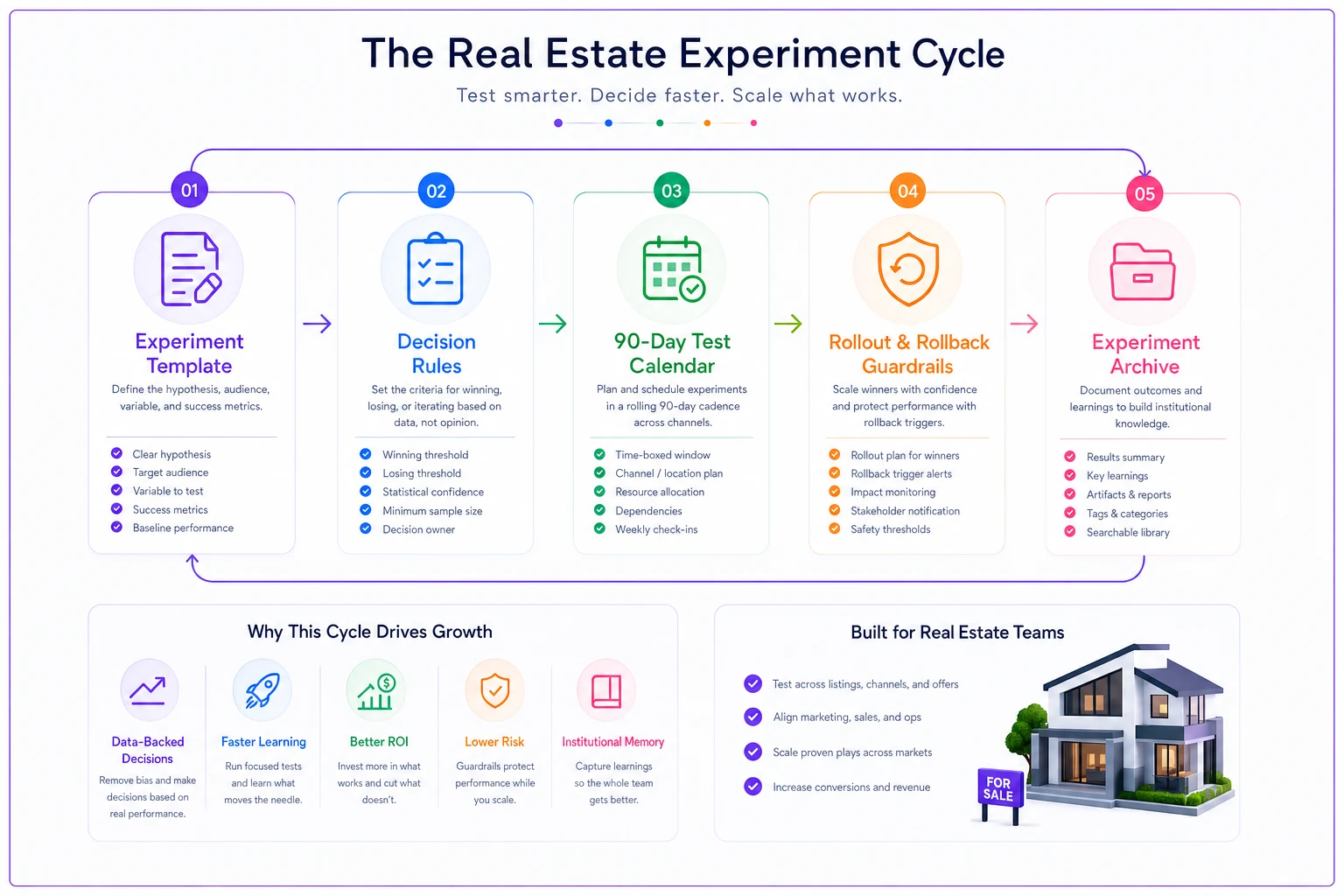
The value here isn't any single test. It's the loop: template forces clarity, decision rules prevent self-deception, the calendar creates rhythm, guardrails let you scale winners safely, and the archive turns wins into permanent playbooks.
That loop is what separates agencies that improve every quarter from ones that just stay busy. Busy agencies run lots of tactics and remember none of them. Agencies with real governance run fewer experiments, learn more from each one, and slowly build a marketing operation that gets smarter instead of just older.
Here's the loop visually.
You don't need more marketing ideas. You almost certainly have plenty. What you need is a disciplined, lightweight way to find out which of them are actually worth keeping — and a place to write it down so you never have to ask that question twice.
You don't need more marketing ideas. You almost certainly have plenty. What you need is a disciplined, lightweight way to find out which of them are actually worth keeping — and a place to write it down so you never have to ask that question twice.
Ready to elevate your real estate business?
Join 2,000+ agencies using TryRealy to streamline operations, close deals faster, and deliver exceptional client experiences.